
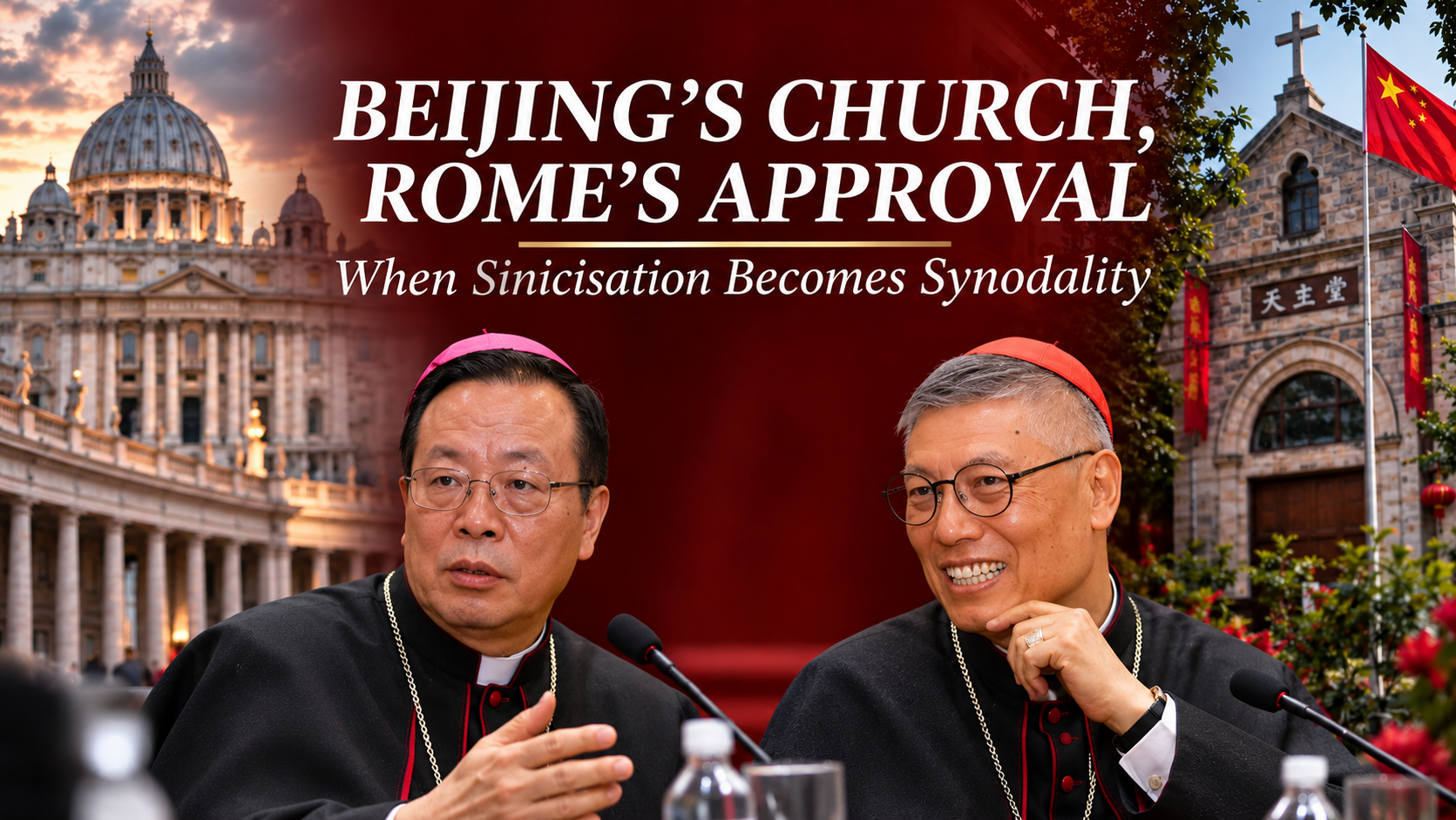
At a Vatican-sponsored conference commemorating the first Chinese bishops consecrated by Pius XI, Archbishop Joseph Li Shan defended Communist supervision of Catholic life as an expression of ecclesiastical independence and catholicity. Cardinal Stephen Chow proposed a more accommodating language of intercultural dialogue, while Leo XIV reaffirmed the indispensable bond between every bishop and the successor of Peter. A century after Rome established an indigenous Chinese episcopate, the proceedings exposed how differently the participants understand the freedom of the Church.
On 5 November 2026, the Pontifical Urbaniana University in Rome hosted an international conference commemorating the centenary of the episcopal consecration of six Chinese priests by Pope Pius XI. The occasion was intended to celebrate an achievement of considerable importance in Catholic missionary history. Among the speakers were Cardinal Pietro Parolin, Vatican Secretary of State, Archbishop Joseph Li Shan of Beijing and Cardinal Stephen Chow Sau-yan of Hong Kong. Pope Leo XIV contributed a video message. Yet proceedings ostensibly devoted to the establishment of an indigenous Catholic hierarchy became an occasion for defending the contemporary Chinese policy of Sinicisation, including the supervision of religious institutions by the Communist state. The contrast between the original achievement and its present interpretation was particularly evident in the address delivered by Archbishop Li Shan, who also serves as president of the Chinese Catholic Patriotic Association.¹
Li Shan traced the origins of Sinicisation to the missionary reforms promoted by Benedict XV and Pius XI, particularly the Council of Shanghai in 1924 and the determination of Archbishop Celso Costantini to establish a genuinely Chinese clergy. He recalled the influence of Father Vincent Lebbe, whose opposition to excessive European control of Chinese missions helped prepare the way for an indigenous episcopate. The historical account contains much that is correct. Foreign missionary institutions had sometimes become entangled with the political privileges of European powers, and the delay in appointing Chinese bishops was a legitimate grievance. Li Shan’s subsequent argument, however, carried this history into rather different territory. He presented the Communist revolution as the decisive emancipation of Chinese Catholicism from foreign political dependence and described the subsequent commitment to independence, autonomy and self-administration as a natural development of the earlier missionary programme.²
The distinction which this account obscures is essential to understanding the whole controversy. The reforms advocated by Benedict XV, Costantini and Pius XI concerned the establishment of a native hierarchy within the universal Catholic Church. Chinese Catholics were to be governed by Chinese bishops, without the assumption that European nationality conferred any special qualification for ecclesiastical authority. Nothing in that programme authorised a national government to determine the constitutional principles by which the Church would subsequently be administered. The six bishops consecrated on 28 October 1926 received their episcopate from the Roman Pontiff precisely because their appointment belonged to the government of the universal Church. Their Chinese nationality was a cause for rejoicing; their communion with Peter was indispensable to the undertaking.
Li Shan nevertheless maintained that the present policy of Sinicisation belongs intrinsically to the Church’s catholicity. He argued that it does not require the abandonment of Catholic doctrine or fundamental canonical discipline, and that adapting ecclesiastical life to Chinese circumstances enables the Church to express her universal character more fully. In itself, that proposition might describe legitimate inculturation. Its difficulty lies in the political arrangements which Li Shan included within the same process. He praised the post-revolutionary development of ecclesiastical independence and self-government, asserted that Chinese state laws establish the legitimate boundaries of religious activity, and maintained that such legislation guarantees the Church’s normal evangelisation and pastoral care. Most remarkably, he associated the administration of ecclesiastical affairs by Chinese clergy, religious and faithful with the recent Synod on Synodality, presenting their collective management as an expression of the same ecclesial principle.³
There is an obvious distinction between consultation among the faithful and the constitutional authority by which the Catholic Church is governed. Synodality, however broadly understood, cannot confer upon a political government powers which belong by divine institution to the episcopate in communion with the Roman Pontiff. Nor does the nationality of those participating in ecclesiastical administration settle the question of their freedom. A Chinese bishop exercising legitimate jurisdiction under conditions of religious liberty and a Chinese bishop whose decisions must conform to Communist Party directives may possess the same nationality and episcopal character, but their circumstances are scarcely equivalent. The issue is the authority under which ecclesiastical decisions are made, and whether the bishop remains free to govern according to the obligations of his office when those obligations conflict with political instructions.
Li Shan’s treatment of civil obedience deserves particular attention because it moves beyond a general appeal for cooperation between Church and state. He invoked the Gospel command to render to Caesar what belongs to Caesar and suggested that civil legislation and ecclesiastical discipline complement one another in the perfection of the human person. Catholics are indeed obliged to obey legitimate civil authority in matters properly belonging to its competence. Their patriotism requires no apology, and the Church has consistently recognised the obligations of citizenship. But civil law does not become morally binding merely because it has been enacted, nor does the state acquire jurisdiction over religious doctrine and episcopal government by declaring such control necessary for national stability. The distinction made by Our Lord establishes a limit upon Caesar’s claims as surely as it acknowledges his lawful authority. To invoke the passage without examining that limit leaves the more difficult half of the teaching unexplained.
The problem is sharpened by the published constitution of the state-recognised Chinese episcopal organisation. As Nuntiatoria examined in its editorial of 23 October, The Bishop Rome Appointed – The Approval Beijing Read, the statutes adopted in May 2023 require adherence to Communist Party leadership, the socialist system and Xi Jinping Thought. They profess independence and self-administration in ecclesiastical affairs, while placing the organisation under state supervision. These are provisions governing institutions which participate in episcopal selection and other matters directly affecting Catholic government. Their compatibility with Catholic doctrine cannot be established by observing that Chinese clergy administer Chinese parishes. The disputed point concerns the authority claimed by the organisation and its political supervisors.⁴
Cardinal Stephen Chow’s contribution approached the difficulty differently. The Bishop of Hong Kong acknowledged the character of the contemporary political programme more explicitly than Li Shan. Under President Xi Jinping, he explained, Sinicisation requires religions to align themselves with Communist Party ideology, socialist values and patriotism. He distinguished the older historical development of indigenous Chinese Christianity from the political programme pursued by the present authorities and recognised that the latter involves what some scholars describe as the alignment of religion with the Party-state. His proposed response was an approach he called interculturality, intended to provide a framework for the formation of clergy, religious and laity who must reconcile the obligations of Catholic faith with their circumstances as Chinese citizens.⁵
The cardinal’s account should not be confused without qualification with Li Shan’s defence of the existing system. Chow was concerned with the practical difficulties confronting Catholics who live under the Chinese authorities and are expected to demonstrate national loyalty. He drew upon a discussion of intercultural dialogue associated with Joseph Ratzinger, arguing that encounters between cultures can involve mutual understanding, correction and development. He then associated this process with synodality and proposed that Catholic formation should take seriously both the Christian faith and the policies of the state. His intention appears to have been the discovery of a means by which Chinese Catholics can retain their religious identity while participating responsibly in national life. Such pastoral concerns are legitimate, especially where religious communities live under political suspicion and the consequences of open confrontation may fall upon ordinary clergy and faithful.
The theological reservation concerns the application of this method to a conflict involving principles which the Church has no authority to surrender. Cultural expressions may be examined, adapted and, where appropriate, incorporated into Catholic life. The philosophical assumptions of a civilisation may be subjected to the criticism of reason and revelation, just as Christian missionaries must distinguish the Gospel from the customs of their own countries. Communist Party ideology, however, is not simply another cultural tradition awaiting mutual interpretation. Where it requires ecclesiastical institutions to acknowledge political supremacy over matters belonging to their spiritual constitution, the conflict concerns jurisdiction and doctrine. Dialogue may help establish practical arrangements and remove misunderstandings. It cannot make contradictory claims to final authority equally acceptable.
Chow’s appeal to Ratzinger consequently requires some discrimination. The future Benedict XVI’s reflections upon intercultural encounter presupposed the possibility of truth being recognised and received across cultural boundaries. They did not imply that revealed doctrine should be reconstructed through negotiation with an external political authority. The Church may learn from Chinese civilisation, whose intellectual and moral traditions long predate the Communist Party. She may also criticise European cultural assumptions which have unnecessarily obstructed evangelisation. Neither undertaking requires her to accept the proposition that Catholic ecclesiastical government must be subordinate to the ideological programme of the Chinese state. Indeed, a serious intercultural conversation would require precisely the freedom to reject that proposition.
The history commemorated at the Urbaniana supplies a more exact standard than the language of contemporary accommodation. Benedict XV’s Maximum illud of 1919 insisted that missionary activity must be disentangled from the national ambitions of foreign powers. Pius XI subsequently acted upon that policy, despite resistance from those who doubted the suitability of Chinese priests for episcopal government. The six consecrations of 1926 were followed by Pius XII’s establishment of the Chinese ecclesiastical hierarchy in 1946. These measures sought to secure the maturity of the Catholic Church in China as a properly constituted part of the universal Church. The later attempt to impose political independence from Rome represented a different development, even where its advocates employed similar language concerning national dignity and self-government.
Pius XII addressed the distinction with considerable precision in Ad Apostolorum Principis, published on 29 June 1958. Confronted by the Communist-sponsored Patriotic Association and episcopal consecrations undertaken without papal mandate, he condemned the attempt to establish an ecclesiastical administration independent of the Apostolic See. He recognised the possibility that the Holy See might authorise particular arrangements for proposing episcopal candidates, but refused the proposition that civil authorities possessed an inherent right to determine appointments or interfere with the Church’s government. His objection was directed towards the substitution of political authority for ecclesiastical jurisdiction, irrespective of the nationality of those carrying out the programme.⁶
Benedict XVI returned to the matter in his 2007 letter to Chinese Catholics. While expressing his willingness to pursue dialogue with Beijing and acknowledging the legitimate responsibilities of the civil authorities, he judged the programme of independence, autonomy and self-management promoted by state-associated religious organisations incompatible with Catholic doctrine. His letter distinguished civil recognition from ecclesiastical communion and accepted that priests and bishops might face painful decisions when official registration required undertakings contrary to conscience. The same document affirmed the Church’s desire for reconciliation and recognised the sacrifices of Catholics who had endured persecution. It therefore offered a more complete account of the problem than a simple opposition between cooperation and resistance.⁷
It is against this background that Cardinal Parolin’s remarks must be considered. The Secretary of State defended the continuation of the provisional agreement concluded with Beijing in 2018 and renewed, most recently, in October 2024 for a further four years. He acknowledged its imperfections while maintaining that it had opened a path towards greater ecclesiastical communion. His argument rests upon a pastoral consideration which cannot simply be dismissed: Chinese dioceses require bishops, and the regularisation of episcopal appointments has enabled men recognised by Rome to exercise ministry where prolonged vacancies and disputed jurisdictions had caused serious difficulties. Diplomatic engagement may secure benefits which a policy of uninterrupted confrontation would place beyond reach.⁸
Yet the agreement’s practical achievements cannot settle the more fundamental question of what the state-recognised episcopal organisation now understands by communion with Rome. In the October editorial concerning Haimen, Nuntiatoria documented the consecration of Bishop Ignatius Ding Zuyao on 15 October 2026. Pope Leo XIV had appointed Ding on 24 August, following his earlier selection through the Chinese system. During the consecration, according to the official Chinese account, the approval of the state-recognised bishops’ conference was formally proclaimed. The published report omitted the Pope’s appointment. This did not prove that a pontifical mandate had been disregarded, and the article expressly distinguished the evidence from that possibility. It did demonstrate the continuing public prominence accorded to the Chinese organisation’s approval within an ecclesiastical arrangement whose governing principles remain contested.⁹
Ding’s presence at the Urbaniana conference gave the historical commemoration an unusually immediate character. Haimen was among the ecclesiastical territories entrusted to the Chinese bishops consecrated in 1926, its first native shepherd being Simon Zhu Kaimin. The present bishop had received his appointment from Leo XIV only a few months earlier. Yet alongside him stood the Archbishop of Beijing, publicly explaining the development of Chinese Catholicism in terms which appeared to place Communist-supervised independence within the Church’s own understanding of catholicity. The juxtaposition brought together the apostolic purpose of the original consecrations, the contemporary diplomatic agreement and the constitutional claims of the Chinese ecclesiastical authorities.
Pope Leo XIV’s message was especially revealing in this respect. Recalling the journey of the six Chinese priests to Rome, he emphasised their reception of episcopal consecration from Pius XI and the bond of communion which unites each bishop to the successor of Peter. He described that unity as an indispensable sign of the Church’s apostolic faith and recalled the teaching of Benedict XVI concerning the preservation of legitimate shepherds in China. The Pope’s remarks were firmly grounded in the universal constitution of the Catholic Church. They offered no endorsement of the proposition that the Communist state might determine the boundaries of ecclesiastical independence, although neither did they directly challenge Li Shan’s account of Sinicisation.¹⁰
The resulting difficulty is less a contradiction between the Pope’s formal teaching and the historical achievements of the agreement than a discrepancy between the principles publicly affirmed in Rome and the arrangements defended by representatives of the recognised Chinese ecclesiastical system. Leo XIV reiterated the importance of episcopal communion with Peter. Li Shan presented the programme of national independence and state-regulated religious activity as a development intrinsic to catholicity. Chow proposed an intercultural approach intended to reconcile Catholic identity with the political expectations of the state. Parolin defended the diplomatic agreement as an imperfect arrangement capable of further improvement. Each spoke to a genuine aspect of Chinese Catholic life, but their statements did not establish that the incompatible claims of ecclesiastical and political authority had been resolved.
Nor can the experience of those Chinese Catholics who resisted the Patriotic Association be excluded from this assessment. Their history includes imprisonment, clandestine worship, disrupted family life and considerable personal sacrifice in defence of communion with the Apostolic See. The Holy See has subsequently sought reconciliation between Catholics worshipping within recognised institutions and those associated with underground communities. Such reconciliation is desirable, and fidelity to Rome cannot be judged solely by a Catholic’s civil registration status. Nevertheless, the sacrifices of earlier generations deserve a coherent explanation of how principles once considered incompatible with Catholic doctrine can now be accommodated within the structures of recognised Catholic administration. The answer cannot rest indefinitely upon the confidentiality of diplomatic arrangements.
The conference also illustrated an increasingly troublesome use of synodality as a justification for institutional practices whose actual relation to ecclesiastical communion has yet to be demonstrated. Li Shan’s comparison of Chinese collective ecclesiastical administration with the Synod of Bishops suggests that the participation of clergy, religious and laity can itself provide legitimacy to a system operating under political supervision. Chow employed the language more cautiously, associating synodality with encounter, listening and the resolution of differences. Both usages require the same governing distinction. Participation in the Church’s deliberations does not abolish the authority of her bishops, while episcopal authority itself remains subject to the universal constitution established by Christ. An ecclesiastical organisation cannot acquire independence from the Roman Pontiff by describing its procedures as participatory, any more than a government can acquire spiritual jurisdiction by consulting those whom it regulates.
There remains a legitimate case for the Holy See’s patient engagement with Beijing. The Catholic population of China cannot be treated as an abstraction employed to demonstrate the purity of a diplomatic theory. Clergy must minister, children must receive instruction and the faithful require access to the sacraments. Bishops who operate within restrictive political conditions may exercise genuine pastoral care despite limitations upon their public freedom. It would be unjust to presume that every participant in the recognised ecclesiastical system has personally accepted every ideological claim made on its behalf. The moral responsibility of individuals must be distinguished from the constitutional principles of the organisations within which they work.
Those considerations make the defence of doctrinal clarity more necessary, because the faithful must be able to recognise which demands of the state belong to legitimate civil obedience and which trespass upon the Church’s spiritual authority. The existence of an agreement concerning episcopal appointments does not render that distinction obsolete. Its terms remain confidential, and the public cannot therefore determine the full extent of Rome’s influence over the selection of candidates or the safeguards which may exist against political interference. What can be examined are the published statutes of the Chinese episcopal organisation, the official accounts of consecrations and the statements made by its representatives. These continue to present questions which neither the diplomatic assurances of the Secretariat of State nor the language of Sinicisation has adequately answered.
The centenary commemoration might have provided an opportunity to explain how the Church’s legitimate incorporation into Chinese culture can be distinguished, in practice, from the state’s requirement that religious institutions conform to Communist Party ideology. Instead, the proceedings demonstrated the continuing uncertainty. Li Shan claimed for Sinicisation the authority of the earlier missionary reforms. Chow acknowledged the political character of the contemporary policy but proposed a method whose practical limits remain unclear. The Holy See reaffirmed communion with Peter while declining publicly to address the constitutional claims of the organisations through which episcopal appointments are now administered.
The historical record is less accommodating of such ambiguity. In 1926, the Holy See deliberately freed Chinese episcopal appointments from the presumption of permanent European missionary control, establishing Chinese shepherds whose authority derived from their apostolic mission and communion with Rome. In 1958, Pius XII condemned an attempt to replace that arrangement with an ecclesiastical independence subject to Communist political direction. The difference between the two programmes concerns the identity and authority of the Church herself.
A century after Pius XI consecrated the first six Chinese bishops of the modern era, Rome has welcomed their successors to celebrate an achievement whose meaning was once unmistakable. The conference has now left the Holy See with a question arising from the very history it assembled to commemorate: how does an episcopate established to secure the Church’s freedom from foreign political control remain free when its recognised governing institutions profess obedience to the political leadership of the Chinese Communist Party?
Until that question receives an answer grounded in the Church’s own constitution, the distinction between Catholic inculturation and state-directed Sinicisation will remain unresolved, however frequently the latter is described as a form of synodality.
1. Agenzia Fides, “The Face of the Universal Church in China: Conference at the Urbaniana University Marking the 100th Anniversary of the Ordinations of the First Six Chinese Bishops”, 28 October 2026; Edgar Beltrán, “Chinese Bishops Praise Sinicization as Synodality at Conference in Rome”, The Pillar, 5 November 2026.
2. Archbishop Joseph Li Shan, “Il Vescovo di Pechino al Convegno sui primi Vescovi cinesi: Radicati nella realtà locale, con il cuore aperto alla cattolicità”, address published by Agenzia Fides, 5 November 2026.
3. Li Shan, “Radicati nella realtà locale, con il cuore aperto alla cattolicità”, 5 November 2026.
4. Nuntiatoria, “The Bishop Rome Appointed – The Approval Beijing Read”, 23 October 2026, particularly the examination of the Chinese Catholic Bishops’ Conference statutes of 12 May 2023.
5. Agenzia Fides, “Cardinal Chow at the Conference on the First Chinese Bishops: An ‘Intercultural’ Approach Can Support the Journey of Catholics in Today’s China”, 6 November 2026.
6. Pius XII, Ad Apostolorum Principis, 29 June 1958, §§35–40, 47. Vatican
7. Benedict XVI, “Letter to the Bishops, Priests, Consecrated Persons and Lay Faithful of the Catholic Church in the People’s Republic of China”, 27 May 2007, §§4, 7–9.
8. Cardinal Pietro Parolin, “Cardinale Parolin al Convegno sui primi Vescovi cinesi: la comunione ecclesiale è la ‘direttrice fondamentale’”, Agenzia Fides, 5 November 2026; Vatican News, “Cardinal Parolin Expresses Hopes for Cooperation after US Midterm Elections”, 5 November 2026.
9. Nuntiatoria, “The Bishop Rome Appointed – The Approval Beijing Read”, 23 October 2026.
10. Leo XIV, “Pope Leo XIV at the Conference on the First Chinese Bishops: Communion Blossoms from the Faith of the Apostles”, video message published by Agenzia Fides, 5 November 2026.







Leave a Reply