
THE PRIESTS OF “REASON” AND THE FAVOURITE ISLAND
When autonomous morality meets power, money, and silence
The revelation that several leading figures of the New Atheist movement travelled, dined, and accepted patronage from Jeffrey Epstein is not merely a scandal of association. It is a moral stress test—and one their worldview conspicuously failed.
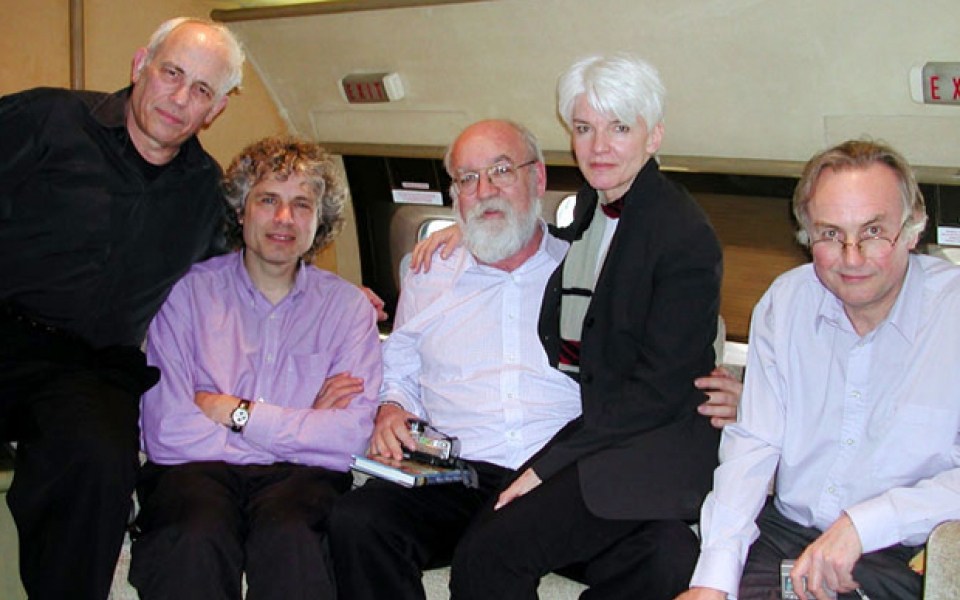
In February 2002, Epstein’s private jet flew from JFK to California carrying passengers to the TED Conference, among them Richard Dawkins, Daniel Dennett, and Steven Pinker—three men who spent two decades lecturing the West on reason, enlightenment, and the alleged moral toxicity of Christianity. Dennett later confirmed the flight publicly, describing it as “uneventful.”¹ The word does more work than intended.

The issue is not criminal complicity by proximity. It is moral incuriosity by principle. These were not private academics without ethical pretension. They were public moralists who insisted that transcendent moral law was unnecessary, that human flourishing could be grounded in evolutionary instinct, rational consensus, and enlightened self-interest. Yet Epstein remained welcomed within elite intellectual circles long after his 2008 conviction, his wealth functioning as a solvent for moral concern.²
The most instructive case is Lawrence Krauss, author of A Universe from Nothing and a self-described “antitheist.” Krauss exchanged extensive email correspondence with Epstein, organised a physics conference funded by Epstein’s foundation in the U.S. Virgin Islands, accepted significant financial support through his Origins Project, and publicly minimised concerns by asserting that the young women surrounding Epstein were “ages 19 to 23.”³⁻⁴ He later remarked, without irony: “I don’t feel tarnished in any way by my relationship with Jeffrey; I feel raised by it.”⁵
“Raised by it” is not a verbal misstep. It is a worldview made audible.
When Krauss himself faced multiple allegations of sexual misconduct spanning several years, it was Epstein he consulted for advice. The counsel he received—discredit the women, portray them as irrational and opportunistic—emerged in documented correspondence later reported by investigative journalists.⁶ In one exchange, Krauss and Epstein joked about hosting a “men of the world conference,” suggesting a guest list that included figures later publicly accused of sexual misconduct.⁷ The pattern is not incidental; it is diagnostic.
This was not an isolated relationship but a network. In 2014, Krauss, Pinker, and Epstein were photographed together at an Origins Project anniversary gala—six years after Epstein’s conviction.⁸ Pinker later insisted he was merely “involuntarily placed next to” Epstein for the photograph, denying any substantive association.⁹ The claim strains credulity in light of the surrounding context.
Nor was this network informal. John Brockman, whose Edge Foundation functioned as a key intellectual hub for secular elites, received over half a million dollars from Epstein-linked charitable entities. The Foundation acted as an intellectual pipeline through which scientists and philosophers were introduced to Epstein’s patronage and social world.¹⁰
What, then, has actually failed here? Not intelligence. Not scientific competence. What has failed is the claim that morality can be sustained without transcendence—that ethical restraint can survive as a purely immanent construct when incentives align against virtue.
Here the warnings of Francis Schaeffer prove prescient. Schaeffer argued that when “autonomous man” cuts himself loose from the infinite-personal God, he does not ascend into liberation but descends—first into philosophical incoherence, then into moral fragmentation, and finally into cultural decadence.¹¹⁻¹² Moral language persists, but its foundations are gone. Values are affirmed rhetorically while abandoned in practice.
The Epstein network is not a refutation of secular ethics by scandal. It is a confirmation by consequence. Within a framework where morality is reducible to preference, consensus, or evolutionary advantage, there is no principled reason to refuse the wrong dinner invitation—only calculations of reputation and exposure. Subjective morality is not neutral. It is permissive.
This is why the appeal to hypocrisy misses the point. Christianity has never claimed that belief guarantees virtue. It has insisted, rather, that virtue requires law—real law, grounded in the character of a holy God, binding regardless of status, wealth, or intellectual pedigree. As Charles Spurgeon observed, persistent hostility to the Word of God often masks a desire to remove its moral impediments.¹³
For years, these men told Christians that we do not need God to be good; that religion poisons everything; that biblical morality is obsolete. Yet when their own system was tested by proximity to money, power, and vice, it supplied no restraint—only rationalisation, evasion, and silence.
“The wicked freely strut about when what is vile is honoured among men.”¹⁴
The Christ they mocked has not changed. The law they dismissed has not moved. The fear of the Lord remains the beginning of wisdom—not because believers are morally superior, but because wisdom begins where accountability cannot be negotiated away.
The Epstein files do not prove Christianity true. They demonstrate something more modest and more devastating: that elite secular moralism, severed from transcendence, cannot bear the weight it claims to carry. And when what is vile is honoured among men, the consequences are never abstract. They are borne by victims—while the priests of “reason” board the jet and call it uneventful.
¹ Daniel Dennett, confirmation of flight on Jeffrey Epstein’s aircraft to TED 2002, Twitter/X post, 2019 (archived and cited in contemporaneous reporting).
² Mark Oppenheimer, “The Talented Mr. Epstein,” The New York Times, 12 June 2019.
³ Emily Shugerman, “Lawrence Krauss Says He Was ‘Raised’ by Jeffrey Epstein,” The Daily Beast, 30 July 2019.
⁴ Arizona State University, Office of the President, public statement on Origins Project funding, July 2019; see also Katherine Long, The New York Times, 26 July 2019.
⁵ Lawrence Krauss, quoted in Shugerman, The Daily Beast, 30 July 2019.
⁶ Ronan Farrow, “Jeffrey Epstein, Billionaire Pedophile, Exploited Scientific World,” The New Yorker, 7 September 2019.
⁷ Epstein–Krauss email correspondence released through litigation and analysed in The Daily Beast and The New Yorker, 2019.
⁸ Reporting and photographic evidence documented in The Boston Globe and The New York Times, July 2019.
⁹ Steven Pinker, public statement reported in Nellie Bowles, The New York Times, 26 July 2019.
¹⁰ James Gleick, “The Edge of Reason,” The New York Review of Books, 2019; The New York Times reporting on Edge Foundation funding.
¹¹ Francis A. Schaeffer, The God Who Is There (Downers Grove, IL: InterVarsity Press, 1968).
¹² Francis A. Schaeffer, Escape from Reason (Downers Grove, IL: InterVarsity Press, 1968).
¹³ Charles H. Spurgeon, Spurgeon at His Best (Grand Rapids, MI: Baker Book House, 1988), p. 47.
¹⁴ Psalm 12:8; cf. Psalm 14:1–3 (Douay-Rheims).
RELATED ARTICLES


LATEST ARTICLES
- Mary Is Co-Redemptrix: Cardinal Burke Reopens Rome’s Marian ControversyCardinal Raymond Leo Burke has declared the Virgin Mary as “Co-Redemptrix” amidst controversy over the Vatican’s restriction on this title. The debate revolves around the appropriateness of certain theological language and whether terminology historically used can still accurately express Marian cooperation in Redemption without compromising Christ’s unique role.
- When Politics Defines Doctrine: Edmund Waldstein, Integralism and the New Boundary at HeiligenkreuzThe ongoing exclusion of Father Edmund Waldstein from teaching at Heiligenkreuz has sparked debate on the limits of acceptable Catholic thought, particularly regarding integralism and its relationship to Church doctrine. Critics argue that Waldstein and similar positions challenge both Catholic teachings and democratic values, raising questions about the intersection of faith and politics.
- Christianity Is Right ~ Not Right WingThe article discusses the distinction between Catholic orthodoxy and modern political ideologies, particularly the Right and Christian nationalism. It argues that Catholic beliefs about family, morality, and authority predate contemporary political classifications and should not be conflated with right-wing politics. The ordo amoris framework is presented as a guiding principle for evaluating political alliances while maintaining a focus on the common good and the Social Kingship of Christ.
- Today’s homily: The Nativity of the Blessed Virgin MaryThe Nativity of the Blessed Virgin Mary marks a significant moment in salvation history, representing the dawn of the Incarnation. Mary’s birth, unnoticed by the world, was part of God’s providential plan leading to Christ. This feast invites reflection on humility, obedience, and trust in God’s will, emphasising Mary’s role as the Mother of the Redeemer.
- Today’s Mass: September 08 The Nativity of the Blessed Virgin MaryThe Nativity of the Blessed Virgin Mary celebrates her birth, symbolising a new beginning tied to salvation. Originating in the East, it gained recognition in Rome under Pope Sergius I. Additionally, the feast commemorates Saint Hadrian, a martyr who converted to Christianity, underscoring themes of faith and redemption.



Leave a Reply