
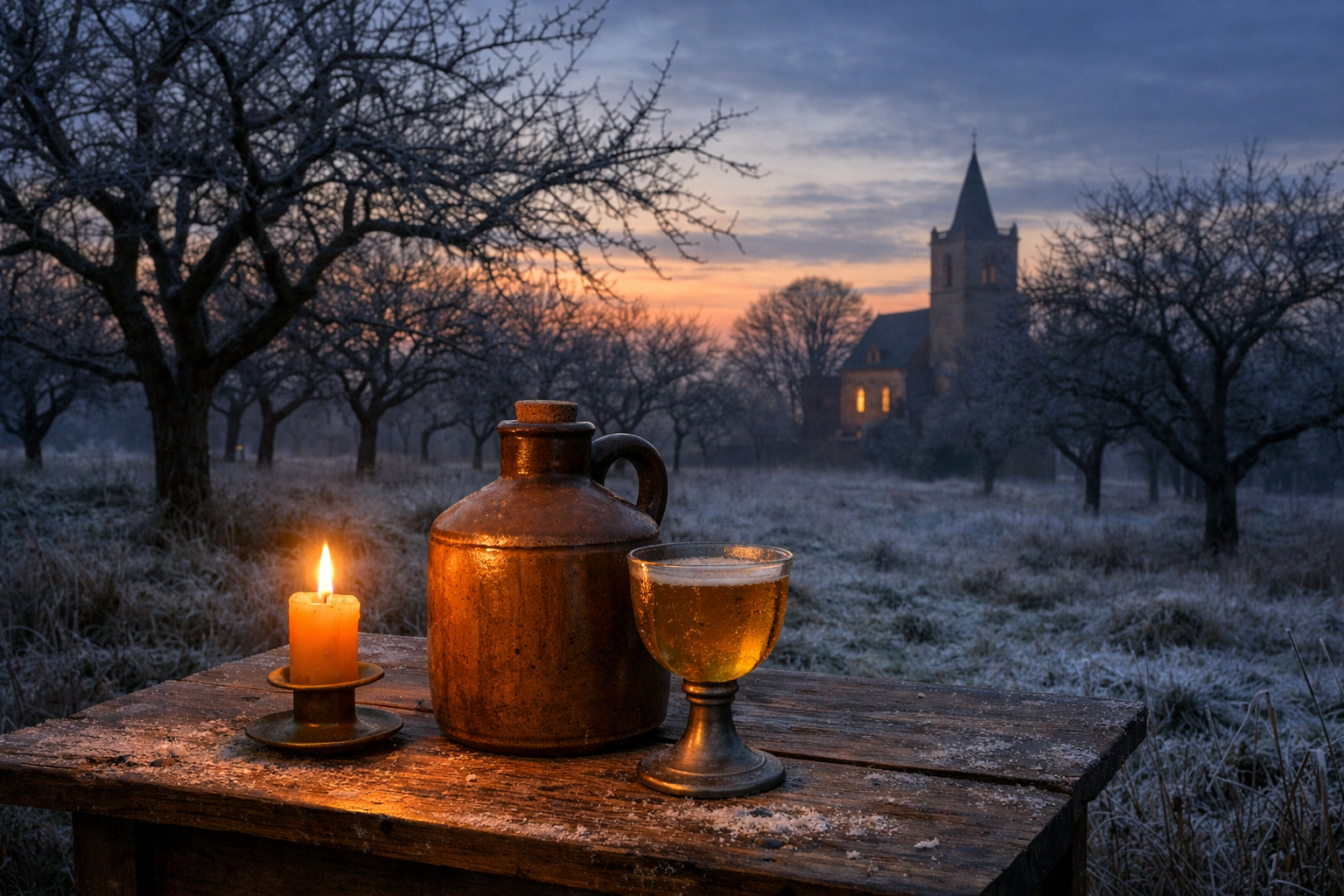
The Blessing of Mead or Cider on Epiphany
Among the quieter survivals of the Church’s traditional liturgical culture is the blessing of mead or cider on the Feast of the Epiphany, observed historically in parts of Northern and Western Europe. Though easily misunderstood or dismissed as folkloric, this custom belongs properly to the Church’s longstanding practice of sanctifying the fruits of the earth and ordering human labour toward thanksgiving and divine praise. Properly framed, it reflects a sacramental vision of reality that modern Christianity has too often neglected.

The Feast of the Epiphany commemorates the manifestation of Christ to the Gentiles, represented by the Magi who bring gifts drawn from the created order—gold, frankincense, and myrrh. These are not abstract symbols but concrete offerings, elevated through worship and made expressive of divine kingship, priesthood, and sacrifice. Within this same theological logic, the blessing of mead or cider situates agricultural produce within the economy of grace, acknowledging both God’s providence and man’s cooperation with it.¹
In regions where cider apples and honey were central to subsistence and seasonal rhythms, fermented drink naturally became associated with festal observance. England, Ireland, and parts of Scandinavia preserved strong agrarian cultures well into the early modern period, and Epiphany—falling shortly after the completion of the harvest cycle—provided an apt moment for communal thanksgiving and petition for the year to come.² The Church’s willingness to bless such products does not signal syncretism but rather fidelity to a principle articulated since patristic times: gratia non tollit naturam, sed perficit. Grace does not abolish nature but perfects it.
Liturgically, the blessing of mead or cider follows the same structure as the Roman Ritual’s benedictions for food and drink, invoking God’s favour upon both the substance itself and those who partake of it. The prayer emphasises divine generosity, the dignity of human labour, and the sanctification of ordinary life. Such blessings were often celebrated either on Epiphany itself or within its octave, sometimes in parish settings, sometimes domestically, reflecting a time when the liturgical year shaped not only the sanctuary but the household as well.³
In England, the Epiphany blessing of cider became intertwined with the custom of wassailing, particularly in cider-producing counties such as Somerset and Herefordshire. While elements of popular festivity undoubtedly persisted, Christian practice consistently reinterpreted these acts through explicit prayer and blessing. The pouring of cider at the roots of apple trees, for example, was understood not as a fertility rite but as a symbolic gesture of thanksgiving and petition, acknowledging dependence upon God rather than upon impersonal natural forces.⁴ Where older customs survived, the Church’s task was not to preserve superstition but to purify intention and direct all blessing unambiguously toward the Creator.
A similar dynamic may be observed in Scandinavian and Celtic contexts, where mead held long-standing associations with celebration and hospitality. When incorporated into Epiphany observance, its symbolism was reshaped by Christian theology: sweetness, abundance, and joy ordered toward Christ’s revelation to the nations. The Magi’s gifts again provide the interpretative key. What is offered is not merely enjoyed, but consecrated—received as gift and returned in thanksgiving.⁵
At a deeper theological level, the blessing of mead or cider illustrates the Church’s sacramental worldview. Christianity does not confine faith to interior sentiment or moral exhortation; it insists that matter itself is capable of bearing grace. Fermented drink, often treated in contemporary discourse with suspicion or triviality, here becomes a sign of rightly ordered joy—one that affirms celebration without excess and gratitude without idolatry. In this sense, the custom also stands as a quiet rebuke to both puritanical suspicion of material joy and modern reduction of festivity to consumption alone.
Epiphany’s universal scope lends the blessing a further missionary dimension. As Christ is revealed not only to Israel but to all nations, so the fruits of diverse lands and labours are gathered under His lordship. The blessing of local produce thus becomes a small but eloquent proclamation of Christ’s kingship over time, labour, and land.⁶ In an age increasingly detached from both the liturgical year and the sources of sustenance itself, the recovery of such customs offers more than antiquarian interest. It restores a vision of Christian life in which creation is received with reverence, enjoyed with gratitude, and ordered ultimately toward the worship of God revealed in Jesus Christ.
| Latin (Textus Authenticus) | English (Literal Translation) |
|---|---|
| V. Adjutorium nostrum ✠ in nomine Domini. | V. Our help ✠ is in the name of the Lord. |
| R. Qui fecit caelum et terram. | R. Who made heaven and earth. |
| V. Dominus vobiscum. | V. The Lord be with you. |
| R. Et cum spiritu tuo. | R. And with thy spirit. |
| Oremus. | Let us pray. |
| Benedic, ✠ Domine, creaturam istam potus, quam ex pinguedine frumenti vel ex pomorum fructu vel ex apum dulcedine producere dignatus es; et praesta; ut sit salus mentis et corporis sumentibus eam; et quicumque ex ea biberint, secundum donum tuae gratiae, sentiant se percipere sanitatem. Per Christum Dominum nostrum. | Bless, ✠ O Lord, this creature of drink, which Thou hast deigned to bring forth from the richness of grain, or from the fruit of apples, or from the sweetness of bees; and grant that it may be a help to mind and body for those who take it; and that all who drink of it may, through the gift of Thy grace, perceive health within themselves. Through Christ our Lord. |
| R. Amen. | R. Amen. |
¹ Acts 14:17.
² C. Miles, Christmas Customs and Traditions: Their History and Significance (London: 2017), 123–125.
³ Rituale Romanum, Benedictiones ciborum et potuum.
⁴ J. G. Frazer, The Golden Bough: A Study in Magic and Religion (London: 1922), 512–514; cf. later Christian reinterpretations in parish customaries.
⁵ D. Ó hÓgáin, The Sacred Isle: Belief and Religion in Pre-Christian Ireland (Woodbridge: 1999), 187–189.
⁶ Cf. Psalm 23:1; Colossians 1:16–20.
related articles


Latest articles
- Today’s homily: St John CantiusThe account of St John of Kenty illustrates true charity, as he prioritised the needs of a poor man over his own comfort, exemplifying how knowledge of faith must translate into actions. His life was marked by humility, generosity, and a dedication to both charitable works and doctrinal integrity, urging a holistic expression of faith.
- Today’s Mass: October 22 St John CantiusSt John of Kenty, originally a humble country lad, succeeded as a theology professor in Kraków but faced opposition that led to his role as a parish priest. Known for his kindness, he lived simply, aiding the poor. After winning his parishioners’ hearts, he returned to teaching, living a life of humility and faith.
- Today’s Mass: October 21 St Ursula, Virgin Martyr & CompanionsSt Ursula and Companions, Virgins and Martyrs; Commemoration of St Hilarion, Confessor. Though legends concerning Ursula and eleven thousand virgins are historically uncertain, early Christian martyrs were venerated at Cologne. St Hilarion, Palestinian hermit and disciple of St Anthony, embraced severe penance and solitude, dying in 371 aged eighty.
- FR RIPPERGER’S YEAR OF SILENCE: Obedience is not an explanationFr Chad Ripperger has accepted a year-long withdrawal from public speaking as requested by Archbishop Golka of Denver, aimed at focusing on his priestly community. This decision, following the removal of another exorcist, raises concerns about the Church’s balance between discretion and public witness regarding exorcism and supernatural matters.
- Today’s Mass: October 20 Octave Day of St Edward, King & ConfessorEdward the Confessor, England’s last Saxon king, ruled from 1042 until his death in 1066. Born in 1003, he fled to Normandy during Danish rule and returned to take the throne. His reign is debated, seen as both weak and a time of peace. Edward’s legacy includes the establishment of Westminster Abbey, where he is buried.




Leave a Reply