
Notre Dame’s Retreat from Mission: A Case Study in the Quiet Secularisation of Catholic Higher Education
The quiet disappearance of Catholic mission from Notre Dame’s staff values marks a defining moment in the story of Catholic higher education in the United States. It has not happened with controversy or fanfare, nor by decree or doctrinal rupture, but by the familiar contemporary method: the administrative refresh, the managerial rewrite, the polite but decisive shift from theological clarity to corporate ambiguity. A single line—once the pillar of institutional identity—has vanished. Yet in that erasure lies a narrative of profound significance.
For generations, Notre Dame understood itself not merely as a university founded by Catholics, but as a Catholic university whose mission animated every aspect of its life. Its purpose was the formation of minds and souls in fidelity to the truths revealed by God and taught by the Church. Employees were therefore expected to “understand, accept and support the Catholic mission of the University.”¹ This was not a demand for personal devotion; it was an acknowledgment that those who serve an institution must not work at cross-purposes with its raison d’être.
The removal of this expectation reveals a new anthropology—one wherein institutional identity is no longer shaped by mission but by human preference, managerial fashion, and market positioning. The new values of “Community,” “Collaboration,” “Excellence,” and “Innovation”² speak a language that is impeccably modern, unobjectionable, and entirely unrooted. They express aspirations but not commitments, mood but not mandate. Any corporation could affirm them; many already do. Their universality is precisely the problem.
The change does not emerge from nothing. It is the natural culmination of developments decades in the making. Catholic universities across the West have slowly migrated from mission-centric governance to a managerial model in which Catholic identity is one brand element among many. The pattern is consistent: signs, symbols, and heritage are retained for marketing and alumni relations, but the operational logic of the institution becomes indistinguishable from that of the secular academy. Georgetown’s reliance on a pluralistic ethos, Fordham’s adoption of globalised social frameworks, and Loyola Chicago’s integration of contemporary ideological language all exemplify this transformation.³ Notre Dame now joins them, not as a follower but as a bellwether.
The implications run deeper than administrative wording. Catholic identity shapes more than brochures—it forms culture. A mission shapes hiring, expectations, and the ethos of daily life. It shapes what is celebrated and what is discouraged; what is permissible, and what is unthinkable. When mission is removed from the operational core, culture changes swiftly. Staff who once felt the university expected a Catholic vision of education will now understand that alignment with that vision is optional. Future applicants will self-select accordingly. Those who wish to advance professionally will conform to the values embedded in reviews and job descriptions, not the ones printed on crests and statues.
The transformation is therefore anthropological. A Catholic anthropology sees the human person as ordered toward truth, virtue, and the life of grace. A corporate anthropology sees the human person as a contributor to institutional outcomes through skills, engagement, and productivity. The former requires fidelity; the latter requires alignment with strategic goals. The old staff value—support for the Catholic mission—presupposed a supernatural vision of education. The new values presuppose no such thing.
It would be naïve to believe that Catholic identity can remain intact when the structures that once protected and transmitted it are relaxed or removed. Institutions do not stay Catholic by inertia. They remain Catholic because their mission is enforced, embodied, and expected. Once that expectation becomes optional, the institution’s trajectory bends inevitably toward assimilation into the dominant culture. As John Paul II taught in Ex Corde Ecclesiae, a Catholic university must be “born from the heart of the Church.”⁴ If its staff are no longer required to uphold that identity, the umbilical cord is practically severed, even if the language of connection persists.
In light of this, Notre Dame’s decision cannot be interpreted merely as an HR update. It is a redefinition of what it means to belong to the institution. Previously, to work at Notre Dame meant to participate in a mission. Now, it means to contribute to an organisational culture. The mission becomes a department rather than a foundation. It becomes heritage rather than identity. It risks becoming past tense rather than present reality.
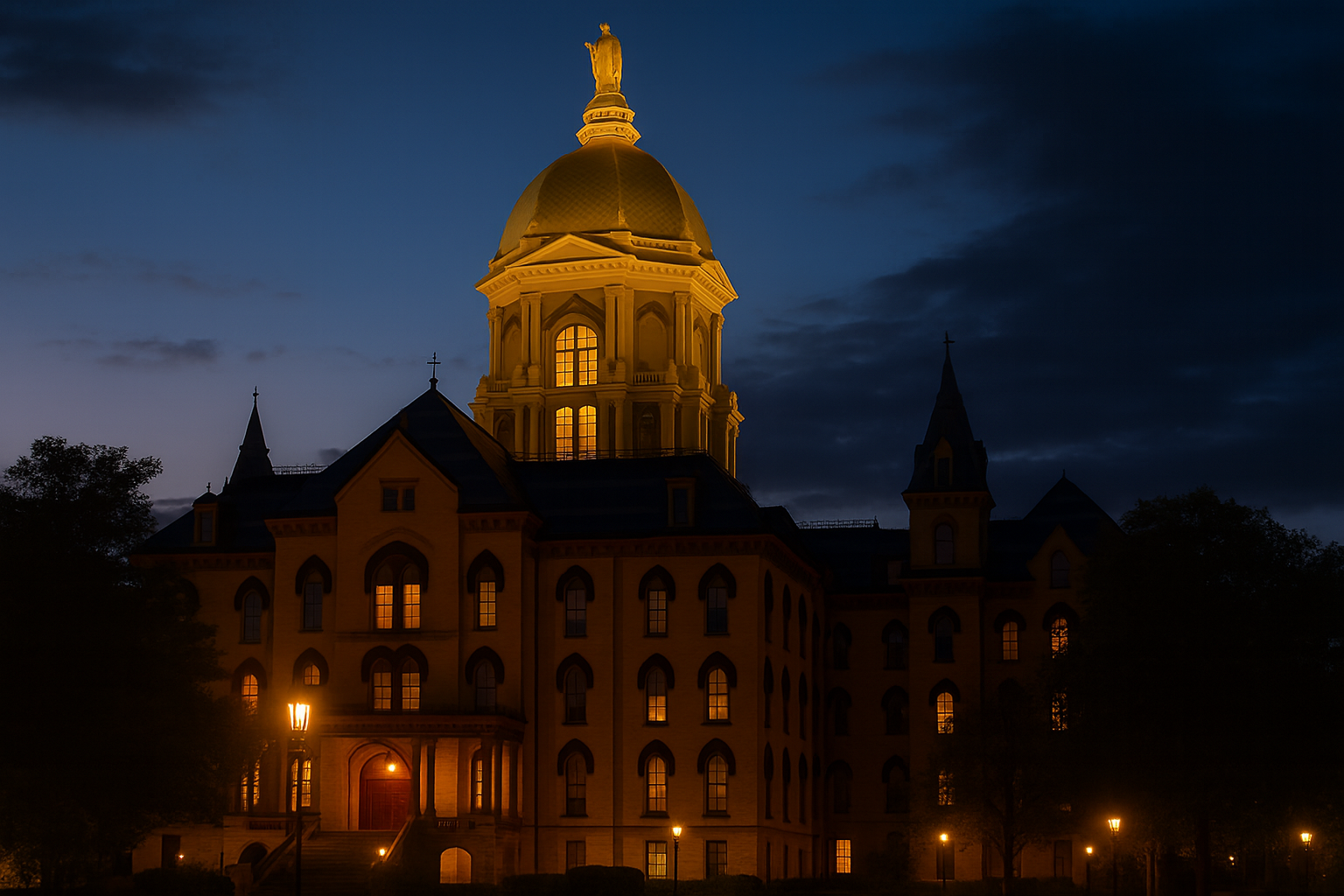
The cultural consequences are profound. Students entering a university where the staff are no longer expected to support the Catholic mission will encounter an environment in which Catholicism is ambient but not formative. Theology becomes one discipline among many; Catholic moral teaching becomes one perspective among many; the liturgical life becomes one optional activity among many. Beauty remains—magnificent buildings, sacred art, stately traditions—but beauty without truth can only enchant, not transform. It can inspire sentiment, but not discipleship.
This process mirrors the secularisation of Christian hospitals and charities. First the mission is affirmed but not enforced. Then it is respected but not required. Then it is tolerated but not central. Eventually it is honoured in memory while the institution functions according to entirely different principles. Nostalgia replaces conviction; heritage replaces purpose. Institutions become museums of their former identity, not monuments of their living one.
Notre Dame still proclaims itself a Catholic research university. That identity is not yet extinguished. But identity untethered from structure is precarious. Mission disconnected from obligation fades into rhetoric. A university that no longer requires staff to support its Catholic mission will soon find that fewer staff are willing to support it at all. Culture shifts subtly but steadily until the institution’s trajectory aligns fully with the prevailing secular order.
The question now facing Notre Dame is not whether it can remain Catholic in name. It is whether it can remain Catholic in substance. Catholic identity is not preserved by banners, symbols, or traditions, but by fidelity to a mission lived concretely in the people who constitute the university. When that fidelity is no longer expected, it is no longer assured. Notre Dame has crossed a threshold. Whether it returns depends on whether its leaders recognise that mission is not an accessory to university life—it is its heart.
- Catholic News Agency, “Notre Dame Drops ‘Acceptance and Support for Catholic Mission’ from Staff Values,” 18 November 2025.
- NDWorks (University of Notre Dame), “Refreshed ND Values: University Updates Shared During Fall Staff Town Hall,” October 2025.
- Inside Higher Ed, “Notre Dame Drops Catholic Mission Reference from Staff Values,” 19 November 2025; see also institutional mission statements publicly available from Georgetown University, Fordham University, and Loyola University Chicago (2019–2025).
- John Paul II, Ex Corde Ecclesiae, §27.


latest
- THE DATA YOU OUTSOURCE IS STILL YOUR RESPONSIBILITYThe RNLI’s exposure through the Beacon CRM cyberattack illustrates a problem far wider than one charity. Organisations can outsource their databases, hosting and technical security, but they cannot outsource responsibility for the information they choose to collect. Data minimisation, supplier scrutiny and controlled access are not merely GDPR exercises: they are duties of custodianship.
- “THAT THE WORLD MAY HAVE LIFE”: LEO XIV GOES TO FRANCEPope Leo XIV arrives in France five weeks after its assisted-dying law came into force and two years after guaranteed access to abortion was written into the Constitution. His first encyclical calls life from conception to natural death the first human right. At the Élysée, Notre-Dame and Lourdes, the question is now how explicitly he will apply that doctrine to France.
- Today’s homily: St Matthew, Apostle & EvangelistThe Reckoning of Mercy reflects on the transformative calling of St Matthew, a despised tax collector, by Christ. It illustrates the concept that God’s grace empowers genuine conversion, emphasising that true mercy requires both acknowledgment of one’s past and active adherence to justice. Matthew’s journey from publican to apostle embodies this principle.
- Today’s Mass: September 21 St Matthew, Apostle & EvangelistMatthew the Apostle and Evangelist, also called Levi, was sitting at his tax-collector’s desk in Capernaum when he was called by Christ. He followed Him at once, and also gave a feast for Him and the other disciples.
- Sermon for St. MatthewToday, we honour St. Matthew, a tax collector called by Jesus to discipleship. Despite their notorious reputation, tax collectors were essential to Jesus’ ministry of redemption. St. Matthew’s Gospel, aimed at a Jewish audience, emphasises Jesus as the fulfilment of prophecy and outlines Christ’s teachings, including the Sermon on the Mount.




Leave a Reply