
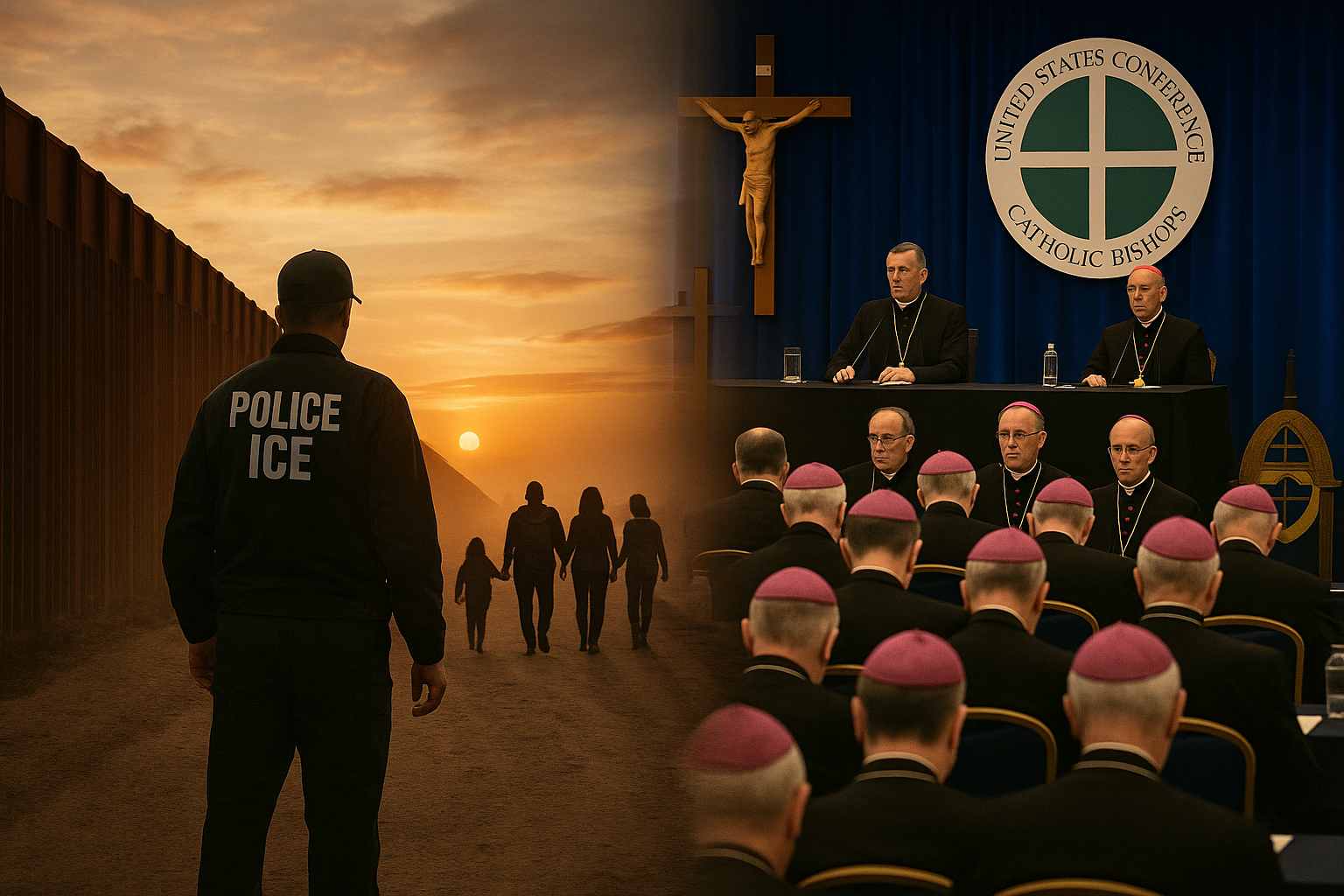
Mercy Without Order? The USCCB, Illegal Immigration, and a Growing Trust Crisis
A Pastoral Message That Stirs Unease
The United States Conference of Catholic Bishops’ recent Special Pastoral Message on Immigration has intensified an already fragile relationship between the episcopate and many American Catholics. The document’s emphasis on fear, vulnerability, and pastoral accompaniment is pastorally sincere, yet it leans heavily toward a humanitarian reading of immigration that underplays the moral reality of illegal entry and treats enforcement with visible suspicion. Recent public backlash against the bishops’ annual Campaign for Human Development solicitation has further highlighted a widening trust deficit: many lay Catholics no longer believe their leaders can hold mercy and justice together. The convergence of these two controversies exposes deeper tensions within the bishops’ messaging and raises urgent questions about ecclesial credibility, the common good, and Catholic social doctrine in practice.
Illegality Reframed as Pure Vulnerability
The bishops’ document rightfully insists that migrants—regardless of legal status—possess inherent human dignity. Yet the rhetorical pattern consistently recasts illegality not as a violation of just law but as a condition that heightens suffering. The moral lens shifts from wrongdoing to vulnerability. Fear of detention, family separation, and lack of documentation are presented as injuries primarily inflicted by enforcement, rather than consequences arising from unlawful entry. This narrative, common in contemporary progressive discourse, risks collapsing categories in a way classical Catholic moral theology does not permit. Mercy presupposes justice; it does not negate it. Illegal immigration remains an objective disorder, even as the Church accompanies those who live within it.
The Implicit Delegitimisation of Law Enforcement
While the USCCB stops short of condemning ICE or Border Patrol, their tone sends a different message. The bishops describe a “climate of fear,” oppose “indiscriminate mass deportation,” and lament conditions in detention centres, yet devote little space to affirming that lawful enforcement—prudently and proportionately exercised—is necessary for the protection of the common good. Former ICE director Tom Homan publicly criticised the bishops’ stance, arguing that enforcement saves lives and that pastoral language detached from legal reality undermines the moral legitimacy of officers tasked with upholding federal law. When the bishops sound “disturbed” by the very environment that enforcement necessarily creates, the implication is clear: the problem is not disorder at the border, but the existence of enforcement itself.
A Universalist Frame Detached from the Common Good
The bishops ground their message in universal human dignity and scriptural appeals to welcome the stranger. These principles are non-negotiable. However, the document’s framing aligns with a universalist anthropology that treats borders as moral embarrassments and national interest as a secondary concern. Catholic social teaching, especially in its pre-conciliar articulation, recognises that nations possess rights and duties: to regulate immigration, preserve social cohesion, protect citizens, and ensure that migration occurs according to just and orderly laws. The USCCB’s message gestures toward this but does not give it adequate weight. The result is a humanitarianism inclined to sentimentalism—one that risks eclipsing prudence, subsidiarity, and the real moral claims of the host society.
The CCHD Backlash: A Sign of Deepening Distrust
The recent report from Complicit Clergy, documenting how the bishops’ annual CCHD solicitation was “pummeled” across social media, underscores how fragile episcopal credibility has become. Commenters accused the bishops of funding organisations that contradict Catholic moral teaching, promoting progressive political agendas, neglecting pro-life priorities, and ignoring the faithful’s concerns. The anger was not merely political; it was ecclesial. Many Catholics no longer trust that episcopal appeals—whether financial or pastoral—are grounded in Catholic doctrine rather than ideological fashion. The immigration message suffers from the same perception. When the bishops emphasise global solidarity, “accompaniment,” or humanitarian language while saying little about the rule of law, assimilation, sovereignty, or border integrity, the laity interpret it as another instance of selective compassion.
A Pattern: Pastoral Language Without Prudential Clarity
Both controversies reveal the same structural problem. The bishops are attempting to offer moral guidance in an age of political polarisation. Yet in doing so, they too often adopt language that mirrors secular humanitarianism more closely than the balanced, tradition-rooted framework of Catholic social doctrine. This creates the impression that they have embraced the emotional grammar of the contemporary Left—victimhood framing, suspicion of enforcement, and a borderless moral anthropology—rather than the Church’s classical synthesis of mercy, justice, order, and the common good. The faithful, sensitive to this discrepancy, push back: “Where is the clarity? Where is the balance? Where is the full Catholic vision?”
Toward a Recovered Catholic Balance
A coherent Catholic response to immigration must unite mercy with order, solidarity with subsidiarity, pastoral concern with respect for law. The USCCB’s message would be strengthened by plainly affirming that illegal entry is a violation of just law; that nations possess legitimate rights over their borders; that enforcement, when proportionate, is morally necessary; that migrants have duties alongside rights; and that pastoral accompaniment must never obscure justice and social cohesion. Likewise, episcopal fundraising efforts require strict transparency, rigorous vetting of partner organisations, and public assurance that Catholic money will not support agendas contrary to the faith. Only a renewed commitment to clarity, doctrinal fidelity, and the full vision of the Church’s social teaching can rebuild trust.
Conclusion
The Church must defend the dignity of migrants with unwavering conviction. But she must also speak clearly about the moral claims of the state, the rights of citizens, and the necessity of lawful order. When mercy becomes detached from justice, the result is not charity but confusion. The faithful long for shepherds who can articulate both sides of the Catholic tradition—compassion and coherence, welcome and wisdom. Until that balance is restored, the criticism witnessed in the CCHD backlash and the scepticism surrounding the USCCB’s immigration message will only deepen.
- USCCB, U.S. Bishops Issue Special Message on Immigration, Plenary Assembly, 12 November 2025. https://usccb.org/news/2025/us-bishops-issue-special-message-immigration-plenary-assembly-baltimore
- MSNBC summary of bishops’ concerns about profiling and fear. https://www.msnbc.com/opinion/msnbc-opinion/paul-coakley-usccb-catholic-immigration-rcna243314
- Denver Catholic report on bishops’ opposition to “indiscriminate mass deportation.” https://www.denvercatholic.org/us-bishops-issue-a-special-message-on-immigration
- National Catholic Register interview with Archbishop Paul S. Coakley on human dignity and national security. https://www.ncregister.com/news/us-bishops-2025-message-on-immigration
- Tom Homan’s critique reported by Our Sunday Visitor. https://www.osvnews.com/trump-border-czar-calls-us-bishops-wrong-after-immigration-statement
- CatholicVote response as reported by Fox News. https://www.foxnews.com/politics/exclusive-catholic-bishops-chided-sowing-confusion-deportations-stance
- Complicit Clergy report on backlash against the CCHD solicitation. https://www.complicitclergy.com/2025/11/16/u-s-bishops-cchd-solicitation-getting-pummeled-on-social-media


Latest
- Today’s Mass: September 13 Sunday XVI Post PentecostThe Sixteenth Sunday After Pentecost celebrates the importance of humility and the grace of God, emphasised in the Gospel through Jesus’ healing and teachings. As believers are called to seek God’s mercy, the commemoration of the Blessed Virgin Mary’s Nativity highlights the beginning of salvation and the pursuit of good works through divine grace.
- Sermon for Sixteenth Sunday after PentecostIn the epistle to the Ephesians, St. Paul encourages believers to remain steadfast amid trials, highlighting the significance of humility and unity in Christ. He contrasts worldly values of pride with the Kingdom’s values, emphasising that true fulfilment comes from reliance on God’s grace and prioritising love for God and neighbour.
- The Line Held Again: UK Parliament Rejects Assissted Suicide Bill – and Reverses Its Own VerdictThe House of Commons has rejected the Terminally Ill Adults (End of Life) Bill, marking a significant parliamentary reversal in views on assisted suicide, shifting from a 55-vote majority for to a 16-vote majority against in less than two years. Concerns over safeguards and support for vulnerable patients informed this decision.
- Sermon for Holy Name of MaryThe feast of the Holy Name of Mary commemorates her Nativity and follows the celebration of the Holy Name of Jesus. It serves as a reminder of Europe’s past resistance against militant Islam, particularly during the Ottoman siege of Vienna in 1683. The rise of secularism and post-modernism threatens this cultural heritage, prompting a call for a renewed spiritual commitment akin to the Church’s role during the fall of the Roman Empire. This revival could inspire societal resilience against external threats.
- The Most Holy Name of MaryThe Church commemorates the Nativity of the Blessed Virgin Mary on 8 September, followed by the Feast of the Holy Name of Mary on 12 September. This close sequence symbolises Mary’s significance in salvation history. The feast has evolved from a regional observance to a universal celebration, particularly linked to the victory at Vienna in 1683, highlighting her role as a maternal intercessor guiding the faithful towards Christ.


Leave a Reply