
The Illusion of a Rival Pope: Why the “Hildebrand” Claim Fails in Law, Doctrine, and Reason
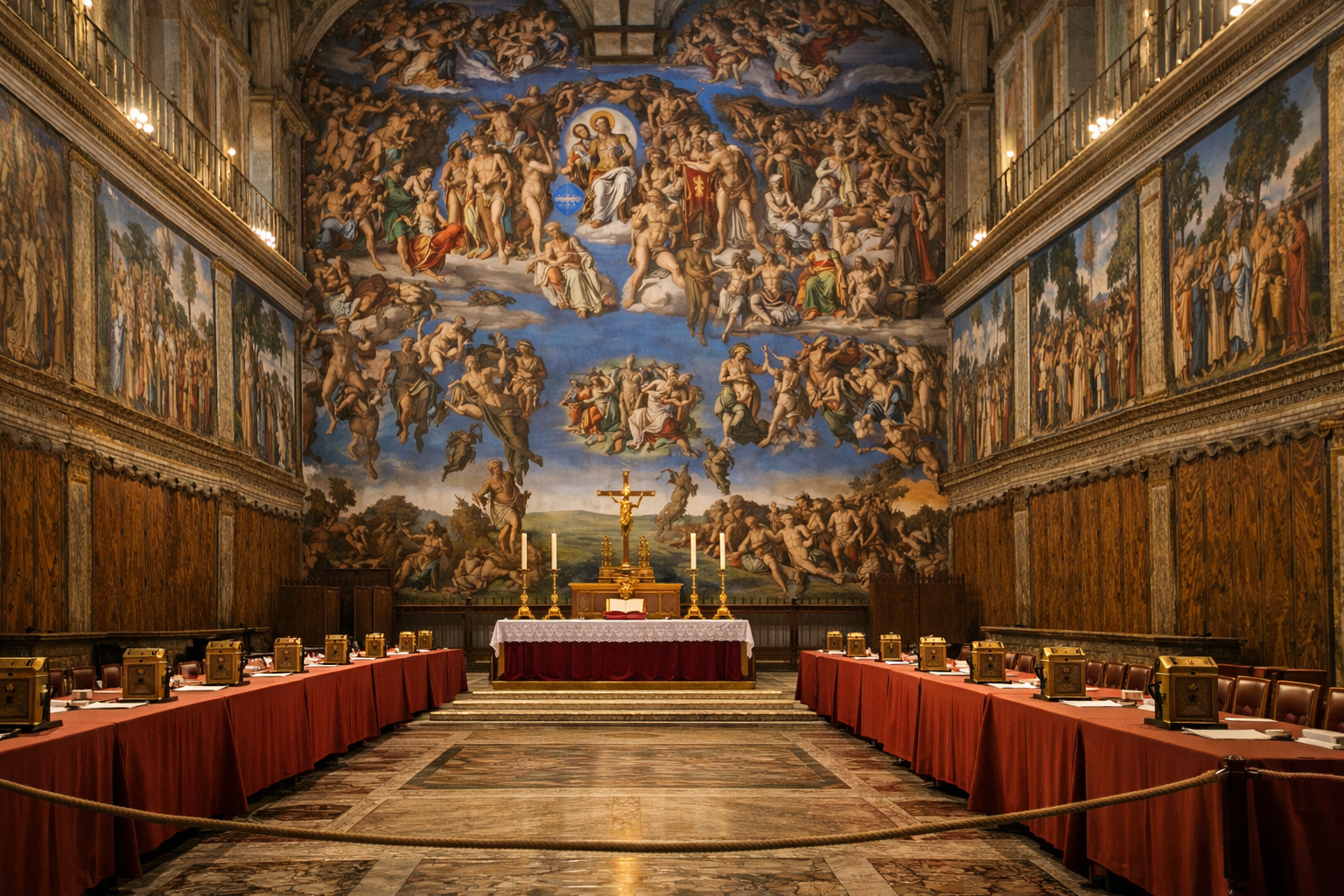
In the months following the May 2025 conclave that elected Pope Leo XIV, a small but increasingly vocal circle has asserted that the election was ipso facto null and void, and that a subsequent “extraordinary” election held in November 2025 produced a rival claimant styling himself “Hildebrand.” These claims, disseminated through online videos and improvised press conferences, rely almost entirely on a selective and erroneous reading of Universi Dominici Gregis, particularly paragraph 76.
Because such arguments can unsettle the faithful and foster division under the guise of juridical rigour, they require a response that is calm, exact, and complete. What follows presents the claims as they are made and then refutes them according to canon law, ecclesial doctrine, and the Church’s settled historical practice.
The Central Claim: Automatic Nullity Under Paragraph 76
The core assertion is that the May 2025 conclave was invalid because 133 cardinal electors participated, exceeding the limit of 120 set out in paragraph 33 of Universi Dominici Gregis. Paragraph 76 is then invoked to claim that, because the “conditions laid down” were not observed, the election was automatically null and void “without any need for a declaration.” On this basis, it is argued that the See of Rome remained vacant and that an alternative election by clergy and laity could lawfully take place elsewhere.
This argument appears forceful only when paragraph 76 is isolated from its juridical context. When the text is read as law, rather than as a slogan, the claim fails.
What Paragraph 76 Actually Means
Paragraph 76 states that if an election is conducted other than as prescribed, or if the conditions laid down are not observed, the election is null and void.¹ In canonical interpretation, however, such general clauses are never read indiscriminately. From the earliest canonical tradition through the 1917 and 1983 Codes, the Church has distinguished consistently between conditions touching the substance of an act (ad validitatem) and disciplinary norms regulating liceity (ad liceitatem). Only the former engage nullity.
This distinction is not imposed externally upon the text. It is evident from the internal structure of Universi Dominici Gregis itself.
Where the Constitution Intends Nullity, It States It Explicitly
Throughout the constitution, John Paul II is precise. Where nullity is intended, it is stated unambiguously. Thus, the election is declared null in cases of simony, coercion, external interference, or if conducted by methods other than secret ballot.² These are violations that destroy the substance of the electoral act.
By contrast, the numerical limit on electors is stated plainly but without any nullifying sanction:
*Numerus Cardinalium electorum non excedat centum viginti.*³
The omission is decisive. The legislator knew how to attach nullity and chose not to do so here. In canonical interpretation, what the law does not say cannot be supplied by private inference.
Why Exceeding 120 Electors Does Not Nullify an Election
Even if one grants, arguendo, that permitting more than 120 electors was contrary to the letter of paragraph 33, such a breach would concern liceity, not validity. The essential elements of a papal election remain unchanged: a vacant Apostolic See; legitimate electors (cardinals under eighty); freedom and secrecy of the vote; attainment of the required majority; and free acceptance by the one elected. All of these conditions were fulfilled in May 2025.
Canon law does not treat a quantitative excess as a qualitative defect. The juridical act remains the same act. To argue otherwise is to collapse distinctions the Church has carefully maintained for centuries.
The Misuse of Paragraph 4 and the Myth of “Innovation”
It is further alleged that paragraph 4 of Universi Dominici Gregis, which forbids innovation of law during sede vacante, was violated. This too rests on confusion. Paragraph 4 prohibits legislative innovation—changing, suspending, or dispensing from law—not factual non-compliance or disputed procedural judgment.⁴ Allowing eligible cardinals to vote, even if judged imprudent or illicit, does not constitute arrogation of papal authority.
Were it otherwise, any contested decision during a conclave would suffice to annihilate an election, rendering the papacy permanently unstable.
The Appeal to “Extraordinary Apostolic Right”
On the basis of the alleged nullity of the May conclave, the rival claimant appeals to medieval precedents and to In Nomine Domini (1059) to justify an “extraordinary” election by clergy and laity outside Rome. This appeal fails decisively.
Extraordinary modes of election presuppose genuine impossibility—physical, moral, or juridical—not disagreement with an outcome. No such impossibility existed in May 2025. Once a conclave has been lawfully convened and completed, recourse to extraordinary mechanisms is excluded. Canon law does not permit private individuals to declare the See vacant and supply their own pope on the basis of disputed interpretation.
Peaceful Acceptance and Ecclesial Certainty
Beyond questions of procedure lies a deeper juridical and theological principle: universalis Ecclesiae adhaesio. Once an elected pope is peacefully accepted by the Church—recognised by the College of Cardinals, named in the sacred liturgy, and received by the episcopate—juridical certainty is achieved.⁵ This principle exists precisely to prevent the chaos of endless rival claimants.
Since May 2025, Leo XIV has been publicly and universally treated as Roman Pontiff. No competent ecclesiastical authority has declared the election void. No rival claimant has emerged with juridical standing, episcopal orders, or ecclesial recognition. Anonymous figures elected by private assemblies cannot overturn a completed conclave received by the Church.
What Is Conclavism—and Why the Church Rejects It
Conclavism is the belief that a small, self-constituted group may elect a pope outside the Church’s recognised juridical order, typically on the claim that a prior conclave was invalid. It tends to arise in moments of crisis and trades on genuine anxiety about legality and orthodoxy. Its defining feature, however, is not vigilance but usurpation.
The Church rejects conclavism for clear reasons. The right to elect the Roman Pontiff belongs to the Church as a public juridical body, not to private individuals acting on personal interpretation. Conclavism collapses the distinction between illicit and invalid acts, denies the doctrine of peaceful acceptance, bypasses the visibility proper to the Church, and replaces ecclesial judgment with private certainty. Historically, its fruits have been suspicion, fragmentation, and isolation rather than reform.
For these reasons, the Church has consistently regarded conclavism not as heroic resistance, but as a grave ecclesial error—one that mistakes rupture for fidelity and substitutes private judgment for the visible order Christ Himself established.
A Pastoral Exhortation to the Faithful
Beloved in Christ, confusion in times of ecclesial strain is not a sign of bad faith. Many who encounter claims of secret elections or rival popes are motivated by a sincere desire to remain faithful. For this reason, the Church has always insisted that private judgment must never replace ecclesial judgment, nor personal certainty be allowed to fracture communion.
When faced with alarming claims, ask simple, stabilising questions: Is this rooted in the public law of the Church? Is it recognised by the Church’s pastors? Does it foster unity or suspicion? Christ did not leave His Church to be governed by hidden identities and improvised rites, but by visible authority, public law, and moral certainty.
Remain anchored, therefore, in what the Church herself recognises and receives. Pray for the Holy Father. Pray for the Church. Resist the temptation to resolve uncertainty by retreating into theories that promise clarity at the cost of communion. Authentic fidelity is not proven by discovering secret truths, but by persevering in obedience, patience, and charity when the truth is tested.
¹ John Paul II, Universi Dominici Gregis (1996), n. 76.
² Ibid., nn. 63–65, 78–82.
³ Ibid., n. 33.
⁴ Ibid., n. 4; cf. 1983 Code of Canon Law, cann. 7–8.
⁵ Classical canonical doctrine on universalis Ecclesiae adhaesio, as treated in pre-conciliar manuals and theological jurisprudence.
related articles


Latest articles
- Today’s homily: St John CantiusThe account of St John of Kenty illustrates true charity, as he prioritised the needs of a poor man over his own comfort, exemplifying how knowledge of faith must translate into actions. His life was marked by humility, generosity, and a dedication to both charitable works and doctrinal integrity, urging a holistic expression of faith.
- Today’s Mass: October 22 St John CantiusSt John of Kenty, originally a humble country lad, succeeded as a theology professor in Kraków but faced opposition that led to his role as a parish priest. Known for his kindness, he lived simply, aiding the poor. After winning his parishioners’ hearts, he returned to teaching, living a life of humility and faith.
- Today’s Mass: October 21 St Ursula, Virgin Martyr & CompanionsSt Ursula and Companions, Virgins and Martyrs; Commemoration of St Hilarion, Confessor. Though legends concerning Ursula and eleven thousand virgins are historically uncertain, early Christian martyrs were venerated at Cologne. St Hilarion, Palestinian hermit and disciple of St Anthony, embraced severe penance and solitude, dying in 371 aged eighty.
- FR RIPPERGER’S YEAR OF SILENCE: Obedience is not an explanationFr Chad Ripperger has accepted a year-long withdrawal from public speaking as requested by Archbishop Golka of Denver, aimed at focusing on his priestly community. This decision, following the removal of another exorcist, raises concerns about the Church’s balance between discretion and public witness regarding exorcism and supernatural matters.
- Today’s Mass: October 20 Octave Day of St Edward, King & ConfessorEdward the Confessor, England’s last Saxon king, ruled from 1042 until his death in 1066. Born in 1003, he fled to Normandy during Danish rule and returned to take the throne. His reign is debated, seen as both weak and a time of peace. Edward’s legacy includes the establishment of Westminster Abbey, where he is buried.



Leave a Reply