
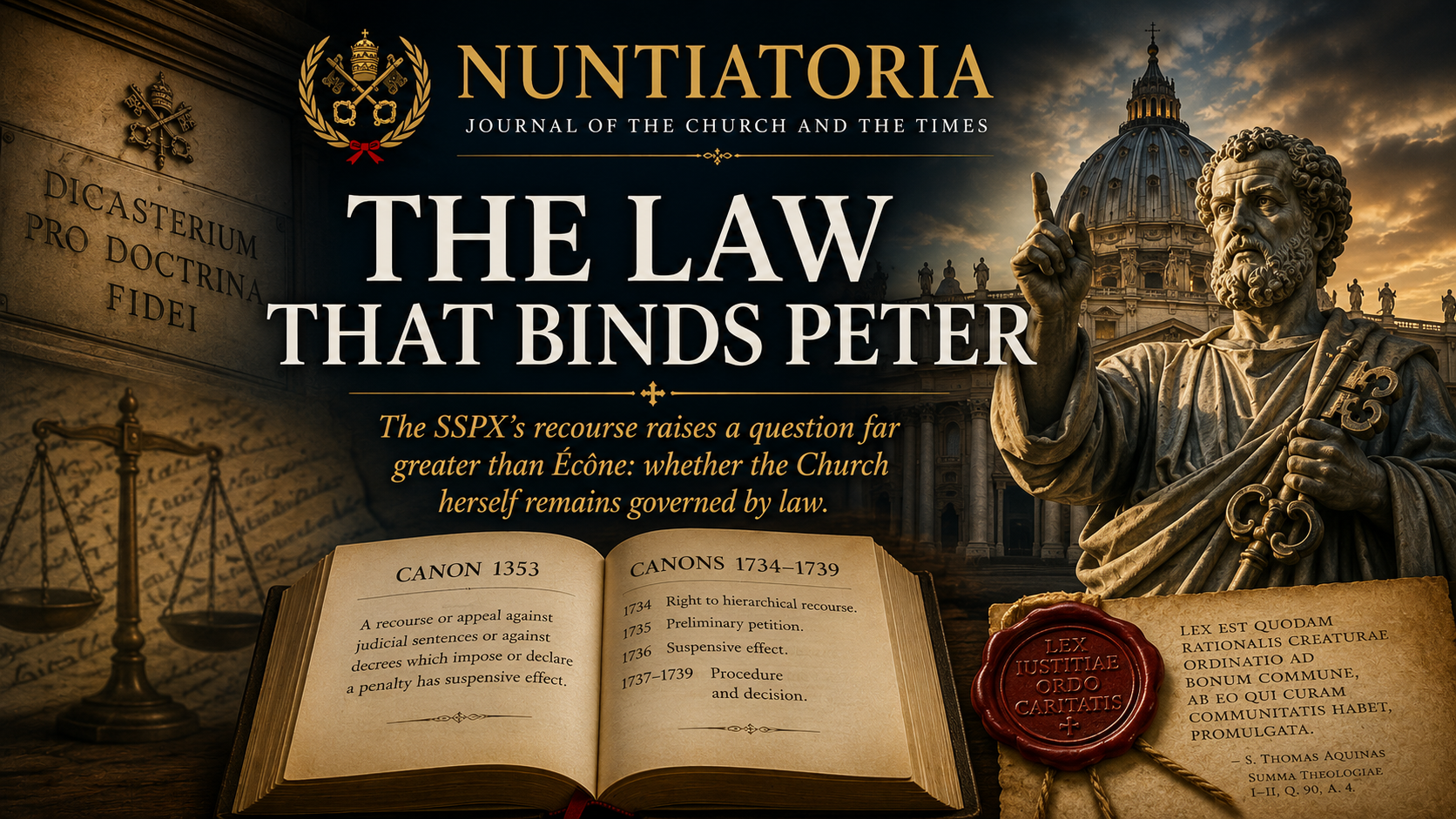
The Law That Binds Peter
The SSPX has appealed not from Roman authority, but to its just exercise. The Holy See must now decide whether canon law remains law when it restrains those who govern.

The Society of Saint Pius X has answered the decree of 2 July neither by declaring the Holy See vacant nor by repudiating the jurisdiction of the Roman Church. It has answered by invoking the Church’s own law. On 11 July, according to a communiqué issued from Menzingen two days later, the Society submitted to the Dicastery for the Doctrine of the Faith the preliminary petition required by canon 1734 before the possible introduction of a hierarchical recourse. It further stated that the petition suspends the execution of the decree under canon 1353.¹
That is more than a procedural manoeuvre. It changes the posture of the entire controversy. Those who have presented the Dicastery’s decree as the final and unanswerable word must now reckon with the fact that the Code itself provides a means by which an administrative penal act may be challenged, corrected, revoked or replaced. The Society has not placed itself beyond the law. It has placed the Dicastery’s act before the judgment of the law.
The canonical argument is serious. Canon 1353 provides that an appeal or recourse against a decree which imposes or declares a penalty has suspensive effect. Canon 1736 §1 adds that, where hierarchical recourse suspends execution by law, the preliminary petition required by canon 1734 possesses the same effect. Since the decree of 2 July expressly declared that named bishops had incurred excommunication, the Society’s contention rests upon the ordinary structure of the Code rather than upon an improvised plea for indulgence.²
Precision is nevertheless essential. The suspensive effect appears strongly grounded in the conjunction of canons 1353 and 1736 §1, but its exact personal and material scope may still be disputed. The decree named particular bishops, while the communiqué states that “the Society” lodged the petition. The Dicastery may therefore ask in whose name the recourse was made, whether each person declared censured is formally represented, and which provisions of the decree are challenged. These are legitimate questions of standing and scope. They do not justify proceeding as though no recourse had been made.
The distinction matters because the decree has repeatedly been treated as though it were a personal papal judgment admitting of no review. It was not. The published act was issued by the Dicastery for the Doctrine of the Faith and signed by Cardinal Víctor Manuel Fernández and the other officials named in the instrument. It bore no papal signature and contained no declaration that Pope Leo XIV had approved it in forma specifica. The Code excludes acts issued by the Roman Pontiff himself from the ordinary system of administrative recourse. The availability of the present remedy therefore depends upon the elementary distinction between a dicasterial act and an act personally assumed by the Pope.³
That distinction is not an evasion of papal authority. It is part of the juridical ordering of papal government. A Roman dicastery acts with authority, but it is not thereby identical with the Roman Pontiff. Its administrative decisions may be disputed, its competence examined, and its acts subjected to the remedies provided by law. Were every curial decree to be treated as a personal and irreformable papal act, the right of recourse would become meaningless precisely where it is most necessary.
The Society’s action therefore exposes the shallowness of the claim that canonical resistance is necessarily ecclesial rebellion. Recourse presupposes authority. A man does not appeal to a jurisdiction whose existence he denies. The SSPX has invoked the canons promulgated by the supreme authority of the Church, addressed the author of the contested decree, and reserved the possibility of carrying the matter to the competent hierarchical superior. Its communiqué speaks deliberately of “respect for ecclesiastical authority” and of “faithful attachment to justice, truth and the good of the Church”. Whatever judgment is made of the consecrations of 1 July, this is not the conduct of a body which believes itself answerable only to itself.
The deeper importance of the recourse lies in what it may compel Rome to examine. The controversy has too often been reduced to the single proposition that bishops were consecrated without a papal mandate. That fact is not disputed. The canonical dispute concerns the consequences attributed to it: whether the act was necessarily schismatic; whether the conditions for excommunication were established; whether necessity, grave inconvenience, diminished imputability or sincere error were adequately considered; and whether the penalties and sacramental consequences asserted by the Dicastery could lawfully be extended beyond the persons and acts identified in the decree.
These questions were not invented after the event. The Society announced the intended consecrations months in advance. Its Superior General wrote to the Dicastery, publicly stated the argument from necessity, issued a declaration of Catholic faith, named the candidates, and sought to explain why it believed episcopal continuity had become indispensable to the preservation of its apostolate. After the consecrations, it again stated that it regretted proceeding without papal authorisation and lamented that Father Davide Pagliarani had not been received personally by Pope Leo XIV.⁴
This chronology matters because penal law is concerned not only with the external act but with imputability. Canonical penalties do not follow merely from a description of what occurred. They require attention to intention, freedom, knowledge, circumstances and the possible operation of excusing or mitigating causes. The Society’s argument from necessity may ultimately be rejected; sincerity does not establish objective necessity. Yet canons 1323 and 1324 exist precisely because identical external acts may carry different penal consequences according to culpability and circumstance.
The recourse should therefore require the Dicastery to demonstrate not merely that consecrations occurred without a papal mandate, but why the canonical arguments raised before them were insufficient even to mitigate liability. It must distinguish the offence attached to illicit consecration from the separate offence of schism, rather than treating the former as though it automatically proved the latter.
That distinction is especially important in the case of Bishop Bernard Fellay. The decree declared him excommunicated under canon 1364 §1 because his participation as co-consecrator was judged to manifest adherence to schism. Yet canon 751 defines schism as the refusal of submission to the Supreme Pontiff or of communion with those subject to him. The juridical question is therefore not simply whether Bishop Fellay participated in an unauthorised consecration, but whether that participation established the specific will required by the canonical definition.
The same demand for precision applies to the distinction between the decree and its explanatory note. This has been repeatedly obscured in subsequent reporting. The decree named the consecrating and consecrated bishops, declared penalties, and warned clergy and lay faithful against adherence to the alleged schism. The explanatory note went further. It asserted broad consequences for SSPX clergy, described their sacramental ministry as illicit, and claimed that Confession and Matrimony were invalid.
Those propositions cannot be treated as though they possess identical juridical weight merely because they were published together. A decree is the act which imposes or declares legal consequences. An explanatory note interprets or comments upon that act. Commentary does not acquire the force of legislation by proximity.
This is not pedantry. No priest can be individually declared schismatic merely by membership of a clerical body, without attention to the alleged offence, imputability and the right of defence. No lay Catholic becomes excommunicated by attending an SSPX chapel, receiving the sacraments there, supporting its apostolate or accepting its account of the crisis. Formal adherence to schism requires a personal act of separation from papal submission or ecclesial communion. It cannot be inferred mechanically from association.
The sacramental claims require equal scrutiny. Pope Francis expressly granted faculties for the valid absolution of sins by SSPX priests, first during the Jubilee of Mercy and then beyond it. He also established provisions concerning marriages celebrated for faithful attached to the Society. A later explanatory note cannot simply be assumed to revoke universal papal concessions without an express juridical act identifying what is withdrawn, by whose authority and with what effect. The burden rests upon Rome to demonstrate revocation, not upon the faithful to infer it from commentary.
Here the distinction between the Pope and the Dicastery becomes decisive. Had Pope Leo personally revoked those faculties, or personally adopted the decree in forma specifica, the juridical position would be materially different. What was published, however, was a dicasterial decree accompanied by a dicasterial explanation. The distinction cannot be invoked when it enlarges Roman power and discarded when it preserves the rights of those affected by a curial act.
The same precision must be applied to the Pope’s letter of 29 June. Leo XIV plainly opposed the intended consecrations and pleaded with the Society to turn back. His will was not obscure. Yet the letter was framed as a paternal and spiritual appeal, not as a singular penal precept drafted in the juridical form by which contumacy is formally established. It warned and implored. It did not thereby become every canonical instrument which later polemic might find useful.
There is therefore no need to attribute a sinister purpose to the Pope’s intervention. The more substantial criticism lies elsewhere. The appeal came after the Superior General’s request for a personal audience had not been granted and after months in which the substance of the Society’s case remained unresolved. Peter’s office is not exhausted by warning his brethren of punishment. It exists to confirm them, govern them, hear them and, where possible, avert rupture before penalties become necessary.
The failure to receive Father Pagliarani personally remains one of the most serious facts in the chronology. The Society had given Rome months of notice. It was not concealing its intentions. The Pope was not required to accept its case, but he was uniquely placed to test it face to face, offer a concrete alternative, provide for episcopal succession under conditions compatible with Roman authority, or make unmistakably clear why no such provision could be granted. Instead, the first publicly known papal intervention came two days before the consecrations.⁵
This does not absolve the Society of responsibility. It does prevent the crisis from being narrated as though one party acted and the other merely suffered. The burden of preventing rupture did not rest upon the SSPX alone. Rome possessed the greater authority, the greater freedom of action and the unique capacity to offer a settlement preserving both canonical order and the Society’s legitimate concern for episcopal continuity. Its failure to exercise that capacity before 1 July cannot be excluded from the moral evaluation of what followed.
The preliminary recourse now returns the controversy to the proper forum. Canon 1733 encourages an equitable resolution between an aggrieved person and the author of a decree. Canon 1739 empowers the hierarchical superior not only to confirm an act, but to declare it invalid, rescind it, revoke it, amend it, replace it or modify it. The law therefore anticipates that administrative authority may err. It provides recourse not as a concession to rebellion, but as an ordinary instrument of ecclesiastical justice.²
That principle must not be obscured by hyperpapalism. The Church is not the mystical body of the Pope. She is the Mystical Body of Christ. The Roman Pontiff is the visible principle of her unity and the supreme governor of her earthly communion, but he is not the source of her life, truth or holiness. The Church continues during an interregnum because Christ remains her Head. The Petrine office belongs indefectibly to her constitution, but its purpose is ministerial: to guard the apostolic confession, preserve communion and confirm the brethren.
Fidelity to Peter cannot therefore be reduced to the unexamined acceptance of every act performed by a Roman department. Such a conception does not exalt the papacy. It diminishes it by confusing the divine office with administrative positivism. Catholic obedience is neither private judgment enthroned nor conscience extinguished. It is the moral submission owed to lawful authority acting within the order of truth, justice and the Church’s own constitution.
Canon law gives juridical form to that order. It is not an obstacle standing between authority and its objectives. It is one of the means by which ecclesiastical government is made recognisably Catholic rather than merely effective. Authority without law becomes will. Law without authority becomes abstraction. The Church requires both because government is ordered not to institutional victory but to the salus animarum, the salvation of souls.
Rome must therefore resist the temptation to answer the recourse politically. It would be easy to dismiss it as another manoeuvre by a body already judged disobedient. It would be easy to contest its standing, narrow its scope, or allow delay to perform the work of rejection. Such a response might preserve the decree. It would not preserve confidence in the justice of the Church’s government.
The Society, for its part, must avoid triumphalism. The filing of a recourse does not vindicate the consecrations or erase every canonical difficulty. Suspension is not annulment. Admissibility is not success. The competent authority may eventually confirm the decree. The Society’s strongest position is the one expressed in its own communiqué: that an injured party may seek correction while remaining respectfully attached to ecclesiastical authority and to the good of the Church.
The significance of the present moment lies precisely there. The SSPX has not appealed from Peter to itself. It has appealed through the law of the Church to the proper exercise of Petrine authority. It has not denied that Rome may judge it. It has demanded that Rome judge according to law.
The next move belongs to the Dicastery and, ultimately, to Pope Leo XIV. Rome may defend the decree, amend it, revoke it or replace it. It may clarify the status of the six named bishops, distinguish them from the priests and faithful of the Society, and state with precision what has become of the sacramental faculties previously granted. What it cannot justly do is insist upon the full force of a penal act while treating the remedies attached to that act as though they were optional courtesies.
The question is no longer simply whether the SSPX will obey Rome. The immediate question is whether Rome will obey its own law.
Justice is not the enemy of authority. It is the moral form by which authority becomes credible. If canon law binds the governed but becomes negotiable when it inconveniences those who govern, the gravest casualty of this controversy will not be the Society of Saint Pius X. It will be confidence that the Church still governs by law rather than by will.
- General House of the Society of Saint Pius X, “Communiqué from the General House”, Menzingen, 13 July 2026.
- Codex Iuris Canonici (1983), cann. 1353, 1733–1739.
- Dicastery for the Doctrine of the Faith, “Decree”, 2 July 2026; Codex Iuris Canonici, can. 1732.
- Society of Saint Pius X, statements and correspondence concerning the episcopal consecrations, February–July 2026.
- Pope Leo XIV, letter to Father Davide Pagliarani, 29 June 2026.
- Pope Francis, Apostolic Letter Misericordia et misera, 20 November 2016, no. 12; Pontifical Commission Ecclesia Dei, letter concerning faculties for marriages of faithful attached to the Society of Saint Pius X, 27 March 2017.
- Codex Iuris Canonici, cann. 751, 1323–1324, 1364 §1 and 1387.
RELATED ARTiCLES


LATEST ARTICLES
- FR RIPPERGER’S YEAR OF SILENCE: Obedience is not an explanationFr Chad Ripperger has accepted a year-long withdrawal from public speaking as requested by Archbishop Golka of Denver, aimed at focusing on his priestly community. This decision, following the removal of another exorcist, raises concerns about the Church’s balance between discretion and public witness regarding exorcism and supernatural matters.
- Today’s Mass: October 20 Octave Day of St Edward, King & ConfessorEdward the Confessor, England’s last Saxon king, ruled from 1042 until his death in 1066. Born in 1003, he fled to Normandy during Danish rule and returned to take the throne. His reign is debated, seen as both weak and a time of peace. Edward’s legacy includes the establishment of Westminster Abbey, where he is buried.
- SYNODALITY CANNOT SUBSTITUTE FOR GOOD BISHOPSCardinal José Cobo has highlighted the extensive process behind episcopal appointments, which includes numerous consultations and documentation, yet questions the effectiveness of this method in selecting suitable bishops. He stresses the need for reform in canon law and cautions against equating thorough procedures with genuine ecclesiastical wisdom and accountability.
- GAZA’S DEAD and the Claims Made in Their NameWestern politicians and media vilify Israel with double standards, while ignoring massacres of Christians across the Middle East. A century ago Christians were 20% of the region; now less than 4%, with persecution “close to genocide.” Yet Israel is the only state where Christians grow and worship freely. The Vatican mobilises diplomacy for Palestine, climate, and migration, but whispers for its own martyrs. Truth, then justice, then peace — anything less is counterfeit.
- PORTSMOUTH’S MISSING GENERATIONBishop Philip Egan has cautioned about the potential disappearance of Catholicism in England. Reports reveal an alarming trend where young people disengage after Confirmation and parents withdraw after baptismal preparation, despite some recovery in Mass attendance. Egan’s missionary programme must effectively transmit the Faith to future generations.
CURRENT EDITION


Today’s Mass Propers
- Today’s Mass: October 20 Octave Day of St Edward, King & Confessor
 Edward the Confessor, England’s last Saxon king, ruled from 1042 until his death in 1066. Born in 1003, he fled to Normandy during Danish rule and returned to take the throne. His reign is debated, seen as both weak and a time of peace. Edward’s legacy includes the establishment of Westminster Abbey, where he is buried.


Leave a Reply