
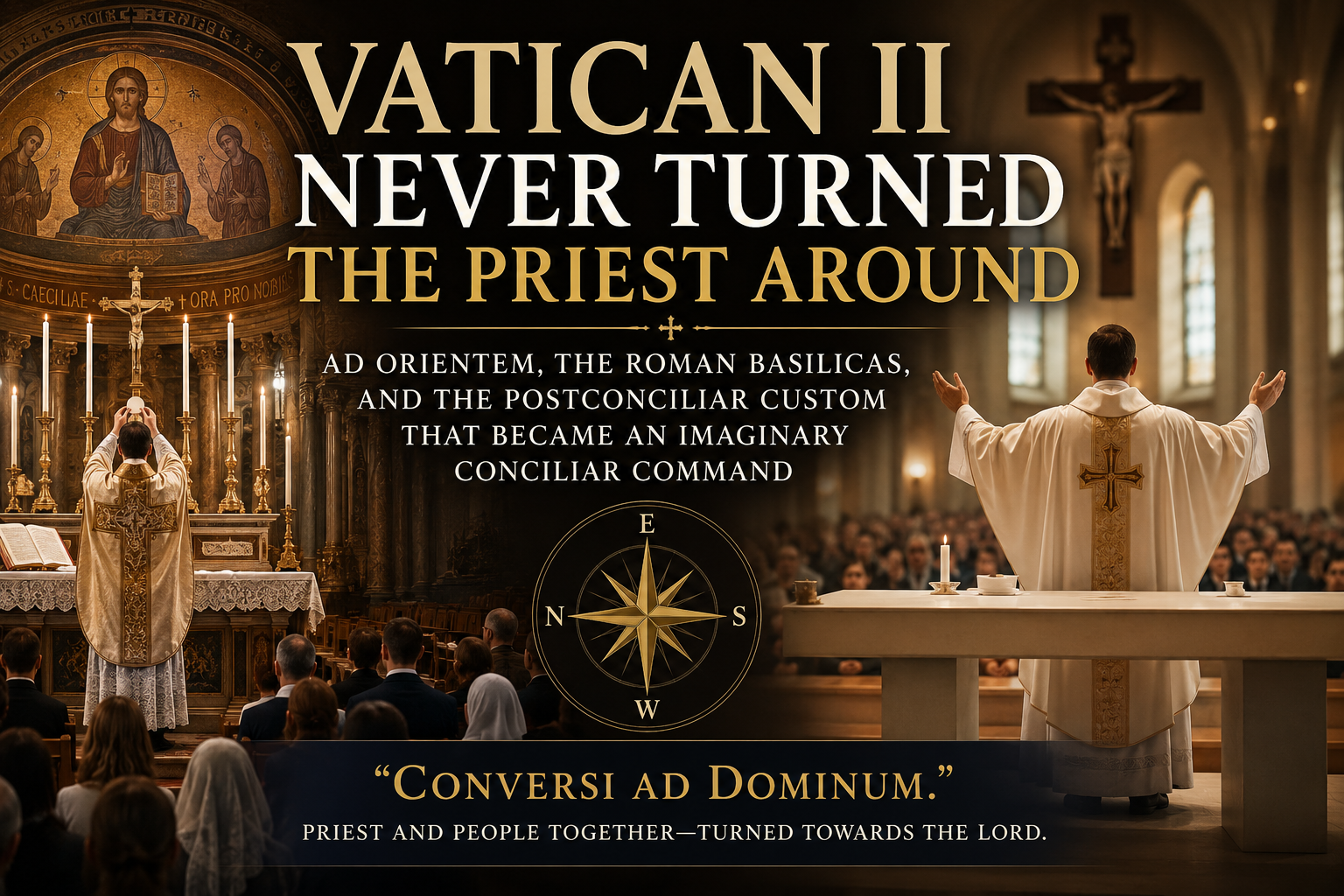
Vatican II Never Turned the Priest Around
Ad orientem, the Roman basilicas, and the postconciliar custom that became an imaginary conciliar command

There are few statements about the Second Vatican Council repeated with greater confidence than the assertion that it “turned the priest around.” The story has become part of Catholic folk-memory. Before the Council, the priest celebrated Mass with his back to the congregation; Vatican II required him to face the people; the freestanding altar therefore became one of the visible signs of obedience to the Council. The difficulty is that the middle part of this story never happened. There is not one provision of Sacrosanctum Concilium requiring the priest to celebrate Mass versus populum. The Constitution neither abolishes ad orientem nor directs the celebrant to stand on the opposite side of the altar from the congregation. It does not address the question at all.¹
That silence is significant because Sacrosanctum Concilium was perfectly capable of specifying the reforms which the Council Fathers actually intended. It called for the rites of Mass to be revised, for unnecessary repetitions to be removed, for the treasures of Scripture to be opened more abundantly, for the Prayer of the Faithful to be restored, for concelebration to be extended in specified circumstances, and for a wider use of the vernacular while preserving the place of Latin in the Latin rites.¹ When the Council wanted something changed, it said so. Yet amid detailed provisions governing the future reform of the Mass there is no direction whatsoever concerning the priest’s orientation at the altar — although within a few years that orientation would become one of the most conspicuous differences between Catholic worship before and after the Council.
The omission is more striking still when placed beside the Council’s governing principle for liturgical reform. Sacrosanctum Concilium insisted that “there must be no innovations unless the good of the Church genuinely and certainly requires them,” and that new forms should grow organically from forms already existing.² Whatever judgement one makes about the reform which followed, this much ought to be elementary history: what Vatican II decreed, what the Consilium subsequently proposed, what Roman authority later permitted, and what eventually became customary are not interchangeable things. Much confusion about the liturgy begins precisely by collapsing them into one another.
In the case of versus populum, there undoubtedly was official postconciliar encouragement for an altar arrangement from which Mass facing the people could be celebrated. There is no reason to conceal that fact; doing so would merely exchange one historical myth for another. On 26 September 1964, nine months after the promulgation of Sacrosanctum Concilium, the Sacred Congregation of Rites and the Consilium issued the Instruction Inter Oecumenici. Paragraph 91 stated that it was preferable for the principal altar to be built apart from the wall so that it could easily be walked around and celebration facing the people could take place. Paragraph 95 went further and expressly permitted Mass versus populum even where a suitably small tabernacle remained upon the altar.³
The Latin deserves attention. Inter Oecumenici says that the altar should be arranged so that celebratio versus populum peragi possit — so that celebration facing the people may be carried out.³ That is plainly an encouragement of the architectural conditions which make the practice possible. It is not, however, a command that every priest must celebrate every Mass in that position. The difference between making something possible and making it compulsory is not an exercise in traditionalist hair-splitting. It is the ordinary meaning of legislation.
There is another distinction which matters just as much. Inter Oecumenici is not Sacrosanctum Concilium. It is an instruction issued afterwards for the implementation of the Constitution. It was approved by Paul VI and possessed proper ecclesiastical authority, but it remains historically false to take a provision introduced in September 1964 and place it silently into a conciliar Constitution promulgated in December 1963. One may defend the implementing decision on its own merits. There is no need to manufacture a command of Vatican II in order to do so.
The present General Instruction of the Roman Missal retains substantially the same provision. Paragraph 299 says that the altar should be built apart from the wall so that it can easily be walked around and Mass can be celebrated at it facing the people.⁴ Its final words — quod expedit ubicumque possibile sit — have produced a small industry of grammatical controversy over exactly what is described as desirable wherever possible. One need not settle every shade of that discussion, because even the interpretation most favourable to a preference for versus populum does not say that the celebrant must face the congregation.
Rome itself removed any reasonable doubt about that twenty-six years ago. On 25 September 2000 the Congregation for Divine Worship and the Discipline of the Sacraments was asked directly whether paragraph 299 excluded the position of the priest versus absidem, towards the apse. The answer was unequivocal: “Negative et ad mentem.” No. The Congregation then explained that the word expedit did not impose an obligatory form but expressed a recommendation concerning both the detached altar and celebration versus populum. It added that the perceived convenience of facing the assembly did not exclude “the other possibility.”⁵
That responsum deserves far more attention than it usually receives, because it disposes of two propositions at once. It establishes that versus populum enjoyed an acknowledged preference in the postconciliar liturgical establishment; and it establishes with equal clarity that the alternative was not prohibited. The Congregation went on to make the deeper theological distinction which much subsequent argument has lost: the physical position of celebrant and assembly must not be confused with the interior orientation of the sacrificial action. It would be a “grave error,” the text said, to imagine that the community is the principal direction of that action. Even when the priest celebrates versus populum, priest and Church are spiritually versus Deum — towards God.⁵
The rubrics of the modern Missal themselves preserve this distinction with a quiet persistence which is difficult to reconcile with the claim that ad orientem somehow stands outside the reformed rite. After preparing the gifts and washing his hands, the priest returns to the centre of the altar and, “facing the people,” says the Orate, fratres. At the peace he again gives the greeting “while facing the people.” Before Communion he takes the Sacred Host and, “while facing the people,” says Ecce Agnus Dei. Immediately afterwards, however, the General Instruction describes him as standing “turned toward the altar” while he communicates himself. If the Prayer after Communion is said from the altar rather than the chair, he is once again directed to face the congregation.⁶
No sensible argument should make those rubrics carry more weight than they can bear. They do not prove that the reformed Missal secretly mandates ad orientem. They do prove that its ritual grammar remains perfectly intelligible when Mass is celebrated that way. A book which explicitly tells the priest when to face the people cannot reasonably be cited as though it had rendered any other orientation juridically inconceivable.
The older Roman Missal makes the conceptual distinction clearer still. In the Ritus servandus in celebratione Missae there is a special rubric for the situation in which the altar is “ad Orientem, versus populum” — towards the East, facing the people.⁷ The expressions which modern polemic routinely treats as opposites stand side by side in the liturgical law of the Roman Church. The reason is simple. Ad orientem and versus populum answer different questions. One concerns the direction towards which the celebrant is oriented; the other describes the position of the congregation in relation to him. In a suitably arranged church, both descriptions may be true simultaneously.
That is why the ancient Roman basilicas are so important to this discussion — and why they must be handled with considerably more care than they usually receive. They are sometimes invoked as though they provided straightforward archaeological proof that the earliest Roman Christians wanted the celebrant to look across the altar at the congregation in the modern manner. They prove nothing so simple.
Old St Peter’s, like the basilica which succeeded it, had its apse towards the west and its principal entrance towards the east. The siting of the Apostle’s tomb and the topography of the Vatican determined an arrangement quite different from the later convention of an eastern sanctuary. A celebrant standing on the apse side of the altar and looking towards geographical East consequently looked across the altar towards the nave. He might therefore be simultaneously ad Orientem and versus populum.⁸ This is not a modern traditionalist explanation devised to rescue an inconvenient piece of archaeology; it is the physical consequence of the building’s orientation.
The ancient Lateran likewise belonged to Rome’s west-apsed basilican tradition. Its successive reconstructions complicate any attempt to speak casually about what a modern visitor sees, but the archaeological work on the Constantinian building places the ancient liturgical focus towards the western end.⁹ St Paul Outside the Walls provides a useful counterpoint: the history of the basilica records a major alteration in orientation when the first Constantinian building was replaced by the vastly larger Theodosian basilica.¹⁰ The Roman evidence is therefore diverse enough to warn against simplistic reconstructions, while remaining perfectly clear on the essential point: the physical fact that a priest looked towards the nave does not by itself tell us why he stood where he did.
There has been genuine scholarly disagreement about the exact disposition of the faithful in some of the west-apsed Roman basilicas, including whether the people themselves turned towards geographical East during the Eucharistic prayer. That disagreement should be acknowledged, not suppressed. It prevents us from turning a complicated archaeological record into a slogan. But it also removes the foundation from the equally simplistic argument on the other side. If a celebrant was physically facing the congregation because he was facing East, one cannot simply take the first fact, ignore the second, and announce that the ancient Roman Church had thereby anticipated the modern theological rationale of versus populum.
This is where the distinction between geographical and liturgical East becomes indispensable. It would be too sweeping to claim that every basilica, chapel and altar in Rome has always possessed the same geographical alignment. Rome’s churches were erected across many centuries upon difficult sites, over tombs and shrines, within pre-existing structures and under quite different architectural conventions. The Catholic tradition did not reduce orientation to the needle of a compass. Where literal East could not determine the building, altar, apse and cross could themselves supply what became liturgical East. The important thing was the common direction of worship beyond the gathered community.
The symbolism is considerably older than the modern liturgical quarrel. East is the place of sunrise, and Christian prayer naturally found there an image of the risen and returning Christ, the Oriens ex alto, the Dayspring from on high. The Lineamenta prepared for the 2005 Synod of Bishops spoke with remarkable directness about this inheritance. Under the heading “The Orientation of Prayer,” the document said that the Christian understanding of salvation inspired “the apostolic tradition of orientating Christian buildings and the altar towards the East, so as to celebrate the Eucharist facing the Lord.” It then rejected the familiar description of the priest as presiding with his back to the people. The better image, it said, is that of the priest guiding the people in pilgrimage towards the Kingdom until the Lord comes.¹¹
That language is worth dwelling upon. The opposition usually presented to Catholics is between a priest “facing the people” and a priest “turning his back on them.” But the second description already contains a judgement. A lecturer who turns his back on an audience has turned away from the people whom he is supposed to address. At the Canon of the Mass, however, the priest is not addressing the congregation. He is addressing Almighty God. The Eucharistic Prayer is offered to the Father through the Son in the Holy Ghost. To describe the celebrant principally in terms of where his back happens to be is to begin from the assumption that the congregation ought to be the object of his physical orientation.
The older arrangement says something else. Priest and people stand upon the same side of the action. He is before them because he goes before them. At those parts of the rite in which he addresses the faithful he quite naturally faces them; the Roman rubrics have always known how to tell him to do so. When he turns again to the altar, the change of direction itself teaches. He is no longer speaking principally to us. He is praying to God with us and for us.
Joseph Ratzinger understood why this was more than an aesthetic preference. His concern was not to insist that every church building be reconstructed upon an exact east-west axis. In The Spirit of the Liturgy he argued instead for the recovery of a common Godward direction, suggesting that where geographical orientation could not be restored the crucifix itself should provide an interior East towards which priest and people could look together. As Benedict XVI he later reduced the matter to its theological essence: **“The fundamental criterion for the liturgy is its orientation to God.”**¹²
Once that principle is understood, the caricature of ad orientem becomes difficult to sustain. The priest is not at the altar primarily as an entertainer, lecturer, chairman or host. He stands sacramentally in the person of Christ the Head and offers the one Sacrifice of Calvary. The faithful do not form an audience observing him perform it. By Baptism they are incorporated into Christ and join themselves to the offering made sacramentally through the ministerial priesthood. Priest and faithful have been brought together for an action whose origin and terminus lie beyond both.
None of this means that a Mass celebrated versus populum is thereby anthropocentric, defective or irreverent. Such a conclusion would be both unjust and theologically crude. Priests celebrate facing their congregations every day with profound recollection, orthodoxy and devotion. Nor does the validity of the Holy Sacrifice depend upon the celebrant’s compass bearing. The point concerns the language of signs. Catholic worship does not take place in a vacuum. Architecture catechises. Gesture catechises. Silence catechises. The location of the tabernacle catechises. Direction does so as well.
A face-to-face arrangement places the celebrant continually within the visual field of the congregation. Much therefore depends, inevitably, upon his personality: his expression, manner, gesture, voice and deportment. Common orientation does not make the priest disappear, but it permits his face to recede at precisely the moment when his personality ought most readily to disappear into his office. It visibly places priest and faithful upon the same side of the mystery, looking beyond themselves.
That is also why common orientation cannot sensibly be opposed to participatio actuosa. Vatican II did not define active participation as continuous visual access to the celebrant. The Constitution speaks of participation in the liturgical action itself: acclamations, responses, psalmody, antiphons, hymns, actions, gestures, bodily attitudes and periods of reverent silence.¹³ A pilgrim is not less involved in a procession because he faces the destination rather than the face of the person leading it. Indeed, facing the same destination may express the common undertaking more clearly.
The archaeological argument for versus populum also encounters another uncomfortable witness: Pius XII. In Mediator Dei he praised serious study of ancient Christian worship but warned against the idea that antiquity possesses normative force simply because it is ancient. Among the examples he deliberately chose was the wish to restore the altar indiscriminately to its supposed primitive table form.¹⁴ His objection was not to the existence of freestanding altars — Roman history itself precludes such an interpretation — but to liturgical antiquarianism: the belief that one reconstructed stage of early Christian practice can simply be lifted from history and treated as inherently purer than the organic tradition which succeeded it.
This is particularly relevant because the case for versus populum was often archaeological before it became supposedly conciliar. The arrangement was presented as a recovery of primitive Christian worship. Vatican II then called for liturgical reform. What was reconstructed as primitive consequently came to appear naturally “conciliar,” even though the Council had said nothing about it. Over time, archaeological hypothesis, implementing preference, pastoral fashion and conciliar authority fused together in the popular memory.
The process by which this happened is not mysterious. Inter Oecumenici encouraged freestanding altars from which Mass could be celebrated facing the people. The practice consequently became easier. Liturgical commissions promoted it. New churches were designed for it. Existing sanctuaries were reordered. Seminaries formed priests who had scarcely known anything else. Each development reinforced the next. Within remarkably few years a permitted arrangement had become the overwhelmingly customary one.
Custom then acquired the force of assumed law. Catholics who watched high altars cease to be used and new altars erected before them were told that these were “the Vatican II changes,” so it was hardly surprising that they concluded Vatican II had ordered them. Priests formed afterwards inherited versus populum simply as the normal meaning of celebrating Mass. By the time anyone thought to ask where the conciliar command could actually be found, the question itself sounded subversive.
Here the much abused phrase “the spirit of Vatican II” does describe something real. It names the way in which a reform undertaken after the Council could gradually be remembered as something contained in the Council. No conspiracy is necessary. Institutions create habits; habits create expectations; expectations harden into assumptions. Eventually the historical distinction between a Council and the manner in which its decisions were implemented becomes almost invisible.
But documents do not change because memories do. Sacrosanctum Concilium contains no command for versus populum. Inter Oecumenici subsequently encouraged an altar arrangement which enabled it. The current General Instruction preserves such provision but does not require every priest to face the congregation. When the competent Roman dicastery was explicitly asked whether GIRM 299 excluded celebration towards the apse, it answered No. The reformed Missal itself continues to instruct the celebrant to face the people at specified moments. The traditional Roman Missal expressly recognises an altar which can be at once ad Orientem and versus populum. The architecture of ancient Rome explains perfectly well how those two descriptions could coexist.
The case for ad orientem therefore requires neither nostalgia nor exaggeration. It is unnecessary to claim that every altar in every Roman basilica has always possessed precisely the same orientation. The actual history is more interesting. In some of the great ancient basilicas geographical East lay across the altar towards the nave, so that eastward celebration was also physically versus populum. Elsewhere priest and people shared a direction towards altar and apse. As church architecture developed, a liturgical East could express what geography could not. Beneath these variations lies a durable Christian instinct: worship has a direction because worship has an Object.
One may prefer versus populum. One may defend the pastoral judgements which produced its near-universal adoption. One may point out, correctly, that it is lawful and has been explicitly facilitated by Roman authority. But a preference should be defended as a preference, and an implementing decision as an implementing decision. Neither becomes a decree of an Ecumenical Council merely because enough people have forgotten the difference.
The statement that “Vatican II turned the priest around” is therefore not an innocent shorthand. It is historically false. The Council did not turn the priest around. The legislation which followed facilitated celebration facing the congregation, and subsequent custom made that arrangement almost universal.
That distinction matters today because it determines whether a priest exercising a liberty still recognised by the Roman books is treated as though he were defying Vatican II. He is not. If priest and faithful stand together before altar and cross, he has not rejected the Council, circumvented the Missal or resurrected a practice which Rome abolished. He has adopted an orientation the Council never forbade and the postconciliar law never extinguished.
Perhaps our vocabulary should therefore recover something older and more exact than the sterile opposition between “facing the people” and “turning your back on them.” The Christian tradition supplies it in the summons which Augustine repeatedly gave his people at the beginning of the Eucharistic prayer:
Conversi ad Dominum.
Not priest against people. Not priest performing for people.
Priest and people together — turned towards the Lord.
¹ Second Vatican Council, Constitution on the Sacred Liturgy Sacrosanctum Concilium, 4 December 1963, nn. 14, 21–23, 36, 47–58.
² Sacrosanctum Concilium, n. 23.
³ Sacred Congregation of Rites and Consilium, Instruction Inter Oecumenici, 26 September 1964, nn. 91, 95, Acta Apostolicae Sedis 56 (1964), pp. 877–900, at p. 898.
⁴ Institutio Generalis Missalis Romani, editio typica tertia, n. 299.
⁵ Congregation for Divine Worship and the Discipline of the Sacraments, Responsum, Prot. No. 2036/00/L, 25 September 2000, Communicationes 32, no. 2 (December 2000), pp. 171–173.
⁶ Institutio Generalis Missalis Romani, nn. 146, 154, 157–158, 165.
⁷ Missale Romanum ex decreto SS. Concilii Tridentini restitutum Summorum Pontificum cura recognitum, editio typica 1962, Ritus servandus in celebratione Missae, V.3.
⁸ Rosamond McKitterick, John Osborne, Carol M. Richardson and Joanna Story, eds., Old Saint Peter’s, Rome (Cambridge: Cambridge University Press, 2013); Uwe Michael Lang, Turning Towards the Lord: Orientation in Liturgical Prayer, 2nd ed. (San Francisco: Ignatius Press, 2009).
⁹ Lex Bosman, Ian P. Haynes and Paolo Liverani, eds., The Basilica of Saint John Lateran to 1600 (Cambridge: Cambridge University Press, 2020), especially Lex Bosman, “Constantine’s Spolia”; Papal Archbasilica of Saint John Lateran, official historical and architectural account of the basilica.
¹⁰ Papal Basilica of Saint Paul Outside the Walls, official historical account of the Constantinian and Theodosian basilicas.
¹¹ Synod of Bishops, XI Ordinary General Assembly, The Eucharist: Source and Summit of the Life and Mission of the Church — Lineamenta (2004), n. 53, “The Orientation of Prayer.”
¹² Joseph Cardinal Ratzinger, The Spirit of the Liturgy, trans. John Saward (San Francisco: Ignatius Press, 2000), ch. 3; Benedict XVI, General Audience, 26 September 2012.
¹³ Sacrosanctum Concilium, nn. 14, 26–30, 48.
¹⁴ Pius XII, Encyclical Mediator Dei, 20 November 1947, nn. 61–64.
RELATED ARTiCLES


LATEST ARTICLES
- October Beneath Our Lady’s StandardThe Feast of the Most Holy Rosary commemorates the 1571 victory at Lepanto and evolved through papal endorsements, especially under Pope Leo XIII in the late 19th century. October, dedicated to the Rosary, serves as a reminder of prayer’s significance during trials, fostering both personal and communal spiritual resilience in Catholic life.
- Marriage Endures as Britain’s Common Christian Framework RecedesRecent ONS data indicates that 83.7 per cent of couples married in 2015 remained together by their tenth anniversary. However, Britain faces declining fertility rates, increasing abortion statistics, an ageing Christian demographic, and a reliance on migration for population growth. The critical challenge lies in transmitting family, faith, and culture across generations.
- Vatican III by Stealth? When “Reception” Becomes RevisionArchbishop Anthony Randazzo warns against the misuse of synodality as a means to eliminate perceived “dead wood” from the Church, stressing the importance of faithfully interpreting Vatican II. He argues that authentic renewal relies on the continuity of the Church’s doctrine, warning that unchecked synodality may lead to revisions of established teachings rather than genuine reception.
- Today’s homily: St Jerome of BethlehemThe homily reflects on St Jerome’s profound transformation from a scholar enamoured with classical literature to a devoted servant of Christ. It highlights the necessity of allowing faith to permeate one’s life, emphasising that merely possessing knowledge of doctrine is insufficient without a corresponding internal change. Jerome’s legacy urges believers to let Scripture guide their lives authentically.
- Today’s Mass: September 30 St Jerome of BethlehemSaint Jerome, born in Dalmatia in 329, was a prominent Doctor of the Church, known for his scripture translations and contributions to Catholic teachings. He emphasised monastic life and the Divine Office. Jerome died in Bethlehem on 30 September 420. Today also marks the name day of His Grace, Jerome OSJV of Selsey.
CURRENT EDITION


Today’s Mass Propers
- Today’s Mass: September 30 St Jerome of Bethlehem
 Saint Jerome, born in Dalmatia in 329, was a prominent Doctor of the Church, known for his scripture translations and contributions to Catholic teachings. He emphasised monastic life and the Divine Office. Jerome died in Bethlehem on 30 September 420. Today also marks the name day of His Grace, Jerome OSJV of Selsey.


Leave a Reply