
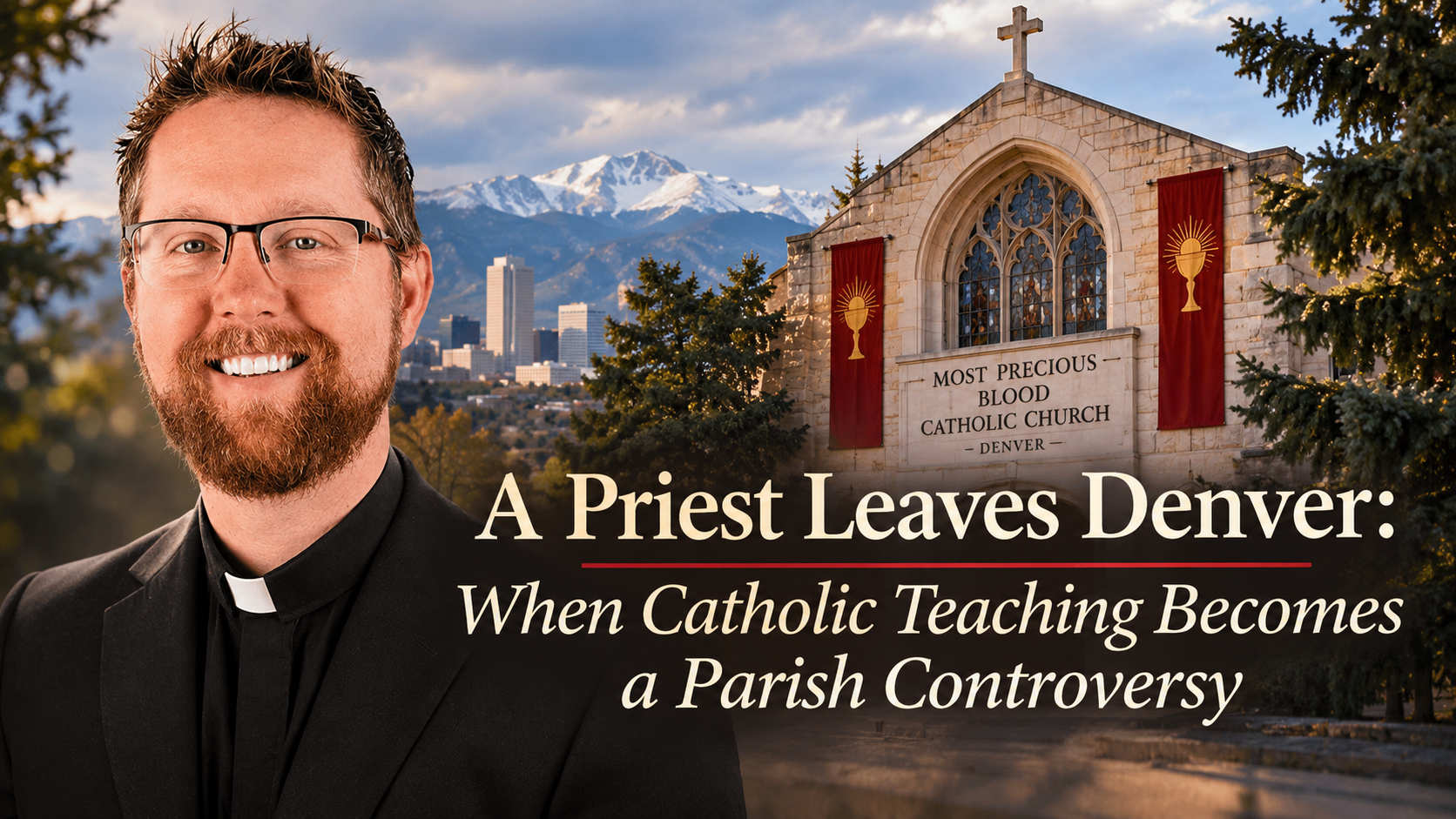
Fr Daniel Ciucci is preparing to leave Most Precious Blood after a bitter parish dispute. Nearly 900 people signed a petition alleging failures of pastoral leadership; the priest describes opposition to his preaching of Catholic doctrine. The facts must be examined without treating either allegation as already proved.
In August 2025, shortly after a petition challenging his leadership appeared, Fr Daniel Ciucci preached a homily to the congregation of Most Precious Blood Catholic Church, Denver, entitled Why Hell Is Welcoming. He argued that a parish could become so attached to its inherited sense of community that it forgot what the community existed for. Some parishioners, he said, complained that he and his assistant priest insisted upon speaking about sin. In November 2026 he announced that he would take a sabbatical after Christmas, with the prospect of another parish appointment in July 2027. The juxtaposition has prompted an obvious accusation: a priest has been made to leave because he preached the Catholic Faith. The evidence requires a closer examination. 1
Fr Ciucci became pastor in the summer of 2021. On 25 July 2025, an independent group of parishioners and school families began collecting signatures in a petition addressed to Archbishop Samuel Aquila. The organisers alleged declining morale, extensive changes of personnel, falling enrolment at the parish school and a breakdown of confidence in the pastor. Some complained that those who questioned his decisions had been ignored, belittled or subjected to retaliation. The petition, now closed, attracted 889 supporters. It does not establish that all its signatories were current parishioners or school parents, nor does it establish the truth of the allegations. 2
Their demands were specific: a diocesan listening session, an assessment of the pastor’s leadership and temporary pastoral assistance if required. When Archbishop Aquila responded in August, the petitioners publicly expressed dissatisfaction, saying that he had defended Fr Ciucci while failing to confront the complaints. The Archbishop apparently sought verifiable accounts from identifiable parishioners. The organisers replied that fear of retaliation had discouraged some from attaching their names to allegations. Their description of his reply is available; the complete original letter, although linked on the petition page, has not been independently extracted for this report. 3
The contemporary investigation by Elizabeth Hernandez, published in the Denver Post on 21 August 2025, clarifies the position of the then Archbishop in a way that later summaries have too often neglected. Aquila told the newspaper that he had “full confidence” in Fr Ciucci’s leadership and distinguished a digital petition from a formally presented grievance. His judgement did not prove the allegations false, still less extinguish the rights of anyone with a genuine complaint. It did establish that the bishop responsible for the priest’s appointment was publicly prepared to defend him after the campaign had begun. 12
Hernandez also reported an instructive admission from David Thomas, a former parishioner. Thomas described a “liberal schism” in Denver and directed his principal objection towards Archbishop Aquila, whose approach to Catholic parish life he considered unduly interventionist. He regarded Fr Ciucci as a consequence of the Archbishop’s policies. Thomas cannot be treated as speaking for the 889 signatories, but his testimony establishes that at least part of the controversy concerned who possessed authority to determine the religious character of Most Precious Blood. In an institution whose parishes exist within the particular Church entrusted to the diocesan bishop, that is hardly an incidental disagreement. 12
On 15 August 2025 the organisers claimed that almost the entire parish staff, more than half the school faculty and over a third of the pupils had left since Fr Ciucci’s arrival. Such figures would be serious if substantiated. The accessible federal Private School Universe Survey provides a starting point: the school reported 322 pupils in kindergarten to eighth grade in 2019–20 and 315 in 2021–22, with 23 teachers in each year. Those numbers predate the claimed later collapse. Several school-directory websites still display 315 as an ostensibly current figure, but appear simply to repeat the historical dataset. They cannot verify or disprove what happened between 2022 and 2026. The school and petition organisers have been asked for the intervening annual figures. 4
Even a verified departure does not explain its cause. Children move schools for many reasons; employees retire or pursue other appointments. Equally, a pattern of departures accompanied by credible evidence of intimidation or persistent disregard of legitimate concerns would be a serious failure of government. The Archbishop’s duty is to establish which explanation the evidence supports. An administrative allegation does not cease to matter because a priest’s theology is orthodox.
There is a detail in the organisers’ correspondence which has attracted rather less attention than the headline figures. They expressly acknowledged Fr Ciucci as a good man sincerely desirous of serving the parish. Their complaint concerned the way he exercised his authority. They also acknowledged that he had arranged parish listening sessions, though they wanted the Archdiocese to supervise a more structured process. The available petition therefore cannot accurately be described simply as a campaign against the Church’s doctrine. 5
The practical changes made by Fr Ciucci deserve more attention than the petition’s general language about trust. Reporting published in August 2025 described his decision to eliminate certain songs he considered unsuitable for Catholic worship, to prevent people from taking the consecrated Eucharist home and to remove artwork described as ‘feminist’ from the parish school. A March 2026 account by Religion News Service also recorded the changes to music and artwork, placing them within wider tensions between Archbishop Aquila’s appointments and some established parish cultures. The precise compositions and artworks have not been documented in the material examined for this report; their suitability cannot be assessed from the labels alone. The reported practice of taking the consecrated Host away from Mass requires a precise distinction. Redemptionis Sacramentum, no. 92, requires care that a communicant consume the Host in the presence of the minister. Canon 935 prohibits carrying the Blessed Sacrament about except where pastoral necessity and the bishop’s prescriptions justify it, as in authorised ministry to the sick. If the incidents concerned communicants departing with the Host for their own purposes, Fr Ciucci was right to stop them. The original reporting does not establish how many incidents occurred or whether any authorised ministers were involved; it would therefore be wrong to infer widespread profanation from the general description alone. 13 These tangible points of disagreement make it less satisfactory to describe the entire controversy as a personality clash. 12
A more substantial change preceded the petition altogether. In February 2025, Denver Catholic, the Archdiocese’s own publication, reported that the tabernacle at Most Precious Blood had been restored from an adjacent corner to the centre of the sanctuary. The request came from Archbishop Aquila during the National Eucharistic Revival, and Fr Ciucci presented it as both an architectural correction and a recovery of the parish’s Eucharistic identity. The parish’s own project notice independently confirms the Archbishop’s initiative. This was consequently no private liturgical enthusiasm of a newly appointed priest. It was a diocesan decision, implemented in a parish dedicated to the Most Precious Blood of Christ. 14
The same contemporary account reported that a planning group comprising parishioners, school parents and an interior designer had met repeatedly about the scheme. Hildegard Hethcote, a parishioner of twenty years, explained that she had initially doubted the wisdom of changing a familiar arrangement, but supported it after reading the pastor’s explanation; another passage in the report describes her response when she saw the completed sanctuary. The Archdiocese’s publication naturally presented the renovation favourably, and these testimonies do not establish universal approval. They do, however, contradict the convenient impression that Fr Ciucci’s entire tenure consisted of unilateral innovations rejected by an otherwise unanimous congregation. His central argument was that true parish communion receives its life from the Eucharist, an argument expressed in the sanctuary itself before it found sharper words in the August homily. 14
Nevertheless, opposition to Catholic doctrine also enters the record. In his homily following publication of the petition, Fr Ciucci said that some considered preaching about sin outdated, pessimistic and destructive of parish hospitality. He believed the dispute exposed an unwillingness to acknowledge the necessity of salvation. In his later video he spoke of the personal pain caused both by pastoral work and by reactions to his proclamation of the Gospel and decisions he regarded as necessary to preserve Catholic tradition and identity. He referred to teaching on contraception, marriage, the Eucharist, confession and the mercy of God as matters for which priests sometimes endure hostility. 1
Contemporary reporting supplies further indications that his preaching itself offended some parishioners. A former parishioner told the Denver Post that homilies concerning penance, guilt and damnation had contributed to his departure. Another reportedly complained of an Easter sermon in which Fr Ciucci described some users of parish services as ‘mooches’. It would be imprudent to pronounce judgement on the latter expression without the recording and its context. A priest may be right about the obligations of parish membership yet wrong in the manner he addresses those who neglect them. Equally, an uncomfortable sermon does not become false doctrine because its hearers are offended. 6
Canon 528 of the Latin Code of Canon Law obliges the parish priest to ensure that the word of God is proclaimed in its entirety, and that the faithful receive instruction in Catholic doctrine. Canon 529 requires him to know his people, visit those in difficulty and care for those whose practice has weakened. The duties are complementary. A parish is not a congregation licensed to select from Catholic teaching whatever sustains its customary social habits; neither is the pastor licensed to dismiss every objection to his conduct as resistance to the truth. 7
The petitioners invoked synodality when requesting a listening session. Consultation about the conduct of a school, the handling of grievances, pastoral accessibility and the communication of decisions is entirely proper. Canon 212 itself recognises that the faithful may and sometimes must express their concerns to pastors. But synodality cannot transfer to parishioners the authority to determine whether the Church ought to teach repentance, sacramental confession or the indissolubility of marriage. A pastor must consult prudently about the exercise of his ministry while remaining faithful to the doctrine that gives his ministry its purpose.
Nor can the matter be settled by declaring that a priest has a right to remain regardless of the state of the parish. Canon 522 provides for stability in the office of pastor. Canon 1740 nevertheless permits removal where his ministry has become harmful or ineffective, even without grave personal negligence. Canon 1741 names, among possible grounds, lasting aversion to the pastor among upright and responsible parishioners. The law then provides procedures for investigating the cause and protecting the priest’s rights. The number of signatures on an internet petition does not of itself satisfy those requirements, nor would the absence of personal misconduct automatically exclude a legitimate change of appointment. 8
That is why the description of Fr Ciucci as ‘removed’ is premature. No public decree of removal, formal canonical proceeding or finding of misconduct has been established. He has described a June 2026 meeting with Archbishop James Golka, installed as Denver’s Archbishop on 25 March, during which he became emotional while speaking about the pain he had been carrying. According to his own account, the Archbishop offered him a sabbatical as an opportunity for prayer and examination of his priesthood. He hopes to undertake a thirty-day Ignatian retreat and pilgrimage along the Camino de Santiago. A fresh parish assignment in July 2027 appears likely, but has not been presented as final. 19
There is a previous Denver story to which Nuntiatoria must refer, although it requires care. In October we examined Archbishop Golka’s request that Fr Chad Ripperger take a year away from public speaking and interviews. The Archdiocese called that arrangement voluntary, and confirmed the priest remained in good standing. Fr Ripperger’s specialised ministry and the reasons stated for his withdrawal differ materially from Fr Ciucci’s parish dispute. There is no demonstrated coordinated policy against doctrinally conservative clergy. Nevertheless, both cases raise a legitimate question concerning how an episcopal authority explains the scope and purpose of a priest’s prolonged withdrawal from accustomed work. 10
Our earlier treatment of priestly exhaustion is likewise relevant. A sabbatical may be a generous and necessary provision for a priest who has suffered. It must not be treated as disguised proof that he governed badly, or as proof that every criticism of him was malicious. Fr Ciucci’s wellbeing is a real pastoral concern. So is the ecclesiastical question of whether objections to his preaching were allowed to influence his prospects at Most Precious Blood. Those questions can coexist without being confused. 11
Fr Ciucci urged his parishioners to welcome their next priest, asked Catholics to support their clergy and declared that he bore no animosity towards anyone. That is a charitable conclusion to his own ministry at the parish. It does not establish why the relationship deteriorated, and it ought not become an excuse for others to avoid the unpleasant work of establishing the facts.
Nuntiatoria has sought comment from the Archdiocese of Denver, Fr Ciucci, the school principal and the petition organisers about the basis of the proposed change, the disputed staffing and enrolment figures and the role of doctrinal disagreements. No replies have yet been received or incorporated. Fr Ciucci’s original video has been identified, but the complete transcript has not yet been independently secured; the quoted statements in this article therefore rely upon identified contemporary reporting.
The question is what sort of accountability is expected in a Catholic parish. The faithful are entitled to competent, charitable government, and a bishop is obliged to investigate credible allegations of failure. Yet a priest’s fidelity to the Church’s teaching is an obligation of his office, and no amount of local dissatisfaction can alter it. The public record proves a sustained conflict and a priest preparing to leave with his Archbishop’s support. It does not prove either that his critics were right about his leadership or that the Church’s doctrine caused his departure. That unanswered distinction is precisely what Denver ought now to clarify.
FOOTNOTES
1. Fr Daniel Ciucci, “A Message of my Sabbatical & Reassignment”, November 2026; Fr Daniel Ciucci, “Why Hell Is Welcoming”, August 2025
2. MPB Independent Community Group, “Call for Accountability at MPB Parish and School”, 25 July 2025
3. MPB Independent Community Group, “Response Received and Next Steps”, 8 August 2025
4. ProPublica, “Most Precious Blood School: Private School Demographics”, NCES survey
5. MPB Independent Community Group, “Follow-Up Letter Delivered to Archbishop Aquila”, 15 August 2025
6. Elizabeth Hernandez, The Denver Post, 16 November 2026; LifeSiteNews, 18 November 2026
7. Code of Canon Law, canons 519–529; canon 212
8. Code of Canon Law, canons 1740–1752
9. Archdiocese of Denver, “Our Archbishop”
10. Nuntiatoria, “Fr Ripperger’s Year of Silence”, 20 October 2026
11. Nuntiatoria, “When Priesthood Becomes a Job”, 28 August 2026
12. Elizabeth Hernandez, “Petitioners challenge priest at Catholic church in Denver, alleging ‘loss of psychological safety’”, Denver Post, 21 August 2025; contemporary excerpts republished by Complicit Clergy, 25 August 2025; Ed Morrissey, HotAir, 25 August 2025; Religion News Service, “Denver’s Catholic archdiocese enters a new era”, 20 March 2026
13. Code of Canon Law, canon 935; Congregation for Divine Worship, Redemptionis Sacramentum, no. 92
14. Marie San Jose, “Most Precious Blood’s Renovation Puts Jesus in the Center Amid Eucharistic Revival”, Denver Catholic, 6 February 2025; Most Precious Blood Parish, “Recentering”


Leave a Reply