
How a linguistic achievement became a Protestant foundation myth
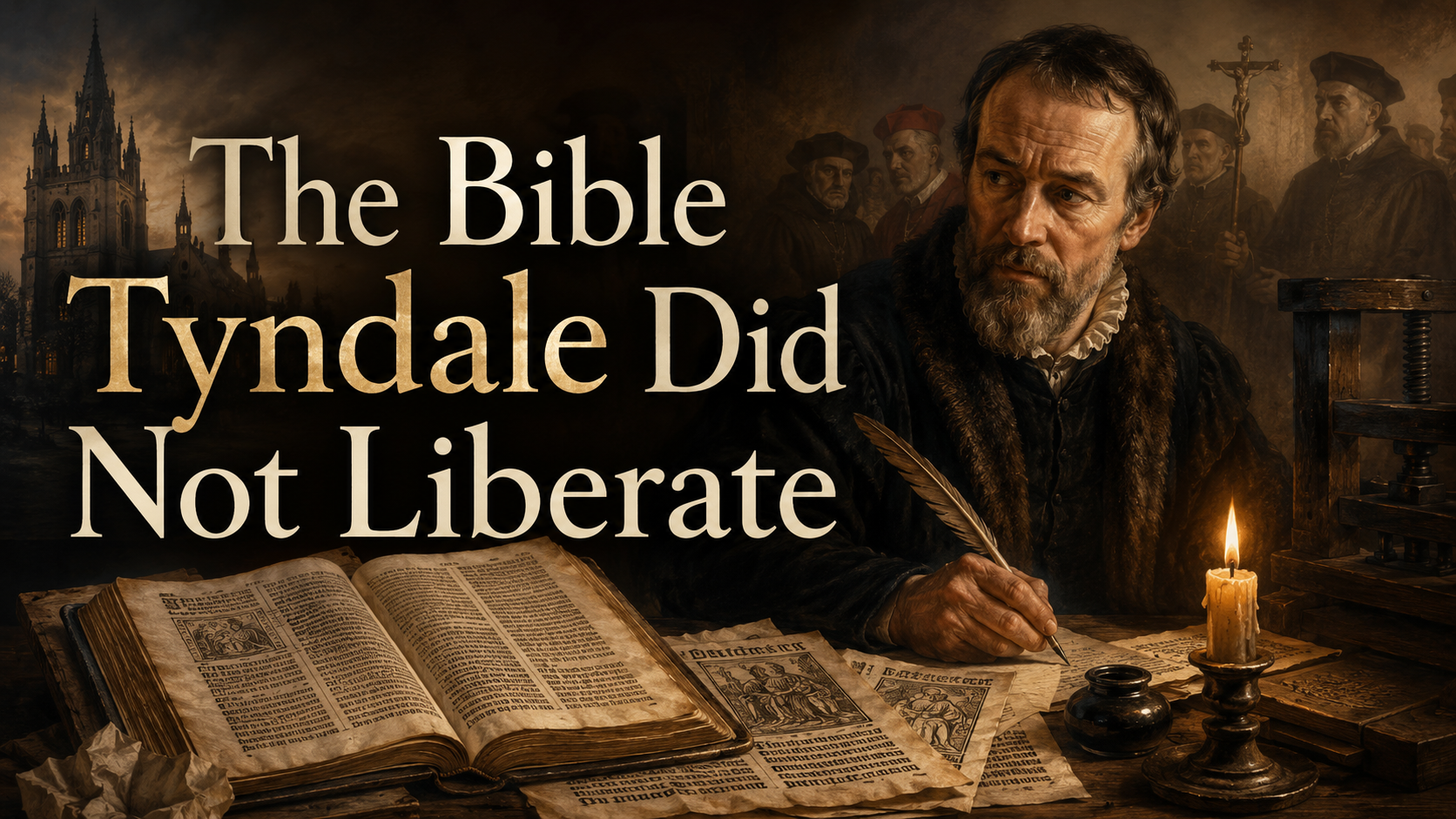
There are really two claims hidden inside the familiar celebration of William Tyndale, and they should never be confused. The first is that Tyndale exercised an extraordinary influence upon written English. That is substantially true. The second is that Tyndale liberated the Bible from a Catholic Church which had kept Scripture inaccessible to ordinary Christians until a brave Protestant translator finally placed the Word of God in their hands. That is something very different. Yet the first claim is repeatedly used to make the second seem equally unquestionable. BBC Radio 4’s recent Artworks programme, The Deadliest Book in England, presented by Susie Dent for the five-hundredth anniversary of Tyndale’s 1526 New Testament, provides an attractive example. We are invited to discover that the language of Tyndale supposedly surrounds us still: in the “signs of the times”, in Taskmaster, even in the ordinary word “landlady”. The linguistic story is fascinating. But around it hangs the shadow of one of the most successful foundation myths of the English Reformation: that before Tyndale there was a Bible which ordinary people could not understand, a Church determined to keep it that way, and a heroic translator hunted because he dared to let Englishmen read the Word of God for themselves.¹
Tyndale does not need that mythology to be important. David Crystal’s recent study of Tyndale’s influence on English demonstrates just how deeply his language entered subsequent biblical translation and, through it, the wider culture. Expressions first recorded in his writings became familiar English; much of the cadence and vocabulary of his New Testament survived into later translations, most famously the Authorised Version of 1611. But even the linguistic claim needs stating carefully. A word being first recorded in a surviving Tyndale text does not prove that William Tyndale invented it. Early sixteenth-century printing suddenly preserved language on a scale manuscript culture had not. Words already circulating orally may first become visible to the lexicographer because Tyndale happened to print them. His achievement was nevertheless immense: he possessed an exceptional ability to produce direct, memorable English whose rhythms endured. Catholics need neither begrudge nor minimise that. What we should resist is the curious assumption that admiration for Tyndale the English stylist obliges us to accept Tyndale the Protestant icon and, with him, the historical mythology constructed around his Bible.²
For the Bible did not arrive in England in 1526. Christianity had already inhabited England for nearly a millennium. Scripture permeated Catholic religious life long before Tyndale was born. Biblical texts and paraphrases existed in Old and Middle English; psalters and Gospel material circulated in the vernacular; Scripture was constantly heard within the Church’s liturgy, expounded and applied through preaching, incorporated into devotional books, contemplated in religious houses, retold in poetry and mystery plays, depicted in glass, wall painting and sculpture, and absorbed into the imagination of generations whose Christianity was profoundly biblical without resembling the later Protestant ideal of an individual sitting alone with a complete vernacular Bible. By the late fourteenth century complete English biblical translations associated with the Wycliffite tradition existed, and roughly 250 manuscripts from that textual tradition survive, many containing New Testaments, psalters or substantial portions of Scripture rather than complete Bibles. This is a remarkable survival for the age before printing.³
That does not mean there was unrestricted circulation of vernacular Bibles in late medieval England. There was not. But the reason matters. England had experienced Lollardy, a movement in which vernacular biblical interpretation became associated with serious doctrinal and ecclesiastical challenges. Archbishop Thomas Arundel’s Constitutions of the early fifteenth century consequently subjected new vernacular translations and their use to ecclesiastical control. Yet the often repeated claim that Arundel simply “banned the Bible in English” is false. English biblical texts continued to be possessed and used with permission by conventionally Catholic clergy and laity. Professor Lucy Wooding — significantly, one of the historians appearing in the BBC programme — has herself challenged the lingering effects of what she calls “triumphalist Protestant rhetoric” on this subject. Her research shows a much richer early Tudor biblical culture than the traditional Reformation narrative permits: English Bibles and New Testaments were possessed by orthodox Catholics, biblical excerpts abounded in devotional literature, the psalms circulated in English, and preaching, meditation and religious literature provided ordinary people with extensive exposure to Scripture.⁴
That distinction is crucial. To say that ecclesiastical authority regulated unauthorized translations after the experience of Lollardy is not remotely the same proposition as saying that the Catholic Church opposed Scripture being understood by laymen. Yet Protestant historiography gradually converted the former into the latter because it served an extraordinarily effective narrative. First create a dark medieval world in which priests possess the Bible and the people do not; then introduce the Reformer carrying the vernacular Scriptures like Prometheus bringing fire to humanity. Once the story has been framed that way, almost any restriction upon a particular translation becomes proof that the Church feared the Bible itself. The theological and political circumstances disappear. So does the awkward fact that Catholic humanists and churchmen could favour vernacular Scripture while simultaneously rejecting the theology being smuggled into England through Protestant translations.
Thomas More himself is particularly inconvenient for the mythology. More fiercely opposed Tyndale’s New Testament, yet he did not oppose vernacular Scripture in principle. Wooding notes that More argued instead for preventing the abuse of a good thing, distinguishing the desirability of English Scripture from the doctrinal use to which Tyndale and his allies were putting it. Henry VIII’s proclamation of 1530 likewise condemned existing translations as defective and accompanied by heretical material while envisaging an English translation produced by learned Catholic scholars when circumstances permitted. The eventual arrival of officially sanctioned English Scripture was therefore not a simple victory of Protestant enlightenment over Catholic obscurantism. It emerged from a far more complicated world in which Catholics, humanists, evangelicals, royal policy and competing understandings of ecclesiastical authority all played their part.⁵
And here we reach the question which the popular Tyndale story most often avoids. Translation is interpretation. There is no such thing as moving a complex ancient text from one language into another without making choices about meaning. That is especially true when the words being translated carry theological significance. Tyndale rendered ekklesia as “congregation” rather than the established “church”; presbyteros as “elder” rather than “priest”; agape as “love” rather than “charity”; and metanoia or its verbal form through the language of “repentance” rather than “penance”. More recognised immediately that these were not merely stylistic substitutions. They altered the vocabulary through which an English Christian encountered ecclesiology, ministry, sacramental life and the Christian moral order.⁶
The Catholic case must be made with precision here, because it is unnecessary and historically foolish to claim that Tyndale’s alternatives were simply impossible Greek. Ekklesia can certainly signify an assembly or congregation. Presbyteros unquestionably possesses the root meaning of elder. Metanoia concerns conversion or change of mind and heart. One can argue over the semantic range of agape and “charity”. Serious philological arguments therefore exist concerning each term. But that does not dispose of More’s objection; it actually reveals its depth. The question was not merely whether Tyndale could defend an individual English word with a Greek lexicon. It was why he systematically selected a particular cluster of words, what theological world those words constructed when taken together, and what Tyndale himself believed the Catholic terminology represented.
On that point the evidence is extraordinarily strong because Tyndale told us. His Answer unto Sir Thomas More’s Dialogue was not the work of a neutral translator surprised to discover that ecclesiastics had misunderstood his innocent lexical preferences. It was an extended theological controversy concerning the Church, Scripture, faith, the papacy, the Fathers and the sacraments. Even commentary published by the Tyndale Society acknowledges that More correctly recognised the ecclesiology implicit in Tyndale’s diction as a “decentralized, desacralized church”. Tyndale defended “congregation” against “church”, “elder” against “priest”, “love” against “charity”, “repentance” against “penance” and related choices because they corresponded to his understanding of Christianity. His translation and his Reformation theology were not two unrelated projects carried on at the same desk. The one expressed the other.⁷
Consider what happens when this is understood. “Church” does not merely denote a room or an aggregate of Christians. In Catholic theology it signifies a visible, divinely constituted society endowed with Apostolic authority, sacramental order and hierarchical continuity. Replacing it systematically with “congregation” does not automatically falsify every Greek sentence, but it can encourage the reader to imagine the Christian community differently. “Priest” carries centuries of sacramental meaning concerning ordination and sacrifice; “elder” naturally suggests office or seniority without necessarily carrying that sacerdotal content. “Penance” belongs to an ecclesial and sacramental world; “repentance” can be heard primarily as an interior disposition. Translate each word separately and one can debate lexicography. Put the choices together and something larger emerges: a different architecture of Christianity.
That is why it is inadequate to say that Catholic authorities simply feared people “understanding the Bible”. The real dispute was partly over what an English reader would be led to understand the Bible to mean. Tyndale was not removing interpretation so that the naked biblical text could finally speak for itself. He was mediating the text through an evangelical theological framework just as surely as he accused Catholic tradition of mediating it through another. Indeed, Wooding’s scholarship identifies a particularly revealing contradiction in the old Protestant story. Reformers proclaimed the clarity of Scripture and attacked Catholic mediation, yet in practice they themselves produced prefaces, commentaries, introductions and theological keys teaching readers how Scripture ought to be understood. Tyndale did not simply hand readers a neutral text and disappear. He taught them how to read it.
There lies an important Catholic response to the slogan of “the Bible for the people”. The question has never been whether Christians should know Scripture. Of course they should. The question is whether Scripture was ever intended by Christ to function as an autonomous authority detached from the Apostolic Church. The New Testament did not fall completed from heaven. It arose within the Church, was received and discerned within the Church, copied and transmitted by the Church, proclaimed within her worship, defended against heretical readings, expounded by her Fathers and handed from generation to generation within her living Tradition. The Church is not an obstacle standing between the Christian and the Bible. She is the historical community within which the Bible was received as Scripture in the first place.
Pope Leo XIII stated the Catholic understanding with admirable clarity in Providentissimus Deus. Far from regarding Scripture as dangerous, he called for its abundant study, urged clergy to immerse themselves in it, celebrated the biblical learning of the Fathers and Doctors and recalled the enormous place occupied by Scripture in the Divine Office, preaching, monasteries, cathedral schools and Catholic theology. Yet he simultaneously insisted that God had delivered the Scriptures to the Church so that Christians might use her as their “guide and teacher”. That is precisely the point the Reformation controversy exposed. Catholicism does not oppose the Word of God to the Church because the same Christ who gave the Apostolic Faith gave the Church commissioned to preserve and teach it.⁸
The consequences of abandoning that principle did not take long to emerge. The Reformation promised that the pure Word, freed from corrupted ecclesiastical mediation, would restore authentic Christianity. Yet removing Rome did not leave one self-evident biblical faith behind. Protestants divided among themselves over Baptism, the Eucharist, predestination, justification, ecclesiastical government, ordination, liturgy, perseverance, the relation between faith and works, and eventually even the contents and status of parts of the biblical canon. Luther, Zwingli and their successors could read the same New Testament and arrive at profoundly incompatible accounts of the Eucharist. Every party appealed to Scripture. Every party believed that the others had misunderstood it. The problem Thomas More perceived therefore outlived both More and Tyndale: if Scripture alone is the final doctrinal court of appeal, who decides between incompatible interpretations of Scripture when every litigant claims the authority of the same judge?
That question is not answered by saying that the Bible is clear, because the existence of the disagreement is the very phenomenon requiring explanation. Nor is it answered by saying that the Holy Ghost guides the sincere reader, unless one is prepared to attribute mutually contradictory doctrines to the Holy Ghost. The multiplication of Protestant confessions did not occur because Protestants stopped reading Scripture. It occurred among people who often read it intensely. The historical result of removing an authoritative interpreter was not the disappearance of interpretation. It was the multiplication of interpreters.
The story of Tyndale’s death likewise deserves history rather than catechetical mythology. He did not die because an English policeman discovered him giving an English New Testament to a ploughboy. Tyndale left England and spent years on the Continent, where he translated, revised and published not only Scripture but explicitly evangelical controversial works. Betrayed by Henry Phillips in the Netherlands, he was arrested by imperial authorities in 1535, imprisoned at Vilvoorde, tried for heresy in 1536 and condemned. He was strangled before his body was burned. His relationship with Henry VIII’s government was itself complicated: Tyndale had angered Henry, not least through his opposition to the King’s attempt to dissolve his marriage, while Thomas Cromwell later attempted to intercede for him. Whatever judgement one makes about the cruelty of sixteenth-century religious punishment, this was plainly more complicated than the slogan that “the Catholic Church burned Tyndale for translating the Bible into English”.⁹
Nor should Catholics feel any obligation to defend the savagery of his execution merely because we reject his theology. Religious coercion in the sixteenth century could be terrible, under Catholic and Protestant rulers alike. Truth does not require sentimentalising cruelty. But neither does cruelty make every proposition held by its victim true. A violent death does not retrospectively convert a controversial theological translation into a religiously neutral one. Still less does it prove that Catholicism feared Scripture. In the Catholic understanding, martyrdom is witness to the true Faith unto death; it is not simply the fact of being killed for sincerely held religious opinions.
There is nevertheless a historical irony worth savouring. Tyndale lost his life, but much of his English won. His language passed into subsequent translations and exercised enormous influence over the Authorised Version. English Christianity consequently inherited many of his cadences even where later translators reversed some of his most controversial terminology: “church” returned prominently; “charity” survived; Tyndale’s linguistic descendants were not obliged to retain every doctrinally freighted choice he had made. Five hundred years later, St Paul’s Cathedral possesses one of only three surviving copies of the first edition of his 1526 New Testament and is displaying it in its current exhibition, A Dangerous Calling: 500 Years of William Tyndale’s New Testament, continuing until February 2027. It deserves to be seen. It is one of the consequential books of English history.¹⁰
But consequence is not the same thing as sanctity, and literary greatness is not theological innocence. That is precisely where so many modern treatments of Tyndale go wrong. They begin with something genuinely impressive — his English — and allow admiration for the prose to authenticate an entirely different historical proposition: that he liberated Scripture from Catholic captivity. Yet medieval and early Tudor Catholic England already knew Scripture extensively. English biblical texts existed before Tyndale. Orthodox Catholics possessed them. Catholic humanists promoted biblical scholarship. Thomas More himself distinguished opposition to Tyndale’s use of Scripture from opposition to vernacular Scripture as such. What Tyndale introduced was therefore not “the Bible” into a country previously deprived of it. He introduced a particular translation at the beginning of a religious revolution, accompanied by a theology which challenged the meaning of Church, priesthood, sacrament and authority.
And perhaps this gives the title The Deadliest Book in England a meaning more interesting than the BBC intended. The truly explosive quality of Tyndale’s New Testament was never simply that ordinary Englishmen could understand its sentences. The revolutionary power of translation lay in the fact that changing the English words through which men encountered Scripture could also change the theological world in which they understood it. Vocabulary could make ecclesiology appear to arise directly from the biblical text. A translation could do the work of a commentary without announcing itself as one. The reader could believe he had escaped interpretation at precisely the moment he had entered somebody else’s.
William Tyndale therefore deserves neither caricature nor canonisation. He was a brilliant English stylist, an immensely consequential translator and a formidable Protestant controversialist. Catholics lose nothing by acknowledging the first two facts. But historical honesty requires the third. He did not discover the Bible for an England abandoned by Catholicism in scriptural darkness, and the controversy surrounding his work cannot be reduced to frightened priests trying to stop ordinary people understanding God’s Word. It was a struggle over something far deeper: whether Scripture was to be received within the Apostolic Tradition and interpreted within the visible Church, or placed over against that Church and made the instrument by which her doctrine, priesthood and authority would themselves be judged and reconstructed.
Five hundred years later, the old liberation myth remains remarkably potent because it flatters the assumptions of the modern world: authority obscures, institutions corrupt, mediation enslaves, while individual access sets us free. Tyndale becomes compelling precisely because he can be made into the patron saint of that story. But the history refuses to remain so tidy. The Bible was already there. The vernacular was already there. Catholic biblical devotion was already there. What arrived with Tyndale was something else as well.
The most dangerous thing about his New Testament was not that it was English.
It was that a new theology could enter England wearing the words of Scripture.
¹ BBC Radio 4, Artworks: The Deadliest Book in England, 18 August 2026.
² David Crystal, William Tyndale and the English Language, Bodleian Library Publishing, 2026.
³ Lucy Wooding, “Encountering the Word of God in Early Tudor England,” The English Historical Review, vol. 136, no. 581, 2021, pp. 836–866.
⁴ Wooding, “Encountering the Word of God in Early Tudor England.”
⁵ Wooding, “Encountering the Word of God in Early Tudor England,” especially her discussion of More, the 1530 proclamation and the Great Bible.
⁶ Robin G. Everitt, “Tyndale’s Translation and Theology,” Tyndale Society Journal.
⁷ William Tyndale, Answer to Sir Thomas More’s Dialogue; introductory commentary by Sr Anne O’Donnell SND, Catholic University of America, Tyndale Society.
⁸ Pope Leo XIII, Providentissimus Deus, 18 November 1893, especially §§2, 6 and 14.
⁹ Hertford College, University of Oxford, “William Tyndale (1494–1536).”
¹⁰ St Paul’s Cathedral, A Dangerous Calling: 500 Years of William Tyndale’s New Testament, 5 June 2026–27 February 2027.



Leave a Reply