
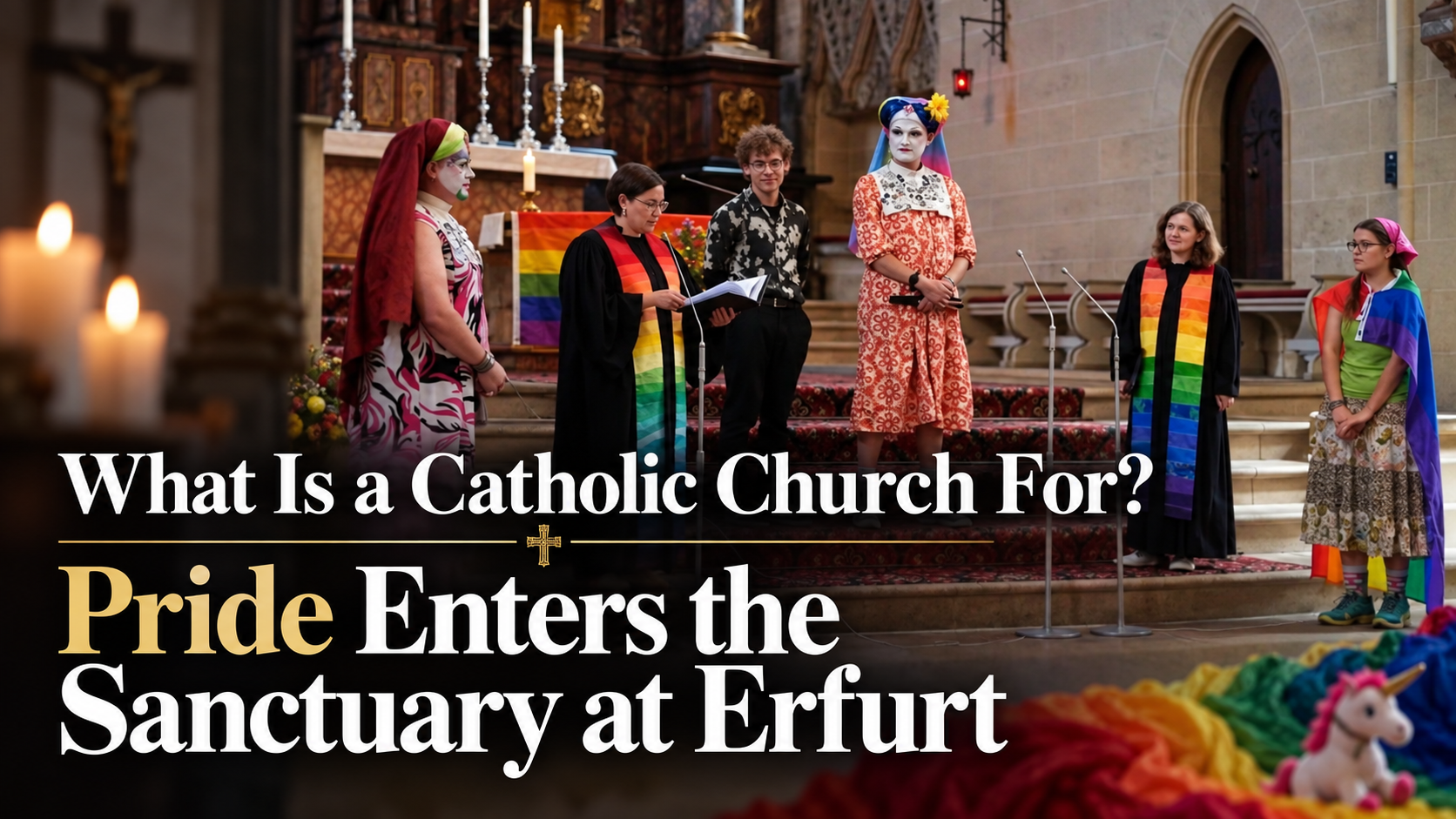
An ecumenical service expressly organised for Christopher Street Day was held inside the Catholic church of St Severi in Erfurt before participants processed to the city’s Pride gathering. Forty years ago, the Congregation for the Doctrine of the Faith specifically warned bishops about religious services and the use of Catholic church buildings by groups whose purposes contradict Catholic teaching. Erfurt therefore raises a question considerably more serious than rainbow flags, costumes or ecclesiastical bad taste. What does it mean for a place to be sacred if the Church herself allows it to become part of a ceremonial programme serving an anthropology she cannot profess?
At noon on Saturday 5 September 2026, St Severi in Erfurt — the great Catholic church standing beside the Cathedral of St Mary — hosted what the Catholic parish of St Laurentius advertised plainly as a “CSD Ökumenischer Gottesdienst”: an ecumenical service for Christopher Street Day. Another ecclesiastical notice supplied the rest of the sequence. Catholic and Protestant clergy from Erfurt and other participants would conduct the service under the theme “Empowerment & Resilienz”; afterwards, “there will be a procession to the CSD.” The city’s Christopher Street Day demonstration subsequently gathered on the neighbouring Domplatz. Police recorded approximately 3,000 participants and reported that its procession through central Erfurt began at 1.45 p.m.¹
There is consequently little room for semantic escape. Christopher Street Day is the German form of Pride. This was not an ordinary ecumenical service which happened to coincide with a demonstration elsewhere in the city. It was advertised as a CSD service, and its participants were expressly invited to process afterwards to the CSD itself.
Nor was the event politically indeterminate. Contemporary local reporting described the Erfurt CSD as “above all a political event” and recorded demands including the expansion of queer structures, queer-inclusive healthcare, compulsory queer-sensitive education in schools, professional training and the further institutional recognition of sexual and gender identities.² The point is not that everyone entering St Severi necessarily subscribed personally to every proposition advanced from the Domplatz. The point is that the religious observance was deliberately attached to a movement possessing an identifiable moral, social and political programme.
The photographs publicised by Chris Jackson at Hiraeth in Exile naturally made the story travel. Rainbow material appeared within the church; a unicorn arrangement became the most memorable image; Jackson described some of those present as dressed in drag or clown-like clothing.³ These things are startling inside a Catholic church. They are nevertheless not the heart of the matter.
Take away the unicorn. Take away the costumes. Remove every rainbow decoration.
The essential fact remains: an active Catholic sacred building was incorporated into the religious programme of Pride.
St Severi cannot be dismissed as an obsolete church hired as an atmospheric civic venue. On the following morning, Sunday 6 September, a Catholic Mass was celebrated there and broadcast by MDR Kultur. The Diocese of Erfurt had announced it in advance; the Catholic city parish of St Laurentius participated with the Bonifatiuswerk, and Monsignor Georg Austen preached.⁴ The building which housed the CSD service on Saturday housed the Holy Sacrifice of the Mass on Sunday.
Catholic teaching addressed the underlying problem with remarkable precision forty years ago. In 1986, the Congregation for the Doctrine of the Faith, under Cardinal ✠Joseph Ratzinger and with the approval of Pope St John Paul II, issued its Letter to the Bishops of the Catholic Church on the Pastoral Care of Homosexual Persons. The document condemned malicious speech, violence and unjust discrimination against homosexual persons and called for genuine pastoral solicitude. Then it turned to a danger which bears directly upon Erfurt.
Bishops were instructed to pay particular attention to religious services and the use of Church buildings by groups whose activities conflicted with Catholic teaching. Permission which appeared superficially generous or charitable could, the Congregation warned, become “misleading and often scandalous.” Its pastoral principle was devastatingly simple: “Only what is true can ultimately be pastoral.”⁵
That is difficult to improve upon.
The CDF did not imagine that fidelity to Catholic moral teaching required contempt for homosexual persons. It required the opposite. Genuine pastoral care meant prayer, friendship, sacramental life, spiritual counsel, conversion and the pursuit of holiness. What it refused was the substitution of institutional affirmation for pastoral charity, particularly where Catholic premises concerning human sexuality were being displaced by those of organised movements outside the Church.
The distinction remains the one contemporary Catholic discussion most often tries to evade. The Catechism teaches that those experiencing homosexual inclinations must be treated with respect, compassion and sensitivity and protected from unjust discrimination. In the same treatment it teaches that homosexual acts cannot be approved and calls homosexual persons, like every Christian according to his state in life, to chastity.⁶ These are not rival teachings between which a pastor must choose. They belong to one Christian account of charity, because respect for the person includes respect for the truth about the good for which that person was created.
A homosexual man or woman entering St Severi to pray is therefore not the difficulty. The church doors should be open. Christ receives sinners, or none of us could approach Him. A person should be able to kneel there, hear the Gospel, seek counsel, confess, struggle, fail, repent, begin again and receive the supernatural means by which Christian holiness is actually attained.
Something different occurs when the sacred building itself becomes part of the ceremonial expression of a movement.
Nuntiatoria has been examining for some time the increasingly important distinction between doctrine remaining formally intact and doctrine continuing to determine ecclesiastical practice. In “What Takes Priority? Leo XIV, Sexual Morality and the Synodal Reordering of Moral Emphasis”, we considered Pope Leo XIV’s language about justice, equality and freedom taking priority over the particular sexual controversy about which he had been questioned. The concern was not that Leo had repudiated Catholic sexual morality. He had not. It was that doctrine can remain formally affirmed while becoming progressively less determinative of pastoral decisions.⁷
Erfurt provides a concrete illustration of why that matters. Nobody has to remove paragraphs 2357–2359 from the Catechism. Nobody has to announce a new doctrine of human sexuality. The pastoral and institutional life of the Church can simply proceed as though the older teaching no longer has sufficient weight to prevent a Catholic sanctuary being integrated into Pride.
The mechanism is already familiar. At Holy Apostles, Pimlico, examined in “‘We Have Moved On’: Cardinal Radcliffe and the Mass That Betrayed Fiducia Supplicans”, the decisive fact was not that two men in a same-sex partnership had attended Mass. The Eucharistic celebration itself was arranged around the fiftieth anniversary of their relationship. The reason for gathering, intercessions, preaching and final blessing communicated an ecclesiastical meaning which the Church’s formal moral doctrine could not supply. The Catechism had not changed. The ceremony had begun teaching as though something else had.⁸
That is why sacred space matters. A church is not mute architecture. Its altar teaches. Its tabernacle teaches. Its crucifix teaches. The sanctuary, orientation, sacred images, gestures, processions and ceremonial use of the building all communicate what Catholics believe without requiring a theological lecture to accompany them.
The same principle applies when the subject is sexual anthropology rather than Eucharistic theology. Once St Severi becomes the place from which worshippers process to Pride after an explicitly CSD-labelled religious service, the building participates symbolically in the event. Sacred place lends religious meaning to what begins there.
Canon law treats that meaning objectively. Canon 1205 defines sacred places as places designated for divine worship or the burial of the faithful through dedication or blessing. Canon 1210 provides that only things serving or promoting worship, piety or religion are permitted there and that whatever is inconsistent with the holiness of the place is forbidden. Even another use exceptionally authorised by the Ordinary may not be contrary to that holiness. Canon 1220 correspondingly requires those responsible for churches to exclude whatever is inappropriate to their sacred character.⁹
Calling an event a Gottesdienst cannot answer the canonical question. The fact that clergy participate in something does not by itself prove its conformity with Catholic religion. The relevant question is whether a religious observance explicitly associated with a movement promoting propositions about sexuality, gender and identity which Catholic doctrine cannot receive is consonant with the objective holiness of a Catholic sacred place.
Precision remains necessary. We have found no evidence establishing that Bishop ✠Ulrich Neymeyr personally devised the service or approved its individual details. Nor can an outside commentator simply pronounce that St Severi was technically “violated” according to canon 1211; that canon itself makes the relevant judgement depend upon the local Ordinary. Neither caution weakens what is already established. A Catholic parish advertised the CSD service. Catholic clergy participated. An active Catholic church hosted it. Participants were expressly invited to process afterwards to CSD.
The wider diocesan context makes the event less easy to dismiss as an isolated lapse. The Diocese of Erfurt maintains an official “Queersensible Pastoral” programme which presents lesbian, gay, bisexual, transgender, intersex and queer identities within its pastoral framework, links to the German Synodal Way’s call for a magisterial re-evaluation of homosexuality and supplies material concerning blessing ceremonies for couples.¹⁰ Pastoral outreach to people using those categories is not objectionable merely because those people exist or because the Church wishes to hear them. A Catholic diocese must pastor the people who actually live within it.
The question is what the pastoral activity is for.
Ratzinger’s 1986 formulation supplies the answer. Only what is true can ultimately be pastoral. Accompaniment which becomes unable to name the destination is no longer Christian accompaniment. Compassion which requires the Church to conceal her judgement about the moral good ceases to be a form of charity and becomes acquiescence.
This also bears directly upon the argument developed in “Christianity Is Right ~ Not Right Wing”. Catholic teaching concerning marriage, sexual complementarity, biological sex, chastity and parental authority did not originate in modern conservative politics. Neither did the Christian prohibition of contempt or injustice originate with the political Left. Catholicism has its own moral grammar, rooted in Creation, natural law, Revelation and man’s supernatural destiny.¹¹
That matters because moral opposition to Pride ideology is now routinely neutralised by political classification. Uphold marriage as the union of man and woman and the position becomes “right-wing”. Defend the reality of biological sex and it becomes a culture-war stance. Insist upon chastity and the argument is redescribed as exclusion. Once the political label has been attached, the underlying Catholic proposition scarcely needs to be examined.
The reverse process then operates ecclesiastically. “Empowerment”, “resilience”, “visibility”, “inclusion” and “queer-sensitive pastoral care” arrive as humanitarian vocabulary rather than theological propositions. Each word can describe something genuinely good in an appropriate context. Yet the language cannot postpone indefinitely the questions Catholic theology must actually answer. What is a man? What is a woman? What is marriage? What is the sexual faculty for? Does biological sex belong to the created order or principally to personal identity? Is chastity obligatory? Can a relationship founded upon conduct the Church judges objectively immoral become an object of ecclesiastical celebration?
No amount of benevolent vocabulary settles those questions.
There is also a revealing contrast in the Church’s present treatment of Tradition. It should be stated without caricature. The SSPX episcopal consecrations at Écône on 1 July raised serious canonical questions, and Nuntiatoria has never pretended otherwise. In “Crisis is the Cause; Necessity is the Effect” we insisted that the Society must demonstrate not merely a grave ecclesiastical crisis but the necessity and proportionality of the remedy it chose.¹²
Equally, “Attendance Is Not Schism: Rome, the SSPX and the Canonical Rights of the Laity” insisted that canonical precision must operate in both directions. A layman is not made a schismatic by rhetorical association. Intention, formal adherence, personal responsibility and the actual canonical definition of schism cannot simply be replaced by collective denunciation.¹³
The point at Erfurt is not that an SSPX episcopal consecration and a CSD service are equivalent canonical acts. They are not.
The contrast concerns ecclesiastical instinct.
Where Tradition is involved, outward acts are recognised as densely meaningful. A consecration means something. Canonical affiliation means something. Attendance may be scrutinised for what it signifies about communion. Liturgical behaviour can disclose an ecclesiology. External actions are capable of carrying objective theological consequences regardless of the intentions claimed by those performing them.
Then a Catholic sanctuary becomes part of the programme of Pride, and suddenly the meaning of outward action seems strangely elusive. The service is pastoral. The rainbow is welcoming. The procession is inclusive. The ideological programme outside is treated as though it casts no interpretative light upon the religious event inside.
One is expected to believe that the Church’s external actions are densely theological when policing Tradition and almost semantically empty when accommodating the sexual revolution.
That cannot hold.
If sacred signs communicate ecclesial meaning at Écône, sacred signs communicate ecclesial meaning at Erfurt. If communion possesses objective content in one controversy, Catholic moral doctrine possesses objective content in another. Authority cannot insist that actions speak when disciplining traditionalists and then retreat into an examination of benevolent intentions when Catholic sacred space is employed in the ceremonial orbit of Pride.
There is another Nuntiatoria argument which Erfurt brings into unexpectedly literal form. In “When ‘Catholic’ Ceases to Qualify” we asked what remains of Catholic institutional identity when the word “Catholic” ceases to impose any meaningful qualification upon the institution carrying it.¹⁴ The same problem now presents itself architecturally.
If “Catholic church” merely means a church owned by Catholics, its use can be determined almost entirely by administrative permission. If the adjective actually qualifies the noun, however, then the building has an identity prior to the preferences of whoever currently controls its diary. Consecration has already said what the place is for.
This is why canon 1210 matters more than any photograph. Sacredness establishes a limit. The church belongs to God in a manner which distinguishes it from an auditorium, meeting room, theatre or civic hall. The parish priest administers it; the bishop governs its ecclesiastical use; neither creates its sacred character from nothing. Their authority presupposes the thing they govern.
A culture incapable of understanding sacredness will inevitably understand objections to Erfurt as objections to people. That is the mistake. The sacred boundary protects people precisely because it protects the truth towards which Catholic pastoral care is ordered. A church which refuses to celebrate adultery does not therefore hate adulterers. A church which cannot ritualise Pride does not therefore despise homosexual persons. The confession of sin, absolution of sinners and entire sacramental economy of Catholicism make sense only because the Church can distinguish unconditional love for persons from unconditional approval of their acts.
The contemporary temptation is to erase that distinction selectively. Nobody proposes celebrating avarice in the sanctuary as an act of welcome towards the greedy. Cruelty does not acquire a pastoral liturgy because cruel people must not be excluded from church. Pride ideology receives a different treatment because modern culture has transformed sexual identity from a matter of conduct and inclination into a privileged account of personhood. Once that anthropology is admitted, refusal to affirm the identity can appear indistinguishable from rejection of the person.
Catholic anthropology cannot accept the premise. The human person is not reducible to sexual desire, still less to an identity constructed from it. Man receives his nature before he describes himself. The body signifies. Sex is given rather than invented. Freedom finds its perfection in the good rather than in limitless self-definition. Grace heals and elevates nature; it does not abolish it.
That is why this controversy is ultimately about considerably more than homosexuality.
It concerns whether the Church still receives a created order which she has no authority to reconstruct.
The danger becomes acute when contradictory assumptions reach worship and sacred space, because the Church then begins to speak two languages at once. Her Catechism may continue to teach chastity, sexual complementarity and the natural institution of marriage while pastoral structures, public ceremonies and ecclesiastical buildings communicate something materially different. Formal doctrine survives; operative doctrine migrates elsewhere.
No decree announcing revolution is required.
Practice can teach before doctrine catches up.
Our Lord’s words after cleansing the Temple therefore belong at the centre of this question rather than at its decorative conclusion: **“My house shall be called the house of prayer.”**¹⁵ The text does not mean that sinners may not enter. Christ received sinners. It identifies ownership and purpose.
The house is His.
That is what consecration means. The altar does not belong to the zeitgeist. The sanctuary is not a neutral platform upon which successive cultural movements may receive religious recognition. Catholics genuflect when they enter because the place is not ordinary. The Blessed Sacrament is reserved there because the building is not interchangeable with a civic hall. Sacred vessels are not ordinary cups; vestments are not ordinary clothes; liturgy is not ordinary theatre. Catholicism depends upon distinctions between things set apart for God and things belonging to common use.
The unicorn, costumes and rainbow decorations will dominate social-media discussion because an image compresses scandal efficiently. They should not be permitted to trivialise what happened.
The decisive question is not whether the display was vulgar enough, absurd enough or provocative enough to offend Catholic sensibilities.
It is whether a Catholic church may be made the religious vestibule of a movement whose anthropology the Catholic Church cannot profess — and whether the word “pastoral” is now expected to make that contradiction disappear.
If it can, the problem is larger than Pride at St Severi.
It is whether sacredness itself still has objective content.
¹ “CSD Ökumenischer Gottesdienst” — Pfarrei St Laurentius Erfurt; “Gottesdienst zum CSD in Erfurt” — Gehörlosen- und Schwerhörigenseelsorge in Mitteldeutschland; “Erfurter Polizei zieht positive Bilanz zum Polizeieinsatz am 05.09.2026” — Landespolizeiinspektion Erfurt.
² “‘Seid laut, richtig laut’ – Erfurts CSD war größer denn je” — t.akt Magazin, 9 September 2026.
³ “Diocese of Erfurt Hosts Ecumenical Clown Drag Rainbow Service Inside St. Severi Catholic Church. Meanwhile, the SSPX is in ‘Schism.’” — Hiraeth in Exile, 8 September 2026.
⁴ “Keiner soll alleine glauben” — Diocese of Erfurt, 20 August 2026.
⁵ Congregation for the Doctrine of the Faith, Letter to the Bishops of the Catholic Church on the Pastoral Care of Homosexual Persons, 1 October 1986.
⁶ Catechism of the Catholic Church, §§2357–2359.
⁷ “What Takes Priority? Leo XIV, Sexual Morality and the Synodal Reordering of Moral Emphasis” — Nuntiatoria, 7 September 2026.
⁸ “‘We Have Moved On’: Cardinal Radcliffe and the Mass That Betrayed Fiducia Supplicans” — Nuntiatoria, 1 July 2026.
⁹ Code of Canon Law, cann. 1205–1222.
¹⁰ “Queersensible Pastoral” — Diocese of Erfurt.
¹¹ “Christianity Is Right ~ Not Right Wing” — Nuntiatoria, 8 September 2026.
¹² “Crisis is the Cause; Necessity is the Effect” — Nuntiatoria, 6 September 2026.
¹³ “Attendance Is Not Schism: Rome, the SSPX and the Canonical Rights of the Laity” — Nuntiatoria, 3 July 2026.
¹⁴ “When ‘Catholic’ Ceases to Qualify: Leo XIV, Freemasonry and the First Jewish President of the Catholic Biblical Association” — Nuntiatoria, 18 August 2026.
¹⁵ St Matthew 21:13 — Douay-Rheims Bible.



Leave a Reply