
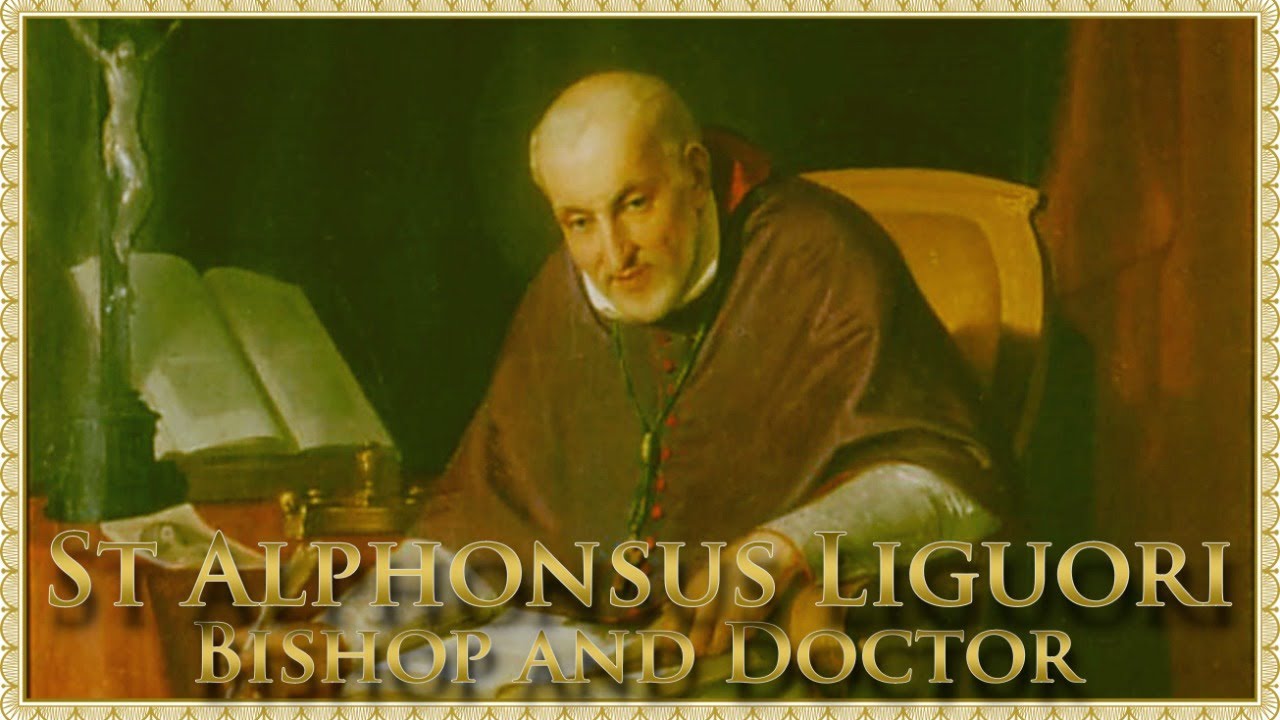
St. Alfonso de Ligouri/Tenth Sunday after Pentecost
Today we celebrate the feast of St. Alfonso de Ligouri, as well as commemorating the Tenth Sunday after Pentecost. St. Alfonso de Ligouri was born in Naples at the end of the seventeenth century. He initially trained as a lawyer and seemed on course for a successful legal career. However, after losing a legal case on one occasion, he decided to abandon his earlier worldly ambitions and instead pursue a vocation for ordination. As a priest he was noted for his sanctity of life, his asceticism and his charity. Drawn to ministry among both the urban and rural poor, he founded the Redemptorist order, modelled on the example of those first disciples who were sent out to proclaim the Kingdom of God in the towns and villages in first century Palestine. He is said to have made a vow never to waste any time, and his life was a productive one. He was noted for his direct preaching style. He wrote works of moral theology, in which he sought to steer a middle course between excessive rigorism and excessive laxity. He was mindful of the principle that the salvation of souls is the highest law, and that the Sabbath is made for man and not man for the Sabbath. He also wrote many devotional treatises and hymns, many of which are still in use today such as “O bread of heaven within the veil Thou dost my very God conceal.” After he was consecrated a bishop he was not overcome by delusions of grandeur about his new position, but continued to live as one who was a servant of the servants of God. Despite ill health his life was a long one and he died in 1787.
It is appropriate that today’s Gospel is from St. Luke’s account of the sending out of the seventy two into the towns and villages, since the Redemptorist order took this example as its model. The disciples were sent out as sheep among wolves. The harvest was plentiful, but the labourers were few and they were to pray the lord of the harvest to send out labourers into his harvest. They were to travel light and not to waste time. They were to be entirely devoted to the proclamation of the Kingdom of God. The Kingdom, future in its fullness, when God’s will would finally be done on earth as it is in heaven, was now present in the person of Jesus himself, in his words and mighty works. His coming was the coming of the Kingdom of God to men, whether they would hear or whether they were to forbear, as the prophet Ezekiel had put it. To accept him was to accept God, to reject him was to reject God. Consequently, the same applied to the disciples who were sent out in his name. To receive them was to receive Jesus, to reject them was to reject Jesus. Time was short and eternity pressed near. Their response to the proclamation of the coming of the Kingdom of God in the person of Jesus would determine their eternal destiny.
In his second epistle to St. Timothy (which we heard today) St. Paul exhorts him to be strong in the grace which is in Christ Jesus. “Labour as a good soldier of Christ Jesus. No man being a soldier of God, entangleth himself in worldly business: that he may please him to whom he hath engaged himself. For he also that striveth for mastery, is not crowned, except he strive lawfully. The husbandman that laboureth must first partake of the fruits.”
St. Timothy had been St. Paul’s most trusted companion. Whereas the apostle had often quarrelled with his fellow missionaries it seems that he remained on good terms with St. Timothy to the end. In this second epistle to St. Timothy he writes as one conscious that his life may soon be drawing to a close. He had fought the good fight. He had finished the course. He had kept the faith. Others had deserted him and only St. Luke remained with him. He therefore wrote to St. Timothy encouraging him to be faithful and persevere, labouring as a good soldier in Christ Jesus. It was important to remain focused and not to lose sight of the crown of eternal life which the Saviour had promised not only to him, but to all who love his appearing.
Though St. Alphonsus had a long and productive life it was not an easy one. Like St. Paul he was constantly beset by trials and tribulations, but, by the grace of God, he persevered and in the end he prevailed. Let us pray for grace to persevere in the face of adversity in our own time and place, that in the end, we too, like St. Alphonsus and St. Paul, may hear that most joyful voice, “Well done, thou good and faithful servant.”
Let us make our own the words of today’s Collect:
“O God who, through the burning zeal of the salvation of souls of blessed Alphonus Mary, thy confessor and bishop, didst enrich thy church with fresh offspring: grant, we beseech thee, that imbued with his wholesome doctrine, and strengthened by his examples, we may, by thy grace, come happily unto thee.
by the Revd Dr Robert Wilson PhD (Cantab), Old Roman Apostolate UK





Leave a Reply