
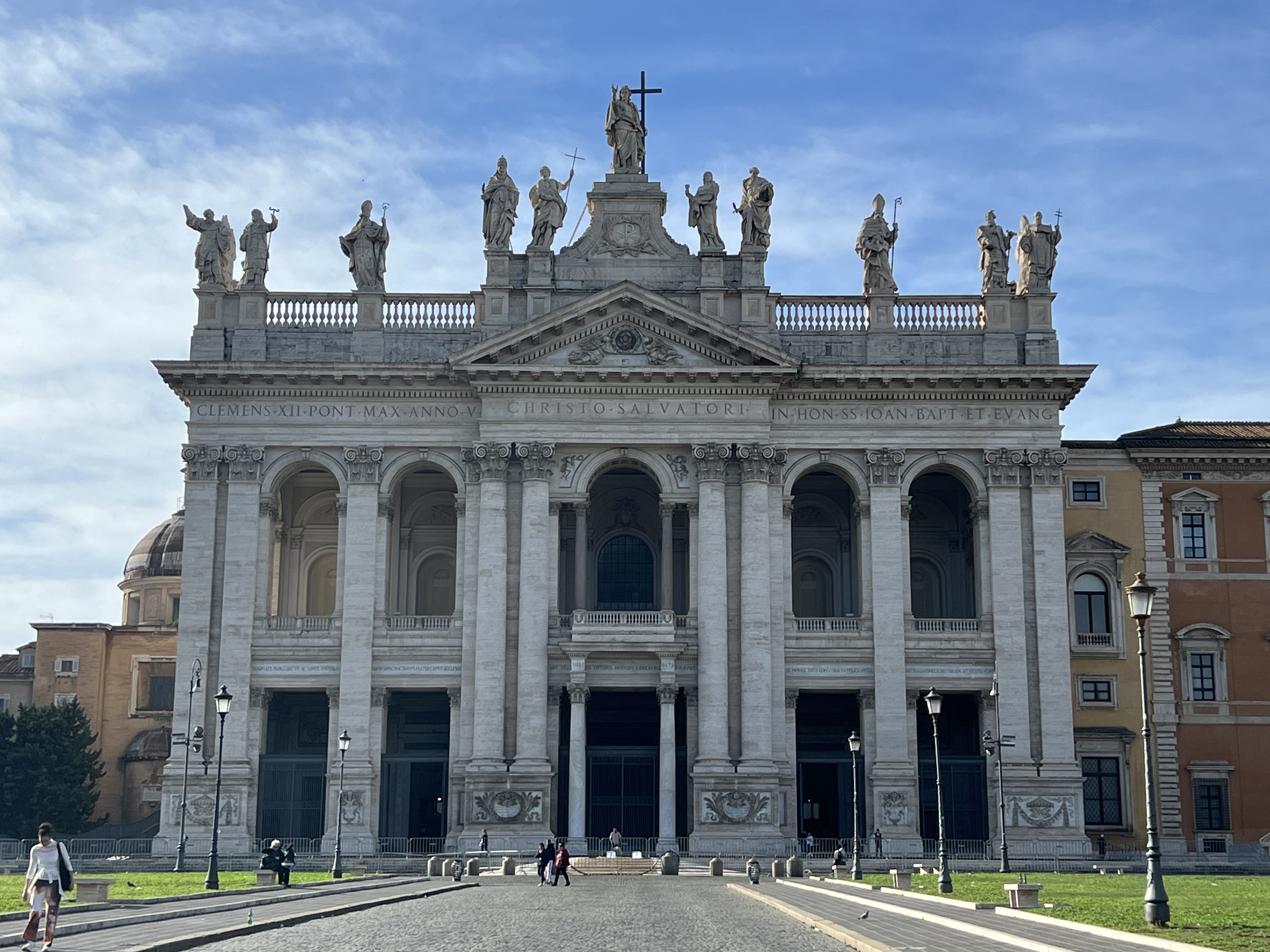
Statio ad St Ioannem Laterano
O God, whom to love above all is righteousness,
multiply in us the gifts of Thine ineffable grace:
and since Thou hast given us in the death of Thy Son
to hope for those things which we believe, grant us by
the Resurrection of the same to attain the end to which we aspire…

The Station at the Archbasilica of Saint John Lateran situates the Church, on this most solemn threshold of Holy Week, within a profound theological geography. The Lateran is not merely one basilica among others: it is omnium urbis et orbis ecclesiarum mater et caput—the mother and head of all churches. Here, after the conversion of Constantine the Great, the episcopal throne of the Bishop of Rome was established, marking the visible emergence of the Church from persecution into public life. Thus, as the faithful process with palms, they mystically enter not only the earthly Jerusalem, but the ecclesial Jerusalem—the Church herself, triumphant yet already overshadowed by the Cross. That this same basilica opened Lent on its First Sunday gives a liturgical inclusio: what began in penitence now culminates in the Passion’s unfolding.
From at least the fourth century, this day’s station has been fixed at the Lateran, and the rites associated with it reveal the ancient Roman genius for liturgical drama. The blessing of palms and the solemn procession—originally distinct from the Mass—were once celebrated here with the full splendour of the papal court, embodying both kingship and sacrifice. Christ is acclaimed as King with Hosanna, yet the liturgy immediately turns toward His rejection and death. Even the now-forgotten rite of the Apostolic Major Penitentiary striking penitents with the virga after Vespers underscores this paradox: mercy is mediated through humiliation, absolution through repentance. The Church, seated in judgment, is at once tribunal and mother—disciplining in order to restore.
Adjacent to the basilica, the Lateran Baptistery deepens the day’s symbolism. Built in the age of Constantine and later restored by Pope Sixtus III, it became the archetype of Western baptisteries. Its octagonal form—signifying the “eighth day” of the Resurrection—announces already the victory hidden within the Passion. The great porphyry columns, drawn from imperial structures, proclaim the subjugation of earthly power to Christ; above them, the dome adorned with scenes of St John the Baptist recalls that entry into Christ’s kingship comes not by acclaim but by rebirth in water and Spirit. The ancient immersion font, encircled by the imagery of the deer from Psalm 42—“As the deer longs for running streams…”—invites the pilgrim to recognise that the Passion into which we now enter is inseparable from baptismal death and new life.
The later embellishments under Pope Urban VIII further inscribe history into theology. The fresco cycles—depicting Constantine’s vision of the Cross, the victory at the Milvian Bridge, and the overthrow of pagan idols—present the Cross not as defeat but as the axis of triumph. The surrounding chapels, each layered with centuries of devotion—from the acanthus mosaics of the fourth century to the Byzantine splendour of St Venantius and the venerable bronzes of the papal residence—form a microcosm of the Church’s memory: suffering, endurance, and glory held together in sacred continuity.
Thus, the stational liturgy at the Lateran does more than commemorate Christ’s entry into Jerusalem; it interprets it. The faithful do not stand as spectators of a past event, but as participants in a present mystery. We acclaim the King, yet we follow Him to Calvary; we enter the Mother Church, yet we are reminded that her true glory is revealed not in earthly magnificence but in sacrificial love. The palms in our hands are already shadows of the Cross, and the waters of the baptistery whisper the end toward which this week hastens: death conquered, life restored, and the Church—born from the side of Christ—standing as the true and eternal Jerusalem.
RELATED ARTICLES


LATEST ARTICLES
- Anglican Orders II: Saepius Officio — Anglicanism’s Strongest Reply to Apostolicae CuraeIn 1897, the Archbishops of Canterbury and York defended Anglican Orders against Leo XIII’s Apostolicae Curae through Saepius Officio. While it challenges Leo’s arguments on sacramental theology and order validity, it acknowledges significant theological alterations in the Edwardine rites, questioning the continuity of sacrificial meaning in priesthood and Eucharist within Anglicanism.
- Today’s homily: Sunday XVI Post PentecostThe sermon focuses on the themes of humility and pride as depicted in the Gospel. It contrasts the visible illness of a man with dropsy and the invisible pride of his companions. Highlighting Christ’s teachings, it emphasises the necessity of recognising one’s dependence on God’s grace, advocating that true Christian humility leads to spiritual healing and lasting fulfilment.
- Today’s Mass: September 13 Sunday XVI Post PentecostThe Sixteenth Sunday After Pentecost celebrates the importance of humility and the grace of God, emphasised in the Gospel through Jesus’ healing and teachings. As believers are called to seek God’s mercy, the commemoration of the Blessed Virgin Mary’s Nativity highlights the beginning of salvation and the pursuit of good works through divine grace.
- Sermon for Sixteenth Sunday after PentecostIn the epistle to the Ephesians, St. Paul encourages believers to remain steadfast amid trials, highlighting the significance of humility and unity in Christ. He contrasts worldly values of pride with the Kingdom’s values, emphasising that true fulfilment comes from reliance on God’s grace and prioritising love for God and neighbour.
- The Line Held Again: UK Parliament Rejects Assissted Suicide Bill – and Reverses Its Own VerdictThe House of Commons has rejected the Terminally Ill Adults (End of Life) Bill, marking a significant parliamentary reversal in views on assisted suicide, shifting from a 55-vote majority for to a 16-vote majority against in less than two years. Concerns over safeguards and support for vulnerable patients informed this decision.



Leave a Reply