

Statio ad St Marcellum
The stational pilgrimage begins with the Collecta at the church built under Pope Marcus, where the Church gathers and gives voice to her prayer: that the fast now drawing to its close may be sanctified, that bodily abstinence may be joined to the mortification of our passions, and that the desire God Himself has placed within us may bear fruit in the illumination of the heart. Carrying that intention, the faithful proceed to the Station at San Marcello al Corso, where this prayer is not merely spoken—but historically embodied.
This church stands upon the Via Lata, the great artery of ancient Rome, on ground once occupied by the house of the noble matron Lucina. Here, in the earliest centuries, a domestic space was transformed into a titulus—one of the original parish centres of the Roman Church. Recent excavations have corroborated the testimony of the Acta Sancti Marcelli, confirming that this was indeed a functioning centre of Christian worship dating to the pontificate of Pope Marcellus I himself. Beneath the present structure, the discovery of a fourth- or fifth-century baptistery—deep enough for immersion—bears silent witness to the sacramental life that once flourished here: a Church baptising, reconciling, and governing in the shadow of persecution.
It was Marcellus who, in the aftermath of the Diocletian persecutions, undertook the arduous work of restoring ecclesiastical order in Rome—organising the tituli, assigning clergy, and reasserting penitential discipline for the reconciliation of the lapsed. This work of rebuilding the visible structure of the Church provoked opposition, and under the emperor Maxentius, the oratory established in Lucina’s house was desecrated. It was converted into a stable for the imperial post, and the pope himself was condemned to serve there as a catabulum, tending the very animals that now profaned the sacred space. Exhausted by this humiliation, he died there around 309.
This is the decisive key to the station: a church born in a house, degraded into a stable, and restored as a sanctuary. The place itself becomes a theological statement. For what the Church asks in the Collect—that our external discipline be interiorised—is here enacted in its most radical form. Marcellus is stripped not only of comfort, but of dignity; not only of honour, but of visible authority. Yet in this abasement he is not diminished, but conformed to Christ. His priesthood is revealed not in governance, but in sacrifice; not in office, but in offering. The stable becomes his altar, and his exhaustion his oblation.
After his death, he was buried in the cemetery of Priscilla, but his memory remained inseparable from this place. By the early fifth century, the church had already assumed a central role in the life of Rome. A letter of the Prefect Symmachus attests that the election of Pope Boniface I took place here in 418, in opposition to the antipope Eulalius. Thus San Marcello became not only a site of martyrdom, but of ecclesial legitimacy and authority. In the ninth century, the relics of Marcellus were translated here from the catacombs, together with those of Pope Vigilius, and placed beneath the high altar, where they remain—binding the memory of papal governance, suffering, and continuity into a single locus.
The church itself passed through cycles of restoration and destruction. Rebuilt by Adrian I and later restored by Stephen V and Gregory IV, it was devastated by fire in 1519. From this catastrophe emerged both renewal and continuity. The reconstruction by Jacopo Sansovino reoriented the church to face the Via del Corso, giving it a new public prominence. Yet from the flames there survived a single, striking witness: the wooden crucifix, preserved intact. This crucifix became one of the most venerated objects in Rome, carried in solemn procession during times of plague, crisis, and uncertainty—even into the modern period. It remains today in the right chapel, not as an ornament, but as a proclamation: that what is united to the Cross is not destroyed, but purified and preserved.
The interior further bears the marks of history in its Renaissance monuments, particularly the tomb of Cardinal Giovanni Michiel and his nephew Orso—a work that speaks both of ecclesiastical patronage and of the more troubled currents of Renaissance Rome, including intrigue and corruption under Pope Alexander VI. Beneath these layers, the ancient baptistery remains—a reminder that before power, before patronage, before architecture, the Church here was a place of rebirth through water and the Holy Ghost.
Today, the church is entrusted to the Order of the Servants of Mary, whose devotion to the Sorrows of Our Lady finds expression in the chapels dedicated to their Seven Holy Founders and to the Dolours of the Blessed Virgin. This continuity of sorrow and redemption extends the meaning of the place: from the suffering of the martyr, to the compassion of the Mother, to the participation of the faithful.
As the Lenten fast draws to its close, the liturgy itself becomes more austere. The omission of the Judica me and the Gloria Patri marks a deliberate restraint, a silencing that corresponds to the deepening gravity of Passiontide. At San Marcello, this liturgical stripping away finds its historical counterpart. The Church prays that our fasting may become interior; here, we see what that means. It is not merely the renunciation of food, but the surrender of self; not merely discipline, but transformation.
Thus, the pilgrim departs with a unified vision. The Collecta has asked that our penance bear fruit; the station has shown how. In the life of Marcellus, in the history of this church, in the crucifix that endured the fire, in the font that speaks of death and rebirth, the same pattern is revealed: that what is humbled is raised, what is purified is illumined, and what is offered to God is brought to completion in Him. Lent, here, is no longer an exercise—but a passage, traced in stone and sanctified in blood, leading the soul toward the mystery of the Cross.
RELATED ARTICLES


LATEST ARTICLES
- STABAT MATER DOLOROSA: The Seven Sorrows of the Blessed Virgin MaryThe traditional feast of the Seven Sorrows on 15 September contemplates Mary’s spiritual martyrdom from Simeon’s prophecy to the Burial of Christ. Distinct in origin from the Passion Friday feast of the Compassion, the September observance came especially through the Servite tradition and was extended to the Latin Church by Pius VII before being raised in rank and fixed to 15 September under St Pius X. Its Mass, Stabant juxta Crucem, presents Mary’s sorrow not as sentimental grief but as perfect faith, charity and conformity to Divine Providence, wholly dependent upon and ordered to the unique redemptive Sacrifice of Christ.
- THE FLAG THEY NEVER EXPLAINEDThe transgender pride flag has become ordinary institutional iconography, but the civic account of its origins is highly abbreviated. Its creator, Monica Helms, is male and began living as a woman in 1997. Helms’s autobiography describes sexual excitement associated with presenting himself as female, closely corresponding to what sexologist Ray Blanchard termed autogynephilia, alongside stolen women’s underwear, adult-video work, sex clubs and sexually themed fiction. The flag’s blue and pink also have separate documented uses as sex-coded colours within paedophile symbolism and child-sex markets, although there is no evidence of any connection with Helms’s design. More significant is the flag’s institutional history. It became embedded throughout public life during the same period in which gender-identity assumptions entered law, medicine, schools and safeguarding practice. The Supreme Court, revised RSHE guidance, KCSIE 2026 and the WellBN investigation now reveal a substantial correction towards biological reality, parental involvement, evidence and professional curiosity.
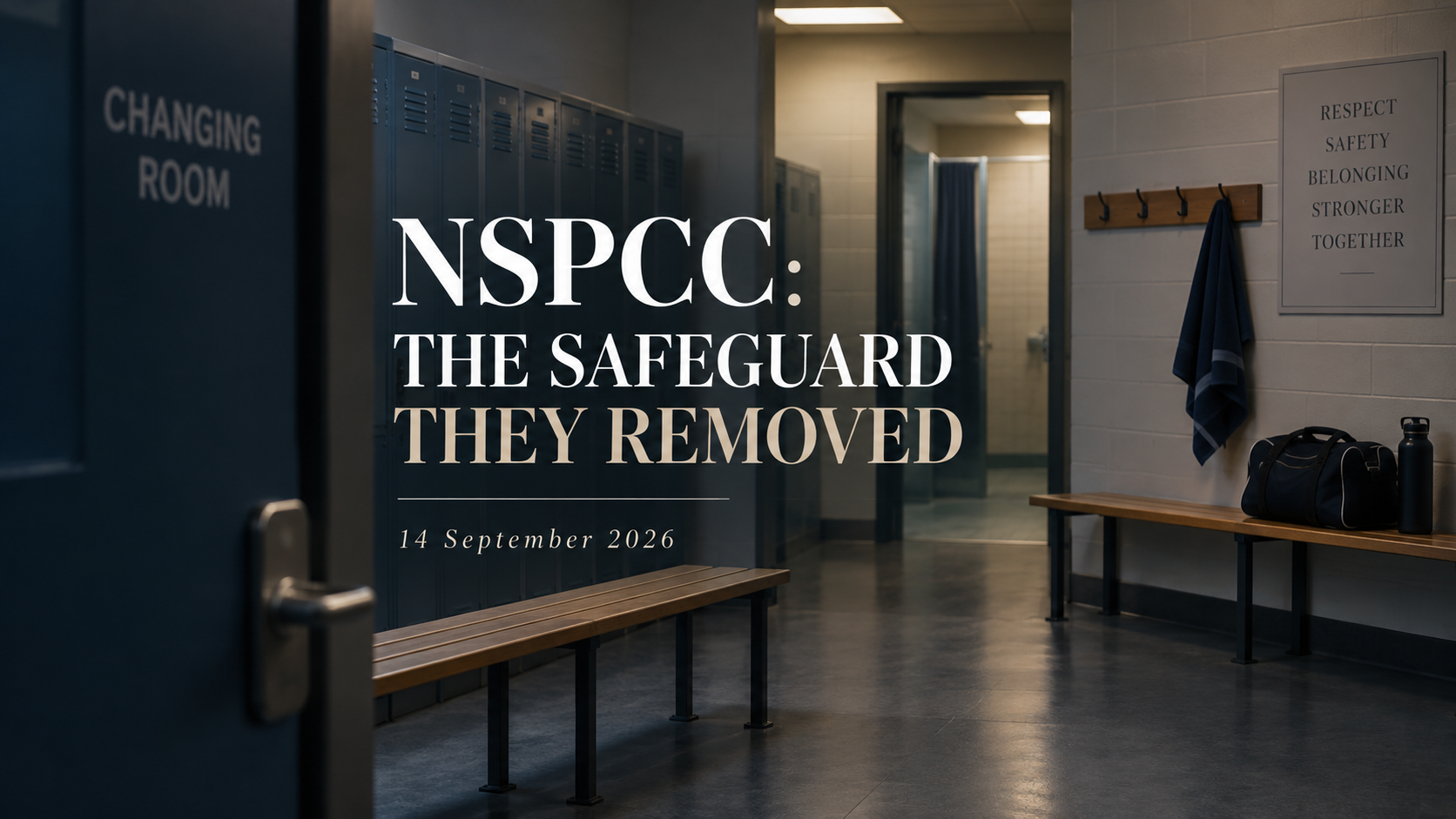
- NSPCC: THE SAFEGUARD THEY REMOVEDThe NSPCC has removed from its new schools guidance the previous recommendation that, where possible, children changing clothes should be supervised by adults of the same sex. Yet in the same month NSPCC Sport retained precisely that principle, while the 2026 statutory safeguarding framework strengthened sex-based protections for school changing rooms. The issue is not suspicion of teachers but why an elementary safeguard protecting children’s privacy, dignity and staff themselves has quietly disappeared.
- PEACE WITHOUT THE KING, UNITY WITHOUT THE CHURCHThe CCEE–CEC meeting in Germany marks the active reception of the revised Charta Oecumenica, whose programme reaches from common prayer and evangelisation to movement towards Eucharistic fellowship. Read beside Pius XI’s Quas Primas and Mortalium Animos, and against the clarifications of Unitatis Redintegratio, Dominus Iesus, Ecclesia de Eucharistia and Apostolicae Curae, the issue is not whether Catholics may cooperate with other Christians. It is whether an ecumenical culture of convergence is beginning to obscure the Social Kingship of Christ, the Catholic missionary claim and the already-existing visible unity of His Church.
- DEFEATED — BUT NOT SETTLEDThe Commons has voted against assisted suicide in England and Wales, with scrutiny revealing concerns over vulnerability, prognoses, and palliative care. Shifted positions among some MPs and the absence of others led to the defeat. The debate underlines the challenges of translating public support into effective legislation amid complex ethical considerations.



Leave a Reply