
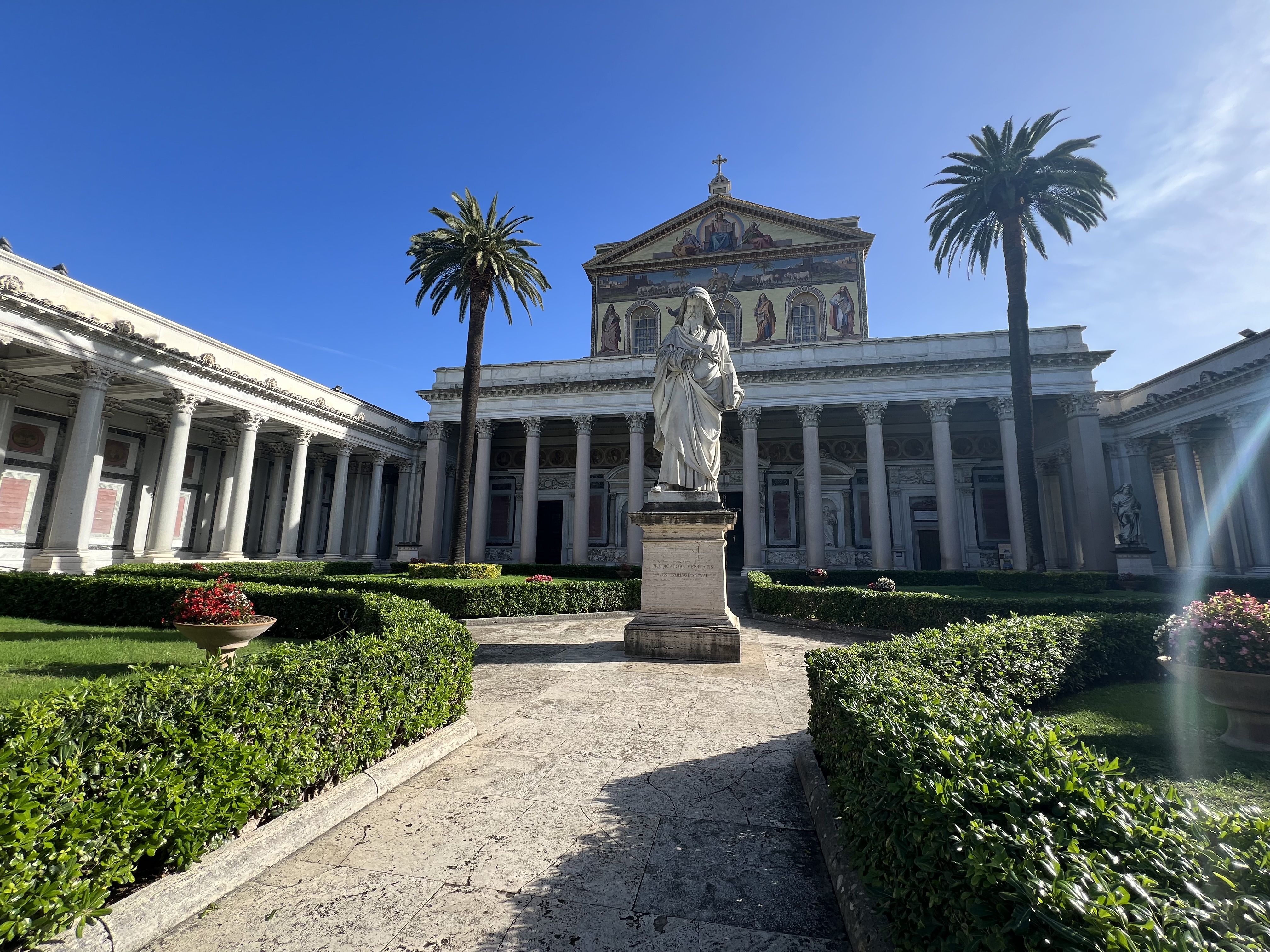
Statio ad Sanctum Paulum extra muros
The Lenten pilgrimage now leads us beyond the ancient walls of Rome, along the road of the Apostle, to the basilica raised over the tomb of Paul the Apostle. There is already a lesson in the journey itself. We are taken outside the familiar, beyond the ordered life of the city, to a place marked by death, witness, and transformation. Lent does not leave us where we are; it compels us outward—toward judgment, toward truth, toward conversion.
Here, beneath the high altar, rests the Apostle who was not always an Apostle. Saul the persecutor became Paul the preacher; the enemy of Christ became His chosen instrument. The Church does not place us here by accident. At this stage of Lent, as the catechumens were once examined and prepared for baptism, we too are brought before the question that defined Paul’s life: not whether we admire Christ, but whether we have truly turned toward Him.
The vast nave stretches before us, ordered, solemn, unwavering in its direction. It draws the eye—and the soul—forward to the altar above the tomb. Nothing here is chaotic, nothing accidental. The architecture itself becomes a silent catechist: the Christian life has a direction, a τέλος, a final end. We are not wandering; we are being led. And yet, how often do we resist that movement, preferring distraction to direction, comfort to conversion?
Above the altar, Christ reigns in the apse mosaic—teacher, judge, and king. He is not presented as an abstraction, nor as a private consolation, but as the Lord who commands belief and obedience. This is the Christ whom Paul encountered—not as an idea, but as a Person who shattered his certainties and demanded everything. To stand here is to stand under that same authority.
And beneath, hidden yet central, lies the tomb. The Church builds her liturgy upon the witness of those who died for the truth they proclaimed. The martyr does not argue; he testifies. The question posed to the pilgrim is therefore sharpened: what, in my life, bears witness? What has been surrendered? What has truly changed?
The scrutinies once held here were searching, even severe. The catechumens were not merely instructed; they were examined. The Creed was not offered as information, but entrusted as a treasure. The Lord’s Prayer was not recited casually, but received as a rule of life. Lent recovers that seriousness. It asks not whether we know the faith, but whether we live it.
The cloister, with its ordered beauty and quiet enclosure, offers a final contrast. Outside lies the world of movement, conflict, and noise; within, a space of recollection and harmony. Yet even here, the peace is not an escape but a preparation. Paul himself did not remain in contemplation; he was sent. The stillness of the cloister serves the mission of the Apostle.
Thus the stational pilgrim must hold these elements together: the road, the tomb, the altar, the mission. Conversion is not a moment but a reorientation of the whole life. Doctrine is not an abstraction but a truth to be lived. The Church is not merely seen but entered—through death to the old man and birth into the new.
At this point in Lent, the question becomes unavoidable. Have we truly left the old road? Or do we still walk, in part, in the shadow of what we were?
Here, at the tomb of the Apostle, the answer cannot remain theoretical. The witness of Paul demands a response. The Church has brought us to this place so that, before the Paschal mysteries, we may choose—clearly, decisively, and without compromise—the way of Christ.
RELATED ARTICLES


LATEST ARTICLES
- Anglican Orders II: Saepius Officio — Anglicanism’s Strongest Reply to Apostolicae CuraeIn 1897, the Archbishops of Canterbury and York defended Anglican Orders against Leo XIII’s Apostolicae Curae through Saepius Officio. While it challenges Leo’s arguments on sacramental theology and order validity, it acknowledges significant theological alterations in the Edwardine rites, questioning the continuity of sacrificial meaning in priesthood and Eucharist within Anglicanism.
- Today’s homily: Sunday XVI Post PentecostThe sermon focuses on the themes of humility and pride as depicted in the Gospel. It contrasts the visible illness of a man with dropsy and the invisible pride of his companions. Highlighting Christ’s teachings, it emphasises the necessity of recognising one’s dependence on God’s grace, advocating that true Christian humility leads to spiritual healing and lasting fulfilment.
- Today’s Mass: September 13 Sunday XVI Post PentecostThe Sixteenth Sunday After Pentecost celebrates the importance of humility and the grace of God, emphasised in the Gospel through Jesus’ healing and teachings. As believers are called to seek God’s mercy, the commemoration of the Blessed Virgin Mary’s Nativity highlights the beginning of salvation and the pursuit of good works through divine grace.
- Sermon for Sixteenth Sunday after PentecostIn the epistle to the Ephesians, St. Paul encourages believers to remain steadfast amid trials, highlighting the significance of humility and unity in Christ. He contrasts worldly values of pride with the Kingdom’s values, emphasising that true fulfilment comes from reliance on God’s grace and prioritising love for God and neighbour.
- The Line Held Again: UK Parliament Rejects Assissted Suicide Bill – and Reverses Its Own VerdictThe House of Commons has rejected the Terminally Ill Adults (End of Life) Bill, marking a significant parliamentary reversal in views on assisted suicide, shifting from a 55-vote majority for to a 16-vote majority against in less than two years. Concerns over safeguards and support for vulnerable patients informed this decision.



Leave a Reply