

Statio ad St Chrysogonum
Sanctify our fasts, we beseech Thee, O Lord
and in Thy mercy grant us pardon for all our sins.
Through Our Lord…

The stational church for this day is the Basilica of San Crisogono in Trastevere, one of the oldest and most historically significant tituli of early Christian Rome. Situated across the Tiber in what was once a densely populated and culturally mixed district, the church reflects the early expansion of Christianity beyond the formal civic centre of the city into its more domestic and mercantile quarters.
The site itself is of exceptional antiquity. Archaeological investigations in 1907 revealed a substantial subterranean structure beneath the present basilica, dating at least to the fourth century and likely earlier in origin. This lower church preserves the remains of what appears to have been a domus ecclesiae—a house adapted for Christian worship—associated with the cult of Saint Chrysogonus. The arrangement includes an apse, fragments of early wall decoration, and two lateral chambers identified as pastophoria, an architectural feature more commonly associated with Eastern liturgical practice. Their presence suggests either early Eastern influence or later adaptation, particularly during periods when Greek-speaking clergy and monastics were active in Rome.
The basilica is first securely documented in the acts of Roman synods of 499 and 595, where priests of the titulus Chrysogoni are recorded, confirming its status among the original parish churches of the city. Its development is closely tied to the Constantinian and post-Constantinian consolidation of Christianity in Rome, when domestic sites of worship were formalised into liturgical centres.
The present upper church dates primarily from the twelfth century, when the earlier structure was rebuilt on a raised platform, effectively preserving the earlier basilica below. This superimposition is characteristic of Roman ecclesiastical architecture, where continuity is expressed physically through vertical layering rather than replacement.
Architecturally, San Crisogono presents a restrained but coherent Romanesque composition. The façade is relatively plain, reflecting later restorations, but the campanile—constructed in 1124—is of particular note. It is one of the few Roman bell towers crowned with both a dome and spire, an unusual hybridisation that distinguishes it within the Roman skyline. The structure retains typical Romanesque features: biforate windows, brick construction, and a gradual lightening of mass toward the upper levels.
Internally, the basilica follows the classical basilican plan: a nave flanked by aisles, terminating in a semicircular apse. The interior incorporates a Cosmatesque floor, typical of Roman medieval craftsmanship, composed of geometric marble inlays. The apse area, while modified in later restorations, maintains the axial emphasis central to Roman liturgical architecture.
Of particular significance is the preservation of the lower basilica, accessed via a staircase. Here, the earlier apse remains visible, along with traces of fresco decoration and the probable site of the martyr’s shrine. This lower level offers a rare and direct insight into pre-medieval Christian spatial organisation in Rome.
The church also contains a notable collection of relics. Among them are the head and arm of Saint Chrysogonus, as well as relics attributed to James the Great and other saints associated with the Trinitarian Order, which has administered the church since the nineteenth century. The presence of these relics reflects the long-standing role of San Crisogono as a centre of devotional and liturgical continuity.
Historically, the church has also been connected with significant ecclesiastical figures. It served as the titular church of Pope Leo XIII prior to his election to the papacy, situating it within the broader network of Roman cardinalatial assignments.
The patron, St. Chrysogonus, remains historically elusive. Tradition identifies him as a Roman official martyred under Diocletian around 304, possibly at Aquileia. His cult was widespread in both Eastern and Western Christianity, and his inclusion in the Roman Canon attests to the antiquity and importance of his veneration. The association with Saint Anastasia, preserved in later hagiographical texts, suggests a role as a spiritual mentor, though such accounts remain difficult to verify historically.
The stational assignment of San Crisogono is traditionally attributed to Pope Gregory the Great, who formalised many aspects of the Roman stational system. Its selection for this day reflects both its antiquity and its association with one of the canonical martyrs of Rome.
In its totality, San Crisogono exemplifies the stratified character of Roman ecclesiastical history: a site where domestic worship evolved into public liturgy, where Eastern and Western elements intersect, and where successive architectural phases preserve rather than erase what came before.
Grant health of soul and body to Thy people, Lord,
so that by preserving in good works that they may deserve
always to be shielded by Thy might power:
Through Our Lord…
RELATED ARTICLES


LATEST ARTICLES
- STABAT MATER DOLOROSA: The Seven Sorrows of the Blessed Virgin MaryThe traditional feast of the Seven Sorrows on 15 September contemplates Mary’s spiritual martyrdom from Simeon’s prophecy to the Burial of Christ. Distinct in origin from the Passion Friday feast of the Compassion, the September observance came especially through the Servite tradition and was extended to the Latin Church by Pius VII before being raised in rank and fixed to 15 September under St Pius X. Its Mass, Stabant juxta Crucem, presents Mary’s sorrow not as sentimental grief but as perfect faith, charity and conformity to Divine Providence, wholly dependent upon and ordered to the unique redemptive Sacrifice of Christ.
- THE FLAG THEY NEVER EXPLAINEDThe transgender pride flag has become ordinary institutional iconography, but the civic account of its origins is highly abbreviated. Its creator, Monica Helms, is male and began living as a woman in 1997. Helms’s autobiography describes sexual excitement associated with presenting himself as female, closely corresponding to what sexologist Ray Blanchard termed autogynephilia, alongside stolen women’s underwear, adult-video work, sex clubs and sexually themed fiction. The flag’s blue and pink also have separate documented uses as sex-coded colours within paedophile symbolism and child-sex markets, although there is no evidence of any connection with Helms’s design. More significant is the flag’s institutional history. It became embedded throughout public life during the same period in which gender-identity assumptions entered law, medicine, schools and safeguarding practice. The Supreme Court, revised RSHE guidance, KCSIE 2026 and the WellBN investigation now reveal a substantial correction towards biological reality, parental involvement, evidence and professional curiosity.
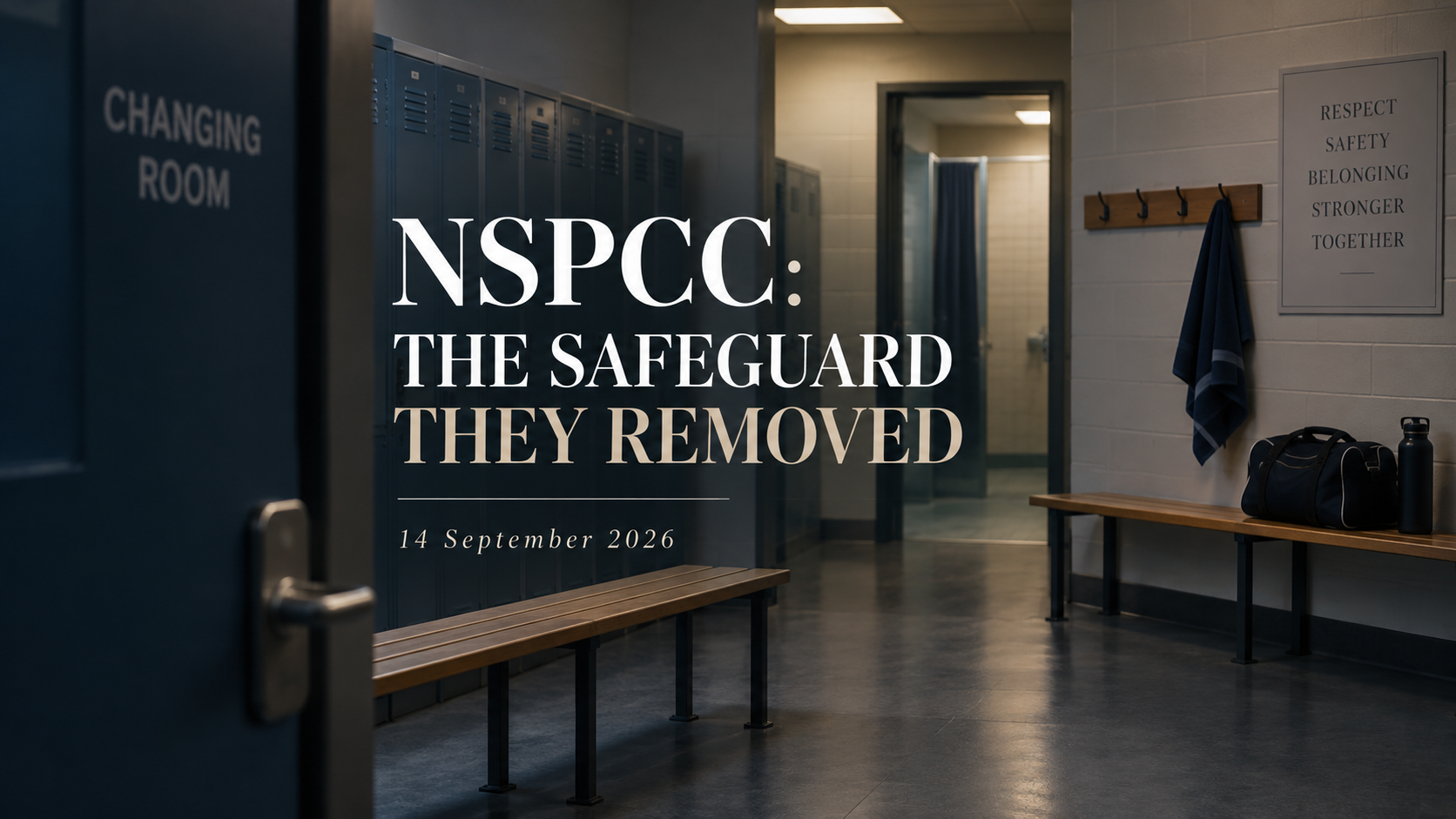
- NSPCC: THE SAFEGUARD THEY REMOVEDThe NSPCC has removed from its new schools guidance the previous recommendation that, where possible, children changing clothes should be supervised by adults of the same sex. Yet in the same month NSPCC Sport retained precisely that principle, while the 2026 statutory safeguarding framework strengthened sex-based protections for school changing rooms. The issue is not suspicion of teachers but why an elementary safeguard protecting children’s privacy, dignity and staff themselves has quietly disappeared.
- PEACE WITHOUT THE KING, UNITY WITHOUT THE CHURCHThe CCEE–CEC meeting in Germany marks the active reception of the revised Charta Oecumenica, whose programme reaches from common prayer and evangelisation to movement towards Eucharistic fellowship. Read beside Pius XI’s Quas Primas and Mortalium Animos, and against the clarifications of Unitatis Redintegratio, Dominus Iesus, Ecclesia de Eucharistia and Apostolicae Curae, the issue is not whether Catholics may cooperate with other Christians. It is whether an ecumenical culture of convergence is beginning to obscure the Social Kingship of Christ, the Catholic missionary claim and the already-existing visible unity of His Church.
- DEFEATED — BUT NOT SETTLEDThe Commons has voted against assisted suicide in England and Wales, with scrutiny revealing concerns over vulnerability, prognoses, and palliative care. Shifted positions among some MPs and the absence of others led to the defeat. The debate underlines the challenges of translating public support into effective legislation amid complex ethical considerations.



Leave a Reply