
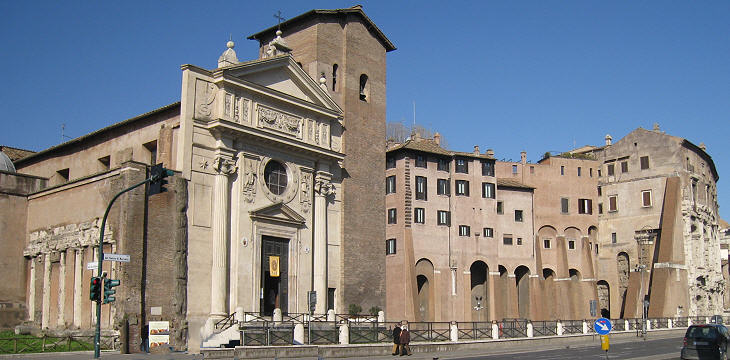
Statio ad St Petrum
The assignment of Passion Sunday to the basilica of St. Peter is not incidental but deliberate, rooted in the earliest strata of Roman liturgical consciousness. From at least the fourth century, this day—already distinguished by its precedence over all feasts—demanded a station of corresponding gravity. No site in Rome could better sustain that weight than the shrine erected over the tomb of the Apostle.
The Constantinian basilica, constructed in the early fourth century after the peace of the Church, marked a decisive architectural and theological gesture: the transformation of a pagan necropolis on the Vatican hill into the monumental centre of Christian memory. Built directly over the tropaion of Peter—identified by the mid-second century—the structure preserved continuity with the earliest veneration of the Apostle while asserting the triumph of the Church over the Empire that had crucified him.
Although the present basilica is the product of the Renaissance and Baroque periods, the essential logic of the site remains unchanged. The great axis of the building still converges upon the tomb. Bernini’s baldacchino, rising above the high altar, does not obscure but rather frames the apostolic grave beneath, drawing the eye downward even as the colossal dome of Michelangelo lifts it heavenward. The vertical tension—earth and heaven, tomb and triumph—is intrinsic to the building’s symbolic programme.
Architecturally, St. Peter’s functions as a synthesis of successive epochs. The Constantinian plan established the basilican form as a vessel of pilgrimage and imperial patronage. Bramante’s early sixteenth-century project introduced the ideal of centralised harmony, later modified by Michelangelo into a structure of monumental clarity and force. The longitudinal extension under Carlo Maderno restored the processional axis required for liturgical use, ensuring that the building could function not merely as a shrine, but as the principal ceremonial space of the Roman Church.
Within this vast architectural framework, the interior is articulated through a dense network of altars, chapels, and commemorative monuments, each preserving fragments of early Christian devotion. The relics of Apostles and martyrs—Simon and Jude, Processus and Martinian, Petronilla—anchor the building in the apostolic age, even as their present settings reflect later artistic interventions. The Chapel of St. Petronilla, for instance, became closely associated with the French crown, demonstrating how political and devotional identities could converge within the basilica’s spatial hierarchy.
The artistic programme of St. Peter’s is inseparable from its function as a statement of ecclesial authority. Sculpture, mosaic, and architecture collaborate to articulate a vision of continuity: from the martyrdom of Peter, through the institutional development of the Church, to its universal claims. The colossal statues of saints, the triumphal inscriptions, and the expansive use of light all serve to situate the visitor within a narrative of permanence and legitimacy.
Yet the basilica is not merely a product of triumphalism. The preservation of the apostolic tomb at its core introduces a counterpoint. Beneath the grandeur lies a grave; beneath the marble and gilding, the memory of crucifixion. This tension between monumentality and martyrdom is essential to understanding the site. The architecture does not erase the Passion—it monumentalises its consequences.
The selection of St. Peter’s as the station for Passion Sunday thus reveals a convergence of liturgical, historical, and architectural logic. The day marks the beginning of the Church’s most intense meditation on the suffering of Christ. The place embodies the historical continuation of that suffering in the life of His chief Apostle. The building itself expresses, in stone and space, the paradox of a Church founded upon death yet ordered toward glory.
In this way, the station at St. Peter’s situates Passiontide within a specifically Roman framework: the Passion is not only remembered—it is inscribed into the very fabric of the Church’s most significant sanctuary.
RELATED ARTICLES


LATEST ARTICLES
- STABAT MATER DOLOROSA: The Seven Sorrows of the Blessed Virgin MaryThe traditional feast of the Seven Sorrows on 15 September contemplates Mary’s spiritual martyrdom from Simeon’s prophecy to the Burial of Christ. Distinct in origin from the Passion Friday feast of the Compassion, the September observance came especially through the Servite tradition and was extended to the Latin Church by Pius VII before being raised in rank and fixed to 15 September under St Pius X. Its Mass, Stabant juxta Crucem, presents Mary’s sorrow not as sentimental grief but as perfect faith, charity and conformity to Divine Providence, wholly dependent upon and ordered to the unique redemptive Sacrifice of Christ.
- THE FLAG THEY NEVER EXPLAINEDThe transgender pride flag has become ordinary institutional iconography, but the civic account of its origins is highly abbreviated. Its creator, Monica Helms, is male and began living as a woman in 1997. Helms’s autobiography describes sexual excitement associated with presenting himself as female, closely corresponding to what sexologist Ray Blanchard termed autogynephilia, alongside stolen women’s underwear, adult-video work, sex clubs and sexually themed fiction. The flag’s blue and pink also have separate documented uses as sex-coded colours within paedophile symbolism and child-sex markets, although there is no evidence of any connection with Helms’s design. More significant is the flag’s institutional history. It became embedded throughout public life during the same period in which gender-identity assumptions entered law, medicine, schools and safeguarding practice. The Supreme Court, revised RSHE guidance, KCSIE 2026 and the WellBN investigation now reveal a substantial correction towards biological reality, parental involvement, evidence and professional curiosity.
- NSPCC: THE SAFEGUARD THEY REMOVEDThe NSPCC has removed from its new schools guidance the previous recommendation that, where possible, children changing clothes should be supervised by adults of the same sex. Yet in the same month NSPCC Sport retained precisely that principle, while the 2026 statutory safeguarding framework strengthened sex-based protections for school changing rooms. The issue is not suspicion of teachers but why an elementary safeguard protecting children’s privacy, dignity and staff themselves has quietly disappeared.
- PEACE WITHOUT THE KING, UNITY WITHOUT THE CHURCHThe CCEE–CEC meeting in Germany marks the active reception of the revised Charta Oecumenica, whose programme reaches from common prayer and evangelisation to movement towards Eucharistic fellowship. Read beside Pius XI’s Quas Primas and Mortalium Animos, and against the clarifications of Unitatis Redintegratio, Dominus Iesus, Ecclesia de Eucharistia and Apostolicae Curae, the issue is not whether Catholics may cooperate with other Christians. It is whether an ecumenical culture of convergence is beginning to obscure the Social Kingship of Christ, the Catholic missionary claim and the already-existing visible unity of His Church.
- DEFEATED — BUT NOT SETTLEDThe Commons has voted against assisted suicide in England and Wales, with scrutiny revealing concerns over vulnerability, prognoses, and palliative care. Shifted positions among some MPs and the absence of others led to the defeat. The debate underlines the challenges of translating public support into effective legislation amid complex ethical considerations.



Leave a Reply