

Statio ad St Apollinarem
The stational pilgrimage today leads us into the heart of ancient Rome, to Sant’Apollinare, a church quietly set amid the dense fabric of the Campus Martius, yet standing upon ground once filled with the noise and splendour of imperial life. Beneath its Baroque façade lie the ruins of the Baths of Nero and Alexander, reminders of a civilisation that sought permanence in stone, power, and administration. Yet those structures have long since fallen into silence, while above them rises a sanctuary dedicated not to empire, but to the endurance of apostolic faith. The pilgrim, entering here, passes symbolically from the transience of worldly power into the abiding reality of the Church.
At the threshold, the gaze is drawn to the Madonna del Portico, venerated as Regina Apostolorum, welcoming the faithful into the mystery of the Church born from the Apostles. Within, the ordered harmony of the architecture—refined under Ferdinando Fuga during the pontificate of Pope Benedict XIV—speaks not of excess, but of clarity and discipline. It is the architecture of a Church conscious of her mission: measured, deliberate, and enduring. Beneath the high altar rest the relics of martyrs from distant lands, a silent but powerful testimony that the faith proclaimed here is not confined to Rome alone, but belongs to the universal Church, united across nations and centuries in the witness of blood.
All this finds its centre in the life of Apollinaris of Ravenna, disciple of Saint Peter, sent forth to preach the Gospel in Ravenna. His life was marked by a pattern that mirrors the Passion itself: preaching, rejection, suffering, return, and finally death. Thrice expelled, he returned; struck down, he rose again to continue his mission; and at last, having endured violence at the hands of a hostile world, he surrendered his life in martyrdom. His witness is not merely one of endurance, but of fidelity—an unyielding adherence to the apostolic mission entrusted to him, whatever the cost.
This is precisely the note struck in the liturgy as Lent draws toward its culmination. The Church no longer speaks merely of penance in the abstract, but of perseverance under trial, of fidelity when the cost becomes real. The example of Apollinaris stands before the pilgrim as a living commentary on the Gospel: the servant is not greater than his Master; the path of Christ is the path of rejection before it is the path of glory. Yet it is also a path of return—of coming back again and again to the work entrusted by God, even after failure, exile, or suffering.
Here, in this church built upon the ruins of empire, enriched by the relics of martyrs, and shaped by centuries of formation and mission, the pilgrim is invited to recognise the true structure that endures: not the works of men, but the apostolic Church founded upon Peter, extended through his disciples, and confirmed by the blood of the saints. The stones of Rome may crumble, but the witness of the Apostles does not pass away.
Thus the station at San Apollinare calls the faithful to a deeper constancy. As the Passion approaches, the question is no longer whether one will follow Christ in principle, but whether one will remain with Him in adversity. The answer is found here—in the life of a bishop who returned when driven out, who preached when silenced, and who remained faithful unto death.
RELATED ARTICLES


LATEST ARTICLES
- STABAT MATER DOLOROSA: The Seven Sorrows of the Blessed Virgin MaryThe traditional feast of the Seven Sorrows on 15 September contemplates Mary’s spiritual martyrdom from Simeon’s prophecy to the Burial of Christ. Distinct in origin from the Passion Friday feast of the Compassion, the September observance came especially through the Servite tradition and was extended to the Latin Church by Pius VII before being raised in rank and fixed to 15 September under St Pius X. Its Mass, Stabant juxta Crucem, presents Mary’s sorrow not as sentimental grief but as perfect faith, charity and conformity to Divine Providence, wholly dependent upon and ordered to the unique redemptive Sacrifice of Christ.
- THE FLAG THEY NEVER EXPLAINEDThe transgender pride flag has become ordinary institutional iconography, but the civic account of its origins is highly abbreviated. Its creator, Monica Helms, is male and began living as a woman in 1997. Helms’s autobiography describes sexual excitement associated with presenting himself as female, closely corresponding to what sexologist Ray Blanchard termed autogynephilia, alongside stolen women’s underwear, adult-video work, sex clubs and sexually themed fiction. The flag’s blue and pink also have separate documented uses as sex-coded colours within paedophile symbolism and child-sex markets, although there is no evidence of any connection with Helms’s design. More significant is the flag’s institutional history. It became embedded throughout public life during the same period in which gender-identity assumptions entered law, medicine, schools and safeguarding practice. The Supreme Court, revised RSHE guidance, KCSIE 2026 and the WellBN investigation now reveal a substantial correction towards biological reality, parental involvement, evidence and professional curiosity.
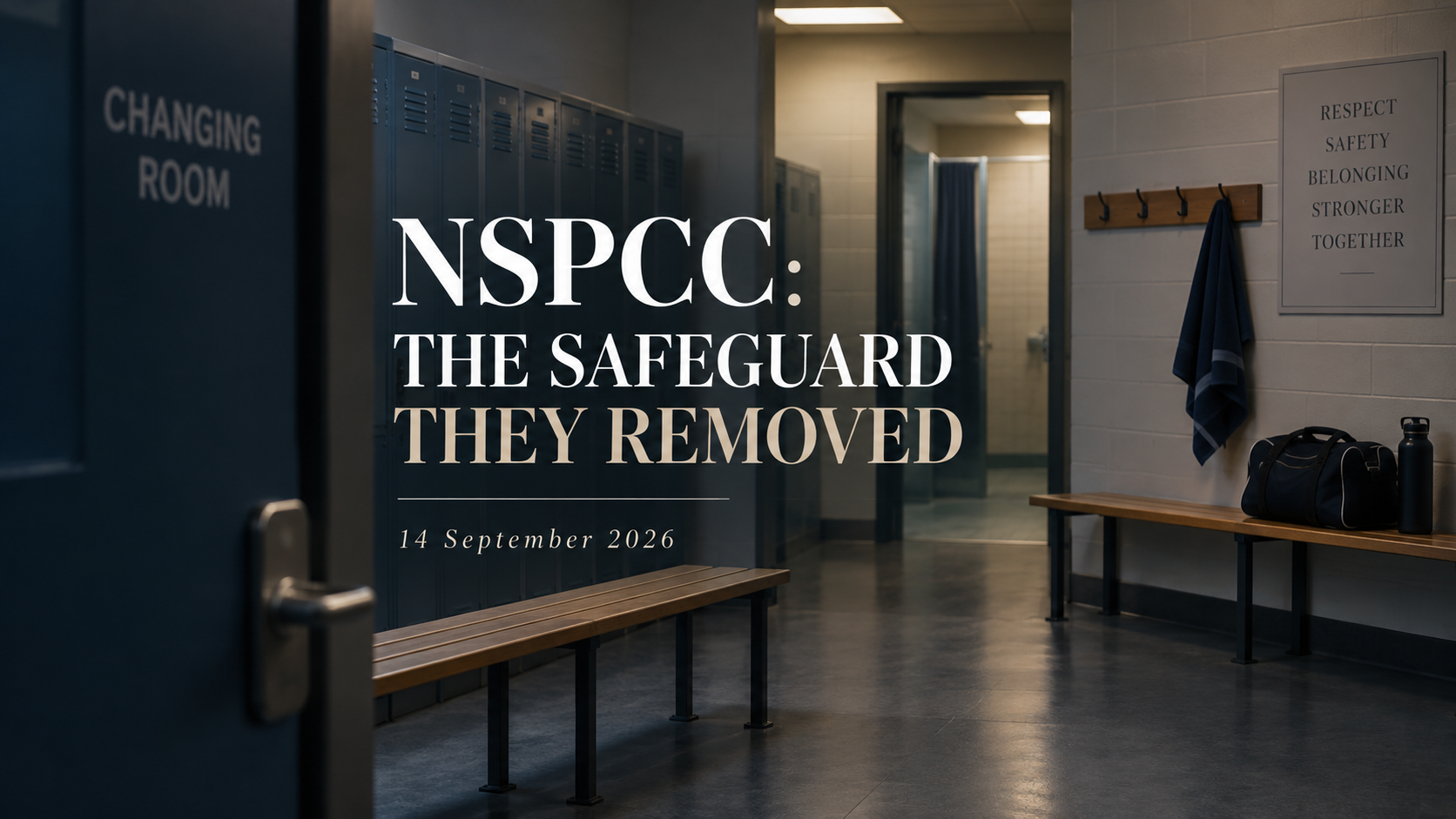
- NSPCC: THE SAFEGUARD THEY REMOVEDThe NSPCC has removed from its new schools guidance the previous recommendation that, where possible, children changing clothes should be supervised by adults of the same sex. Yet in the same month NSPCC Sport retained precisely that principle, while the 2026 statutory safeguarding framework strengthened sex-based protections for school changing rooms. The issue is not suspicion of teachers but why an elementary safeguard protecting children’s privacy, dignity and staff themselves has quietly disappeared.
- PEACE WITHOUT THE KING, UNITY WITHOUT THE CHURCHThe CCEE–CEC meeting in Germany marks the active reception of the revised Charta Oecumenica, whose programme reaches from common prayer and evangelisation to movement towards Eucharistic fellowship. Read beside Pius XI’s Quas Primas and Mortalium Animos, and against the clarifications of Unitatis Redintegratio, Dominus Iesus, Ecclesia de Eucharistia and Apostolicae Curae, the issue is not whether Catholics may cooperate with other Christians. It is whether an ecumenical culture of convergence is beginning to obscure the Social Kingship of Christ, the Catholic missionary claim and the already-existing visible unity of His Church.
- DEFEATED — BUT NOT SETTLEDThe Commons has voted against assisted suicide in England and Wales, with scrutiny revealing concerns over vulnerability, prognoses, and palliative care. Shifted positions among some MPs and the absence of others led to the defeat. The debate underlines the challenges of translating public support into effective legislation amid complex ethical considerations.



Leave a Reply