
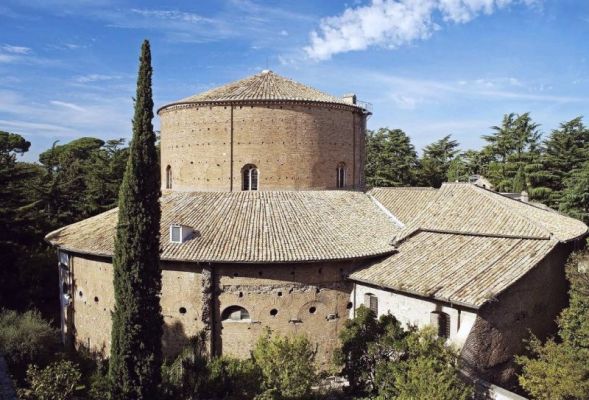
Statio ad St Stephanum in Caelio Monte
Graciously pour forth Your grace into our hearts, we beseech You, O Lord, that, keeping our sinful inclinations under control by self-denial, we may suffer for a brief while rather than be condemned to everlasting punishment. Through Jesus Christ, thy Son our Lord…

The Station on the Friday of Passion Week is held at Santo Stefano Rotondo, on the Caelian Hill—one of the most ancient and symbolically charged sites in the Eternal City. The Church appoints this sanctuary of the Proto-Martyr, Saint Stephen the Protomartyr, as the place of assembly in these final days before the Passion, when the liturgy itself begins to darken, and the faithful are drawn ever more deeply into the mystery of suffering, witness, and sacrifice.
The proximity of this station to the collecta at Basilica of Saints John and Paul situates the pilgrim within a concentrated sacred geography. Yet this ground was not always Christian. The Caelian Hill preserves layers of religious history: once associated with the cult of the Magna Mater on the nearby Palatine, where outsiders were forbidden to tread, and later occupied by imperial barracks that housed a Mithraic sanctuary—a cult especially favoured among Roman soldiers. Thus, the Christian sanctification of this place represents not merely continuity but conquest: the triumph of martyrdom over pagan secrecy, of revealed truth over esoteric rite.
The church itself, dating to the 5th century, is among the most architecturally distinctive in Rome. Unlike the basilican norm, Santo Stefano Rotondo is circular—modelled deliberately upon the Church of the Holy Sepulchre. This is no mere aesthetic imitation but a theological statement: the martyrdom of Stephen is inseparably bound to the death and resurrection of Christ. The original design comprised three concentric ambulatories, allowing pilgrims to circulate around the central altar in a manner analogous to Jerusalem. Though the outer ring and three projecting arms of the Greek cross have been lost, the remaining structure still conveys a powerful sense of enclosure and focus. Twenty-two ancient granite columns form a ring around the sanctuary, creating a solemn rhythm of space that draws the eye inward—toward the altar, toward the sacrifice.
Within this architectural theology, the art completes the catechesis. The 16th-century fresco cycle, commissioned under the Society of Jesus after their stewardship of the church began in 1580, depicts twenty-four martyrdoms in stark and often brutal detail. These are not decorative images but instruments of formation. Each scene is accompanied by inscriptions identifying the persecuting emperor and citing Scripture, embedding each martyrdom within both history and revelation. Jesuit seminarians were brought here to meditate upon these images before departing for missionary territories, a sobering preparation for the reality that the apostolic vocation might culminate in blood.
To the left of the entrance lies the Chapel of Saints Primus and Felician, whose relics were translated here under Pope Theodore I. The 7th-century mosaic depicting them is among the rare survivals of its period in Rome, its austere dignity contrasting with the later dramatic frescoes. Nearby stands the so-called chair of Pope Gregory the Great, linking the site not only to martyrdom but to the pastoral governance of the Church. The later addition of devotion to Saint Stephen of Hungary reflects the evolving layers of dedication, though the identity of the Proto-Martyr remains dominant.
Thus, the choice of this station on Passion Friday is neither incidental nor merely traditional. Here, in a place once marked by exclusion, secrecy, and imperial power, the Church gathers to contemplate the cost of discipleship. The circular form encloses the faithful within a silent witness: that the Cross is not an abstraction but a historical reality, repeated in the lives of the saints. As the Passion draws near, Santo Stefano Rotondo confronts the pilgrim with a stark question—whether he, too, will follow Christ not only in word, but in suffering, endurance, and fidelity unto death.
Grant, we beseech You, almighty God, that we who seek the grace of Your protection, having been delivered from all evils, may serve You with untroubled minds. Through Jesus Christ, thy Son our Lord…
RELATED ARTICLES


LATEST ARTICLES
- Today’s Mass: November 1 All SaintsThe Solemnity of All Saints, celebrated on November 1st, honours all saints, both recognised and unknown. This tradition dates back to the Fifth Century, with Pope Gregory IV formalising the date. The day’s liturgy emphasises the significance of the saints’ intercession and their merit through Christ’s sacrifice, inviting the faithful to rejoice in their honour.
- Today’s Mass: October 31 Vigil of All SaintsThe Vigil of All Saints, observed in traditional chapels, commemorates martyrs who sacrificed their lives for Christ. Originating from the Eighth Century, it involves a solemn vigil with penitential liturgy and fasting. This preparation anticipates All Saints’ Day, reflecting the Church’s reverence for saints and their intercession in prayers.
- 01.11.26 Nuntiatoria CXXX: MEMENTOAs the Church observes All Saints and All Souls in November, it underscores the deeper responsibilities of faith, charity, and fidelity beyond mere remembrance. The editorial highlights the importance of preserving traditions and understanding the obligations to the deceased and future generations. It advocates for active faith and charitable actions in daily life.
- ORDO w/c 01.11.26From 1–8 November 2026, the Church commemorates All Saints and reflects on the faithful departed. This period includes diverse celebrations such as the Octave of All Saints, All Souls’ Day, and the feasts of St Charles Borromeo and St Willibrord. These observances highlight the communion among saints, those in purification, and the Militant Church, emphasising charity and the efficacy of intercession.
- REQUIEM AETERNAM: THE CHURCH THAT WILL NOT FORGET HER DEADThe All Souls liturgy highlights the Catholic Church’s commitment to assisting the departed through the Holy Sacrifice of the Mass, intercessory prayers, and suffrages. It explores the theology of Purgatory, the significance of the Requiem, and the privilege established by Benedict XV for offering three Masses, encouraging remembrance of the deceased.



Leave a Reply