
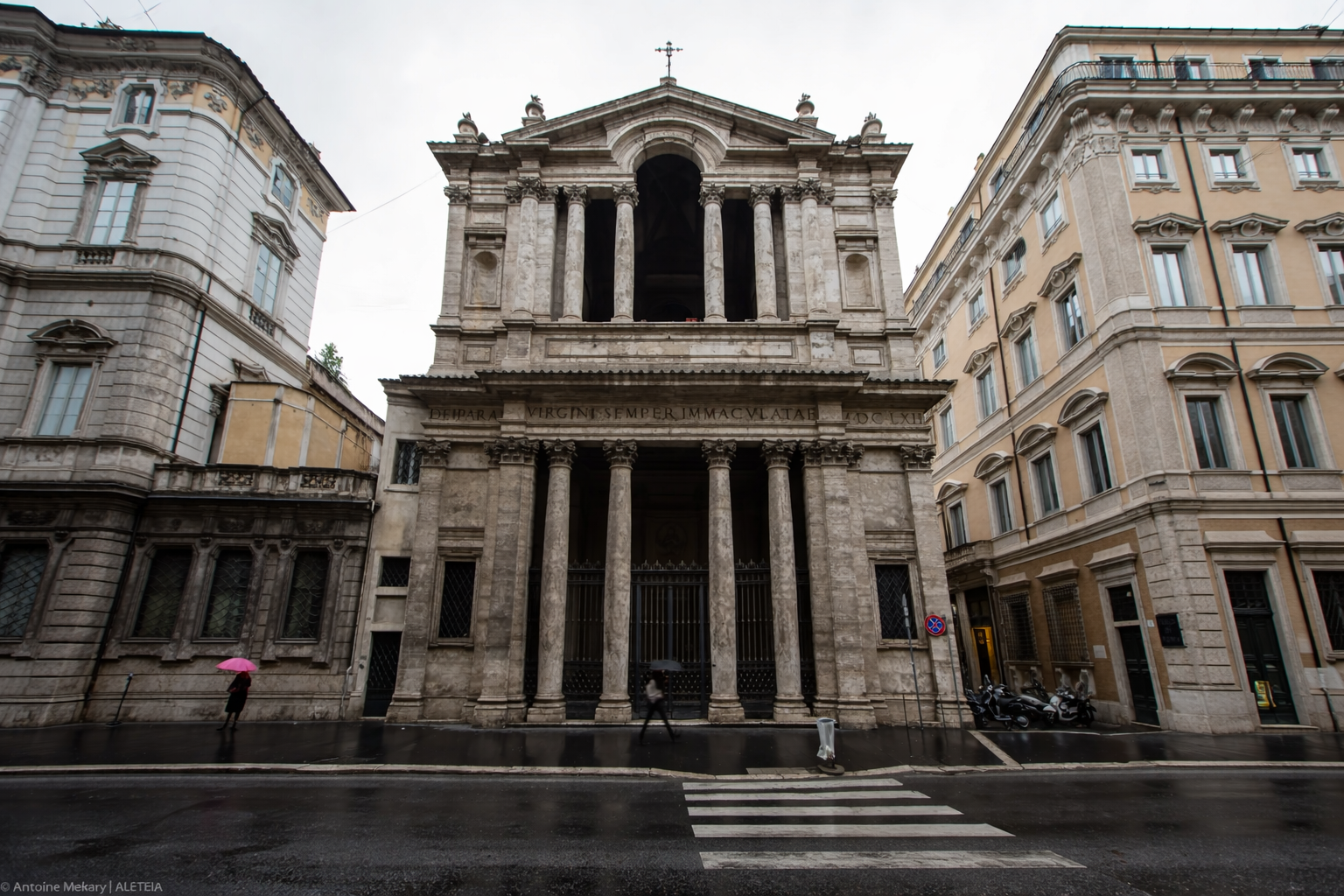
Statio ad St Cyriacum
The stational pilgrim arrives today not at the original basilica of St. Cyriacus, but at its living successor, Santa Maria in Via Lata—a church which gathers into itself the memory of martyrdom, apostolic witness, and the layered endurance of the Roman Church. The ancient titulus Cyriaci, once situated near the Baths of Diocletian, has vanished from the visible city, its foundations weakened by flood and time. Yet its saint has not been lost. His relics, translated here, render this church not a substitute but a continuation: the station persists because the Church remembers, and what she remembers she makes present.
The façade before the pilgrim—severe yet noble—speaks the language of Roman continuity. Its classical columns, rising in ordered ranks, echo the architecture of imperial Rome even as they are pressed into the service of Christ. This is no accident. The Church in Rome does not erase the past; she baptises it. The stones themselves proclaim a theological claim: that what once served empire now serves eternity. The upper loggia, with its open arches, draws the eye upward, suggesting both proclamation and watchfulness—an architectural gesture fitting for a place bound to the preaching of the Apostles.
Descending into the crypt, the pilgrim encounters something older, quieter, and more intimate: the chambers traditionally identified with the imprisonment of Saint Paul. Here, beneath the noise of the modern street, the memory of apostolic Rome endures. The worn stone, the low ceilings, the sense of enclosure—these are not grand but austere, and precisely for that reason they correspond to the liturgy of Passiontide. For this is not a day of triumph, but of constriction, of withdrawal, of silence. As the liturgy omits the Judica me and suppresses the Gloria Patri, so too the pilgrim is led downward, into a space where the Church remembers that the Gospel was first proclaimed not from thrones, but from chains.
The presence of St. Cyriacus within this apostolic setting deepens the meaning of the station. A deacon and martyr of the early Church, Cyriacus belongs to that generation for whom service and sacrifice were inseparable. Tradition associates him, like the prophet Daniel, with witness before hostile powers—a man who stood firm amid the structures of pagan authority. It is therefore no coincidence that the lesson of Daniel in the lions’ den is read today. The early Christians saw in Daniel not merely a story of deliverance, but a pattern of fidelity: the just man surrounded, tested, yet preserved by God. In the catacombs, Daniel appears again and again, arms raised in prayer, a figure of serene defiance. So too Cyriacus: a servant who became a witness, and a witness who became a martyr.
Within the church above, this theology is clothed in art. The ancient icon of the Vergine Avvocata presides with quiet authority, reminding the pilgrim that the Church does not walk Passiontide alone. Mary, Advocate and Mother, stands at the threshold of the Passion, interceding for her children. The relics of martyrs—Cyriacus, Agapitus, and others—testify that the path of Christ has been walked before, and that its end is not destruction but glory. Even the later monuments, the tombs and memorials of successive centuries, reinforce the same truth: that the Church endures, not by escaping suffering, but by passing through it.
The discipline of the day sharpens this message. The ancient Roman practice noted that ordinarily no station was held on this weekday, unless it were marked by martyrdom. That this day retains a station, and that it is linked to a martyr, is itself a liturgical statement. The Church interrupts her restraint only for those who have given everything. The pilgrim, therefore, is not merely visiting a church but entering a hierarchy of witness: Apostle, deacon, martyr—each bearing the same Cross in different forms.
Thus the relevance of this station to the Lenten liturgy becomes clear. The pilgrim stands between memory and anticipation: between the hidden Apostle below and the veiled mysteries above; between the silence of Passiontide and the promise of Easter. The Post-Communion prayer speaks of the Eucharist as both pledge and foretaste—pignus futurae gloriae. Here, in this place of chains and relics, that pledge is made tangible. For what is seen is restraint, obscurity, even loss—but what is promised is deliverance, vindication, and life.
And so the pilgrim departs with a sharpened understanding: that the Church does not deny suffering, nor does she merely endure it. She orders it, sanctifies it, and integrates it into the very structure of her worship. The vanished basilica of Cyriacus, the preserved relics, the apostolic crypt, the austere liturgy—all converge to teach a single lesson: that fidelity in the present, however hidden or constrained, is already a participation in the victory to come.
RELATED ARTICLES


LATEST ARTICLES
- WHEN THE BISHOP BECOMES THE MESSAGE: The Cult of Personality, Episcopal Pride and the Betrayal of Apostolic TrustArchbishop Josef Grünwidl of Vienna has openly advocated for women’s ordination, reflecting a troubling trend among bishops who express personal opinions at odds with established Catholic doctrine. This practice undermines their primary role of teaching the faith and raises concerns about episcopal pride and the proper handling of doctrinal authority by the Church.
- SANDIE PEGGIE: WHEN THE UNION FAILS THE WOMEN IT SHOULD DEFENDThe Royal College of Nursing successfully defended its actions in a discrimination case brought by Sandie Peggie, yet the ruling highlights concerns about the union’s failure to acknowledge members’ rights amid ideological conformity. This raises critical questions regarding the adequacy of trade union representation for employees facing complex workplace issues.
- Today’s homily: St Winefride of HolywellSt Winefride’s courage, and the survival of devotion to her through centuries of persecution, reveal the cost and beauty of Christian fidelity. Her feast challenges us to move beyond outward observance, cultivate genuine holiness, resist compromise, and persevere in sanctifying grace, ready to meet Christ, our divine Bridegroom.
- Today’s Mass: November 3 St Winefride of HolywellThe spring attached to her legend has given its name to Holywell (Tre Ffynnon), Clwyd, and down the centuries, and right up to the present day, pilgrims have travelled there in the hope of finding healing for their illnesses. Such pilgrimages even continued throughout the Reformation with 14,000 people and 150 priests gathered there on St Winefride’s feast day in 1629 – a time when Catholics were still dying as martyrs.
- THE GOSPEL IS NOT AN ALIBI FOR BUREAUCRACYBishop Philip North contends that spiritual renewal is paramount for the Church of England, sidelining organisational reform. He defends diocesan administration despite concerns over rising costs and declining clergy and congregations. This editorial emphasises the need for both faithful evangelisation and responsible financial stewardship as interconnected necessities for the Church’s survival.




Leave a Reply