
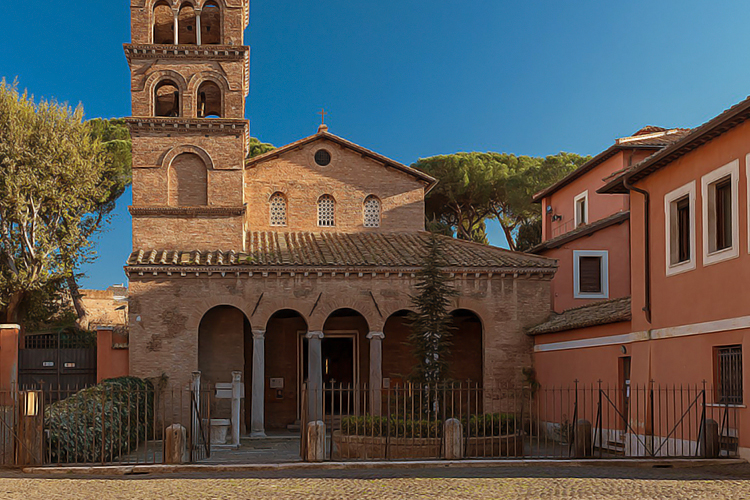
Station Passiontide Saturday I: Statio ad St Ioannem ante Portam Latinam
May the people prosper who are devoted to Thee by the affection of pious devotion, we beseech Thee O Lord; that instructed by the holy rites, they may be made more pleasing to Thy majesty, and more may they abound in excellent gifts. Through Jesus Christ our Lord…

The Place of Trial and Triumph
Today’s Station draws the Lenten pilgrim to one of the most evocative and historically layered corners of Christian Rome: the basilica of San Giovanni a Porta Latina, standing just within the ancient Porta Latina of the Aurelian Wall. This is no arbitrary selection. The Church places us here, at the threshold between city and exile, memory and prophecy, because this ground bears witness to one of the most paradoxical episodes in apostolic history: the attempted martyrdom of St John the Evangelist.
According to the ancient tradition preserved by Tertullian, the beloved disciple—he who leaned upon the breast of Christ—was condemned under Domitian and cast into a cauldron of boiling oil. Yet, unlike the martyrs whose blood sanctified the soil of Rome, John emerged unharmed—quasi de balneo, “as from a bath.” Thus this place is not merely a site of suffering, but of miraculous preservation: a Passion without death, a martyrdom deferred, a witness reserved for exile and revelation.
Just beside the gate stands the exquisite San Giovanni in Oleo, the small octagonal chapel marking the very spot of this ordeal. Rebuilt in 1509 and later restored by Francesco Borromini, it preserves in architectural form the memory of this strange and singular Passion. It is fitting that on this final Saturday before Holy Week, the Church gathers where fire did not consume, but instead revealed the inviolable life of grace.
The Basilica: Antiquity, Beauty, and Apocalypse
Crossing the quiet threshold into San Giovanni a Porta Latina, one encounters a basilica of striking austerity and antiquity. Its origins reach deep into the early Christian centuries, though the present structure owes much to its reconstruction under Pope Celestine III in 1191. The church’s long custodial history—passing through canons, mendicants, confraternities, and religious orders—reflects the layered continuity of Roman ecclesial life, even through periods of upheaval, suppression, and restoration.
Architecturally, the basilica preserves an almost archaic simplicity. Ten ancient columns of differing provenance line the nave, a visible testimony to the Roman habit of sanctifying the remnants of the pagan world. The triple-apsed sanctuary, with its polygonal exterior and rare selenite windows, evokes an eastern influence—an architectural gesture toward the universality of the Church and the apostolic mission of John himself.
Most striking, however, are the twelfth-century fresco cycles. Here, the entire economy of salvation unfolds in visual catechesis: from the Creation and Fall in Genesis to the Redemption wrought in Christ. Above all, in the central apse, the vision culminates in the twenty-four Elders of the Apocalypse—an unmistakable allusion to the authorship of St John. The one who survived the cauldron would later behold the heavenly liturgy, and here, in pigment and plaster, that vision is rendered for the pilgrim. This is no mere decoration; it is theology in image, binding together history, prophecy, and liturgy.
The Station and the Liturgy of the Threshold
Passiontide has now reached its final stillness before the storm. The Church has veiled her images, silenced her Gloria Patri, and stripped the liturgy of its former brightness. And now, she brings us to the Apostle who did not die—but endured, waited, and received.
This is the key to today’s Station. St John stands at the threshold: between martyrdom and mission, between suffering and revelation, between the Cross and the Apocalypse. His preservation in the oil prefigures the mystery that suffering, when united to Christ, does not destroy but transforms. His exile to Patmos—following this failed execution—becomes the occasion for the final unveiling of divine glory.
Thus the place, the saint, and the liturgy converge. At the edge of the city, beside the gate of departure, the Church prepares us for Holy Week. We are not yet at Calvary—but we are no longer far from it. Like John, we are asked to remain: to stand, to endure, to behold. The Passion is imminent; the revelation is coming.
And so the pilgrim departs this Station not with resolution, but with readiness. For beyond this gate lies the Cross—and beyond the Cross, the vision of the Lamb.
Let Your right hand, we beseech You, O Lord, guard Your people who call upon You; purify them and graciously teach them; that, by Your aid in this life, may they advance toward the good things to come. Through Jesus Christ, thy Son our Lord…
RELATED ARTICLES


LATEST ARTICLES
- STABAT MATER DOLOROSA: The Seven Sorrows of the Blessed Virgin MaryThe traditional feast of the Seven Sorrows on 15 September contemplates Mary’s spiritual martyrdom from Simeon’s prophecy to the Burial of Christ. Distinct in origin from the Passion Friday feast of the Compassion, the September observance came especially through the Servite tradition and was extended to the Latin Church by Pius VII before being raised in rank and fixed to 15 September under St Pius X. Its Mass, Stabant juxta Crucem, presents Mary’s sorrow not as sentimental grief but as perfect faith, charity and conformity to Divine Providence, wholly dependent upon and ordered to the unique redemptive Sacrifice of Christ.
- THE FLAG THEY NEVER EXPLAINEDThe transgender pride flag has become ordinary institutional iconography, but the civic account of its origins is highly abbreviated. Its creator, Monica Helms, is male and began living as a woman in 1997. Helms’s autobiography describes sexual excitement associated with presenting himself as female, closely corresponding to what sexologist Ray Blanchard termed autogynephilia, alongside stolen women’s underwear, adult-video work, sex clubs and sexually themed fiction. The flag’s blue and pink also have separate documented uses as sex-coded colours within paedophile symbolism and child-sex markets, although there is no evidence of any connection with Helms’s design. More significant is the flag’s institutional history. It became embedded throughout public life during the same period in which gender-identity assumptions entered law, medicine, schools and safeguarding practice. The Supreme Court, revised RSHE guidance, KCSIE 2026 and the WellBN investigation now reveal a substantial correction towards biological reality, parental involvement, evidence and professional curiosity.
- NSPCC: THE SAFEGUARD THEY REMOVEDThe NSPCC has removed from its new schools guidance the previous recommendation that, where possible, children changing clothes should be supervised by adults of the same sex. Yet in the same month NSPCC Sport retained precisely that principle, while the 2026 statutory safeguarding framework strengthened sex-based protections for school changing rooms. The issue is not suspicion of teachers but why an elementary safeguard protecting children’s privacy, dignity and staff themselves has quietly disappeared.
- PEACE WITHOUT THE KING, UNITY WITHOUT THE CHURCHThe CCEE–CEC meeting in Germany marks the active reception of the revised Charta Oecumenica, whose programme reaches from common prayer and evangelisation to movement towards Eucharistic fellowship. Read beside Pius XI’s Quas Primas and Mortalium Animos, and against the clarifications of Unitatis Redintegratio, Dominus Iesus, Ecclesia de Eucharistia and Apostolicae Curae, the issue is not whether Catholics may cooperate with other Christians. It is whether an ecumenical culture of convergence is beginning to obscure the Social Kingship of Christ, the Catholic missionary claim and the already-existing visible unity of His Church.
- DEFEATED — BUT NOT SETTLEDThe Commons has voted against assisted suicide in England and Wales, with scrutiny revealing concerns over vulnerability, prognoses, and palliative care. Shifted positions among some MPs and the absence of others led to the defeat. The debate underlines the challenges of translating public support into effective legislation amid complex ethical considerations.



Leave a Reply