
THE END OF WAITING? Bishop Pierre Roy, Ecclesial Authority, and the Question Traditional Catholicism Can No Longer Avoid
Introduction
In a lengthy and widely discussed interview on Church and State, Bishop Pierre Roy, superior of the Mission Notre-Dame de Joie in Eastern Canada, articulated a position that has unsettled traditional Catholic circles not because it is rash, but because it names—without euphemism—the question many have learned not to ask.
If the Holy See has been vacant for generations, is waiting itself now functioning as an ecclesiology? And if so, can such a posture still claim fidelity to a Church that is visible, indefectible, and divinely constituted?
Bishop Roy does not present himself as a conclavist, nor as a self-appointed restorer of order. He insists repeatedly on restraint, universality, and submission once the Church speaks. Yet he refuses to sanctify inertia. His intervention exposes a fault line running through traditional Catholicism: the uneasy coexistence of emergency measures and permanent delay.

The Core Thesis
Bishop Roy’s argument rests on several interlinked claims.
First, the Church is a perfect society endowed by Christ with all the means necessary to fulfil her mission, including governance and unity under Peter. A Church that indefinitely lacks a visible head is not merely enduring a trial; she is in a condition demanding resolution.
Second, despite profound disagreements over Vatican II, papal legitimacy, and jurisdiction, most traditionalist positions converge on the same practical remedy: wait. Wait for divine intervention. Wait for Rome to correct itself. Wait for modernists to convert. Bishop Roy argues that this posture is historically unprecedented. The Church has never waited indefinitely for heretics to repent; she has judged and expelled them.
Third, if those who publicly profess the post-conciliar religion lack the Catholic faith, then they cannot constitute the Church’s governing hierarchy. Conversely, if traditional clergy truly constitute the Church by virtue of faith, sacraments, and apostolic orders, then jurisdiction cannot be entirely absent from their midst. To deny this is to imply that the true Church has no power to act—an implication Bishop Roy rejects as incompatible with Catholic ecclesiology.
From these premises he cautiously raises the possibility of an imperfect general council: a gathering of bishops and clergy who have preserved the Catholic faith, convened not to innovate, but to address the crisis at the head of the Church by establishing the vacancy of the Holy See and, if possible, restoring the papacy.
Why This Is Not Crude Conclavism
Much of the reaction to Bishop Roy has centred on accusations of conclavism. These miss the substance of his proposal.
Conclavism presumes that the canonical electors of a pope exist and can be assembled. Bishop Roy explicitly rejects this premise. He is not calling for a conclave of cardinals, nor for a private election by a handful of bishops. Rather, he appeals—by analogy, not identity—to moments in history when the Church acted extraordinarily because ordinary mechanisms had failed.
His reference to the resolution of the Great Western Schism is not an assertion that the present crisis is identical, but a reminder that the Church did not respond to paralysis with silence. She acted imperfectly, provisionally, and at great cost—but she acted.
The real question he raises is not who should elect a pope tomorrow, but whether the Church still believes she possesses the authority and duty to resolve a prolonged vacancy at her head.
The Strength of the Intervention: Ending Permanent Emergency
Bishop Roy’s most compelling contribution is his rejection of what might be called permanent emergency Catholicism.
For six decades, extraordinary measures—supplied jurisdiction, irregular episcopal consecrations, non-territorial ministry, independent seminaries—have been defended as temporary. Yet a temporary measure that lasts three generations ceases to function as an exception and becomes a system.
Here his critique bites. If emergency conditions justify sacramental and pastoral action, why do they not justify ecclesial action aimed at restoring the papacy? If the Church can survive indefinitely without a pope, what becomes of the dogma of her visible unity?
Bishop Roy’s argument is not driven by impatience but by a serious concern for ecclesial coherence. It is precisely because he takes the papacy seriously that he refuses to normalise its absence.
Where the Argument Remains Fragile
Yet for all its force, the proposal is not without serious difficulties.
The most significant concerns universality. A council—even an imperfect one—does not become the Church speaking merely because its participants hold the true faith. Universality must be manifest, not assumed. Bishop Roy appeals to “moral unanimity” and to those who have preserved the faith, but the criteria by which such unanimity would be recognised remain undefined. Who determines participation? What degree of dissent would invalidate the act? On what basis would its decisions bind those absent?
Closely related is the question of jurisdiction. Bishop Roy is correct to reject the notion that jurisdiction can permanently reside in public heresy. He is also right to observe that traditional clergy already act as though jurisdiction exists. Yet moving from functional necessity to ordinary governing authority requires more than appeal to urgency. Without careful theological grounding, there is a risk of replacing canonical positivism with ecclesial voluntarism—acting because something must be done, rather than because authority is demonstrably present.
These unresolved questions do not invalidate his concerns, but they do indicate that the path forward is far less clear than the diagnosis.
How the Old Roman Apostolate Would Likely Respond
The likely reaction of the Old Roman Apostolate (ORA) would be cautious but not dismissive.
At the level of diagnosis, ORA would largely agree with Bishop Roy. ORA has consistently framed itself not as an end-state, but as a body awaiting restoration of full juridical communion. The critique of “waiting as a theology” would therefore land uncomfortably close to home.
Where ORA would diverge sharply is on timing and legitimacy. ORA’s ecclesiology is deeply anti-voluntarist. It emphasises material continuity, recognisability, and restraint. While sympathetic to the need for papal restoration, ORA would resist any move that appears self-legitimating or precipitous. Their concern would be that asserting authority without unmistakable universality risks substituting resolve for indefectibility.
In short, ORA would likely say: the problem is real, but the remedy is premature.
How the SSPX Reaction Would Differ
The response of the Society of Saint Pius X would be fundamentally different—sharper, more defensive, and more dismissive.
Bishop Roy’s thesis threatens the SSPX’s post-1988 governing paradigm. The Society’s position depends on three assumptions: that there is a pope in Rome (however gravely erring), that canonical normality is not suspended, and that the Society exists to preserve Tradition rather than to reconstitute authority.
Roy’s argument—that prolonged sedevacancy is intolerable and demands ecclesial action—undermines all three. Accepting his premise would force the SSPX to admit that its own posture of indefinite preservation has hardened into paralysis. For this reason alone, his proposal would almost certainly be rejected outright.
The SSPX would frame his position as sedevacantist speculation, a temptation to conclavism, and an example of substituting activism for divine providence. Unlike ORA, the Society cannot afford to acknowledge that “waiting” itself has become problematic, because doing so would unravel the logic that has sustained it for decades.
The Deeper Issue Revealed
What this debate ultimately exposes is not a dispute over tactics, but a crisis of ecclesiology. Traditional Catholicism has not yet articulated a settled doctrine of authority under prolonged apostasy and papal absence.
Bishop Roy has not solved this problem. He has, however, refused to allow it to remain unspoken. His intervention forces a question that can no longer be deferred: if the Church is divine, visible, and indefectible, how can prolonged headlessness be treated as a permanent norm?
Conclusion
Bishop Pierre Roy has not offered a blueprint for restoring the Church. He has done something both more modest and more unsettling: he has challenged traditional Catholicism to examine whether fidelity has quietly become indistinguishable from inertia.
His proposal raises unresolved questions about universality, jurisdiction, and legitimacy that require far deeper theological work. Yet it succeeds in exposing the inadequacy of a posture that treats sedevacancy as an endpoint rather than a crisis.
Whether Bishop Roy’s suggested direction is ultimately correct remains an open question. What is no longer credible is the assumption that waiting itself constitutes an ecclesiology. The dam has been cracked. What follows will require far greater clarity, humility, and theological depth than slogans of patience or calls to action alone can provide.

- Vatican Council I, Pastor Aeternus, ch. 2–3.
- Pius XII, Mystici Corporis Christi, AAS 35 (1943).
- St. Robert Bellarmine, De Ecclesia Militante, bk. II.
- Cajetan, De Comparatione Auctoritatis Papae et Concilii.
- Council of Constance (1414–1418), Session XLII.
- Code of Canon Law (1917), canons 218–221.
- St. Vincent of Lerins, Commonitorium.
- Leo XIII, Satis Cognitum.
related articles


Latest articles
- Omnia autem probate: quod bonum est tenete ~ Prove all things; hold fast that which is good: Spiritual Conference for Nuntiatoria CXXVIThe conference reflects on St Paul’s assertion to “prove all things” in relation to self-judgement and the Church. It explores themes of synodality, ecumenism, and the importance of discernment, emphasising the need for humility in understanding truth and the challenge of maintaining genuine holiness in the midst of contemporary ecclesiastical crises.
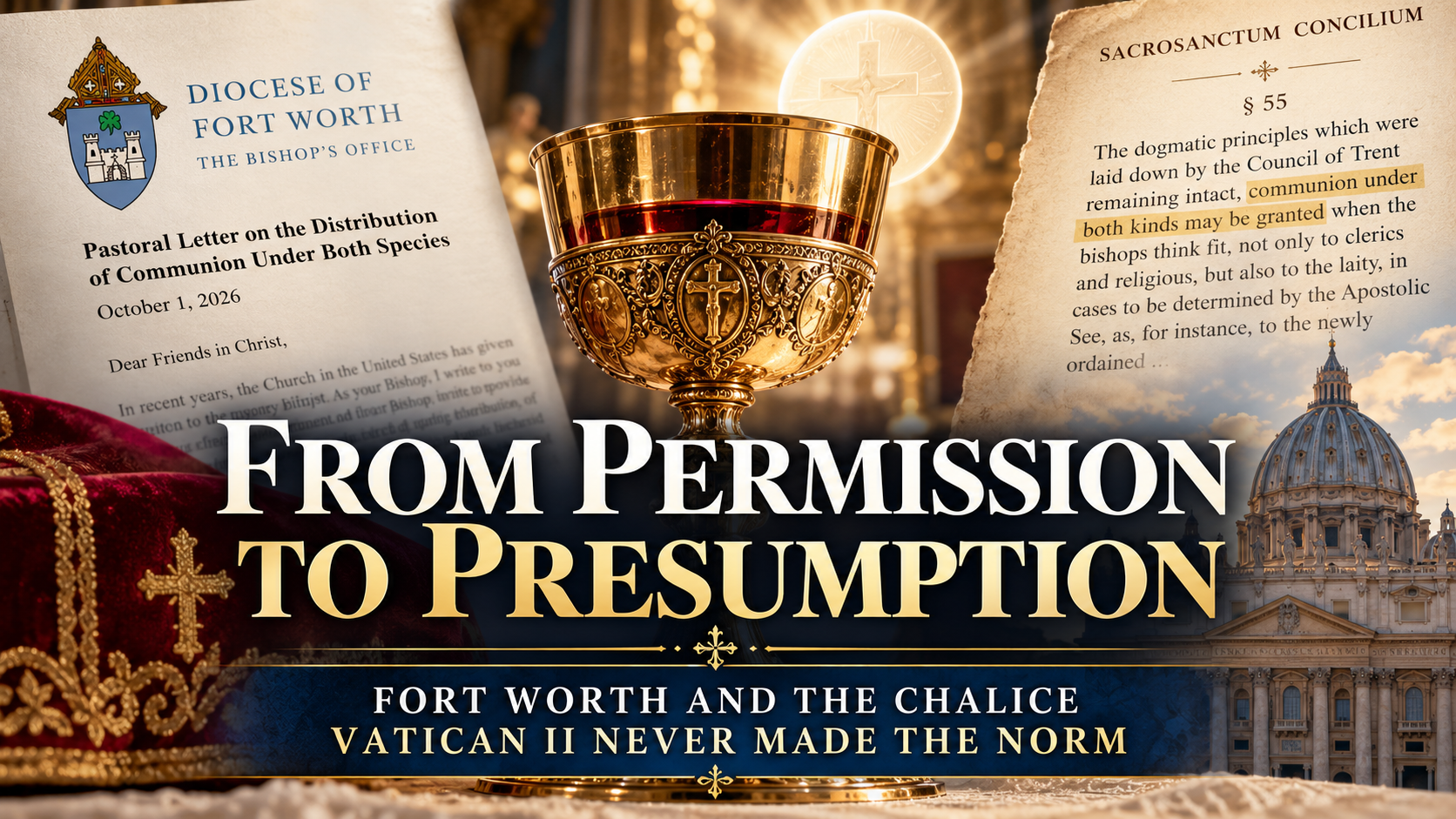
- FROM PERMISSION TO PRESUMPTION: Fort Worth and the Chalice Vatican II never made the NormBishop Michael Olson has implemented strict limitations on the distribution of Communion under both species in the Diocese of Fort Worth, prompting a discussion on the historical evolution of liturgical practices following Vatican II. This decision aims to reaffirm the doctrine of the Eucharist, emphasising that Christ is fully present under either species, while addressing misconceptions surrounding modern practices.
- AUGSBURG 2030: Can Rome commemorate a Confession it once confuted?Pope Leo XIV aims to revitalise the ecumenical spirit of the Augsburg Confession for its 2030 anniversary. However, historical responses from Rome highlight significant doctrinal differences between Catholics and Lutherans. True reconciliation must acknowledge these unresolved issues, as merely celebrating commonality risks glossing over critical theological distinctions that led to the Reformation.
- Today’s homily: St BrunoThe text reflects on Saint Bruno’s journey towards a life of solitude, prayer, and contemplation, emphasising the importance of genuine pursuit of God amidst distractions. It highlights that true spiritual growth requires silence and self-examination, urging believers to reclaim quiet moments for reflection, repentance, and devotion in daily life.
- Today’s Mass: October 06 St Bruno, ConfessorSaint Bruno, born in 1030 in Cologne, founded the Carthusian Order, embracing solitude and prayer. After studying theology and serving as a chancellor, he established a hermitage in the Chartreuse Mountains, combining hermitic and monastic lives. Bruno died on October 6, 1101, leaving a legacy of asceticism and contemplation.




Leave a Reply