
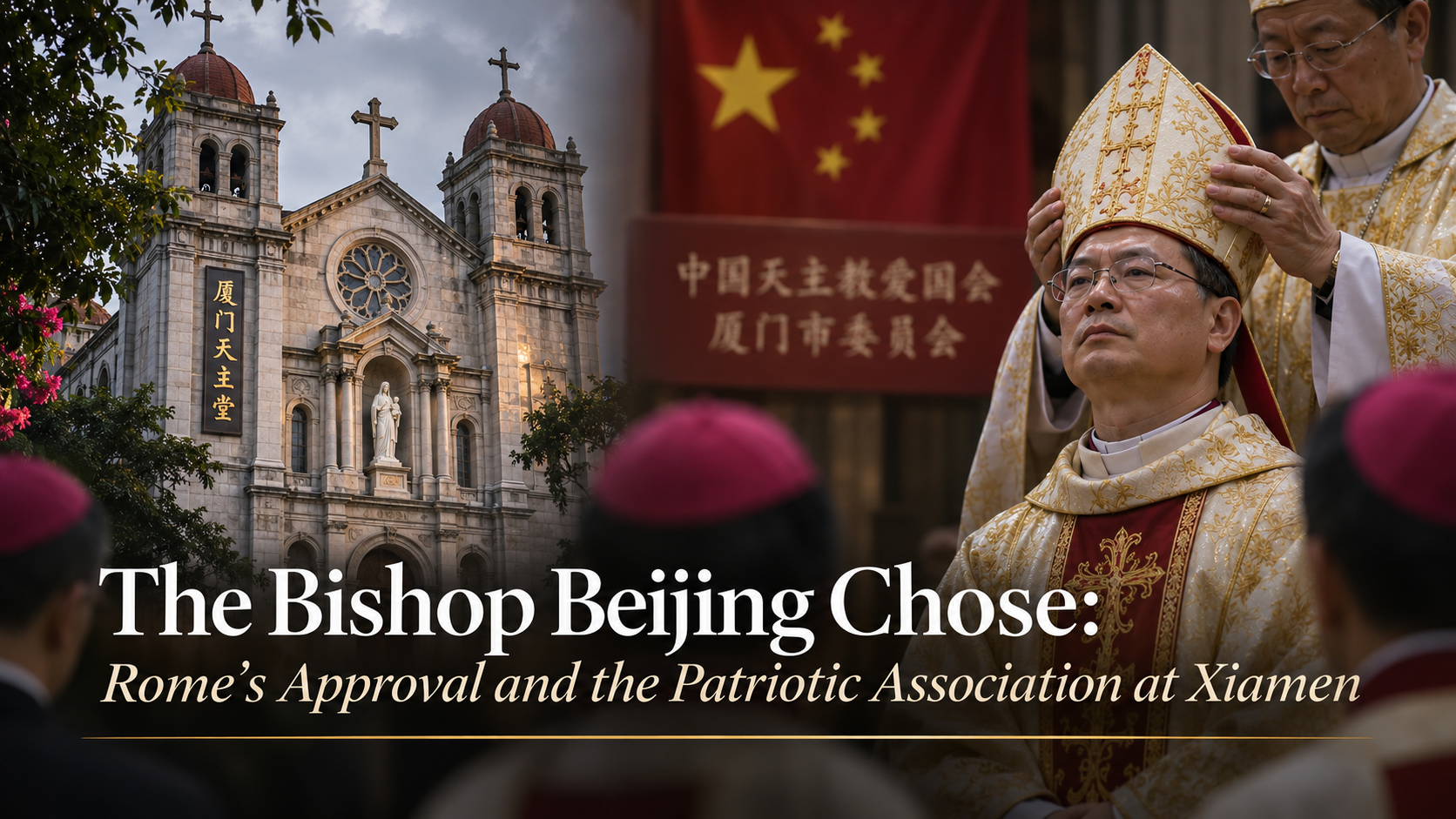
Joseph Liu Hengping has been consecrated Bishop of Xiamen with papal approval. Chinese records establish that he was elected bishop-designate nearly four months before the papal appointment and held senior offices within the state-supervised Catholic Patriotic Association. What those arrangements mean for the freedom of a Catholic bishop deserves more than a recital of diplomatic success.
On 18 November, Joseph Liu Hengping was consecrated Bishop of Xiamen in China’s Fujian province, following an appointment made by Pope Leo XIV on 15 October. The Holy See confirmed that the Pope had approved Liu’s candidacy within the framework of the provisional agreement between Rome and Beijing. The ceremony was presided over by Bishop Joseph Yang Yongqiang of Hangzhou, assisted by five other Chinese bishops, with approximately five hundred clergy, religious and lay faithful attending.1
As episcopal appointments under the agreement have become increasingly regular, the Holy See has generally presented them as evidence that a workable procedure now exists for providing bishops to Chinese dioceses. The claim is not without substance. The Church requires bishops, and the difficulties attending episcopal appointments in China have caused prolonged uncertainty and division. There is genuine pastoral benefit when a diocese receives a bishop recognised by Rome and able to exercise his ministry openly.
A report published by the Chinese Catholic Patriotic Association on 10 June records that Fr Liu chaired a meeting of the Zhangzhou Catholic Patriotic Association on 4 June, identifying him as chairman of the municipal body. The published agenda was concerned with much more than the maintenance of buildings or accounts. It included political study, personnel management, financial administration, the control of online activity and disciplinary rules. Those present studied regulations governing religious affairs and were instructed in the application of state policy, including the requirement that religious personnel practise socialist core values and refrain from unauthorised online religious activity.2
This was no distant association inferred from an ecclesiastical ceremony. Liu presided over a meeting explicitly concerned with applying the state’s political and regulatory expectations to Catholic organisations. More significantly, a register issued by Fujian’s provincial government records him as a vice-chairman of both the provincial Catholic Patriotic Association and the Catholic Ecclesiastical Affairs Committee, following changes filed on 30 January 2026. The Chinese authorities’ account of his episcopal consecration likewise describes him as a deputy head of the province’s official Catholic bodies. The new bishop’s involvement is therefore established at both municipal and provincial levels, and by public administrative records rather than conjecture.3
That fact does not establish that Liu has acted contrary to Catholic doctrine, nor does it reveal the circumstances in which he accepted or exercised the chairmanship. Chinese Catholic clergy operate under circumstances which differ substantially from those enjoyed by clergy in societies where the Church possesses greater institutional freedom. Participation in recognised bodies may be regarded as necessary for the maintenance of ordinary pastoral activity. Nevertheless, the institutional connection is relevant to an episcopal appointment whose purpose is to ensure that the Church in China possesses bishops capable of exercising their office in communion with the successor of Peter.
The chronology is now independently established by the Chinese ecclesiastical authorities themselves. Their report of 18 November states that Liu was elected bishop-designate on 29 June 2026, whereas the papal appointment was dated 15 October, one hundred and eight days later. It was not publicly announced by the Holy See until the day of the consecration. The same Chinese report states that Fr Yang Yu, secretary-general of the state-recognised Chinese bishops’ organisation, read its document of approval during the ceremony. This is no longer a date which need be cautiously attributed to secondary reporting: the Chinese organisation concerned has placed it on the public record.4
The order of the public announcements does not tell us when Rome was first consulted, whether alternative candidates were considered or whether the Pope exercised an effective right to reject the nominee. Those matters remain hidden by the confidentiality of the agreement. What the published evidence does establish is that an election organised within the official Chinese structures preceded the papal appointment and that the Chinese bishops’ organisation publicly expressed its own approval at the consecration. Neither the legitimacy of the papal mandate nor the sacramental validity of the new bishop is thereby called into question. The issue is whether the Pope’s authority is exercised with real freedom, and whether the bishop, once appointed, can govern without political obligations incompatible with his office.
Pius XII confronted the underlying difficulty in Ad Apostolorum Principis in 1958, when a national Catholic organisation was being constructed under Communist authority and consecrations without a pontifical mandate endangered ecclesiastical unity. He distinguished the legitimate aspiration for a native Chinese clergy and hierarchy from a programme which would subject Catholic teaching and government to a political authority alien to the Church’s constitution. China’s circumstances have changed, particularly in this instance because Rome has approved the consecration. The principle has not: a bishop’s teaching office cannot be derived from the state or constrained by a political programme.5
Benedict XVI was equally careful in his 2007 letter to Chinese Catholics. He recognised that civil authorities may have legitimate concerns about the social consequences of episcopal appointments and envisaged an agreement over candidates and their civil recognition. He nevertheless insisted upon the Holy See’s freedom to appoint bishops and explained why the official bishops’ organisation as then constituted could not be recognised as an episcopal conference by Rome. Some circumstances have changed since that letter, including the reconciliation of bishops formerly considered illegitimate; it would be wrong simply to transfer every judgement about the personnel of 2007 to 2026. The distinction between cooperation over civil affairs and subjection in matters of faith and ecclesiastical government remains decisive.6
The local history also complicates any account which treats Xiamen merely as an ecclesiastical vacancy. Joseph Cai Bingrui, formerly its bishop, was transferred to Fuzhou in January 2025 with papal approval. Agenzia Fides reports that Xiamen has more than thirty thousand Catholics, eleven parishes, forty-two churches and approximately twenty priests. Liu subsequently assumed greater responsibility for local pastoral initiatives, including visits to the families of priests and religious and the organisation of sacred music. The diocese has also sustained catechetical work and preparations associated with the Jubilee. Such details concern a living Catholic community whose spiritual welfare must be taken seriously. Precisely because its sacramental and pastoral life is real, the freedom of its bishop to teach and govern cannot be a secondary question.7
The official records place Liu within a structure whose published activities extend to political education and compliance with the state’s regulations for religion. Civil government may properly enact laws concerning public safety, property, financial accountability and other matters within its competence; the Catholic Church does not claim exemption from every civil obligation merely because she is a religious body. She cannot, however, acknowledge the state as an authority over the content of doctrine, sacramental communion or the essential responsibilities of bishops. The question raised by the Zhangzhou meeting is therefore practical. When a political programme is introduced into the management and formation of Catholic organisations, how are the respective demands of the Patriotic Association and episcopal office to be reconciled? The report does not prove that Liu has surrendered his ecclesiastical responsibilities. It does establish that the question concerns offices which he himself has held.
The presence of Bishop Vincent Zhan Silu of Mindong among those assisting at the consecration gives the event a further historical significance. Mindong figured prominently in the first consequences of the Vatican–China rapprochement, when Bishop Vincent Guo Xijin, previously recognised by Rome, was asked to yield his position to Zhan. The experience of unregistered Catholics and the difficulties surrounding that transition have been considered in previous Nuntiatoria investigations.8 Zhan’s participation at Xiamen is not evidence that the new consecration was irregular. It illustrates the developing composition of the Chinese hierarchy under the agreement and the extent to which earlier disputed episcopal arrangements have become part of its ordinary institutional life.
The wider context is supplied by the recent conference at the Pontifical Urbaniana University marking the centenary of the first Chinese bishops consecrated by Pius XI in 1926. Archbishop Joseph Li Shan of Beijing defended the policy of Sinicisation, while Leo XIV and Cardinal Pietro Parolin spoke of the importance of ecclesiastical communion and the relationship between the bishops and the successor of Peter. Nuntiatoria examined the differing assumptions present in those interventions on 6 November.9 The consecration at Xiamen offers a concrete test of the arguments advanced in those interventions. Rome has appointed a bishop and publicly acknowledged his consecration. Chinese Catholics have received a new ordinary. Both developments have pastoral significance. The accompanying evidence shows that the man chosen has also exercised an office within the local Patriotic Association, an institution whose function and governing commitments require careful consideration in any discussion of ecclesiastical independence.
Liu’s offices do not, in themselves, establish personal infidelity, and the exceptional pressures under which Chinese Catholics live forbid any facile judgement about individual motives. They do establish the institutional responsibilities of the man whom Rome has now entrusted with the government of Xiamen. The Holy See may judge that its agreement with Beijing provides the best practicable means of repairing decades of disputed episcopal appointments and preserving Catholic life. That prudential judgement must be assessed by more than the number of consecrations. The contents of the agreement are undisclosed, leaving unanswered how freely the Pope exercises his choice of candidates. The records at Zhangzhou and Fujian raise the equally important question of what freedom a bishop retains afterwards. When the claims of state policy and the obligations of his sacred office diverge, will the Bishop of Xiamen be able to act as a Catholic bishop, or as an official required to implement a political programme? The available documents establish the grounds for asking. They do not yet provide the answer.
FOOTNOTES
¹ Holy See Press Office, Consecration of the Bishop of Xiamen, 18 November 2026; Agenzia Fides, Joseph Liu Hengping Appointed Bishop of Xiamen, 18 November 2026
² Chinese Catholic Patriotic Association, Zhangzhou Internal Management Meeting, 10 June 2026
³ Fujian Provincial Department of Civil Affairs, Registered Changes to Catholic Association Leadership, February 2026; Chinese Catholic Authorities, Consecration of Bishop Liu Hengping in Xiamen, 18 November 2026
⁴ Chinese Catholic Authorities, Consecration of Bishop Liu Hengping in Xiamen, 18 November 2026; Xinde, Reproduction of the Xiamen Diocesan Announcement, 18 November 2026; Catholic Herald, New Chinese Bishop Consecrated with Papal Approval, 18 November 2026
⁵ Pius XII, Ad Apostolorum Principis, 29 June 1958
⁶ Benedict XVI, Letter to Chinese Catholics, 27 May 2007, §§8–9
⁷ Holy See Press Office, Transfer of Bishop Joseph Cai Bingrui, 23 January 2025; Agenzia Fides, Joseph Liu Hengping Appointed Bishop of Xiamen, 18 November 2026
⁸ Nuntiatoria, The Bishops in the Shadows, 28 August 2026
⁹ Nuntiatoria, Beijing’s Church, Rome’s Approval, 6 November 2026; Agenzia Fides, Cardinal Parolin at the Conference on the First Chinese Bishops, 5 November 2026




Leave a Reply