
Bells and adhāns in Beirut: ambiguity at Martyrs’ Square
Introduction
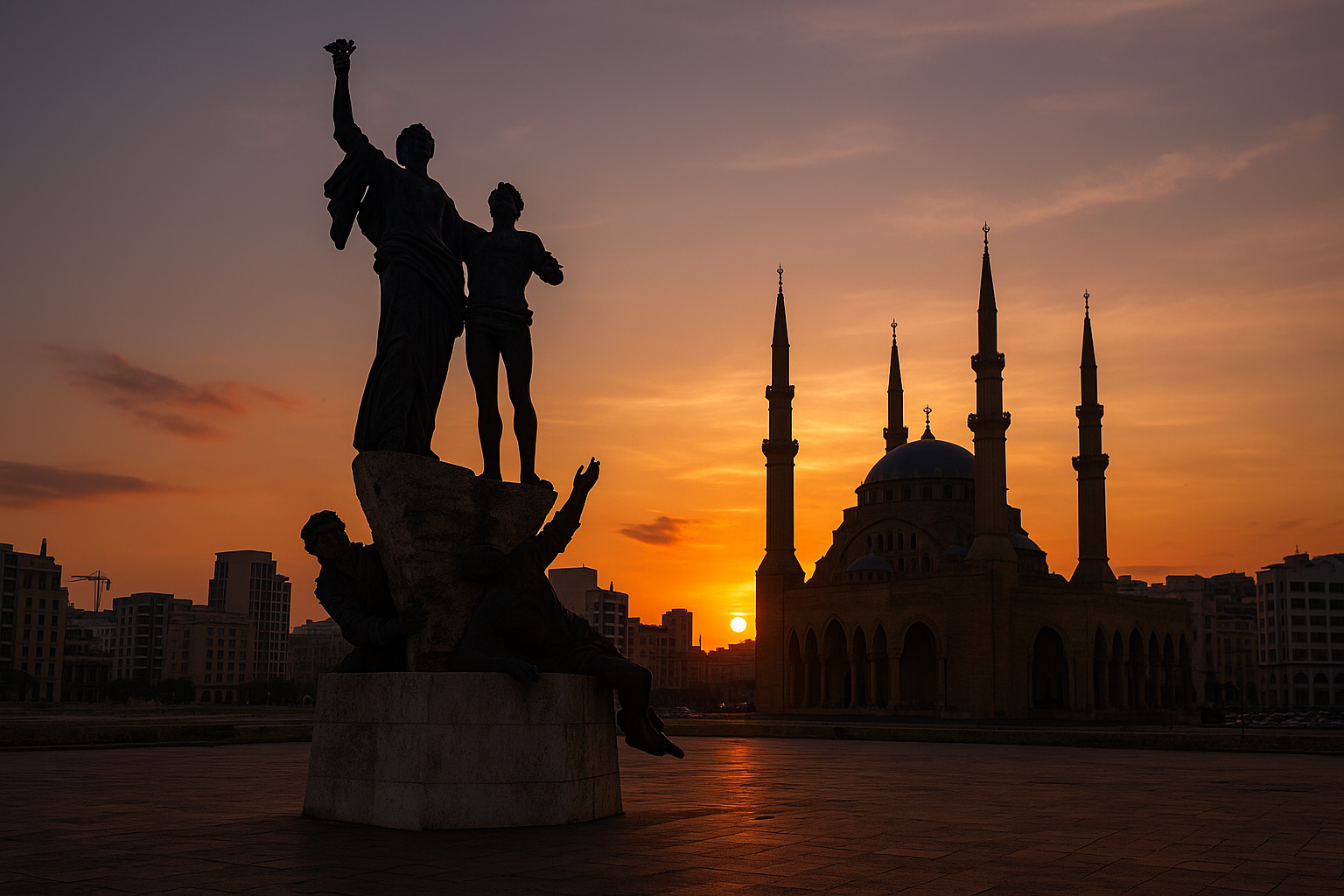
On 1 December, Pope Leo XIV addressed a vast interfaith gathering in Martyrs’ Square, Beirut. In a speech marked by poetic sentiment, he appealed for a “single hymn” uniting the Catholic bell and the Islamic adhān as praise to “the one God.” The world’s press welcomed the symbolism as a powerful image of peace. Yet for Catholics who measure words not by sentiment but by revealed truth, the event exposed once more the deep doctrinal ambiguity that has characterised this pontificate.
Having appeared hopeful with his Christological emphasis early in his pontificate, Leo XIV now seems willing to set aside the exclusivity of Christ and of the Catholic faith in order to promote a broad project of interfaith and inter-denominational progressivism. The Beirut address, precisely because it was so carefully staged and symbolically loaded, crystallises this shift.
Martyrs’ Square and the weight of history
Martyrs’ Square is not a neutral civic venue. It commemorates, among other things, the execution of Lebanese and Syrian nationalists by the Ottoman authorities in 1916, many of them Christian figures who died under an Islamic imperial regime⁽²⁾. The place is marked by memories of conflict, contested sovereignty, and the suffering of Christians in a Muslim-majority context.
To stand on such ground and evoke the blending of Christian bells and Islamic calls to prayer into “a single hymn” is therefore not a harmless piece of poetic license. It invites the question: what kind of “unity” can exist between acts of worship that explicitly contradict one another at the most basic level, namely, who God is and who Jesus Christ is?
What the Pope actually said
According to the published text, Leo XIV declared in Beirut that “minarets and bell towers rise side by side… testifying to the enduring faith of this land in the one God,” and appealed: “may every bell and every adhān resound together: may every call to prayer be founded in a single hymn”⁽¹⁾. The language is deliberately elevated and affective.
Yet the problem is not the desire for peace, nor even for civic concord among believers of different religions. The problem is theological: these words suggest, or at least strongly imply, that Christian and Muslim worship are oriented in substance toward the same God in such a way that their liturgical voices can be portrayed as one.
But Islam’s confession of God explicitly rejects the Trinity, denies the Incarnation, and repudiates the salvific meaning of the Cross. Islamic monotheism is not an incomplete Christianity awaiting fulfilment; it is, at the dogmatic level, a structured rejection of Christianity’s central mysteries. To speak, in such a context, of “one God” in a way that seems to relativise these contradictions risks treating revelation itself as negotiable.
Nostra Aetate and the “same God” question
Defenders of this kind of language appeal quickly to Nostra Aetate §3, where the Council states that Muslims “adore the one God, living and subsisting in himself; merciful and all-powerful, the Creator of heaven and earth”⁽³⁾. This sentence has long been controversial in traditional circles, not because it is false in every respect, but because it is imprecise in a highly charged domain.
At the level of natural theology, there is a sense in which Christian and Muslim discourse can be said to refer to the one Creator, since there are not two or three “creators” of heaven and earth. But as soon as we speak of adoration and of revealed faith, the difference becomes decisive. The “one God” whom the Church confesses is Father, Son, and Holy Ghost. The “God” of the Qurʾān is defined in part by a categorical denial that God could have a Son.
Dr Peter Kwasniewski has rightly noted that Nostra Aetate’s statements “about Christians and Muslims adoring the same God” stand among the “real problems” in certain conciliar formulations that call for later correction or clarification⁽⁴⁾. The Beirut imagery does not correct this ambiguity; it radicalises it, turning a contested conciliar sentence into a liturgical-symbolic project.
Dominus Iesus and Redemptoris Missio: clarity against pluralism
The irony is that the post-conciliar magisterium has itself warned, in unusually strong terms, against precisely the theological relativism that the Beirut discourse appears to presuppose.
In Redemptoris Missio §5, Pope John Paul II recalls the witness of the early Church: “Christ is the one Savior of all, the only one able to reveal God and lead to God”⁽⁵⁾. Salvation “can only come from Jesus Christ,” because no other name is given under heaven by which men must be saved. This is not a negotiable emphasis but the foundation of the Church’s missionary mandate.
The Declaration Dominus Iesus reaffirms that “those solutions that propose a salvific action of God beyond the unique mediation of Christ would be contrary to Christian and Catholic faith”⁽⁶⁾. It insists that the one Church founded by Christ is the “universal sacrament of salvation” and that this truth must not be set in opposition to God’s universal salvific will⁽⁶⁾.
Read in this light, the Beirut proposal that bells and adhāns form “a single hymn” risks suggesting precisely such a “salvific action of God” independent of Christ’s mediation and the Church he founded. It moves from a legitimate recognition that God’s grace can work mysteriously in every heart to an illegitimate flattening of doctrinal contradiction at the level of public worship.
Do Christians and Muslims worship the same God?
The question is often posed in abstract form, but the Beirut event forces it in concrete terms. When the Catholic bell rings, it summons the faithful to the Eucharistic Sacrifice: to adore the Son of God, true God and true man, really present on the altar, who died and rose for our salvation. When the muʾadhdhin intones the adhān, he proclaims that “Allah is the greatest” and that “Muhammad is the messenger of Allah,” while explicitly denying that God can have a Son.
Cardinal Gerhard Müller has argued that, because of the Trinity, “we [Christians] cannot pray like or with Muslims” in a way that suggests a shared liturgical faith, since the very distinction of the three divine Persons entails “a fundamental difference in belief in God and in the image of man” compared with other religions⁽⁷⁾. His concern is not political but theological: worship expresses what we truly believe about God.
Bishop Athanasius Schneider has gone further, warning that the idea that God positively wills a plurality of religions is “contrary to divine revelation,” and insisting that “Christianity is the only God-willed religion”⁽⁸⁾. His critique is directed precisely at the pastoral habit of speaking as though different religions were complementary paths to the same salvific reality.
Leo XIV’s trajectory: from Christological hope to interfaith progressivism
Many Catholics hoped, at the beginning of Leo XIV’s pontificate, that his evident comfort in speaking about Christ might herald a recovery of doctrinal clarity after decades of confusion. Early addresses seemed to place renewed emphasis on the person of Jesus, the Cross, and the need for conversion.
The Beirut speech suggests otherwise. The Christological centre of gravity is now displaced by a narrative of “Abrahamic” togetherness and “shared faith in the one God,” in which explicit confession of the Trinity and the Incarnation is conspicuous by its absence. Leo XIV appears to have accepted the logic of a project in which interfaith and inter-denominational progressivism becomes the chief instrument of “peace,” even at the cost of silencing those truths that alone can bring true reconciliation.
The contemporary category of “Abrahamic religions” illustrates this shift. As historians note, the term itself is a twentieth-century construct, developed above all by figures such as Louis Massignon and popularised in recent decades as a tool of interfaith diplomacy⁽⁹⁾. Whatever limited descriptive use it may have, it is unknown to the Fathers, the Doctors, and the pre-conciliar magisterium. To make it foundational for Catholic theology risks replacing the concrete scandal of the Cross with an abstract family resemblance around the figure of Abraham.
Mary of Lebanon — but which Christ?
Leo XIV concluded in Beirut by invoking Our Lady of Lebanon, a title dear to Maronite Catholics whose fidelity has been tested by war, persecution, and emigration. Marian devotion is, of course, deeply rooted in the Middle East; even the Qurʾān grants Mary an honoured place, though in a radically different theological horizon.
Yet here, too, the logic of the address is dissonant. Mary is Theotokos, Mother of God incarnate, the woman through whom the eternal Son assumed our flesh. Her whole identity is bound up with the confession that Jesus is “true God of true God… consubstantial with the Father.” To place her at the end of a discourse that carefully avoids confessing the divinity of her Son risks instrumentalising her as a symbol of generic monotheistic unity.
If Christ is not proclaimed, Mary cannot be rightly understood. Her last recorded words in Scripture are not an invitation to dialogue but a command: “Do whatever he tells you” (Jn 2:5). To invoke her while leaving the uniqueness of her Son in the shadows is not Marian piety but the use of Marian imagery in the service of a different agenda.
Named critics and the need for a future correction
Taken together, recent papal gestures have prompted a growing chorus of theologians and pastors who insist that the Church’s magisterium must one day clarify the limits of acceptable language in interreligious contexts.
Bishop Schneider has repeatedly argued that certain formulations of Vatican II, especially in Nostra Aetate, are in need of doctrinal correction to prevent their abuse in favour of religious relativism⁽⁸⁾. Cardinal Müller warns that any approach which sidelines the confession of the triune God effectively undermines Christian anthropology and soteriology⁽⁷⁾. Kwasniewski explicitly lists Nostra Aetate’s treatment of Christians and Muslims “adoring the same God” among those conciliar expressions that have generated serious problems and require a more precise hermeneutic of continuity — or, if necessary, revision⁽⁴⁾.
The Beirut event will undoubtedly become a key reference in this ongoing debate. It encapsulates the unresolved tension between the post-conciliar desire for dialogue and the perennial obligation to proclaim Christ as the unique Savior and his Church as the ark of salvation.
Five points of Catholic clarity
Events like the one in Beirut make it urgent to restate several truths which no Catholic may surrender:
- The object of worship matters. Catholics do not, in the strict theological sense, worship in common with religions that deny the Trinity and the Incarnation⁽⁶⁾.
- Christ is not one path among many. He is “the one Savior of all, the only one able to reveal God and lead to God”⁽⁵⁾.
- The Church exists to evangelise. Interreligious dialogue has a legitimate role, but it must never replace the mandate to “make disciples of all nations.”
- The blood of martyrs refutes syncretism. Christians have died rather than utter a formula implying that Jesus is only a prophet or that all religions are equal. Their witness stands in silent contradiction to any rhetoric of a “single hymn.”
- Peace without truth is fragile and false. Authentic peace is the fruit of justice and truth. A peace built on doctrinal confusion is a truce with error, not the reconciliation willed by God.
Conclusion
Lebanon’s sufferings and its delicate confessional balance rightly move Catholic hearts to pray for peace and to support every just effort at coexistence. But the Church cannot serve that peace by blurring the identity of God or by suggesting that worship which denies the Son can be harmonised with Eucharistic adoration.
Bells and adhāns cannot form a single hymn in any theological sense. They signify two radically different visions of God, revelation, and salvation. To pretend otherwise is to surrender the content of the Gospel in the name of a unity built on sentiment.
Let the bells ring, then — but clearly, purely, and unapologetically. Let them call souls to the worship of the Father, through the Son, in the unity of the Holy Ghost. Let them sound not as one voice among many in a religious marketplace, but as the audible sign of the one true faith, offered to all and compromised for none.
And let Catholics pray for the Pope — not to succeed in a project of syncretic diplomacy, but to recover the courage to speak plainly of Christ, “the same yesterday and today and forever” (Heb 13:8), Lord of Lebanon and of every nation.
¹ Based on the official transcript of Pope Leo XIV’s address at the ecumenical and interreligious encounter in Martyrs’ Square, Beirut, 1 December 2025.
² On the historical significance of Martyrs’ Square, including the execution of Lebanese and Syrian nationalists by Ottoman authorities in 1916, and subsequent memorialisation.
³ Second Vatican Council, Nostra Aetate (28 October 1965), §3.
⁴ Peter A. Kwasniewski, “Catholic Obedience to Unfaithful Church Leaders,” interview material.
⁵ Pope John Paul II, Redemptoris Missio (7 December 1990), §5.
⁶ Congregation for the Doctrine of the Faith, Dominus Iesus (6 August 2000), §§14, 16.
⁷ Gerhard Ludwig Müller, “The Gift of Filial Adoption,” Catholic World Report, commentary on religious dialogue and the Trinity.
⁸ Athanasius Schneider, “The Unique Role of the Catholic Church in Salvation” and related interventions on interreligious dialogue.
⁹ Guy G. Stroumsa, “From Abraham’s Religion to the Abrahamic Religions,” Historia Religionum 3 (2011), and related scholarship on the modern origins of the category.
RELATED ARTICLES


Latest ARTICLES
- TRADITION BEHIND THE FENCEThe Vatican’s prohibition of the traditional Ad Petri Sedem pilgrimage to St Peter’s Basilica has sparked controversy, especially among traditional Catholics. While some cite scheduling conflicts, the broader issue lies in the restrictive policies of Traditionis custodes, which may confine traditional liturgical practices to specific enclaves, risking the transmission and recognition of Catholic Tradition within the wider Church.
- Today’s Mass: October 24 St Raphael the ArchangelThe Feast of Saint Raphael the Archangel highlights his healing powers as depicted in the Book of Tobit, where he aids Tobit and his son, Tobiah. Venerated as a protector of travellers and the blind, Raphael is celebrated for his miraculous interventions. His legacy includes support for nurses, matchmakers, and Catholic studies.
- 25.10.26 Nuntiatoria CXXIX: CHRISTUS REXThe text discusses the relationship between Christ’s kingship and authority within the Church amidst contemporary challenges. It contrasts ecclesiastical power with genuine faith, emphasising that authority must protect divine truth rather than alter it. The witness of imprisoned priests illustrates the enduring significance of fidelity to Christ over institutional conformity.
- THE DOMESTIC CHURCH: 25 October – 2 November 2026 A Home with Room for Heaven: Preparing for All Saints and All SoulsThe content outlines a week’s plan for traditional Catholic families to prepare for the feasts of All Saints and All Souls. Emphasising daily prayers, remembrance of the deceased, and engagement with children’s activities, it aims to integrate Catholic customs into family life, enriching spiritual practices and fostering a shared faith experience.
- ORDO w/c 25.10.26The text outlines the liturgical calendar for the last week of October and the beginning of November, highlighting key celebrations. Notable events include the Feast of Christ the King, St Evaristus, the Vigil of Saints Simon and Jude, and the Feast of All Saints, emphasising themes of holiness, unity in faith, and the Church’s teachings.




Leave a Reply