
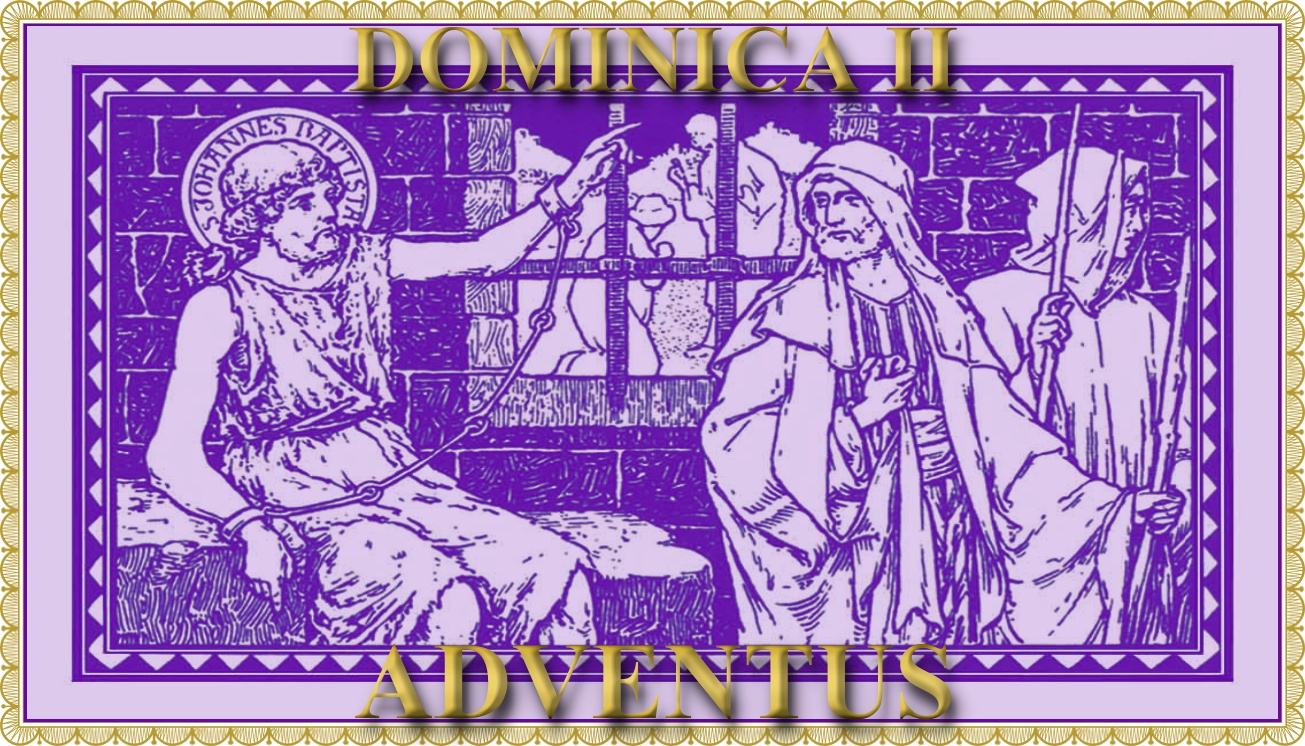
THE SECOND SUNDAY OF ADVENT: PROPHECY, HOPE, AND THE COMING KING
Introduction
The Second Sunday of Advent in the traditional Roman Rite (Missa “Populus Sion”) stands as one of the most theologically rich stations in the Church’s ascent toward Bethlehem. Where Advent I announces judgment and the need for vigilance, Advent II lifts its voice with a promise: “Populus Sion, ecce veniet Dominus ad salvandas gentes.” The liturgy moves forward with quiet majesty, teaching the faithful to expect the Lord not merely with sentiment, but with the deep hope formed by Scripture, the stern humility embodied by St John the Baptist, and the upward movement of the soul toward the vision of God.
The Tridentine liturgy retains intact the ancient Roman instinct that Advent is always double: an expectation of the Incarnation and an anticipation of the Parousia. The two comings are not parallel themes but a single mystery, experienced in different modes. Advent II holds them together more tightly than any other Sunday of the season.
The Living Voice of Isaiah
The Introit, drawn from Isaiah, speaks not of a distant dream but of an impending divine visitation. The Fathers held that prophecy does not merely recall the past but makes divine truth present to the praying Church. St Jerome notes that the prophetic word “sounds anew whenever proclaimed,” for Scripture is a living voice, not a historical document⁽¹⁾.
This Sunday therefore restores the Church to the position of ancient Israel: waiting, longing, and stretching out toward the promised Redeemer. In the Tridentine Rite, Isaiah’s cry becomes the Church’s own cry; the longing of the Old Covenant becomes the longing of the Bride awaiting her Bridegroom. The faithful do not imagine what Israel once felt—they are invited to feel it themselves by participating in the very same promises.
The Epistle: Scripture as the School of Hope
St Paul’s words to the Romans stand at the heart of Advent II: “Whatsoever things were written, were written for our learning; that through patience and the comfort of the Scriptures, we might have hope.” Hope in the Christian sense is not optimism but a virtue infused by grace. St Thomas Aquinas teaches that hope is formed when the soul recognises a divine promise too great for its own strength—yet guaranteed by God’s fidelity⁽²⁾.
Thus the Epistle announces Christ as both the fulfilment of the patriarchal promises and the revelation of God’s mercy to the Gentiles. Advent II therefore marks the moment when Israel’s expectation becomes universal. The Church becomes the new Sion into which all nations are gathered. The chants of the day express this widening horizon: what Isaiah spoke to Jerusalem, the liturgy now sings to the world.
John the Baptist: The Forerunner of Every Christian Soul
The Gospel introduces St John the Baptist at the moment when his public mission nears completion. Imprisoned under Herod, he sends his disciples to Christ with the question: “Art Thou He that art to come?” The Fathers are clear that John does not ask for himself. St Gregory the Great insists that the Baptist sends them “to learn from the Lord what he had already proclaimed, that they might transfer their loyalty to Him”⁽³⁾.
Christ’s reply is itself a proclamation of prophecy fulfilled: the blind see, the lame walk, the lepers are cleansed, the dead rise. These works correspond precisely to Isaiah’s signs of the Messiah. In this, the Lord does not merely declare who He is—He reveals that the promises of God have entered history and taken flesh.
John the Baptist thus becomes the prototype of Christian asceticism: the one who decreases so that Christ may increase. St Augustine remarks that John personifies the diminishing of the Old Covenant in the presence of the true Light⁽⁴⁾. The Tridentine liturgy uses his example to instruct the faithful that Advent is not merely preparation for a feast; it is the lifelong work of interior purification that makes the soul ready to receive the Lord.
The Collect: Excita, Domine—Awaken Us
The Collect of this Sunday is among the most beloved of the Advent season: “Stir up our hearts, O Lord, to prepare the ways of Thine only-begotten Son.” The Latin excita carries the strong sense of rousing from lethargy, stirring to life, summoning to action. This establishes a central Advent truth: the work of preparation is itself a grace.
The Church confesses here that she cannot prepare the way for Christ unless God Himself awakens the heart. The Second Council of Orange teaches that even the beginning of faith arises through prevenient grace⁽⁵⁾. The liturgy therefore rejects all Pelagian self-reliance. Advent preparation is real, but it is always a response to the divine initiative.
From Exile to Ascent: The Arc of the Mass Propers
The Offertory expresses the interior poverty of the season: “Wilt Thou not revive us again, O God?” It is the cry of a people who know they cannot save themselves. But the Communion antiphon completes the drama: “Jerusalem, arise and stand on high, and behold the joy that cometh to thee from thy God.”
Here the ancient Roman Rite manifests its gift for dramatizing the spiritual life. The soul is carried from supplication to vision, from exile to elevation. Origen interprets Jerusalem’s “arising” as the ascent of the soul into contemplation⁽⁶⁾. The Tridentine liturgy preserves this upward movement without flattening it, guiding the faithful from the longing of Advent to the joy of beholding the Coming King.
Christ the Consoler and Christ the Judge
Advent II presents Christ in a double aspect: gentle Consoler and majestic Judge. The ancient Church saw no contradiction here. St Cyril of Jerusalem teaches that the Christian lives “between the two comings”—first in mercy, later in glory⁽⁷⁾.
The traditional liturgy refuses to sentimentalise the Incarnation. The Child of Bethlehem is the Lord who will return in splendour, and the Church keeps both truths before the faithful. This Sunday therefore deepens the Advent tension: longing for mercy and trembling before majesty.
It is a tension necessary for true conversion. Without the Judge, Advent becomes sentiment; without the Consoler, it becomes dread. The Tridentine Rite preserves the balance that shapes Christian maturity.
Conclusion: The Church Beside the Jordan
In the theology and prayer of this Sunday, the Church stands mystically beside the Jordan with John the Baptist, listening for the footsteps of the Messiah. She takes upon her lips the oracles of Isaiah, receives the encouragement of the Apostle, and ascends toward the vision promised in the Communion antiphon.
The Second Sunday of Advent therefore forms the faithful in the posture proper to the Christian life:
a longing sharpened by repentance,
a hope sustained by Scripture,
a humility modelled on the Forerunner,
and an expectant joy directed toward the coming King.
The ancient liturgy does not ask the faithful merely to remember the coming of Christ; it teaches them to await Him. For Advent II proclaims that the Lord who once came in humility is the same Lord who now comes in grace and will one day come in glory.
- Jerome, Commentary on Isaiah, Preface.
- Thomas Aquinas, Summa Theologiae, II–II, q.17, a.1.
- Gregory the Great, Homilies on the Gospels, Homily 6.
- Augustine, Tractates on the Gospel of John, Tractate 6.
- Second Council of Orange (529), Canons 3–5.
- Origen, Homilies on Isaiah, Homily 4.
- Cyril of Jerusalem, Catechetical Lectures, Lecture 15
related articles


Latest articles
- Today’s homily: Christ the KingThe homily reflects on Christ’s kingship as seen in the Gospel narrative. It contrasts earthly authority with divine truth, emphasising that true allegiance to God requires genuine obedience and transformation. Believers are called to examine their personal commitments and respond to Christ’s demands in everyday life, ultimately recognising their identity as bearers of God’s image.
- Sermon for Christ the KingToday marks the celebration of Christ the King and the Twenty Second Sunday after Pentecost, a feast asserting Christ’s sovereignty against totalitarianism. St. Paul emphasised Christ’s supremacy over power and principalities, challenging early Gnostic beliefs. The early Church’s victory over evil is affirmed in Christ’s resurrection, offering hope and unity amidst contemporary struggles.
- Today’s Mass: October 25 SOVEREIGNTY OF OUR LORD JESUS CHRIST, SUPREME KINGThe Feast of the Sovereignty of Our Lord Jesus Christ celebrates Christ’s dual kingship by birth and conquest. Established by Pius XI, it aims to deepen faith and counter anti-clericalism. The liturgical observance underscores His authority as King, advocating for societal recognition of His reign to bring peace and harmony.
- TRADITION BEHIND THE FENCEThe Vatican’s prohibition of the traditional Ad Petri Sedem pilgrimage to St Peter’s Basilica has sparked controversy, especially among traditional Catholics. While some cite scheduling conflicts, the broader issue lies in the restrictive policies of Traditionis custodes, which may confine traditional liturgical practices to specific enclaves, risking the transmission and recognition of Catholic Tradition within the wider Church.
- Today’s Mass: October 24 St Raphael the ArchangelThe Feast of Saint Raphael the Archangel highlights his healing powers as depicted in the Book of Tobit, where he aids Tobit and his son, Tobiah. Venerated as a protector of travellers and the blind, Raphael is celebrated for his miraculous interventions. His legacy includes support for nurses, matchmakers, and Catholic studies.





Leave a Reply