
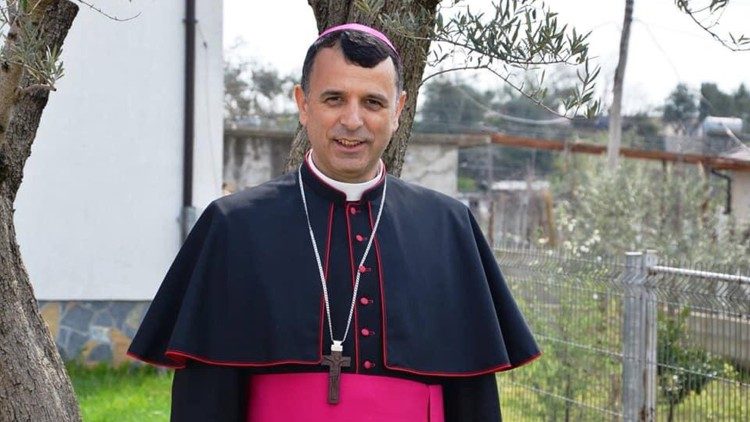
Simon Kulli (1973–2025): A Shepherd of Albania’s Resurrection
The Catholic Church in Albania, and the universal Church rejoicing in the rebirth of faith after persecution, mourn the sudden death of Bishop Simon Kulli, Bishop of Sapë, who died on 29 November 2025 at the age of fifty-two. His departure marks the end of a life that embodied the wounds and the glory of the Church in Albania: born under the regime that declared the country “the world’s first atheist state”, baptised secretly at the peril of his family, formed by living martyrs, and ordained among the first generation of priests in a free Church.

Born on 14 February 1973 in Pistull, northern Albania, he came into the world at the height of Enver Hoxha’s enforced atheism, when every religious sign was forbidden by law, and sacred objects became contraband. In this atmosphere of fear, his grandparents took him—when he was only a week old—to be baptised in secret. The sacrament was administered not by a priest, but by Sr María Kaleta, a Stigmatine religious who quietly baptised infants, carried the Eucharist from prisons, and sustained the faithful in hidden domestic chapels.¹ Such clandestine gestures were heroic in their simplicity: making the sign of the Cross could lead to imprisonment; teaching a child the Our Father could cost a family their freedom. Yet the faith endured, passed privately from memory to memory, from whisper to whisper, from crucifix hidden in a wall to the heart of a child.
The seeds of his priestly vocation were sown long before he spoke the words aloud. While the nation was still sealed behind ideological walls, he witnessed the resilience of priests who had survived forced labour, torture, and humiliation. He later recalled the moment that defined his vocation: the first public Latin Mass celebrated in his parish after the fall of the regime, presided over by a priest who had spent twenty-eight years in prison. Bent by suffering, his voice faltering, the old priest’s fidelity drew the young Kulli to the altar. In that moment, he felt the call to take the place of a man whose youth had been sacrificed for Christ.² His calling was therefore not abstract, but incarnate: born from the blood and tears of his elders.
After the collapse of the regime, he entered the Interdiocesan Seminary of Our Lady of Good Counsel in Shkodër in 1992, one of the first young Albanians to do so openly after decades of persecution.³ His formation coincided with a moment of institutional resurrection. Churches had been used as warehouses or stables; monasteries had been destroyed or converted into barracks; theological libraries had been burned. The task of rebuilding fell to men like him: young, unbroken by prison, but formed by those who were. The Church he entered was materially poor but spiritually rich, rooted in witness rather than structure.
He was ordained priest on 29 June 2000, and immediately entrusted with responsibilities beyond his years, serving as assistant parish priest, diocesan secretary, and later chancellor of the Diocese of Sapë.⁴ In these roles he became a bridge between generations: the persecuted clergy, many frail and marked by suffering, and the younger faithful who had never known formal catechesis. He helped restore sacramental life, rebuild pastoral structures, and support initiatives for the poor and elderly in rural communities whose cultural memory of the Church had survived silently in the home.
Following the death of Bishop Lucjan Avgustini in 2016, he was appointed diocesan administrator, and on 15 June 2017 Pope Francis named him Bishop of Sapë. He received episcopal consecration on 14 September 2017.⁵ In 2024, his brother bishops elected him Vice-President of the Albanian Bishops’ Conference, a recognition of his moral authority and his experience in rebuilding the Church from the roots. He also served as Commissioner for Pastoral Care to Health-Care Workers, combining sacramental ministry with advocacy for the dignity of the sick, and he was a member of the Executive Committee of the European Federation of Catholic Medical Associations (FEAMC).⁶ His voice in these contexts was marked by gentleness and realism: he spoke as someone who had grown up in a society that had once tried to erase faith from public life, and who understood that true healing always demands a spiritual horizon.
A distinctive theme of his ministry was his devotion to the Albanian martyrs, beatified in 2016, men and women whose fidelity to Christ under torture became the seed of a new Christian culture. He insisted that their final cry—“Long live Christ the King, Albania, and the Pope!”—remains a mission statement for the Church today: a proclamation that patriotism and universal communion are not opposites, and that loyalty to the Successor of Peter deepens, rather than diminishes, love of one’s nation.⁷ His preaching emphasised that the martyrs’ blood would produce vocations, not nostalgia: they did not die to preserve memories, but to ensure that Christ’s name would be confessed freely by future generations.
On 29 November 2025, he died suddenly in Vau i Dejës, reportedly from cardiac arrest.⁸ Local tributes described his death as “a wound for the Church”, not only for the loss of a bishop, but for the interruption of a story still being written. Presiding at funerals, visiting remote villages, listening quietly to the elderly—his episcopate had been marked not by grand projects but by the quiet presence through which a bishop becomes a father. Plans for his burial include days of public homage and interment at the Cathedral of Mother Teresa in Vau i Dejës, symbolising his union with the diocese he served.
Bishop Simon Kulli’s life narrates the path of the Catholic Church in Albania:
from the silence of a crucifix hidden inside a wall,
to the whispered baptism of a newborn,
to the first Mass after liberation,
to the rebuilding of parishes and seminaries,
to the teaching of a new generation.
His story is therefore not one chapter among others, but a key to understanding how the Church survives a political system designed to erase it: by fidelity, by hidden prayer, by sacramental life in the home, and by courage that refuses despair.
May he rest in eternal peace, and may his intercession strengthen the Church in Albania, inspire young people to the priesthood and religious life, and encourage all persecuted Christians to remain faithful, remembering that resurrection follows the cross, and that Christ always triumphs.
¹ Vatican News (Albanian edition), “Ndërron jetë ipeshkvi i Sapës, Imzot Simon Kulli,” report on the death of Bishop Kulli, 29 November 2025.
² Aid to the Church in Need, interview by Maria Lozano, “I was secretly baptised and my vocation is due to a priest who spent 28 years in prison,” 24 February 2025.
³ Vatican News (Albanian edition), biographical notice, 29 November 2025.
⁴ Catholic Hierarchy, “Bishop Simon Kulli,” biographical data and dates of ordination.
⁵ Catholic Hierarchy, “Bishop Simon Kulli,” episcopal appointment and consecration.
⁶ European Federation of Catholic Medical Associations (FEAMC), “In Memoriam: Msgr. Simon Kulli (1973–2025),” obituary tribute, 2025.
⁷ Aid to the Church in Need, interview by Maria Lozano, 24 February 2025.
⁸ Politiko and Shqiptarja, local reports on the death of Bishop Kulli, 29 November 2025.
RELATED ARTICLES


LATEST ARTICLES
- Today’s Mass: September 09 Day II in the Octave of The Nativity of the Blessed Virgin MaryThe feast of Our Lady’s Nativity, of ancient Eastern origin and established at Rome by the time of Pope St Sergius I, celebrates Mary as the immaculate New Eve and the dawn of salvation, the chosen tabernacle from whom the Redeemer would take His flesh. Today the Church also commemorates St Gorgonius, an officer of the imperial household at Nicomedia who, with his companion Dorotheus, embraced the Faith and suffered martyrdom under Diocletian in A.D. 303; his relics were later translated to Rome.
- NOMEN MANET, RES DEEST ~ The Name Remains; the Reality Is Lacking: Spiritual Conference for Nuntiatoria CXXIIThe content emphasises the disconnect between the names associated with Catholicism and the actual practices of faith. It highlights the importance of embodying belief through genuine actions, urging self-examination rather than mere external observance. Ultimately, it advocates for a restoration of sincerity in faith, calling individuals to authentically reflect their beliefs through their lives and worship.
- Mary Is Co-Redemptrix: Cardinal Burke Reopens Rome’s Marian ControversyCardinal Raymond Leo Burke has declared the Virgin Mary as “Co-Redemptrix” amidst controversy over the Vatican’s restriction on this title. The debate revolves around the appropriateness of certain theological language and whether terminology historically used can still accurately express Marian cooperation in Redemption without compromising Christ’s unique role.
- When Politics Defines Doctrine: Edmund Waldstein, Integralism and the New Boundary at HeiligenkreuzThe ongoing exclusion of Father Edmund Waldstein from teaching at Heiligenkreuz has sparked debate on the limits of acceptable Catholic thought, particularly regarding integralism and its relationship to Church doctrine. Critics argue that Waldstein and similar positions challenge both Catholic teachings and democratic values, raising questions about the intersection of faith and politics.
- Christianity Is Right ~ Not Right WingThe article discusses the distinction between Catholic orthodoxy and modern political ideologies, particularly the Right and Christian nationalism. It argues that Catholic beliefs about family, morality, and authority predate contemporary political classifications and should not be conflated with right-wing politics. The ordo amoris framework is presented as a guiding principle for evaluating political alliances while maintaining a focus on the common good and the Social Kingship of Christ.



Leave a Reply