
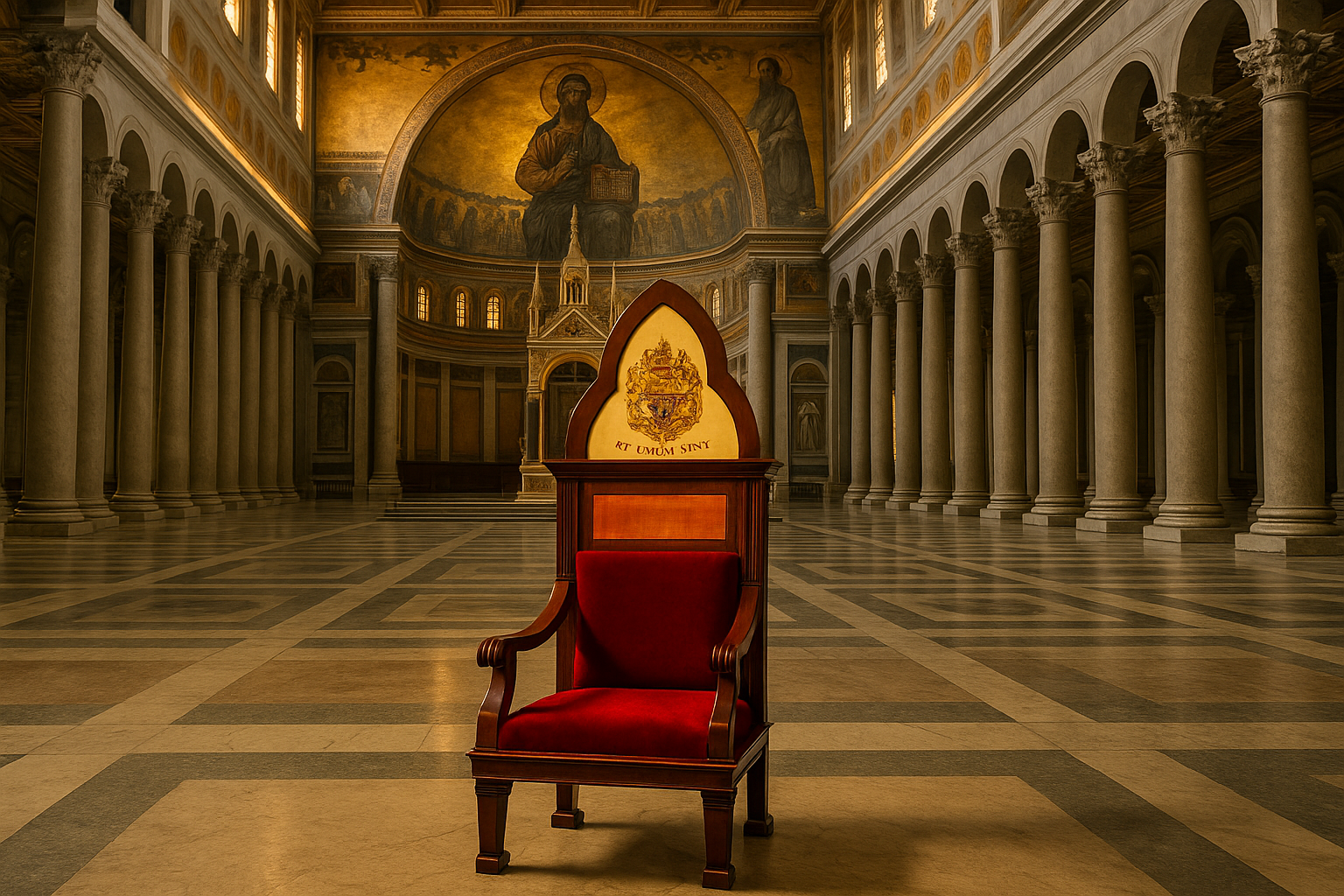
The Gilded Gesture: Ceremony Without Conversion in the Quest for Communion
The pageantry of diplomacy has always held a certain allure. Thrones, robes, and processions stir something instinctively noble in the imagination. Yet for the Catholic mind, ceremony must serve substance, beauty must speak truth, and splendour must always bow before sanctity. When these are divorced—when splendour is mistaken for sanctity or theatre for theology—the result is not harmony but confusion.
Such confusion was on full display in the Vatican’s reception of King Charles III and Queen Camilla. Cardinal Vincent Nichols, in his glowing account of the visit, spoke of “red carpets laid with precision,” of “great historical resonance,” and of “the healing of an ancient wound.” The words were tender, the sentiment sincere—but the theology perilous. For while the Cardinal celebrated the first “united voice” of Pope and King in centuries, he failed to name the true wound that separates Rome and England, and the only balm that could heal it.
The Illusion of Unity
To the casual observer, it seemed a triumph of reconciliation: the monarch of England praying alongside the successor of Peter, two ancient institutions long estranged meeting in amity. Yet this scene, so carefully choreographed, concealed more than it revealed. The wound between England and Rome was not political but doctrinal; not one of etiquette but of faith. It began with a crown set above the Cross—with a king declaring himself head of the Church, a Parliament abolishing the Mass, and bishops made servants of the State rather than shepherds of souls.
To stand beneath the frescoed vault of the Sistine Chapel and speak of “healing” without repentance is to build a bridge over a chasm rather than across it. As Nuntiatoria observed of the present pontificate, “The Vatican’s empty ecumenism pretends to honour Christian unity, but betrays Pius IX by diluting the dogmatic confrontation his pontificate required.”¹ “When the gesture of unity takes precedence over the confession of faith,” it continued, “the Church becomes an instrument of statecraft rather than a sign of the Kingdom.”²
The Catholic Church has never taught that unity can be negotiated; it must be embraced through conversion. Catholic Culture expressed this perennial truth succinctly: “Ultimately, ecumenism cannot avoid the question of conversion.”³ True unity is not achieved when Rome and Canterbury shake hands, but when hearts return to Peter and confess once more, Tu es Christus Filius Dei vivi. As Catholic World Report rightly noted, “Ecumenism had conversion to the Catholic faith as its ultimate aim.”⁴
The Drift of Empty Ecumenism
Since the Council, the temptation has been to soften difference, to replace clarity with cordiality, and to treat truth as an inconvenience to fraternity. Yet, as the SSPX observed, “There is no ecumenical reconciliation without conversion and renewal.”⁵ It is not intolerance to say that unity requires truth—it is love. Pius XI’s Mortalium Animos warned against the false ecumenism of sentiment: “The unique Church founded by Jesus Christ is the Catholic Church,” he wrote, “and unity cannot be sought by conceding or agreeing to things which concern the integrity of faith.”⁶
The Church once knew this instinctively. Pius IX, whose pontificate defined the Immaculate Conception and convoked Vatican I, anathematised “the proposition that Protestantism is a form of the true religion.”⁷ Yet today, the same Holy See that venerates him embraces ceremonies that obscure those anathemas under layers of diplomatic etiquette. Catholic Culture has warned that “genuine ecumenism requires the conversion of mind and heart to Christ, not the blurring of distinctions.”⁸
The Triumph of Spectacle
In Cardinal Nichols’s account, it is not truth but magnificence that takes centre stage: “The magnificence of the events enhanced the richness,” he wrote. Yet magnificence cannot mediate grace. The danger is not in splendour itself—beauty belongs to God—but in mistaking splendour for sacrament. As Nuntiatoria observed in its own critique, “When communion becomes a photo-op, the Sacrament risks being reduced to a symbol of statecraft rather than a means of grace.”⁹
This risk is not hypothetical. The same edition warned: “The liturgy was never meant to be a backdrop for royal diplomacy; yet today the Church seems content to place the Cross at the service of the Crown rather than place the Crown at the service of the Cross.”¹⁰ In such scenes, ritual is no longer a sign of divine reality but a prop for temporal reconciliation. “Ritual without conversion,” Nuntiatoria concluded, “is the luxury of the comfortable, not the challenge of the repentant.”¹¹
The SSPX has long made the same point: “Post-conciliar ecumenism has too often become the diplomacy of compromise rather than the charity of conversion.”¹² The resemblance is undeniable. Beneath the domes of Rome, symbols of devotion were refashioned into instruments of diplomacy—beauty pressed into service of politics rather than truth.
Even Cardinal Newman, whose own conversion transformed English Catholicism, would have recoiled from such theatre. “After his conversion,” as the MDPI Religions Journal notes, “he defended the authenticity of the Catholic Church as the true continuation of the apostolic faith, persistently nurturing a deep desire for Christian unity grounded in conversion.”¹³ Newman knew what the Church now forgets: that the way to unity runs not through protocol, but through penance.
The Martyrs and the Monarchs
When Cardinal Nichols speaks of “the ancient cooperation of Popes and Kings,” he invokes the splendour of medieval Christendom—but forgets its collapse. The England that once defended the Faith under St Thomas Becket became the realm that slew its priests and banished the Mass. The Cardinal’s joy in royal fraternity is therefore profoundly misplaced.
As Nuntiatoria wrote in its All Saints’ edition: “The Feast of the Blessed Martyrs of Douai recalls Catholics who chose exile to save the Mass, and yet their legacy is now betrayed by a Church that honours kings and crowns but forgets the altar.”¹⁴ It continued, “Honour is paid to the monarchy, but little honour remains for the hidden Mass, the barn-chapel, the recusant who would endure death rather than be silent.”¹⁵
Those martyrs were not ecumenists but confessors. They did not long for ceremonial rapprochement; they longed for the restoration of the Faith. Their blood sanctified English soil. The modern Church’s forgetfulness of their witness is not reconciliation but betrayal.
Faith as Ornament
In his closing paragraphs, Cardinal Nichols praises faith as “a resource for our human family,” aligning it with King Charles’s pluralist vision of religion as moral capital. Yet this is not the supernatural virtue of faith but its secular parody. “Empty honours and shared photos,” Nuntiatoria warned, “reveal a Church more eager for applause than apostolic fidelity.”¹⁶
Faith cannot be reduced to cultural heritage or moral consensus. It is not a civic virtue but a theological one, ordering man’s intellect to divine revelation. When faith becomes an instrument of social harmony rather than a participation in divine truth, it ceases to be faith at all. As the National Catholic Register recently observed of the very same event, “Some people see it very much as a bit of a superficial unity, which covers up serious theological differences.”¹⁷
Thus, in Rome’s attempt to appear magnanimous, it risks appearing faithless. The Cross is not a diplomatic emblem; it is a sign of contradiction.
The Hope That Does Not Disappoint
Cardinal Nichols concludes that these ceremonies speak of “hope” — of wounds healed and futures reconciled. Yet Christian hope is not built on sentiment or spectacle. It looks beyond earthly unity to divine fulfilment: “We hope for what we do not yet see; we wait for it with patience.” (Rom 8:25). Hope demands truth, and truth demands conversion.
Catholic Stand was right to remind readers that “Critics claim that Vatican II’s views on ecumenism are wrong because they contradict previous Church teaching.”¹⁸ Such tensions cannot be resolved by silence or smiles. The Church must recover her voice—the voice that once called nations to repentance, not merely to dialogue.
Thus the gilded gesture of October 2025—its prayers, chairs, and photographs—may have pleased courtiers, but it cannot heal the wound of separation. As Nuntiatoria has written elsewhere, the Church’s danger today is “diplomacy at the altar”: the appearance of unity masking the absence of faith. The true healing of England and Rome will not come through carpets and chorales, but through confession, conversion, and the Cross. Only when the monarch bows before Christ the King as servant of His Church, not patron of her ceremonies, will the ancient wound be healed. Until that day, every gesture remains gilded, but hollow.
¹ Nuntiatoria, “The Honour and the Heresy,” 24 Oct 2025.
² Ibid.
³ Catholic Culture, “Ecumenism: The Conversion Question,” 2024.
⁴ Catholic World Report, “Ecumenism, Proselytism, and the Danger of Doctrinal Ambiguity,” 2016.
⁵ Society of St Pius X, “True vs False Ecumenism,” fsspx.news.
⁶ Mortalium Animos, Pope Pius XI, 1928.
⁷ Nuntiatoria, “The Honour and the Heresy,” 24 Oct 2025.
⁸ Catholic Culture, ibid.
⁹ Nuntiatoria, “Rome’s Photo-Op Communion,” 24 Oct 2025.
¹⁰ Ibid.
¹¹ Ibid.
¹² SSPX.org, “What is the Problem with Ecumenism?” 2019.
¹³ MDPI Religions Journal, “Ecumenism of a Convert: John Henry Newman’s Desire for Unity,” 2024.
¹⁴ Nuntiatoria, “England’s Forgotten Heroes,” 30 Oct 2025.
¹⁵ Ibid.
¹⁶ Nuntiatoria, “The Honour and the Heresy,” 24 Oct 2025.
¹⁷ National Catholic Register, “British Catholics React to Historic Prayer Service with Pope,” 2025.
¹⁸ Catholic Stand, “Ecumenism: Did Vatican II Make a Mistake?” 2022.



Leave a Reply