
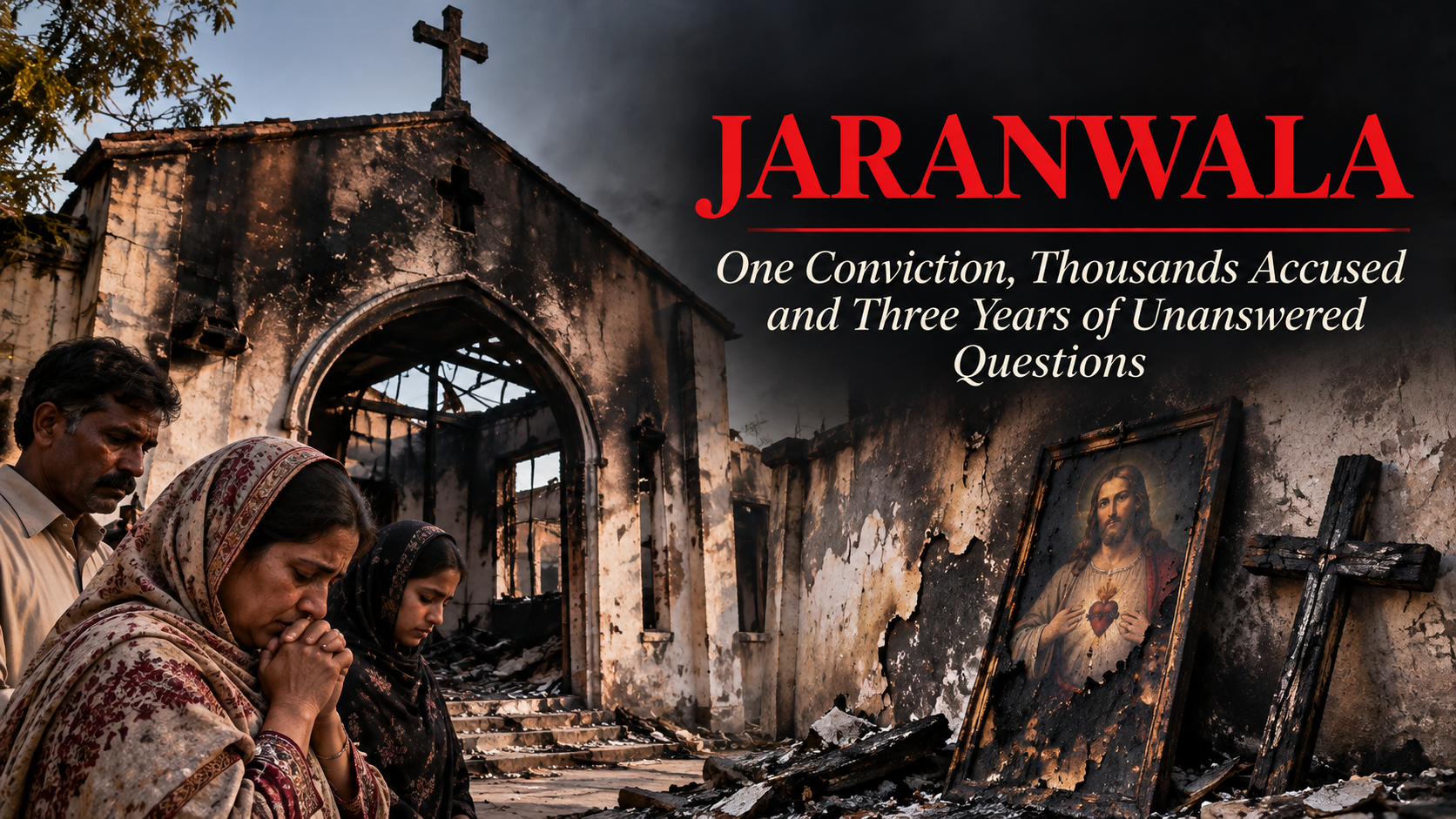
Pakistan’s courts have begun to punish those responsible for the destruction of Christian churches in 2023. Their judgments have also exposed serious failures in the police investigation, while Parliament continues to question the government’s treatment of victims.
On 13 July 2026, Judge Waseem Mubarik of the Anti-Terrorism Court in Faisalabad convicted Irfan Yousaf for his part in the destruction of churches during the anti-Christian violence which devastated Jaranwala three years earlier. Yousaf, a crane operator, had used his machinery to demolish parts of church buildings as mobs attacked Christian neighbourhoods following allegations of blasphemy. He received a ten-year prison sentence. Twelve co-defendants were acquitted because the prosecution had failed to establish their guilt.¹
The conviction was significant. For nearly three years, the Christian community had watched hundreds of suspects arrested, subsequently released on bail or discharged, while the prosecution of those responsible for burning churches and destroying homes made scarcely any discernible progress. Yet the court’s judgment was accompanied by an indictment of the police investigation itself. Officers had failed to intervene effectively, preserve evidence, obtain proper identification and act promptly upon information available to them. The defects were sufficiently serious to prevent convictions in cases arising from violence which had occurred in public, before numerous witnesses, much of it recorded on mobile telephones.
There is something profoundly disturbing about a prosecution in which the destruction of a church can be established beyond dispute while identifying those responsible becomes a near-insuperable difficulty. The problem is more serious still when the trial court itself attributes that difficulty to the conduct of the authorities charged with investigating the offence.
On 16 August 2023, Muslim mobs descended upon Christian neighbourhoods in Jaranwala, in Pakistan’s Punjab province, following accusations that two Christian brothers had desecrated pages of the Qur’an. The allegations subsequently proved false. More than twenty churches were attacked, together with Christian homes, businesses and other property. Catholic churches were among the buildings vandalised or set alight, while families fled with little more than they could carry.
The precise number of affected properties varies between investigations. Aid to the Church in Need (ACN) has reported damage to twenty-six churches and approximately eighty homes. Other assessments have identified a larger number of affected households, particularly where several families occupied one building. The distinction is relevant when considering the compensation subsequently promised by the Punjab authorities.²
The Human Rights Commission of Pakistan (HRCP), which investigated the violence, questioned whether the attacks had been spontaneous at all. Its inquiry identified evidence suggesting deliberate mobilisation, including the activities of religious political organisations, and raised concerns about the failure of the police to prevent the violence. Religious accusation had provided the occasion for the attacks. The mobilisation and destruction which followed required organisation, encouragement and sufficient confidence that effective intervention would not immediately follow.³
In August 2025, Nuntiatoria reported the anger of Bishop Indrias Rehmat of Faisalabad over the absence of convictions for the attacks. His frustration was well founded. More than 5,200 people had been identified or accused in connection with the violence, approximately 380 had been arrested, and not one of those prosecuted for the destruction of Christian property had then been convicted. In June 2025, an anti-terrorism court had acquitted ten suspects charged in connection with an attack on a church in Chak 651/2 GB.⁴
The position changed in July 2026 with Yousaf’s conviction, and that development must be acknowledged. An investigation which continues to report that nobody has been convicted would now be inaccurate. The more serious question concerns what that solitary conviction tells us about the thousands originally implicated.
The figures themselves require examination. In August 2024, Amnesty International reported information obtained directly from the Faisalabad City Police Office indicating that 5,213 people had been accused in connection with the attacks. Of these, 380 had been arrested, 228 subsequently released on bail and seventy-seven had the charges against them dropped. That left 4,833 accused persons who had not been arrested at the date of the police return.⁵
Two years later, the situation remained confused. According to a June 2026 report presented to the Senate Human Rights Committee and examined by Pakistani journalists, police had registered twenty-two First Information Reports naming 142 accused persons and thousands of unidentified suspects. Charge sheets, known in Pakistan as challans, had been submitted against 134 of the named accused, while two were declared proclaimed offenders and six remained pending. Among the unidentified suspects, 254 had been included in charge sheets while thousands of cases remained unresolved.⁶
These figures should not simply be added together. Different reports include named defendants, unidentified suspects, persons subsequently identified and those charged in overlapping proceedings. Their discrepancies are themselves a reason to demand a consolidated account from the Punjab authorities.
The question is how the criminal investigation has proceeded from its original identification of thousands of suspects to a judicial outcome which, according to the latest detailed reporting available, has produced one confirmed conviction for the attacks upon Christian property.
The judgment concerning Irfan Yousaf provides a partial explanation for the wider failure to secure convictions. Reporting by UCA News and Pakistani journalists describes judicial criticism of police officers who failed to secure forensic evidence, undertake timely identification procedures and intervene effectively as the attacks unfolded. In one case, the court questioned why the incident had been formally reported six days after the violence, notwithstanding the presence of officers who had witnessed it. The quality of identification parades and the failure to collect available recordings also featured in the court’s criticism.¹ ⁶
Such failures are decisive in criminal proceedings. The prosecution cannot secure a conviction merely by establishing that a defendant belonged to a crowd which committed violence. Individual criminal responsibility must be proved through admissible evidence. It follows that acquittal where the prosecution has failed to establish guilt is a proper exercise of judicial authority, however distressing the outcome may be to victims.
The difficulty arises when the failure of proof results from investigative omissions which could reasonably have been avoided. If police officers have failed to collect available evidence, neglected witnesses or delayed essential procedures, an acquittal may reveal defects in the investigation without establishing any impropriety on the part of the court.
This distinction is essential to understanding Jaranwala. The right of an accused person to a fair trial and the right of the victim to an effective investigation are not competing privileges. Both belong to the administration of justice. A state which fails to investigate serious offences properly can deprive victims of legal redress while simultaneously placing defendants at risk of unreliable accusations.
These failures are especially serious where the original violence was directed at the religious identity of the victims. Pakistan’s Constitution, under Article 20, recognises the right of citizens to profess, practise and propagate their religion, subject to law, public order and morality. Article 25 guarantees equality before the law and equal protection of the law. The provisions contain qualifications, but neither offers a licence to destroy Christian churches, threaten congregations or compel families to abandon their homes.⁷
The difficulties which confront Christians when they seek to exercise those rights have been documented repeatedly. Blasphemy accusations can generate public hostility before police or courts have examined the complaint. In Jaranwala, two Christian brothers were accused of desecrating the Qur’an. They were subsequently acquitted after investigators established that they had been framed.
In April 2025, a Faisalabad court imposed a death sentence and an additional term of imprisonment upon another defendant for his role in fabricating the accusation which had implicated the brothers. That proceeding must be distinguished from the prosecutions of those responsible for the attacks upon Christian property. The criminal law had produced a conviction connected with the origins of the violence before it secured a conviction for participation in the destruction which followed.⁸
Meanwhile, a separate Christian defendant had received a death sentence in July 2024 in proceedings concerning an allegedly blasphemous social-media post associated with the Jaranwala disturbances. Amnesty International drew attention to the contrasting progress of that prosecution while the cases against participants in the mob violence had yet to reach trial.⁵
The comparison deserves scrutiny, although it cannot by itself establish discriminatory judicial conduct in any individual case. Different offences involve different evidence and different defendants. Nevertheless, the speed with which serious accusations of blasphemy can produce criminal consequences contrasts sharply with the sustained difficulty of prosecuting those who have attacked Christian communities.
It was precisely this problem which Nuntiatoria examined in July 2026 in the case of Nadeem Masih, the blind Catholic acquitted after nearly ten months’ imprisonment following a blasphemy allegation. His case demonstrated the practical power which an accusation may exercise long before a court determines whether an offence has occurred. The Jaranwala prosecutions reveal the other side of the same difficulty: the apparent inability of the authorities to convert substantial evidence of public violence into a corresponding number of sustainable prosecutions.⁹
There is also evidence of pressure upon victims and witnesses after the attacks. In August 2026, Pakistani journalist Naeem Ahmad reported the account of Shakeel Bhatti, a Jaranwala resident and complainant, who described the destruction of Christian property and the continuing presence of alleged attackers in the community. Other complainants described intimidation and pressure to abandon proceedings. These remain allegations requiring examination, but they are consistent with concerns raised by the HRCP and by lawyers representing affected families.⁶
The involvement of members or supporters of Tehreek-e-Labbaik Pakistan (TLP) has also been raised repeatedly. The HRCP’s reporting identified allegations concerning individuals associated with religious political organisations, while Christian representatives have questioned the granting of bail to persons accused of incitement. The original police investigations and subsequent bail decisions require individual scrutiny before criminal responsibility can be attributed to particular leaders. What is established is that the courts have been asked to address offences arising from violence mobilised through religious accusation, and that the adequacy of the police response has been questioned by the judiciary itself.
The Pakistani Supreme Court intervened in February 2024, rejecting an inadequate report from the Punjab authorities and demanding a more satisfactory account of the investigation. On 31 March 2026, it reportedly directed that outstanding proceedings should be concluded within six months and that absconding suspects should be apprehended.¹⁰
That period had elapsed by the end of September 2026. The available public record does not establish that all outstanding proceedings were concluded within it. A current consolidated return from the Anti-Terrorism Court and Punjab prosecution authorities is therefore essential. Without it, neither the number of defendants remaining before the courts nor the final disposition of the cases can be stated with confidence.
Compensation has become a separate and increasingly public dispute. In August 2023, the caretaker government of Punjab announced compensation of two million Pakistani rupees for each affected family. Reconstruction of damaged churches was also promised. Government representatives subsequently reported substantial expenditure on repairs and compensation. A June 2026 account cited spending of Rs126.49 million on the reconstruction or rehabilitation of twenty-three churches and Rs168 million distributed among eighty-four families, each receiving Rs2 million.⁶
These are substantial payments and should not be disregarded. Several churches have reopened, including St John’s Catholic Church in Jaranwala, while local ecclesiastical authorities and charitable organisations have contributed to rebuilding. Their restoration represents genuine progress after the violence of 2023.
The published financial figures do not, however, resolve which affected families have received adequate compensation. Amnesty International’s 2024 investigation referred to 146 affected families identified by the local parish, of whom eighty-five had received compensation according to a submission before the Supreme Court in February of that year. In 2026, government reporting continued to refer to eighty-four compensated households. The difference between the figures has not been satisfactorily reconciled in the publicly available accounts. Nor has it been established that the government’s eligibility criteria correspond to the full extent of losses identified by the affected Christian community.⁵ ⁶
A house may contain several families. A family may have lost possessions, business equipment and its livelihood without the building itself being destroyed. Some houses required reconstruction, while others suffered looting or damage to their contents. A payment made to one household representative does not necessarily compensate every person whose property was lost.
Government officials have maintained that some claims could not be verified. In September 2026, reporting from the Senate Human Rights Committee described a review of 126 claims, including cases where compensation had already been paid to a household head, where several families shared an address, and where officials disputed the existence or extent of damage. The Punjab authorities therefore possess an explanation for some unpaid claims. The validity of those explanations needs to be tested against the evidence supplied by the applicants.¹¹
Parliamentary scrutiny has now brought those complaints within an official examination of the government’s response. At its meeting of 9 September 2026, the Senate Functional Committee on Human Rights, chaired by Senator Samina Mumtaz Zehri, was informed that 389 persons had been arrested in connection with the Jaranwala cases. Members expressed concern about prolonged proceedings and unresolved compensation. The chairwoman directed that losses should be assessed properly, with affected families consulted and payments determined according to the damage actually suffered.¹²
This was an official parliamentary examination of the government’s response, undertaken more than three years after the attacks. The committee’s insistence upon renewed assessment confirms that questions about compensation remained unresolved notwithstanding the considerable sums already distributed.
There is no justification for describing the government’s entire response as nonexistent. Financial assistance has been provided, buildings have been repaired and criminal proceedings have taken place. Nor can the acquittal of an accused person be treated as evidence of judicial misconduct simply because the alleged offence was serious. The record supports a more exacting criticism.
Pakistan’s authorities have failed to demonstrate that the scale and quality of their investigation correspond to the violence committed in Jaranwala. The judiciary has identified deficiencies in police conduct. Parliament has questioned the adequacy of compensation. Christian residents continue to report intimidation, financial hardship and the absence of effective accountability.
The result is particularly troubling because the state has been presented with repeated opportunities to correct the failures. The Supreme Court intervened in 2024 and again in 2026. The Senate has now demanded renewed examination of the victims’ losses. Criminal courts have explained why the evidence placed before them was insufficient. The problem can therefore no longer be attributed merely to the confusion which followed the original violence.
Responsibility for answering the outstanding questions lies with the Punjab Police, prosecution authorities, the provincial administration and those implementing judicial and parliamentary directions. Three matters now require public answers. The first is a complete account of the twenty-two criminal cases, identifying judgments, pending trials, appeals and the whereabouts of defendants still sought by the authorities. The second is an examination of whether officers responsible for serious investigative omissions have faced disciplinary or criminal proceedings. The third is a reconciled compensation register, distinguishing payments made, claims refused, the reasons for refusal and the additional assistance required where families have suffered losses beyond damage to buildings.
These requests amount to the effective application of constitutional protections which Pakistan already professes to recognise. The conviction of Irfan Yousaf demonstrates that prosecution was possible. His case also shows that usable evidence existed when it was properly obtained and presented. Whether the authorities can now remedy the defects exposed in the remaining proceedings will determine the longer significance of the judgment.
Three years after the churches of Jaranwala were burned, a restored building is evidence that the damage can be repaired. The continuing difficulties in obtaining convictions and compensation raise the more enduring question of whether those who worship inside it can rely upon the state to protect them.






Leave a Reply