
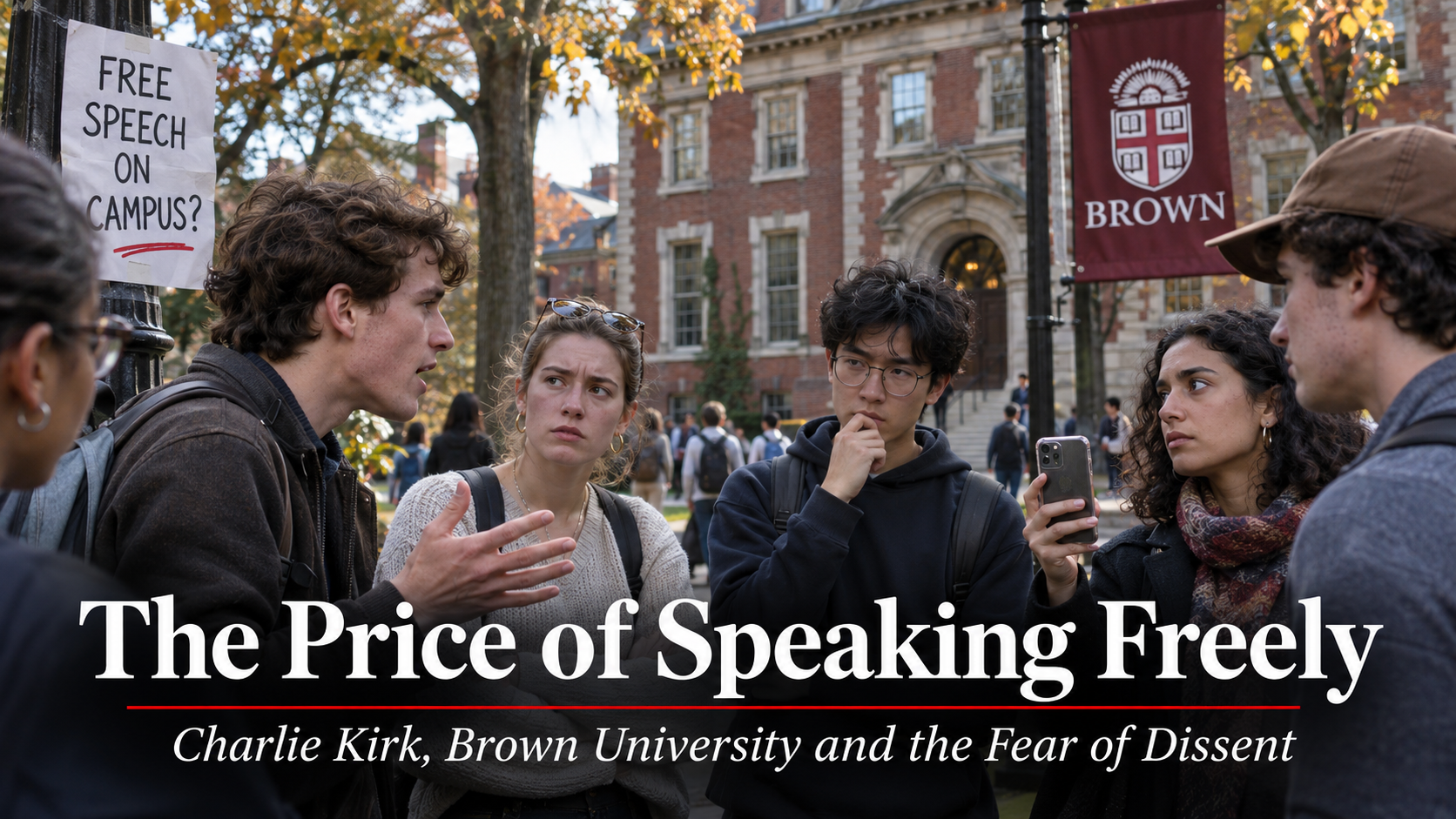
Warren Smith’s encounters at Brown University raise difficult questions about whether students are willing to discuss political murder without fear or evasion. Independent reporting of reactions to Charlie Kirk’s assassination shows a more complicated picture than any one video, but it also supplies evidence of the intellectual intolerance which universities ought to resist.
A university ought to be among the few places in which a difficult question can be asked without the questioner immediately becoming the difficulty. Warren Smith’s video of his encounters with students at Brown University, filmed in the aftermath of Charlie Kirk’s assassination, suggests how uncertain that assumption has become. Smith approached students to ask about their reactions to the killing and about reports that some had celebrated it. The exchanges which he recorded were often hesitant, defensive or anxious. What the footage establishes most securely is the difficulty of obtaining a candid conversation on a subject which ought to admit of an elementary moral judgement.1
Kirk was shot dead on 10 September 2025 during a public event at Utah Valley University. His political views had been sharply contested for years, frequently in the very campus settings to which he deliberately brought them. Those disagreements supply necessary context for understanding the reaction to his death. They cannot establish a moral entitlement to welcome an assassination. A political opponent remains a human being, and the deliberate killing of a person for speaking in public cannot be made acceptable by cataloguing the opinions which others found objectionable.
The difficulty in assessing Smith’s encounter is that a street interview is an edited record of particular conversations, not a representative survey of a university. His title describes students forcing him away, but the footage cannot by itself establish a general policy of Brown University or demonstrate what the entire student body thought. Even where an interviewee claims to have heard celebrations of Kirk’s death, that recollection should be reported as the interviewee’s account unless the relevant conduct can be verified independently. The distinction is essential if the investigation is to be more than another instalment in the manufacture of outrage.
Brown’s students were, in fact, recorded expressing very different views immediately after the assassination. WPRI interviewed students in Providence on 11 September 2025 who described shock and distress at Kirk’s killing and concern about the growth of political violence. These interviews do not disprove every contrary account of private conversations or social-media posts. They establish, however, that Brown cannot responsibly be portrayed as a campus on which the murder was universally celebrated or treated with indifference. The evidence requires a distinction between particular voices and the character of an institution as a whole.2
There is independent evidence that disturbing reactions appeared elsewhere. At Belmont University, the student publication The Belmont Vision reported that several students had posted celebratory comments about Kirk’s death on the campus-specific anonymous platform Fizz. Its editorial condemned the reactions and noted that the university president had addressed the matter. The significance of that record is its specificity. It identifies the institution, the medium through which the comments circulated and the source which reported them, rather than converting an unnamed recollection into a national verdict upon students.3
At Stanford, The Stanford Review published an account of social-media posts which its author regarded as celebrations of the assassination. That is evidence of the responses examined by a named student publication, although the author’s interpretation of the prevailing campus sentiment remains an editorial judgement rather than the finding of a university-wide inquiry. These qualifications are not devices for diminishing the ugliness of the sentiments reported. They are the ordinary disciplines by which journalism distinguishes what has been seen from what has been inferred.4
A separate development at Boston University disclosed the other side of the problem. The university’s College Republicans appealed publicly for protection of political expression after Kirk’s death, alleging that conservative students had long experienced intimidation, hostility and fear of academic or social repercussions. Local reporting documented their letter and the university community’s discussion of it. The organisation’s allegations cannot be treated as proven in every instance merely because they were made; nor should they be dismissed because those alleging intimidation represented an unpopular viewpoint. A university committed to intellectual inquiry has a responsibility to examine whether its students can speak without fearing consequences unrelated to the merit of their arguments.5
These records make the controversy more serious than the conduct of a few ill-mannered interviewees. Students who delight in the killing of a political opponent have lost sight of the moral boundary without which argument becomes a contest of power. Students who believe it unsafe to express disagreement are being trained in caution rather than intellectual courage. These are not identical failings, but both injure the conditions required for education. One concerns the judgement that violence can be a welcome answer to speech; the other concerns the social pressure by which dissent can be suppressed without any formal prohibition.
Universities now possess elaborate statements about inclusion, safety and the respectful exchange of ideas. The difficulty is that language of this kind can be applied asymmetrically. A student whose views are approved by the prevailing campus culture may find that forceful expression is praised as courage, while another whose convictions are unfashionable is encouraged to avoid causing discomfort. The vice does not depend upon a particular political affiliation. Any institution that teaches students to assess the legitimacy of speech by the identity of the speaker has abandoned an essential part of its educational responsibility.
The response to Kirk’s assassination also exposed the danger of retaliatory politics. A Reuters investigation in November 2025 identified more than six hundred Americans who had been dismissed, suspended, investigated or otherwise disciplined following public comments about the killing. The cases varied considerably and cannot be assimilated into a single judgement about lawful discipline. Yet they show how rapidly public disapproval can become an organised effort to destroy a person’s employment or standing. Defending the principle that murder should never be celebrated does not require approving every campaign to punish those who spoke offensively about it.6
An institution may properly take account of conduct which threatens others, breaches an applicable professional duty or amounts to unlawful harassment. It does not follow that every cruel or foolish statement should be answered by an administrative sanction. The question is whether the response rests upon a legitimate rule, is proportionate and can be defended by principles equally applicable to comparable conduct. The same considerations ought to protect students who condemn an assassination and those who dispute the political programme of the man killed.
The issue has a particular importance for the purpose of higher education. The university was historically intended to provide an ordered pursuit of knowledge in which arguments are subjected to examination, authorities are questioned and conclusions are justified by reasons. Its modern forms differ greatly from the medieval institutions from which the name derives, but the obligation to discipline judgement remains. Education has failed at something fundamental when a graduate can repeat the approved vocabulary of moral concern yet is unable to explain why the murder of an adversary is wrong.
Catholic moral reasoning provides a clear starting point without requiring agreement with the victim’s politics. Human life possesses a dignity which is not granted by public opinion. Deliberate unjust killing is gravely wrong, and the obligation to recognise that wrong is not withdrawn when the person killed has spoken provocatively or held mistaken views. The distinction between condemning an act of violence and endorsing every conviction of its victim is elementary, though it appears to become remarkably difficult whenever the political temperature rises.
That moral clarity does not make historical or political investigation unnecessary. Kirk’s public statements may be subjected to searching criticism, and those who challenge his legacy retain the same right of argument which he exercised. What must be resisted is the tendency to decide first whether a person is an acceptable member of the moral community and only afterwards whether his death deserves condemnation. A political culture conducted on those terms will find fewer and fewer people qualified to receive ordinary human sympathy.
Smith’s interviews deserve attention because they show how awkward a simple question can become where students anticipate public judgement for every answer. Their evidential limitations should be acknowledged, but they are not a reason to abandon the larger inquiry. The reports from Belmont and Stanford, the appeals by conservatives at Boston University and the independently recorded condemnations at Brown establish a landscape of conflicting reactions. The task of serious journalism is to describe it accurately before making claims about the state of American higher education.
Brown University ought not to be convicted by a video title, nor excused from the wider questions that title raises. Any university which claims to foster independent thought should be able to explain how it protects unpopular expression and how it teaches students to recognise the difference between political disagreement and moral permission for violence. Students should leave such institutions better able to hear an opponent, test an argument and make a judgement upon evidence. Where instead they learn only which opinions may safely be spoken, the university will have educated their caution while neglecting their minds.
FOOTNOTES
1. Warren Smith, Secret Scholar Society, Ivy League Students KICK ME OUT for Asking About Charlie Kirk’s Murder, 2026.
2. WPRI 12, College Students in Providence React to Charlie Kirk’s Killing, 11 September 2025.
3. The Belmont Vision, Editorial: Have Empathy for Charlie Kirk, 11 September 2025.
4. The Stanford Review, Stanford Students Celebrate Charlie Kirk’s Murder, 12 September 2025.
5. Boston.com, Silenced by Fear: In Wake of Charlie Kirk’s Killing, BU Conservatives Say They’ve Been Marginalised, 15 September 2025.
6. Reuters, The Charlie Kirk Purge: How 600 Americans Were Punished in a Pro-Trump Crackdown, 19 November 2025.





Leave a Reply