
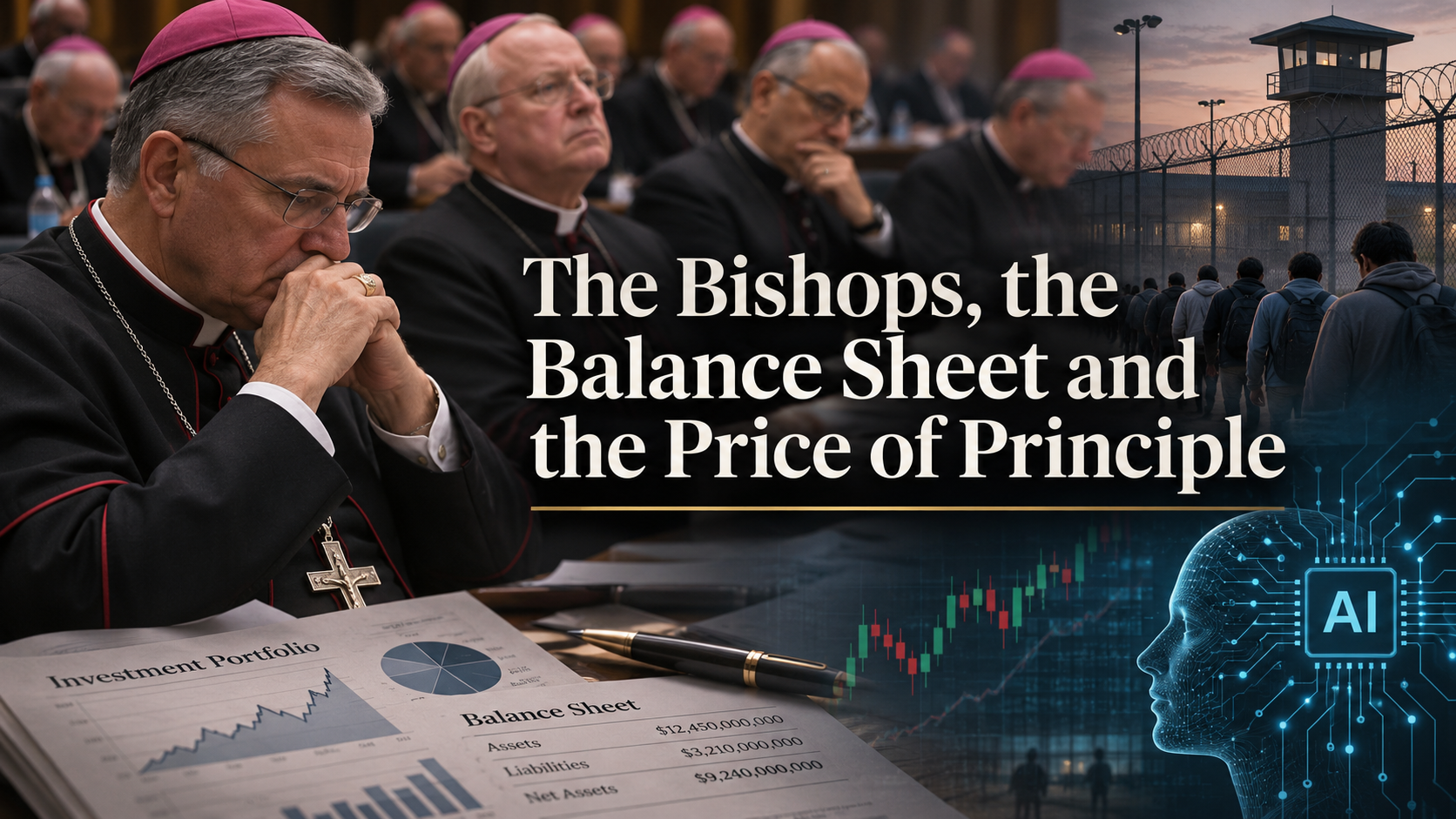
America’s bishops have adopted new restrictions upon their own investments, addressing private prisons, artificial intelligence and emerging financial risks. The decision invites a more exacting examination of whether the principles publicly taught by ecclesiastical institutions can be traced through the accounts they keep.
The United States Conference of Catholic Bishops has adopted a substantially revised policy for its investments, including a categorical exclusion of companies which build or administer private prisons and immigration detention facilities. The guidelines also address the developing risks associated with artificial intelligence, financial markets and corporate conduct. Announced formally on 19 November following the bishops’ assembly in Baltimore, the measure was approved by 217 votes to none, with one abstention. It is an unusually clear institutional decision on an issue which Catholic authorities have more often addressed through statements directed towards governments and businesses.1
Archbishop Shelton J. Fabre of Louisville presented the revisions in the context of the conference’s responsibilities as an investor. The approved Socially Responsible Investment Guidelines replace the 2021 version, extending the existing framework to economic activities that have become more prominent during the intervening five years. They distinguish activities from which the conference is to exclude itself from those where it intends to use investment and shareholder influence to encourage change.2
The vote deserves attention precisely because the bishops have placed their own financial decisions within the scope of their moral judgements. It is relatively straightforward for an episcopal conference to deplore commercial exploitation or warn against the abuse of technology. It is rather more demanding to tell investment advisers that identifiable companies or practices are unacceptable holdings, then to monitor what happens when those instructions encounter the ordinary demands of portfolio management.
The restriction concerning private prisons is especially definite. The revised policy prohibits investment in companies involved in constructing or administering prisons and detention facilities, including those used in immigration enforcement. The judgement reflects the conference’s concern that the commercial incentives of confinement can conflict with the human dignity of persons deprived of their liberty. An operator receiving income through detention has financial interests which are not necessarily identical to the public purposes of justice, rehabilitation and humane treatment.2
That concern must be understood accurately. Catholic moral teaching does not declare the legitimate administration of criminal justice intrinsically unjust, nor does the conference’s policy establish that every privately operated facility necessarily treats prisoners worse than every public prison. Public administrations have been responsible for grave abuses of their own. The bishops have reached a prudential decision about the risks inherent in a particular commercial arrangement, and have decided that their conference should not finance it. The argument is more coherent when it is presented on those terms.
The inclusion of immigration detention brings the policy into a field in which American political disagreements are particularly acute. Questions about the lawful control of borders, public safety and the responsibilities of sovereign states cannot simply be dissolved by appeals to compassion. Equally, a state which detains persons retains obligations towards their dignity, medical care, family circumstances and access to lawful processes. The bishops’ investment rule concerns enterprises which profit from operating detention facilities. It does not itself resolve every disputed question about immigration law or the use of detention in individual cases.
Artificial intelligence has required a more differentiated set of provisions. The guidelines identify practices involving autonomous weapons and other high-risk systems, surveillance, the exploitation of personal information, manipulation, disinformation and decisions taken without meaningful human oversight. They also consider the effects of automation on workers, the protection of children and the environmental demands associated with large-scale computing. It would be misleading to summarise the policy as a simple ban upon investment in artificial intelligence companies. A technology has many applications, and moral assessment must attend to the use for which it is designed and the responsibilities of those deploying it.3
That distinction is particularly important when technological firms participate in numerous industries at once. A company may produce valuable medical or educational systems alongside products raising substantial moral concerns. Where the guidelines establish an outright exclusion, investment managers must comply with it; where they call for scrutiny, engagement or safeguards, the nature and effectiveness of that response become the relevant questions. Treating every reference to a risk as though it established the same categorical prohibition would obscure the discipline which the conference has attempted to construct.
The revised document also addresses food speculation, child labour and the exploitation of personal data. Emerging financial practices receive attention through specific guidance concerning cryptocurrency, prediction markets and private equity. The concerns include the ethical consequences of speculation, potential misuse, the adequacy of oversight and the need to protect vulnerable persons from exploitation. These are serious matters, although they do not admit of precisely the same moral judgement or remedy. The new text is strongest where it acknowledges that difference.3
A financial activity cannot be condemned merely because it is novel, complex or capable of misuse. Equally, the appearance of technical sophistication is not a defence against moral assessment. Prediction markets may produce circumstances in which profit becomes attached to human disaster. Cryptocurrency arrangements may present concerns relating to fraud, environmental demands or inadequate safeguards. An investment policy claiming Catholic moral coherence must explain which characteristics of an activity are objectionable and what due diligence can establish that an investor is not financing them.
The question of implementation therefore becomes central. The USCCB has adopted a more structured system of accountability, including annual reporting by investment advisers and records of corporate engagement and proxy voting. It intends to look beyond intentions towards measurable results and systematic change. Such provisions are welcome, provided that they produce accounts capable of independent examination rather than an annual compilation of activities undertaken without evidence of their effect.3
Shareholder engagement is often offered as the alternative to selling a holding. There are circumstances in which it is a legitimate exercise of stewardship. An investor may retain shares in order to question directors, support a reform or encourage a change in corporate practice. But the argument becomes less persuasive when engagement has no defined objective, no credible means of assessment and no apparent consequence after repeated failure. Where continued investment is justified on these grounds, the conference will eventually need to explain what has changed because its money remained invested.
This is one reason the categorical detention exclusion is important. It identifies circumstances in which the conference has judged that continued investment and advocacy are inadequate responses. Other provisions permit greater discretion because the activity being assessed may have legitimate purposes, or because the particular conduct of a company admits of correction. The distinction is principled only if the managers applying the policy can show why comparable cases receive comparable treatment.
The guidelines also raise a question of ecclesiastical governance. The conference has its own resources and investment responsibilities. The decision is binding as a policy of that body; it is not a universal canonical law directed to every American diocese, eparchy, university, religious institute or charity. In its formal announcement the USCCB explicitly stated that those institutions may choose to adopt the guidelines for their own investment practice. It does not claim to govern their compliance through the conference’s policy.1
That limitation is significant. The conference can demonstrate leadership by adopting a standard and accounting for its own conduct. It cannot be assumed, without examining the records of individual institutions, that the decision has already transformed the financial practices of Catholic organisations throughout the United States. Some may have adopted similar rules before November; others may choose to do so; still others may raise legitimate questions about implementation or the treatment of investments held through pooled funds.
The financial reporting responsibilities of dioceses were considered separately at the Baltimore assembly. The bishops approved revised diocesan financial-reporting guidelines by 205 votes to two, with one abstention. Those guidelines, distinct from the investment policy, offer non-mandatory best practices for diocesan administration. They should not be conflated with the 217–0–1 vote on socially responsible investments. The distinction is necessary if the public is to understand which obligations arise from each decision and which remain subject to adoption by other ecclesiastical authorities.4
An investment policy also raises questions which the publication of its text cannot answer. The conference has not, simply by voting, established the size of any holdings requiring disposal, the adjustments which managers must undertake, or the financial consequences of the exclusions. It would be irresponsible to calculate the economic cost of the decision without the relevant investment records. Equally, the absence of an immediate balance-sheet analysis should not become an excuse for treating implementation as a private matter beyond reasonable scrutiny.
Catholic institutions increasingly entrust their assets to professional firms whose commercial skill may exceed their familiarity with the distinctions made by Catholic moral theology. The responsibility of the bishop or trustee is not discharged by selecting a manager of respectable reputation and assuming that ethical concerns will take care of themselves. Mandates, reporting obligations, voting arrangements and the treatment of indirect exposures have to express the principles which the institution publicly professes.
Here the bishops have an opportunity to make a useful example of their own administration. It will require more than a formal assurance that investments are socially responsible. The material questions concern the portfolio as actually held, the instructions given to those who administer it, the treatment of companies whose activities straddle excluded and permitted fields, and the evidence gathered when shareholders attempt to secure change.
Nor should prudential decisions be invested with a doctrinal finality which they do not possess. Catholics may accept without reservation the inherent dignity of prisoners, migrants, workers and children while disagreeing about particular mechanisms for responsible investment. Such disagreement is not a rejection of Catholic social teaching. It is a recognition that applying moral principles to complex institutions requires accurate knowledge of circumstances, proportionate judgement and a willingness to revise an ineffective policy.
The vote in Baltimore is therefore of more than passing interest. The bishops have announced which kinds of business their conference will no longer finance, expanded their scrutiny of technologies and markets, and undertaken to account more systematically for the conduct of the advisers who act on their behalf. The practical test will come from records rather than declarations. Having chosen to subject their investments to public moral standards, the bishops should welcome serious examination of whether those standards are being observed.
FOOTNOTES
1. United States Conference of Catholic Bishops, U.S. Bishops Affirm Updated Socially Responsible Investment Guidelines, 19 November 2026.
2. USCCB, Socially Responsible Investment Guidelines for the United States Conference of Catholic Bishops, 18 November 2026.
3. USCCB, Putting Catholic Social Teaching into Practice: What’s New in the USCCB Investment Guidelines?, 18 November 2026.
4. USCCB, Recap of U.S. Bishops’ Plenary Assembly in Baltimore, 19 November 2026.





Leave a Reply