
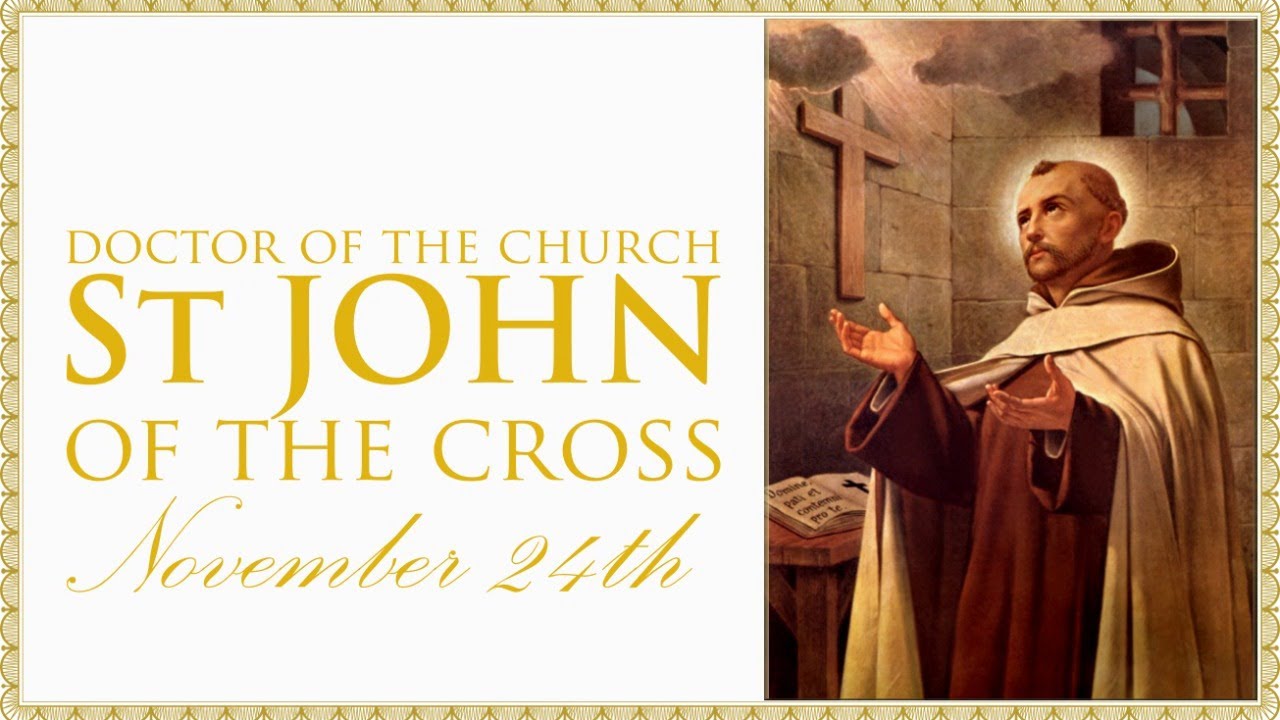
St. John of the Cross
Today we celebrate the feast of St. John of the Cross. He was a Spanish Carmelite who lived in the sixteenth century, who, along with his contemporary St. Teresa of Avila, was devoted to the reform of the Carmelite Order. His attempts at reform met bitter opposition and he was imprisoned for a time by those of his own order who opposed his reforms. After his release from his imprisonment he continued to work for the reform of his order, as well as writing the spiritual classics of Christian mystical literature for which he is now famous, such as the Dark Night of the Soul and the Ascent of Mount Carmel. He died on this day in 1591.
But what is the place of mysticism in Christianity? To describe someone as a mystic suggests that they are far removed from ordinary life and experience, and may suggest something esoteric. It should be said at once that Christianity is not primarily about mystical experience, but rather service of God and neighbour. The revelation of God recorded in the Law and the Prophets and incarnate in the Word made flesh is a public revelation addressed to all, rather than a mystical experience only accessible to some. The Law received by Moses on the mountainside was addressed to the people of Israel as a whole. It was not an esoteric or private mystical experience only attainable by certain elect souls. The prophets likewise addressed themselves to the people of Israel as a whole, whether they will hear or whether they will forbear. Since Christ came to fulfil the Law and the Prophets he too addressed himself to the people as a whole, not just an elect few. The Christian faith is for all nations, tribes and tongues.
That is why the early Church rejected Gnosticism (the belief in salvation by esoteric or secret knowledge inaccessible to the multitude). The message of the Incarnation is all about the Word becoming flesh in time and history, so that the human race can be redeemed from sin and death. The message of redemption is for all, not just some. It is not like the impassive serenity of the Buddha, detached from the world of suffering in an impersonal nirvana.
However, though Christianity is not primarily about mystical experience, this does not mean that there is no place for mysticism in the Christian life. What distinguishes Christian from non Christian mysticism is that it is focused on Christ, and takes as its basis the Scriptures and the liturgy of the Church. Precisely because it is centred on Christ it is a mysticism that is addressed and accessible to all, not just a private revelation for the few. It is not about withdrawal from the world of suffering, but about redemption through suffering.
St. John of the Cross devoted his life to the reform of his order, and suffered persecution because of it. He embraced the way of the Cross and sought redemption through it. It was from this experience that he was able to write so powerfully about the life of holiness, and the need to become detached from worldly attitudes to focus on God. The human race has fallen from grace because it has sought happiness in the things of this world. Redemption can only be found through detachment from the things of this world and being reborn in Christ. Yet, as we are reborn and renewed and less absorbed by worldly standards and attitudes, we are able to become more, not less, involved in this world because we are now able to see what really matters. We can become by grace what Christ is by nature.
This was a difficult message to embrace then, and it is certainly so now. The whole focus of contemporary society is about material success and competition. The advertising industry encourages people to buy things that they do not need with money they do not have in order to impress people who are not worth impressing. The world is divided into winners and losers, and success is defined as “playing the game”, in other words manipulating the system to one’s own advantage, regardless of any form of ethics or morality. Those who are not successful in this world’s terms are left angry and frustrated because they are deprived of the material success that others are enjoying. Yet the paradox is that those who are materially successful are also angry and frustrated because they can never have enough and so can never relax because of the need to stay ahead of those they are competing against. They know the price of everything, but the value of nothing. A world that prizes material success above all instead produces unhappiness and misery.
When we realise the futility of so much in contemporary society we experience what St. John of the Cross called the “dark night of the soul” (indeed this phrase is sometimes now used to describe a state of depression) in which all hope seems to be gone and it seems that everything has failed. Yet it is at precisely this point, when we begin to recognise the futility of worldly standards and attitudes, that we can start to undergo the process of purgation which St. John of the Cross described. Let us conclude in his own words:
Strive always, not after that which is most easy, but that which is most difficult
Not after great things, but after little things
Not after that which is elevated and precious, but after that which is vile and despised
Strive not to desire anything, but rather nothing
Seek not after that which is better, but that which is worse, and desire to be detached from all things, empty and poor for Christ’s sake. This state is to be embraced with a perfect heart, and the will must conform thereto. Because if our heart be truly engaged herein, we shall in a short time attain to great joy and consolation, doing our work orderly and with discretion
In detachment the spirit finds quiet and repose, for coveting nothing, nothing wearies it by elation, and nothing oppresses it by dejection, because it stands in the centre of its own humility; for as soon as it covets anything it is immediately fatigued thereby.
In that happy night,
In secret, seen of none,
Seeing nought myself,
Without other light or guide
Save that which in my heart was burning.






Leave a Reply