

The Freedom to Love God
MASS In medio
EPISTLE 2 Timothy 4:1–8
GOSPEL St Matthew 5:13–19
HOMILIST Mt Revd Jerome Lloyd OSJV

In the Name of the Father, and of the Son, and of the Holy Ghost. Amen.
Carissimi, beloved in Christ
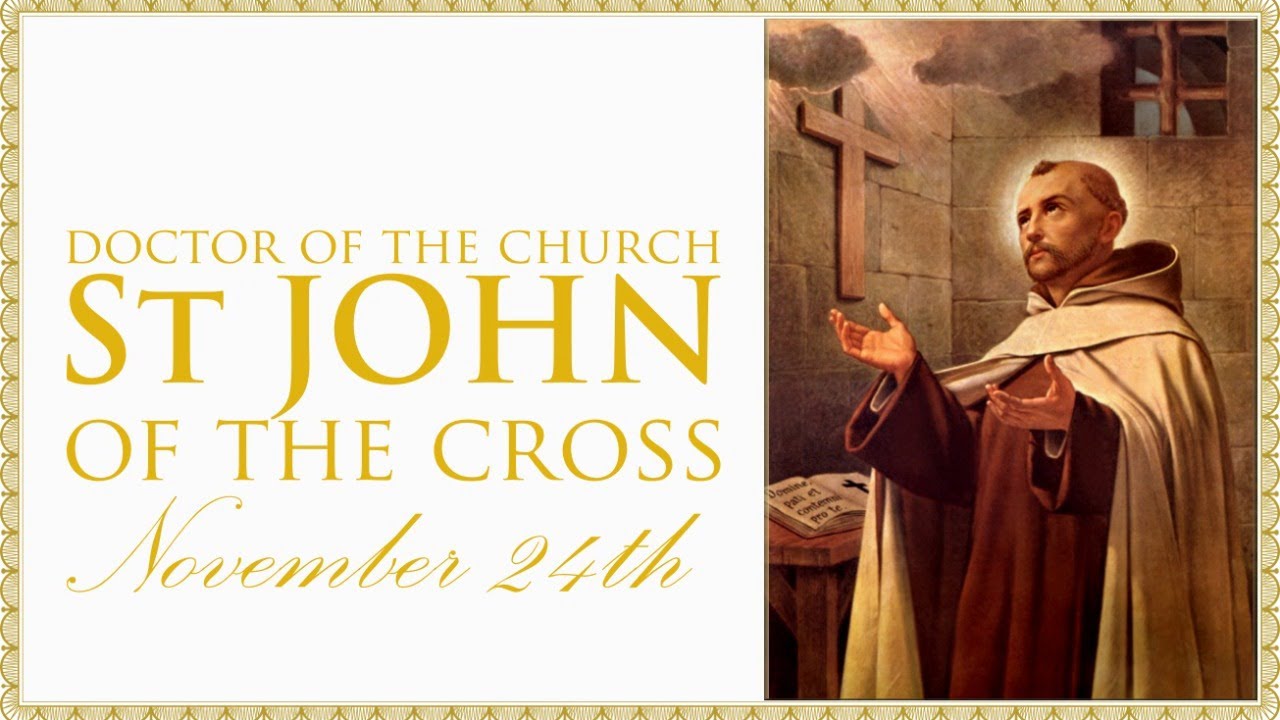
Today we celebrate St John of the Cross, the Spanish Carmelite whose writings have become classics of Christian spirituality. With St Teresa of Avila, he laboured to restore a more exact observance of religious life. His efforts met bitter opposition, and in 1577 he was imprisoned at Toledo by members of his own order. The experience was cruel; it also became part of the history of his prayer. Some of his finest poetry began in captivity. We should not suppose that the cruelty was therefore justified. God can bring good from what men do wickedly, without making their actions good.
John’s books, especially The Ascent of Mount Carmel and The Dark Night, can seem to belong to a Christianity reserved for unusually devout people. Mysticism suggests secret experiences, perhaps something remote from the demands of family, work and ordinary parish life. Yet the question which occupies John concerns every Christian: how can we learn to love God above everything else?
Christianity has never offered salvation through secret knowledge possessed by a spiritual elite. Moses addressed Israel; the prophets spoke to a people who might listen or refuse; Our Lord preached openly and commanded His Apostles to teach all nations. The Church rejected the Gnostic notion that redemption depended upon esoteric knowledge. The Word became flesh, suffered, died and rose again for our salvation. We encounter Him through the faith handed down by the Apostles, above all in the sacramental life of the Church.
Christian contemplation grows from that common inheritance. No genuine progress in prayer releases us from the commandments, from charity towards our neighbour, or from the duties of our state. Someone who imagines himself too spiritually advanced to apologise, keep a promise or make an honest confession has probably made less progress than he thinks.
John saw that one of our greatest difficulties is attachment. Some desires are sinful and must be rejected. Others concern good things which become disordered when we expect them to provide the happiness only God can give. Possessions, security, admiration, comfort, even the affection of those we love, may come to govern our peace of mind. We then find ourselves anxious whenever they are threatened, and dissatisfied whenever they fail to fulfil our expectations.
Contemporary society has made an industry of encouraging this condition. We are invited to buy things we do not need, sometimes with money we do not have, to impress people whose opinions should scarcely matter. The successful must remain successful; those who have less are told that they have somehow failed. There is always another purchase, another promotion, another person to surpass. People learn the price of everything and may end by forgetting the value of anything. It is a remarkably expensive way of becoming miserable.
John’s teaching on detachment is therefore far from irrelevant. He does not ask parents to love their children less, or Christians to become indifferent to suffering. He asks that every created good should be loved in its proper place, beneath the love of God. A father who regards his children as gifts entrusted to him can serve them more faithfully than one who expects them to satisfy his ambitions. A person freed from the need for applause can perform an unnoticed kindness without resentment.
Detachment is sometimes mistaken for coldness. In truth, it makes charity possible. The less we are occupied with possessing others, the more freely we can seek their good. We can rejoice in another person’s success without envy, bear disappointment without bitterness, and give without calculating what admiration our generosity will purchase. Such freedom is difficult, because our self-love is remarkably resourceful. It can even turn religious observance into an occasion for vanity. We may become attached to being thought devout, to our preferred way of doing things, or to the satisfaction of correcting others. The test is whether our devotion makes us more truthful, more patient and more willing to serve those who can offer us nothing in return.
This brings us to the dark night for which John is famous. The phrase is now used for almost any period of distress, and sometimes for depression. We must not confuse these things. Illness and psychological suffering deserve proper attention and care. John’s account concerns the purification of the soul, including God’s work in freeing it from dependence upon the consolations which may accompany prayer.
A Christian may once have found prayer sweet and reassuring, only to discover that it has become dry and difficult. This does not necessarily mean that God has withdrawn His grace. He may be teaching the soul to seek Him rather than the pleasure of feeling close to Him. But neither should every distraction or spiritual difficulty be declared a mystical night. Tiredness, negligence and ordinary worries are real enough. John himself supplies criteria for discernment; humility and wise spiritual counsel remain necessary.
What matters is fidelity. The person who kneels to pray without enjoyment, yet remains before God in faith, may offer something very precious. Love does not cease to be love when it ceases to be pleasant. We learn this already in family life, in caring for the sick, keeping promises and doing what duty requires when nobody notices.
In today’s Gospel Our Lord calls His disciples the salt of the earth and the light of the world. Their light must shine in good works, so that glory is given to the Father. John spent long periods in silence, yet his hidden life continues to illuminate the Church. The worth of holiness cannot be measured by the attention it attracts. Christ also declares that He has come to fulfil the Law and the Prophets. Any supposed contemplation which makes obedience unimportant is contrary to His teaching.
St Paul, in the Epistle, charges Timothy to preach the word, endure hardship and fulfil his ministry. Looking towards death, he can say that he has fought the good fight and kept the faith. This is the perseverance John asks of us. Enthusiasm at the beginning of the Christian life is a blessing, but it is not the same as remaining faithful through the years.
The sacraments are indispensable here. In confession we acknowledge the sins and evasions which pride would rather conceal, and receive the grace of forgiveness. At Mass we stand before the sacrifice of Christ, whose love was shown most perfectly upon the Cross. In Holy Communion, received worthily, He gives Himself to us. We need not hunt for extraordinary religious experiences while neglecting the extraordinary gifts He has placed within our reach.
As Advent approaches, we might ask what presently has the greatest hold upon our hearts. What loss do we fear so much that we cannot trust God with it? What resentment have we carefully preserved? What duty have we postponed while waiting to feel more inclined to perform it? These are practical beginnings of detachment, and they lie within the reach of every one of us.
John’s imprisonment was exceptional; the call to holiness is not. The Cross ordinarily comes to us through the circumstances of our vocation, and grace enables us to carry it without surrendering to bitterness. Let us ask St John to obtain for us perseverance in prayer, sincerity in confession, devotion to the Holy Eucharist and a heart increasingly free to love. The end of this purification is not emptiness. It is the possession of God, for whom we were made.
In the Name of the Father, and of the Son, and of the Holy Ghost. Amen.





Leave a Reply