
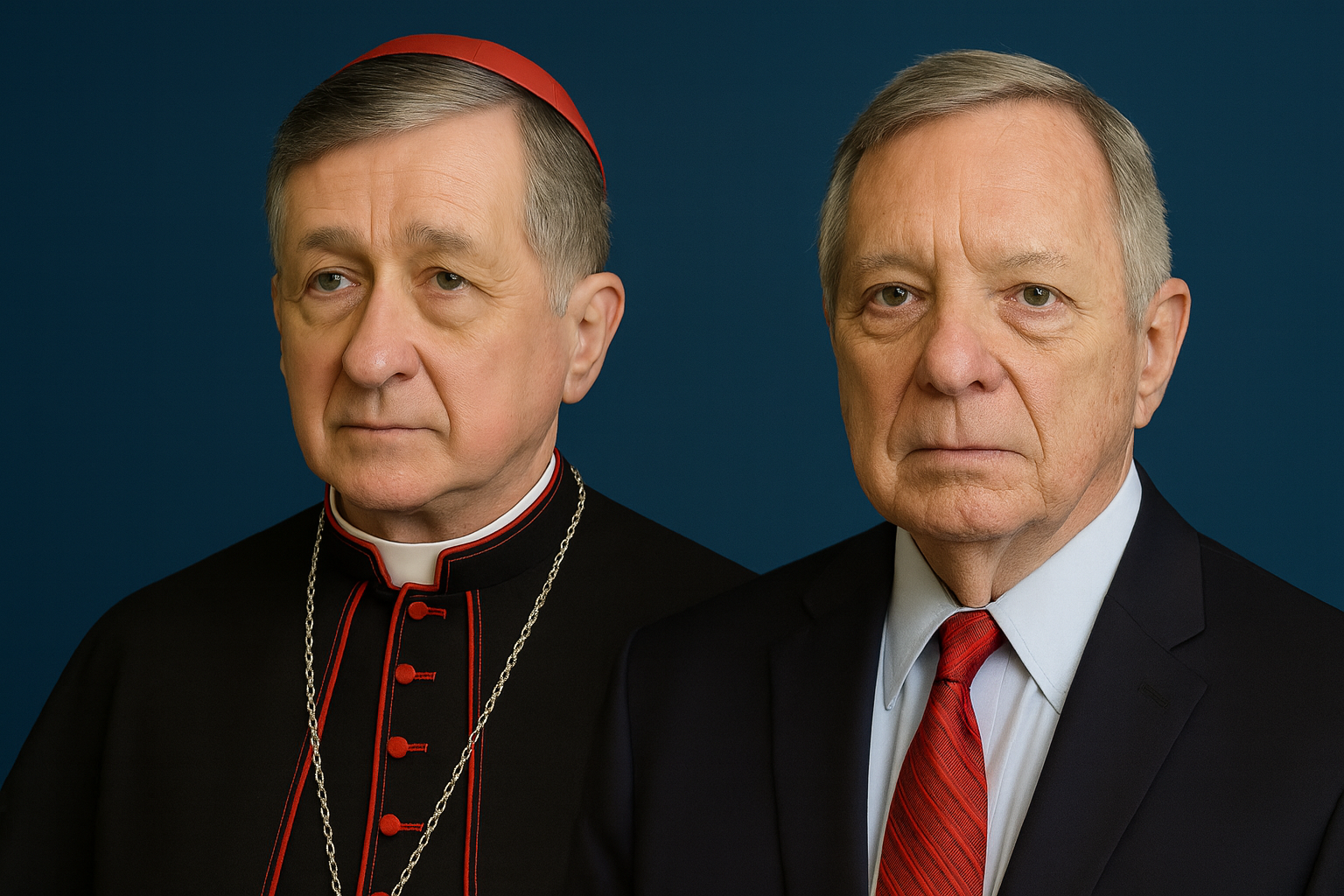
Honoring Contradiction: The Paprocki–Durbin–Cupich Controversy
A Test of Catholic Witness in the Public Square
The Archdiocese of Chicago’s decision to confer a “lifetime achievement award” upon U.S. Senator Dick Durbin has ignited a controversy that cuts to the heart of Catholic identity, sacramental discipline, and episcopal responsibility. Cardinal Blase Cupich, Archbishop of Chicago, announced that the award will recognize Durbin’s decades of advocacy for immigrants, laborers, and the marginalized. Yet the honor comes despite Durbin’s consistent record as one of the nation’s most vocal Catholic supporters of abortion rights, including opposition to measures that would protect infants born alive after failed abortion attempts.
For many Catholics, the decision raises a haunting question: Can the Church publicly honor a man who has spent his political career advancing policies that undermine the most fundamental right—the right to life—without weakening her own witness?
Paprocki Speaks Out
Bishop Thomas Paprocki of Springfield, in whose diocese Durbin retains canonical domicile, did not hesitate to respond. Paprocki has long enforced a prohibition against Durbin receiving Holy Communion in Springfield under canon 915 of the Code of Canon Law.¹ His reasoning is clear: a Catholic who publicly and persistently advocates for abortion laws is engaged in manifest grave sin, and to admit him to Communion would risk grave scandal.
When the Chicago award was announced, Paprocki said he “had to say something.”² To remain silent, he argued, would make him complicit in confusion about the Church’s teaching on life. He insisted his protest was not about partisan politics but about the moral gravity of abortion: “This is not about Democrats or Republicans, but about abortion.”³
Paprocki also pointed to the 2004 U.S. bishops’ statement Catholics in Political Life, which explicitly instructs Catholic institutions not to give honors to those who act in defiance of fundamental moral principles.⁴ In his view, the Chicago archdiocese is violating both national episcopal guidance and its own internal policies, which similarly restrict honors to those in alignment with Catholic moral teaching.
Cupich’s Defense
Cardinal Cupich, however, has defended the award. He emphasizes that Durbin is a registered parishioner in Chicago and considers Cupich his bishop.⁵ He insists the recognition pertains specifically to Durbin’s work on immigration, workers’ rights, and social justice causes, not his abortion record. In Cupich’s framing, to engage and honor Catholic politicians for their positive contributions is a way of maintaining dialogue rather than burning bridges. He cited the Vatican’s 2021 call for “dialogue” with Catholic politicians, which encouraged accompaniment over exclusion.⁶
Cupich also invokes the concept of a “consistent ethic of life,” extending the Church’s concern from the unborn to migrants, the poor, and the environment. In this sense, the award is presented as a reflection of a broad moral vision, not a narrow political gesture.
Other Bishops Join the Chorus
Yet the response from other bishops shows the depth of unease. Archbishop Salvatore Cordileone of San Francisco publicly aligned himself with Paprocki, warning that honoring a Catholic politician who defends abortion gravely undermines the credibility of the Church’s teaching.⁷
Soon afterward, Bishop James Conley of Lincoln, Nebraska, added his voice. “I too was shocked and bewildered,” Conley said, stressing that Durbin’s record is “consistently pro-abortion” and includes opposing safeguards for children who survive abortion attempts. “That goes against the fundamental moral principles of the Catholic Church. It seems to me there is still time to reconsider this decision. I pray… the scandal it will likely cause the faithful is avoided.”⁸
The Archbishop of Selsey has also spoken, lamenting not only the award itself but the silence of the wider episcopate. Out of more than four hundred bishops in the United States, only three have protested. “What does this silence betray?” he asked. “It betrays a fear of men greater than the fear of God. Silence before scandal is not unity but betrayal.” He warned that evil often advances not by bold proclamation but by silence: “Pilate washed his hands and said nothing.” He urged the American bishops to remember that it is not applause but the judgment of God that matters.⁹
The Scandal of Selectivity
Critics contend that Cupich’s decision exemplifies a troubling selectivity in applying the “consistent ethic of life.” The Catholic League has declared that the award “sets off alarms,” noting the hypocrisy of honoring a politician for “human dignity and solidarity” while ignoring his consistent efforts to deny the most basic dignity—the right to life—to the unborn.¹⁰
Paprocki himself has argued that Cardinal Joseph Bernardin, who coined the language of the “seamless garment,” never intended abortion to be relativized among other issues.¹¹ Instead, abortion was to be recognized as foundational: without life, there can be no justice.
Unity, Truth, and the Apostolic Tradition
Some critics accuse Paprocki of undermining episcopal unity by openly challenging Cupich. Paprocki counters that true unity cannot be built on silence in the face of false witness.¹² He invoked St. Paul’s confrontation with St. Peter in Antioch, when the truth of the Gospel was endangered by ambiguity (Gal. 2:11).
This dispute mirrors earlier controversies in the Church. St. Ambrose of Milan withheld Communion from Emperor Theodosius after the massacre at Thessalonica, demanding repentance before the emperor could re-enter the Church. In the medieval era, popes refused honors to rulers who publicly violated divine law. The consistent principle is that the Church’s witness is weakened whenever political expedience trumps fidelity to truth.
The Stakes for the Faithful
At stake is not only the reputation of one senator or one cardinal, but the Church’s ability to give clear moral witness in the public square. For decades, American Catholics have watched prominent politicians—Durbin among them—proclaim their faith while advancing laws that contradict the most basic Catholic teaching. The faithful rightly ask whether the hierarchy will defend the sanctity of the Eucharist and the integrity of Catholic identity, or whether political alliances and cultural accommodation will prevail.
Pope John Paul II foresaw this moment when he warned in Evangelium Vitae: “The common outcry… for the rights of man—especially the right to life—demands from us the courage to utter the truth.” (§5). To honor Durbin is to risk muffling that voice of courage in favor of compromise.
Conclusion
The Chicago award to Senator Durbin represents a crucible for Catholic witness. Bishop Paprocki has spoken; Archbishop Cordileone and Bishop Conley have joined him. The Archbishop of Selsey has reminded the Church that silence itself is a form of acquiescence. Whether more bishops will act remains uncertain. But one thing is clear: the scandal lies not only in the award itself but in the failure of so many shepherds to speak.
The faithful are watching. The world is watching. And Heaven itself bears witness.
- Code of Canon Law (1983), canon 915.
- The Pillar, “Paprocki: On Durbin award, ‘I had to say something’,” Sept. 23, 2025.
- Ibid.
- USCCB, Catholics in Political Life, 2004.
- National Catholic Register, “Cardinal Cupich: Senator Durbin Award is About Immigration, Not Abortion,” Sept. 2025.
- Congregation for the Doctrine of the Faith, Note to the U.S. Bishops on Catholic Politicians, 2021.
- America Magazine, “Paprocki, Cordileone oppose Chicago award to Durbin,” Sept. 23, 2025.
- LifeNews, Steven Ertelt, “Bishop Conley Joins Call For Cupich To Abandon Award For Dick Durbin,” Sept. 24, 2025.
- Archbishop of Selsey, Public Response, Sept. 2025.
- Catholic League, “Sen. Durbin’s Catholic Award Sets Off Alarms,” Sept. 2025.
- The Pillar, “Paprocki interview,” Sept. 23, 2025.
- Galatians 2:11; cf. The Pillar, Sept. 2025.



Leave a Reply