
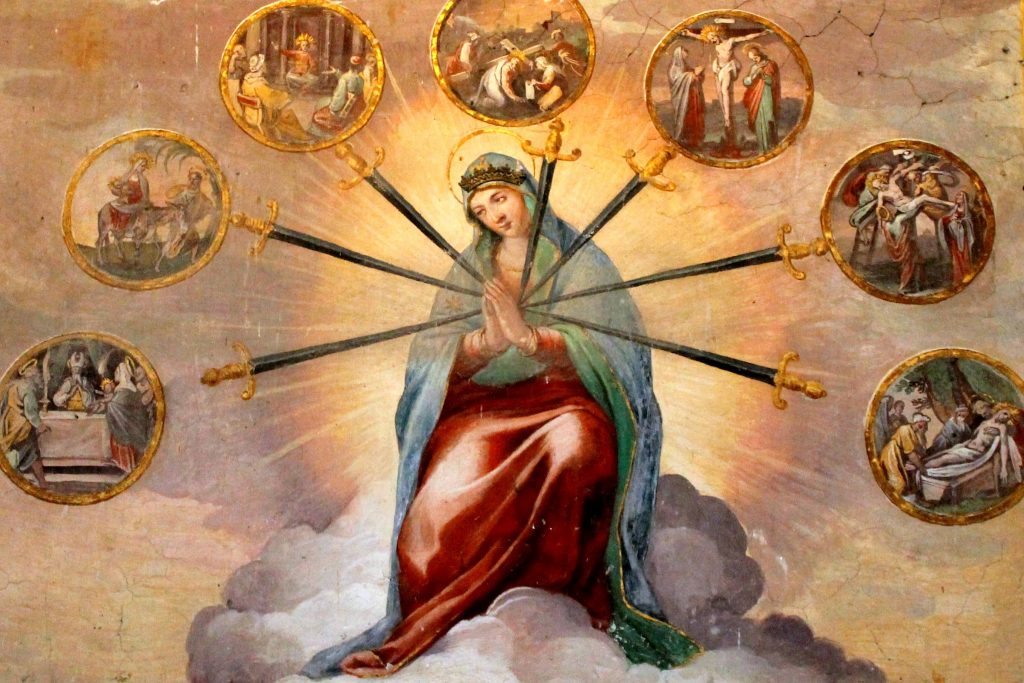
Seven Sorrows of the Blessed Virgin Mary/Octave of the Nativity of the Blessed Virgin Mary
by the Revd Dr Robert Wilson PhD (Cantab), Old Roman Apostolate UK
Today is the feast of the Seven Sorrows of the Blessed Virgin Mary, as well as the Octave of her Nativity. Today’s feast, the Seven Sorrows, shows Mary not only as the theotokos, the God bearer, but also as the Mater Dolorosa, the Mother of Sorrows. Yesterday we celebrated the Exaltation of the Holy Cross, and we sang the great hymns of Christ’s triumph over the powers of sin and death on the cross. Today we focus more on the pathos of the scene, a theme especially developed in the medieval Western Church, as we sing the Stabat Mater
At the Cross her Station keeping
Stood the mournful mother weeping
Close to Jesus at the last.
Today’s Gospel of the scene at the foot of the cross of Jesus is one of the most poignant in the Gospels. Christ entrusts his mother to the care of St. John, the beloved disciple. “Woman, behold thy son. Son, behold thy mother.”
God in Christ came into the world to suffer and to die, though being in the form of God, he made himself of no reputation and humbled himself to death on the cross. He came as one without form and comeliness, a man of sorrows and acquainted with grief. Though his mother was chosen to be the bearer of the Word made flesh, she was also chosen to be the mother of sorrows. At the Presentation of Christ in the Temple the aged Simeon foresaw that a sword would pierce her own heart also. This was fulfilled when she witnessed his suffering at the foot of the cross.
It is a reminder that love is inseparable from suffering. C. S. Lewis said that we can either remain detached and uninvolved or we can love and be involved, and that will involve suffering. This contrasts with the ancient Stoics who prided themselves on viewing with indifference the world of pain and suffering. Likewise, the classic images of the Buddha show a figure serene and detached from this world, for to attain nirvana is to cease to care about the pain and suffering of human life. By contrast, the message of the Cross is one of redemption through suffering, a message very different from the impassive serenity of the Buddha. St. John in his epistle speaks of Christ who came by water and by blood, the blood and water that flowed from his side pierced by the soldiers at the crucifixion. The Risen Christ who appeared to the apostle Thomas still bore the scars of the crucifixion on his glorified and resurrected body. Our hope is in the resurrection of the body and the ultimate healing of our own wounds, not the dissolution of our personalities into some impersonal absolute.
Meditation on the sufferings of the Passion of Christ and the Seven Sorrows of Mary is a type of spirituality that is very attractive to some minds, though it is repellent to others. It is associated with the transition that historians of Christian art and iconography have observed to take place in the medieval period between the earlier representation of Christ on the Cross as alive with open eyes to the more realistic later images of Christ on the cross as dead with closed eyes. The Stations of the Cross were developed and popularised by the Franciscans, while meditation on the Seven Sorrows of Mary was the particular charism of the Servites. For some this represents a falling away from earlier and more symbolic iconography, for others it marks a positive development of greater realism in Christian art. It is essentially a medieval and western development, though it is not to be dismissed simply because it is medieval and western.
It is a theme that is especially associated with St. Bernard of Clairvaux in the twelfth century. Commenting on today’s Gospel he stated: “The martyrdom of the Virgin is set before us, not only in the prophecy of Simeon, but also in the story itself of the Lord’s Passion…. Even so, O Blessed Mother! The sword did indeed pierce through thy soul! For nought could pierce the Body of thy Son, nor pierce thy soul likewise. Yea, and when this Jesus of thine had given up the ghost, and the bloody spear could torture him no more, thy soul winced as it pierced his dead side- his own soul might leave him, but thine could not. The sword of sorrow pierced through thy soul, so that we may truly call thee more than martyr, in whom the love, that made thee suffer along with thy Son, wrung thy heart more bitterly than any pang of bodily pain could do. Did not that word of his indeed pierce through thy soul, sharper than any two edged sword, even to the dividing asunder of soul and spirit, – “Woman, behold thy son”. O what a charge to thee! Thou art given John for Jesus, the servant for his Lord, the disciple for his Master, the son of Zebedee for the Son of God, a mere man for Very God. O how keenly must the hearing of those words have pierced through thy loving soul, when even our hearts, stony, iron as they are, are wrung at the memory thereof only! Marvel not, my brethren, that Mary should be called a martyr in spirit. He indeed may marvel who remembereth not what Paul saith, naming the greater sins of the Gentiles, that they were “without natural affection”. Far other were the bowels of Mary, and far other may those of her servants be! But some men perchance will say: Did she not know that he was to die? Yea, without doubt she knew it. Did she not hope that he was soon to rise again? Yea, she most faithfully hoped it. And did she still mourn because he was crucified? Yea, bitterly. But who art thou, my brother, or whence hast thou such wisdom, to marvel less that the Son of Mary suffered than that Mary suffered with him? He could die with the body, and could she not die with him in her heart? His was the deed of that love, greater than which hath no man, her’s, of a love, like to which hath no man, save he.”
Hence, while it is true that meditations on the Passion of Christ and the Seven Sorrows of his Mother has sometimes been associated with an unhealthy obsession with suffering, when properly understood it does point to the central doctrine of our faith, that of redemption through suffering. It is this that distinguishes the Christian faith from other religions. The teachings of the Buddha or Confucius give good advice, but not good news. Mohammed claimed that authority of a prophet, but not that of a Saviour who brings redemption through suffering. By contrast, the Christian faith gives not only good advice, but good news, the good news of redemption through the life, death and resurrection of Jesus Christ.
O God, at whose suffering the prophecy of Simeon was fulfilled, and a sword of sorrow pierced through the gentle soul of the glorious Virgin and Mother Mary, mercifully grant that we who speak worshipfully of her woes, may obtain the saving purchase of thy suffering.



Leave a Reply