
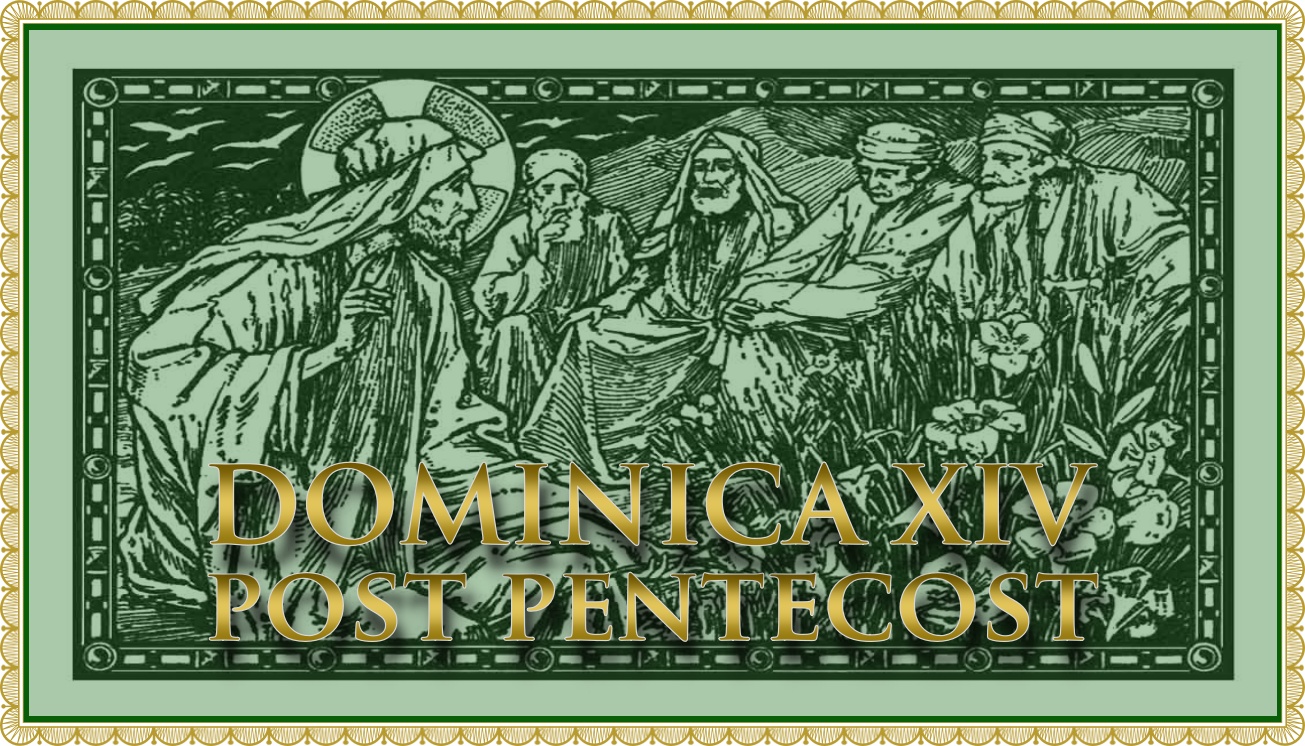
The Liturgy of the Fourteenth Sunday after Pentecost
The Introit
Protector noster, aspice, Deus, et respice in faciem Christi tui … — “Behold, O God, our Protector, and look upon the face of Thy Christ.” (Ps. 83:10–11)
The Introit recalls God’s providential care over His people. Dom Guéranger notes that this prayer of protection, drawn from the pilgrim’s psalm, places us under the gaze of the Father, who looks upon us in Christ. The verse continues: “For better is one day in Thy courts above thousands” (Ps. 83:11), setting the tone of detachment from worldly anxieties and delight in divine service.
The Collect
Custodi, Domine, quaesumus, Ecclesiam tuam propitiatione perpetua … — “Guard Thy Church, O Lord, we beseech Thee, with everlasting favor, and since without Thee mortal man falls, may Thy protection ever keep him from harm and guide him to salvation.”
This prayer encapsulates the whole message of the day: man is frail, easily distracted by vice and care, but God’s grace sustains and protects. Guéranger interprets it as the soul’s acknowledgment of dependence, a cry for God’s unceasing defense against both inner sin and outer adversity.
The Epistle (Gal. 5:16–24)
St. Paul contrasts the works of the flesh—fornication, uncleanness, idolatry, quarrels, envyings, murders, drunkenness—with the fruit of the Spirit—charity, joy, peace, patience, kindness, goodness, longanimity, gentleness, faith, modesty, continency, chastity.
Goffine observes that the Apostle calls virtues “fruit,” not “works,” to show that they are brought forth by divine grace, not merely by human effort. The Epistle reminds the faithful that union with Christ requires crucifying the flesh with its vices.
The Gradual and Alleluia
Bonum est confidere in Domino, quam confidere in homine … (Ps. 117:8–9) — “It is good to confide in the Lord rather than to have confidence in man.”
The chants reinforce the Gospel’s theme: only in God is security. Human designs, wealth, and powers are unstable; God alone is steadfast.
The Gospel (Matt. 6:24–33)
“No man can serve two masters … You cannot serve God and mammon … Seek first the kingdom of God and His justice, and all these things shall be added unto you.”
Here Christ insists on the impossibility of divided service. Baur highlights that this teaching is not rhetorical but absolute: the soul cannot simultaneously serve both God and worldly cares. Goffine explains that Christ does not condemn honest labor but condemns the consuming anxiety that betrays lack of trust. Guéranger connects the timing of this Gospel—after the summer harvest—with the temptation to rely on barns full of grain rather than on divine providence.
The Offertory
In te speravi, Domine; dixi: Tu es Deus meus, in manibus tuis tempora mea … (Ps. 30:15–16) — “In Thee, O Lord, have I hoped; I said: Thou art my God, my times are in Thy hands.”
This chant is the soul’s surrender: every season of life rests in God’s providence. The offering of bread and wine becomes a visible sign of entrusting all things to His care.
The Secret
Grant, we beseech Thee, O Lord, that this saving Victim may both cleanse us from our faults and protect us from all adversities.
The double petition—purification from sin and protection from harm—corresponds to the Epistle’s inward struggle and the Gospel’s outward anxieties.
The Communion Antiphon
Primum quaerite regnum Dei et justitiam ejus, et omnia adjicientur vobis … (Matt. 6:33) — “Seek ye first the kingdom of God and His justice, and all these things shall be added unto you.”
The liturgy closes with Christ’s own words, placed upon the lips of the faithful as they receive Him in Holy Communion. The very Eucharist embodies this promise: if we seek first God’s kingdom in the Bread of Life, He will not fail to provide all else.
The Postcommunion
May Thy Sacraments, O God, ever cleanse and defend us; and by their aid may we attain eternal salvation.
The Church prays that the grace received may continue its effect: cleansing inwardly, defending outwardly, guiding the faithful toward their final end.
Conclusion
The Fourteenth Sunday after Pentecost weaves a single thread through its Propers and readings: the Christian cannot serve two masters. The faithful are warned against sin by the Epistle and against anxiety by the Gospel. The chants, Collects, and Offertory confirm the same truth—man is frail, but God provides. Guéranger remarks that the liturgy is the “school of detachment”: teaching us to seek first God’s kingdom, that in the fruit of the Spirit we may live wholly for Christ and trust the Father’s care.





Leave a Reply