
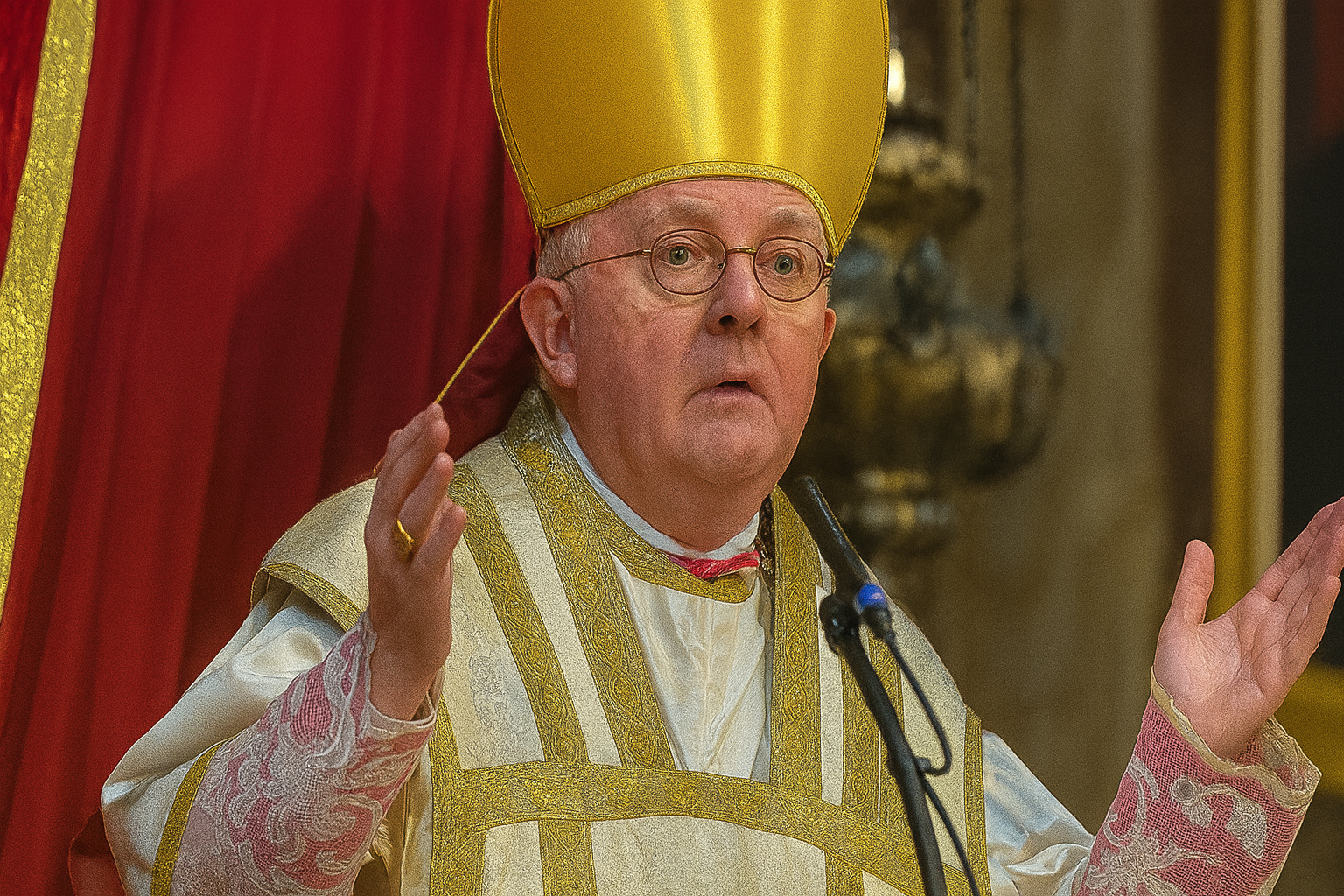
Counterfeit Mercy in Rome: The Longley Appointment and Its Lessons
The Vatican announced this week that Archbishop Bernard Longley of Birmingham has been appointed as a consultant to the Commission for Religious Relations with the Jews, part of the Dicastery for Promoting Christian Unity. This is Longley’s third Roman appointment in as many months, following earlier nominations to the Dicastery for Promoting Christian Unity in June and the Dicastery for Interreligious Dialogue in July.
At seventy years old, Longley has become one of the most senior English prelates at the Vatican under Pope Leo XIV, who has made rapid moves to shape the Curia in continuity with the “pastoral agenda” of his predecessor. For many Catholics, however, the Archbishop’s record on homosexuality and his active encouragement of “LGBT outreach” make his elevation a cause for grave concern.
The Soho Masses and Their Legacy
As auxiliary bishop of Westminster, Longley was placed in charge of the notorious Soho Masses Pastoral Council, which from 1999 until 2013 organised liturgies explicitly for those identifying as homosexual. Secular media outlets such as Pink News praised his leadership, while faithful Catholic groups such as Pro Ecclesia et Pontifice condemned the events as a betrayal of the Church’s call to chastity.
When critics questioned the contradiction between Church teaching and public celebration of same-sex lifestyles, Longley retorted that there could be no “moral means-testing” before Holy Communion, a statement that effectively sidestepped the question of objective grave sin. The late Daphne McLeod noted with sorrow that participants were “perfectly honest about their homosexual lifestyles” and made no pretence of striving for chastity. “No one, apart from the Archbishop, tries to pretend they are living or striving to live chaste lives,” she observed.
This refusal to confront sin directly represents the pastoral strategy later codified in Amoris Laetitia (2016), which blurred the line between accompaniment and affirmation. The words of St. Augustine remain prophetic here: “The good shepherd distinguishes between the diseased sheep and the healthy; he does not feed both alike.”¹
Synodal “Listening” and LGBT Structures
As Archbishop of Birmingham, Longley has continued this trajectory. His diocesan synodal response in 2023 referred positively to the “loving relationships” of remarried divorcees, polygamous unions, and LGBT couples. He thanked the “LGBTQ+ community” for its feedback and sponsored the creation of a diocesan LGBT group. Earlier this year, that group organised an “LGBTQ+ Vigil Welcome Mass,” with Longley assuring participants that “everyone should feel welcome in the family of the Church.”
This reflects a wider synodal dynamic in which “listening” becomes a pretext for introducing structures of dissent within diocesan life. Pope Pius XI’s encyclical Casti Connubii (1930) warned that to excuse sins against chastity on the basis of sentiment or circumstance is to “open wide the way to the destruction of public morals.”² Yet the very innovations condemned by Pius XI are now being dressed in the language of welcome and dialogue.
Leo XIV’s Signals
Longley’s promotion does not stand alone. Pope Leo XIV has received high-profile pro-LGBT activists in private audience, including Fr. James Martin, S.J., and Sr. Lucia Caram. He allowed the “Tent of Jonathan” gathering to process through the Holy Door of St. Peter’s Basilica and to celebrate a liturgy in the Jesuit Church of the Gesù—events advertised on the Vatican’s official Jubilee website.
Leo himself has publicly implied that doctrine follows practice: that if pastoral attitudes shift, doctrinal change may one day be declared. This inversion of Catholic tradition is precisely what St. Vincent of Lérins warned against in the Commonitorium, where he stated that true development means deepening what has been handed down, not altering it into something else.³
A Perilous Confusion of Charity
The present moment is marked by a perilous confusion between authentic charity and sentimental indulgence. True charity, as St. Thomas Aquinas teaches, seeks the eternal good of the other.⁴ To confirm people in acts gravely contrary to divine law is not pastoral accompaniment but spiritual neglect. As Our Lord himself warned: “Woe to you when all men speak well of you, for so their fathers did to the false prophets.”⁵
The Fathers were unanimous: shepherds who fail to warn sinners bear responsibility for their blood.⁶ St. Gregory the Great, in his Pastoral Rule, insisted that the pastor must never be silent when truth is at stake, for silence in the face of sin becomes complicity.⁷ What is at stake is not mere policy but the eternal destiny of souls.
It is here that the faithful find guidance from the Archbishop of Selsey’s pastoral epistle Omnium Hominum: On Chastity and Sexuality (2023), which addressed the very crisis now emboldened in Rome. There he wrote that “the virtue of chastity is demanded of all men without exception, for it is the key to the Christian life and the foundation of authentic freedom.” He warned that indulgence of impurity under the guise of mercy is in fact “a pastoral betrayal,” since true charity cannot contradict truth. By rooting chastity not only in divine command but in human flourishing, the Archbishop set forth a corrective utterly opposed to the present climate: “The Church must summon her children to conversion, not confirm them in corruption.”¹¹
The Way Forward
The Catholic faithful are not without guidance. St. Paul’s admonition stands in every age: “Do not be conformed to this world, but be transformed by the renewal of your mind.”⁸ The perennial Magisterium—from Humanae Vitae (1968) to Veritatis Splendor (1993)—has consistently upheld chastity as the non-negotiable condition for authentic human love.⁹ No synod, no papal comment, and no episcopal appointment can overturn divine law written into nature and revelation.
Archbishop Longley’s rise to influence under Pope Leo XIV illustrates the trajectory of a pontificate content to exchange doctrinal clarity for cultural approval. Yet, against this counterfeit gospel, Catholics hear another voice—the voice of the Archbishop of Selsey, who in his Pastoral Epistle on Chastity declared that indulgence of impurity is “a pastoral betrayal” and that the Church’s mission is not to welcome sin but to summon sinners to conversion.¹¹ Where one prelate speaks of “listening” without judgment, the other insists on teaching with clarity; where one proclaims welcome without conditions, the other proclaims mercy that transforms.
The faithful must discern which shepherd truly reflects the voice of Christ, who said not only “Come to me, all you who labour” but also “Go, and sin no more.” In that distinction lies the difference between flattery and salvation, between a Church remade in the image of the world and the Bride of Christ who remains spotless and true.
- St. Augustine, Sermon 46 on the Shepherds, in Nicene and Post-Nicene Fathers, First Series, vol. VI (New York: Christian Literature Publishing, 1888).
- Pius XI, Casti Connubii (1930), §62.
- St. Vincent of Lérins, Commonitorium, ch. 23.
- Thomas Aquinas, Summa Theologiae II-II, q.24, a.3.
- Luke 6:26, RSV.
- Ezekiel 3:18.
- Gregory the Great, Regula Pastoralis (Pastoral Rule), Part II, ch. 4.
- Romans 12:2, RSV.
- Paul VI, Humanae Vitae (1968), §12; John Paul II, Veritatis Splendor (1993), §80.
- Pius XII, Address to the Catholic Young Women of Italy (Rome, 1949).
- Archbishop of Selsey, Omnium Hominum: A Pastoral Epistle on Chastity and Sexuality, April 12, 2023, selsey.org.


Leave a Reply