
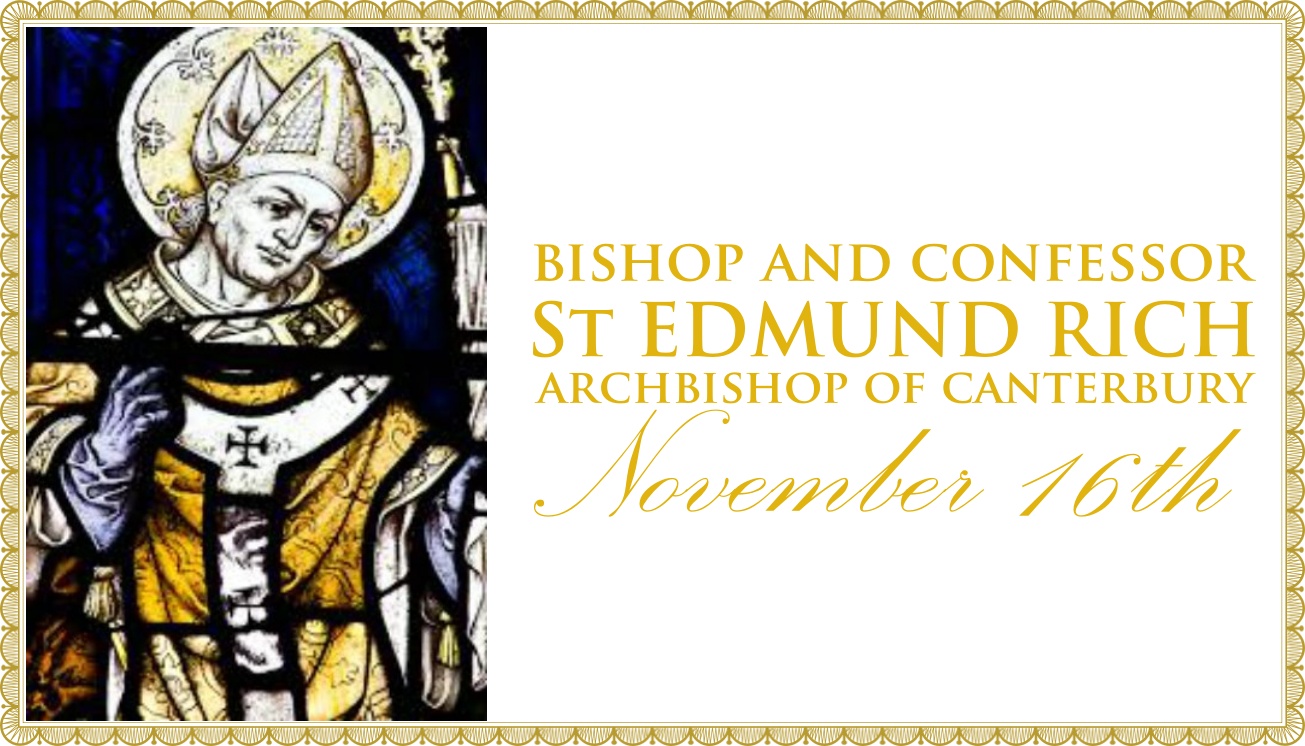
St. Edmund of Abingdon/Twenty Third Sunday after Pentecost (NOV 16)
by the Revd Dr Robert Wilson PhD (Cantab), Old Roman Apostolate UK
Today we celebrate the feast of St. Edmund of Abingdon, as well as commemorating the Twenty Third Sunday after Pentecost. St. Edmund was born in Abingdon near Oxford in England around 1174. He discerned a religious vocation from an early age and studied at the universities of Oxford and Paris. By around 1200 he had become a teacher, lecturing in mathematics and dialectics at both universities. The site where he lived and taught in Oxford subsequently became the college of St. Edmund Hall. After some years his vocation led him to study theology. He spent a year with the Augustinian canons at Merton priory, was ordained, took a doctorate in divinity and became a lecturer in theology. He was also noted as a preacher. At some point between 1219 and 1222 he became vicar of Calne in Wiltshire and treasurer of Salisbury cathedral.
In 1233 he was appointed by Pope Gregory IX to be Archbishop of Canterbury. The chapter of Canterbury cathedral had already made three selections which the Pope had declined to confirm. St. Edmund was initially reluctant to accept, but was eventually persuaded to do so. He was consecrated on 2nd April, 1234. He chose as his chancellor Richard of Wich, who was later himself canonised as St. Richard of Chichester. St. Edmund was concerned to resist arbitrary power in both the civil and ecclesiastical sphere. Though he was gentle in his dealings with others, he was uncompromising when fundamental principles were at stake. A week after his consecration he threatened to excommunicate King Henry III if he did not agree to dismiss his councillors, many of them foreign, who in St. Edmund’s view were obstructing the good government of the realm. The king yielded and the royal favourites were removed from power. St. Edmund successfully negotiated peace with Llywelyn the Great of Wales, but found himself increasingly at odds with the king. He was popular among the people who respected him for his holiness of life, but his willingness to speak truth to power without fear or favour made him many enemies. This affected not only his relations with the king, but also with several monasteries, including his own monastic chapter at Canterbury.
In 1236 the king persuaded the Pope to send a legate with the intention of emancipating himself from St. Edmund’s control. Cardinal Odo arrived in 1237 and worked with the king to block St. Edmund’s reforms at virtually every point. The king and legate upheld the monks at Canterbury who had objected to St. Edmund’s authority. St. Edmund responded by excommunicating all who infringed the liberties of Canterbury, but his actions had no impact and the Pope declined to reverse his legate’s decisions. St. Edmund came to find increasingly that his position was becoming untenable due to the obstructive behaviour he was facing and started to consider retirement. In 1240 he travelled to Rome to gain papal support for his reforming agenda, but fell ill on the way and died on this day at Pontigny in France. There were reports of miracles at his grave and he was canonised in 1246, despite the opposition of King Henry III.
There is much that can be learnt from the life of St. Edmund. He came of age at a time when theological leadership was passing from the monasteries, who had kept the candle of faith alive during the long so called dark ages, to the recently founded universities. The new scholastic method relied on logical analysis of propositions and was heavily dependent on the writings of the Greek philosopher Aristotle, whose works St. Edmund helped to promote. It seemed that St. Edmund would spend the rest of his life in such an academic environment. Perhaps if he had done so he would be remembered today as a model teacher rather than as a bishop.
However, his life took another course and he was persuaded to become Archbishop of Canterbury. In many ways he found himself ill prepared for this new role. He had no delusions of grandeur and continued to live simply. His gifts as a preacher and his sanctity of life led him to be highly regarded among the people, but he soon found himself embroiled in seemingly intractable controversies with those who had little interest in reform and were obsessed with maintaining their own power at all costs. Though he initially had some success, the weight of opposition came increasingly to overwhelm him and probably contributed to his death at Pontigny in France on his way to appeal to Rome.
It is always difficult to achieve the right balance between having clear principles and being pragmatic about what is realistically possible in a given situation. It may be said that St. Edmund would have had more success if he had been more prepared to compromise, but (even though he personally suffered the consequences) he was ultimately right to take a stand on matters of principle. He was in the almost impossible position of having to deal with exceptionally aggressive personalities who seem to have been solely interested in their own power and authority and were prepared to use virtually any means to justify their positions. But what ultimately mattered was not power for the sake of it, but the proper exercise of it. St. Edmund would be one who spoke truth to power without fear or favour, who was uncompromising in matters of principle, but still by nature gentle.
The Parable of the Talents in St. Matthew’s Gospel (which we heard today) reminds us that we will ultimately be judged in accordance with our faithfulness to the talents that have been given to us. None of us know the day and the hour of our own death so we must always seek to live so as to fully utilise the gifts or talents that we have been given. In the case of St. Edmund this was primarily an academic vocation and there can be little doubt that he would have preferred to have remained a teacher in the newly founded universities of Paris and Oxford. But, despite his personal misgivings, he accepted the offer of Archbishop of Canterbury. He did not alter his manner of life or compromise his principles, whether they will hear or whether they will forbear, as the prophet Ezekiel had put it. He continued to preach the gospel in season and out of season. In the short term his episcopate embroiled him in seemingly interminable controversies involving fundamentally irresponsible and conflicting forces. Despite these setbacks he remained faithful and could say at the last, with St. Paul, that he had fought the good fight, he had finished the race as one who was a good and faithful servant.
Let us pray for grace to follow the example of St. Edmund today, that we may speak the truth in love, firm in upholding matters of principle, but remaining gentle in our dealings with all, and that at the last we will be found faithful.



Leave a Reply