
The sorrowful irony of commemorating a martyr for the Roman Rite with a Protestantised liturgy
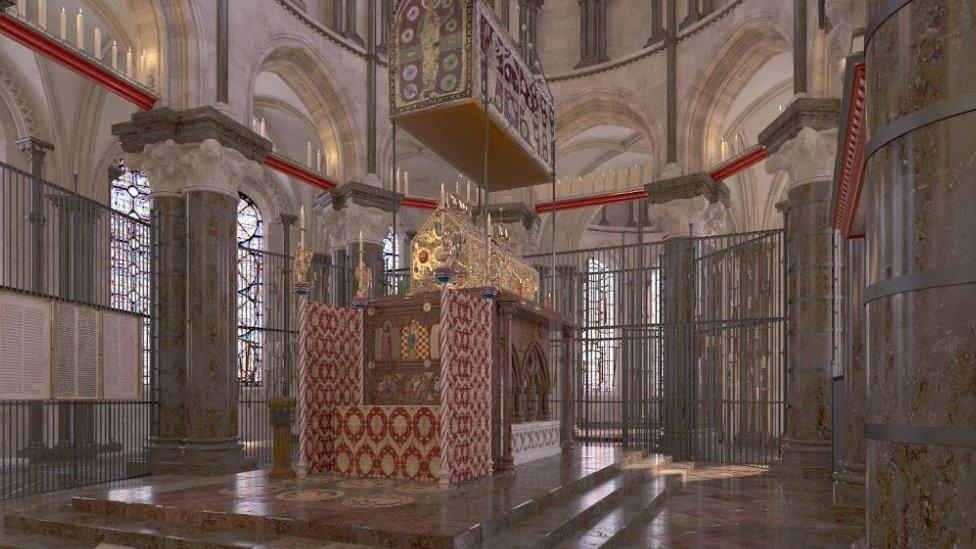
The July 7th celebration of a Catholic Mass in Canterbury Cathedral—marking the Feast of the Translation of St Thomas Becket—has been widely hailed as a triumph of ecumenical progress. Commentators have drawn attention to the historic significance of a papal nuncio offering Mass in the mother church of Anglicanism, once the centre of Catholic life in England before the schism under Henry VIII. Indeed, it has been over four centuries since a Roman Catholic liturgy was publicly offered in that sacred space by a representative of the Holy See¹.
And yet, for all the enthusiasm, there remains a sorrowful irony: the rite employed bore greater resemblance to Protestant communion services than to the sacred liturgy St Thomas himself would have known, venerated, and offered in fidelity unto death.
While it is no small matter that a Catholic Mass was celebrated at all in Canterbury Cathedral, one must ask whether the content and form of that liturgy honoured the martyr as he deserved. The Novus Ordo Missae—though valid when properly offered—has long been criticised for its theological ambiguities, its anthropocentric emphases, and its deliberate rupture from the organic development of the Roman Rite². In its structure, tone, and ceremonial minimalism, the reformed liturgy often approximates Protestant services more than it continues the Roman liturgical tradition preserved through the centuries³.
To celebrate a martyr for the traditional Roman Mass with the very rite devised in the wake of Vatican II to make Catholic worship more palatable to Protestants is more than a liturgical inconsistency—it is a tragic dissonance. As Archbishop Annibale Bugnini, chief architect of the postconciliar reform, reportedly declared, “We must strip from our Catholic prayers and from the Catholic liturgy everything which can be the shadow of a stumbling block for our separated brethren, that is, for the Protestants”⁴. Whether or not the precise wording is verbatim, the sentiment undeniably animated the liturgical reform: to align Catholic worship more closely with Protestant sensibilities under the banner of ecumenism. St Thomas Becket was murdered at the altar in defence of the Church’s liberty and her sacramental life, including the Mass that had been handed down with reverence from apostolic times⁵. He stood against the intrusion of worldly power into spiritual affairs, insisting that the Church must remain free to worship God as she has always done⁶. To replace that inheritance with a ritual so clearly shaped by the priorities of a committee rather than the devotion of the ages is to honour the man while quietly disregarding the very cause for which he died.
Of course, this irony is not unique to Canterbury. Across the world, saints who died for the Roman Rite or who worshipped according to its ancient form are routinely commemorated in rites they would neither recognise nor approve. But here, in this instance, the incongruity is especially stark. Canterbury was once a beacon of liturgical and doctrinal unity with Rome. Its cathedral witnessed centuries of the Holy Sacrifice offered in Latin, ad orientem, with the reverence and awe due to the mysteries of the altar⁷. That today it hosts a rite which often sidelines the sacrificial character of the Mass in favour of communal self-expression speaks volumes about the ongoing crisis of liturgy and identity in the Church⁸.
We must be grateful, certainly, that the name of Christ was proclaimed in that place, and that a representative of the Holy See could once again offer Mass in so historic a setting. But we must also have the honesty to say what this moment revealed: that the outward trappings of unity can obscure deep divisions of faith, form, and fidelity. True unity must be rooted in truth, and the truth is that the Roman Rite handed down through the centuries has been obscured—if not openly suppressed—in favour of a liturgy shaped by modernist and ecumenical ideals rather than tradition and transcendence⁹.
The Church cannot afford to honour her martyrs with compromises that dishonour the very faith they upheld. If we are to remember St Thomas Becket rightly, we must do more than offer Mass where he once walked—we must offer the Mass he died to protect.
Footnotes
¹ Religion News Service, “A Catholic Mass in Anglicanism’s home cathedral signals UK’s vogue for pre-Reformation relics,” 2 July 2025.
² Cardinal Alfredo Ottaviani and Cardinal Antonio Bacci, A Short Critical Study of the New Order of Mass (1969), commonly known as the Ottaviani Intervention.
³ Fr. Louis Bouyer, Memoirs (Ignatius Press, 2015), esp. pp. 222–226. Bouyer, who helped draft the new liturgy, later described it as “a banal, on-the-spot fabrication.”
⁴ Quoted in Jean Guitton, Paul VI secret (Éditions du Centurion, 1979); see also L’Osservatore Romano, 19 March 1965. For commentary, see Michael Davies, Pope Paul’s New Mass (Angelus Press, 1980), pp. 463–465; Yves Chiron, Annibale Bugnini: Reformer of the Liturgy (Angelico Press, 2018), ch. 6.
⁵ Dom Prosper Guéranger, The Liturgical Year, Vol. XIII, Feast of St Thomas Becket.
⁶ Pope Alexander III, Epistolae et Decreta, confirming Becket’s canonisation and the cause of ecclesiastical liberty.
⁷ Adrian Fortescue, The Mass: A Study of the Roman Liturgy (1912), pp. 214–220.
⁸ Benedict XVI (Joseph Ratzinger), The Spirit of the Liturgy (Ignatius Press, 2000), esp. pp. 78–83.
⁹ Archbishop Marcel Lefebvre, An Open Letter to Confused Catholics (1986): “The new rites have been protestantised. They no longer express clearly the truths of the Catholic faith.”

Leave a Reply