
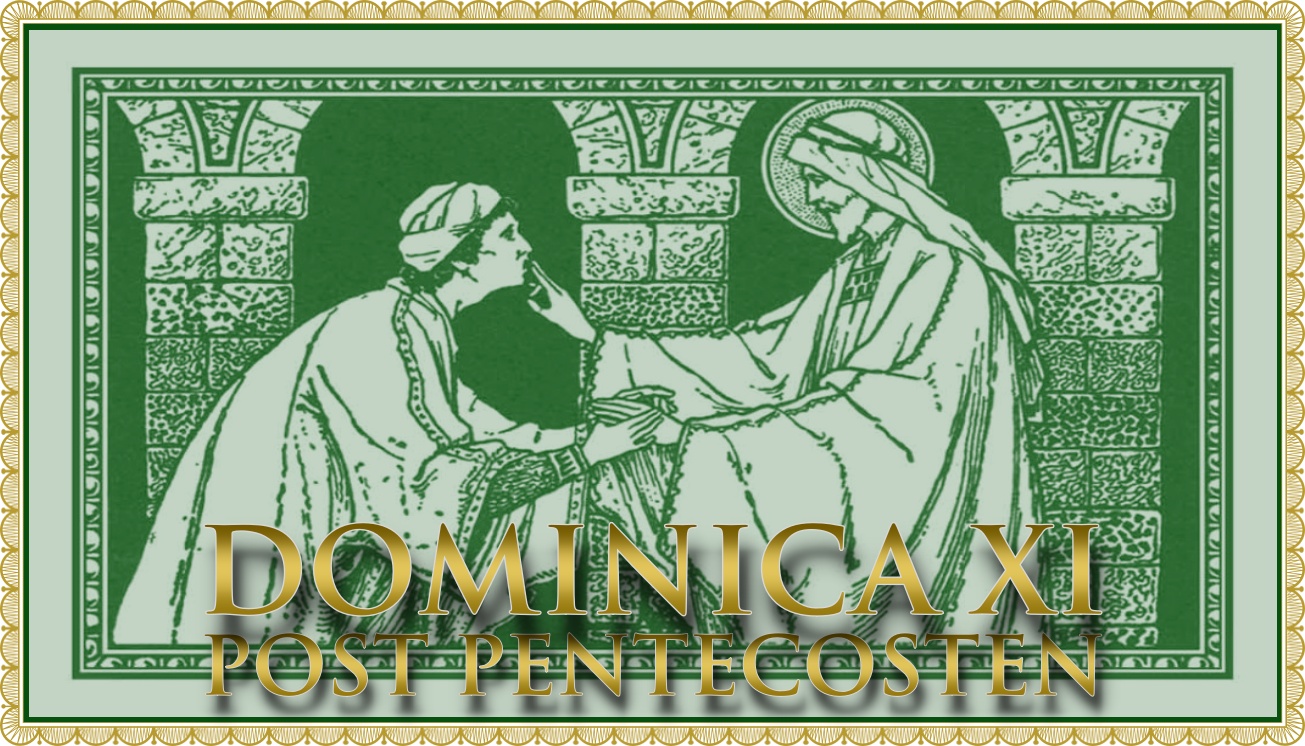
The Liturgy of the Eleventh Sunday Post Pentecost
The Eleventh Sunday after Pentecost gathers the faithful around a theme that echoes throughout the Propers: man in his weakness, raised up and transformed by the superabundant grace of God. The texts, from Introit to Gospel, speak of mercy, renewal, and the confession of faith.
The Introit
“Deus in loco sancto suo: Deus qui inhabitare facit unanimes in domo: ipse dabit virtutem et fortitudinem plebi suae” — “God in His holy place; God who maketh men of one mind to dwell in a house: He shall give strength and power to His people” (Ps. 67:6–7, 36).
Dom Guéranger observes that the Introit places before us the God of Israel dwelling in the midst of His people, but now in the Church: “The house is the Church; unity is her note; and her strength, which comes from God, makes her invincible against the gates of hell”¹.
The Collect
“Almighty, everlasting God, who in the abundance of Thy goodness dost exceed both the merits and the prayers of Thy suppliants, pour forth Thy mercy upon us…”
Pius Parsch notes that this Collect teaches the heart of Christian prayer: “We ask little, we merit nothing, yet God gives all and gives before we ask; His mercy outruns our prayer and surpasses our deserts”².
The Epistle: 1 Corinthians 15:1–10
St. Paul recalls the Gospel he preached and confesses: “By the grace of God, I am what I am; and His grace in me hath not been void.” Guéranger remarks: “He is keenly alive to the nothingness of man left to himself, and to the omnipotence of grace; yet he is also conscious that grace requires the fidelity of the human will”³. Goffine comments: “We are nothing without grace; yet we must co-operate with grace, otherwise it remains fruitless”⁴.
The Fathers confirm this truth. St. Augustine: *“When God crowns our merits, He crowns nothing else but His own gifts”*⁵. Chrysostom: “Paul ascribes all to grace, but does not destroy free will, for he adds, I labored more abundantly”⁶.
The Gradual and Alleluia
“O Lord, our Lord, how admirable is Thy Name in the whole earth! For Thy magnificence is elevated above the heavens” (Ps. 8:2).
Here the Church bursts into praise: the weak may boast only in the greatness of God’s Name. As Baur remarks, “the Gradual interrupts human speech with divine praise, lest man dwell on his weakness without rejoicing in God’s majesty”⁷.
The Gospel: Mark 7:31–37
The healing of the deaf and dumb man is proclaimed. Jesus takes him aside, touches his ears and tongue, and sighs heavenward before saying: Ephpheta! — “Be opened!” Immediately, he speaks plainly.
Guéranger: “This man represents the human race, made deaf and dumb by original sin. The cure cost the Savior sighs and tears, even unto death”⁸. Fr. Gabriel of St. Mary Magdalen applies: “The miracle is a symbol of the grace of baptism. The ears signify faith which comes by hearing; the tongue the confession of faith. Without grace, man is deaf to divine truth and dumb to God’s praise”⁹.
St. Ambrose had already seen the baptismal connection: “The priest touches the ears and nostrils of the catechumen, saying, Ephpheta, that he may receive both faith and the breath of divine life”¹⁰. The Roman Catechism explains: “The opening of the ears signifies that faith comes by hearing; the loosing of the tongue, that we must confess with the mouth the faith which we hold in the heart”¹¹.
The Offertory
“My hope is in Thee, O Lord; I have said: Thou art my God; my times are in Thy hands” (Ps. 30:15–16).
Here the Church places her confidence wholly in God. Guéranger sees in this a renewal of baptismal vows: “The soul, once dumb and deaf, now speaks: ‘Thou art my God!’”¹².
The Communion
“Honour the Lord with thy substance, and with the first of all thy fruits: and thy barns shall be filled with abundance, and thy presses shall run over with wine” (Prov. 3:9–10).
Baur interprets the Communion spiritually: “The true offering is man’s heart, his first fruits, sanctified by grace. Then God fills the soul with abundance — a superabundance of divine life, pressed down and overflowing”¹³.
Mystical Application
This Sunday, then, teaches the soul its condition and its cure: weakness without Christ, strength in Him. St. Bernard reminds: *“The tongue that speaks not of Christ is mute, and the ear that hears not His voice is deaf”*¹⁴. But Christ still sighs to heaven, still touches ear and tongue, still utters Ephpheta! — that we may hear and proclaim.
The liturgy is therefore not merely a remembrance but a sacramental present: what Christ wrought on the man of Decapolis, He now works in us. We, too, are taken aside by the liturgy, touched by divine power, and bidden to be opened — to faith, to confession, to praise, and to life. 🔝
- Prosper Guéranger, The Liturgical Year, vol. 10 (Dublin: O’Shea, 1884), p. 187.
- Pius Parsch, The Church’s Year of Grace, vol. 4 (Collegeville: Liturgical Press, 1962), p. 110.
- Guéranger, Liturgical Year, vol. 10, p. 190.
- Leonard Goffine, Devout Instructions on the Epistles and Gospels (New York: Benziger, 1880), p. 508.
- St. Augustine, Epistle 194, 5.19 (PL 33: 890).
- St. John Chrysostom, Homilies on First Corinthians, Homily 38 (PG 61: 323).
- F. X. Baur, Die Erklärung der Sonntagsevangelien (Mainz, 1863), p. 246.
- Guéranger, Liturgical Year, vol. 10, p. 194.
- Gabriel of St. Mary Magdalen, Divine Intimacy (Rockford: TAN, 1987), meditation 254.
- St. Ambrose, De Mysteriis, I.3 (PL 16: 386).
- Catechismus Romanus, Part II, Ch. 2 (trans. Donovan, 1829), p. 151.
- Guéranger, Liturgical Year, vol. 10, p. 196.
- Baur, Sonntagsevangelien, p. 250.
- St. Bernard of Clairvaux, Sermon on the Song of Songs, 18.6 (PL 183: 862).




Leave a Reply