
The UK’s Fertility Crisis: A Failure of Honesty
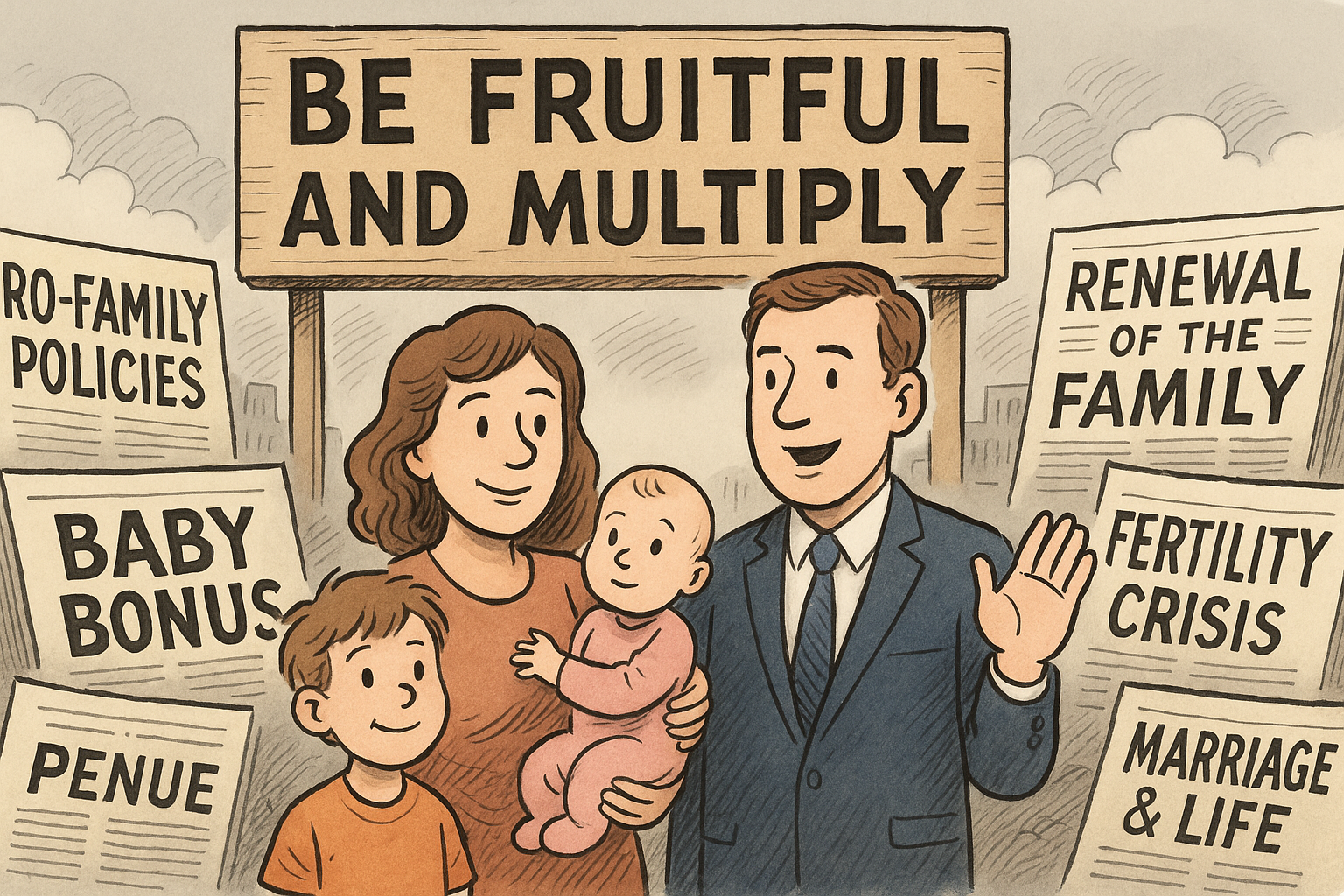
New data from the Office for National Statistics reveal that women in England and Wales bore, on average, just 1.41 children in 2024—the lowest figure since records began in 1938. Public debate has treated this decline as the result of smaller families, but as Stephen J. Shaw has argued, the real crisis is that increasing numbers never become parents at all.¹
Contrary to the prevailing narrative, British parents are still having roughly two or more children, much as they did in the 1970s. What has changed is the rising tide of childlessness. ONS projections suggest that only 65% of women are likely to become mothers if current patterns continue—down from 71% in 2020.² The issue is not rejection of parenthood, for surveys consistently show that most still desire children, but what Shaw terms “unplanned childlessness”—a hoped-for family that never materialises.
This exposes the falsehood of the modern myth that parenthood can be postponed indefinitely. While biological fertility does not collapse at 28, ONS analysis shows that women childless at that age in 2023 had only a 50% chance of ever becoming mothers.³ The issue is not biology alone but the increasing unlikelihood of forming a stable union at the right time. Society has built a world that frustrates family formation, with prolonged education, careerist structures hostile to early parenthood, and cultural narratives that treat family as secondary to self-realisation.
Shaw observes that governments have spent decades “throwing money at the wrong end of the problem” with childcare subsidies, parental leave, and IVF access—policies that support those already in relationships, but do nothing for the growing number who never arrive at that point.⁴ The problem is not merely economic but profoundly cultural. The modern secular creed of autonomy and delay corrodes the natural progression to marriage and family life.
The Church has long warned that when society undermines the family, it undermines itself. Pope Pius XI taught that “the family holds directly from the Creator the mission and hence the right to educate the offspring” and that no social order can be healthy if it neglects or suppresses this divine institution.⁵ Likewise, St. John Chrysostom urged his flock to embrace marriage and parenthood not as optional but as the ordinary path of sanctity for most: “The begetting of children is the most suitable cause of marriage… The home is a little Church.”⁶
Today, a third or more of the population faces lifelong childlessness. This is not merely demographic decline but civilisational decay. For without renewal in marriage and family, society itself cannot be renewed. As Pope Leo XIII declared: “The domestic household is the cornerstone of the State… when the home is destroyed, the nation itself totters.”⁷
The Catholic answer to this crisis is not technocratic but evangelical: to recall men and women to the truth that family is not an accessory to life but its natural fulfillment, a vocation written into our nature by God Himself. Until Britain rediscovers this, her fertility will continue to collapse—not through shrinking families, but through a society that no longer allows its people to become mothers and fathers at all. 🔝
- Office for National Statistics, Births in England and Wales: 2024 (London: ONS, 2025).
- Stephen J. Shaw, “Britain’s Birthrate Crisis,” Sunday Times, 31 August 2025.
- Ibid., citing ONS data on age and fertility probabilities.
- Shaw, Sunday Times, 2025.
- Pope Pius XI, Divini Illius Magistri (1929), §32.
- St. John Chrysostom, Homily on Ephesians 20.
- Pope Leo XIII, Rerum Novarum (1891), §12.



Leave a Reply