
The Myth of a Palestinian State: A Historical Reality Check
In the ongoing debate over Israel’s legitimacy, one of the most frequently repeated assertions is that the Jewish state replaced an existing “Palestinian state” in 1948. This claim is not only false but fundamentally ahistorical. A sober review of the record reveals that, across millennia, no such sovereign state ever existed. The land was always controlled either by foreign empires or by the Jewish people themselves. Far from erasing a native Palestinian polity, modern Israel is the only restoration of indigenous sovereignty the land has ever known.
Imperial Rule, Not Palestinian Sovereignty
When Israel declared independence in 1948, it did so from the British Mandate for Palestine, established in 1922 under the League of Nations.¹ Britain, in turn, had inherited the land after the collapse of the Ottoman Empire at the end of the First World War. For four centuries prior (1517–1917), the Ottomans had governed Palestine as part of their empire, taxing its inhabitants and appointing officials from Istanbul.² At no point in those centuries was there even a hint of an independent Palestinian government.
Before the Ottomans, the land was held by the Mamluk Sultanate of Egypt (1250–1517), an Islamic state dominated by military elites of Turkic and Circassian origin.³ Their rule replaced that of the Ayyubid dynasty (1171–1250), founded by Saladin after he recaptured Jerusalem from the Crusaders.⁴ Saladin’s victory was an Islamic triumph, but it was not the birth of a Palestinian state; Jerusalem was incorporated into his broader Arab-Kurdish empire centered in Egypt and Syria.
Between 1099 and 1291, much of the land had been part of the Christian Kingdom of Jerusalem, a Crusader state.⁵ This polity, too, was not Palestinian but European in character, established by knights from France and Italy who carved out territories after the First Crusade. Prior to the Crusaders, the land had been under the control of the Umayyad and later Fatimid Caliphates, vast Arab empires stretching from Spain to Egypt.⁶ Still earlier, the territory belonged to the Byzantine Empire, the Christian continuation of Rome, and briefly fell to the Sassanid Persians (614–629) before being reconquered by Emperor Heraclius.⁷ None of these regimes ever created a Palestinian state.
The Roman and Jewish Foundations
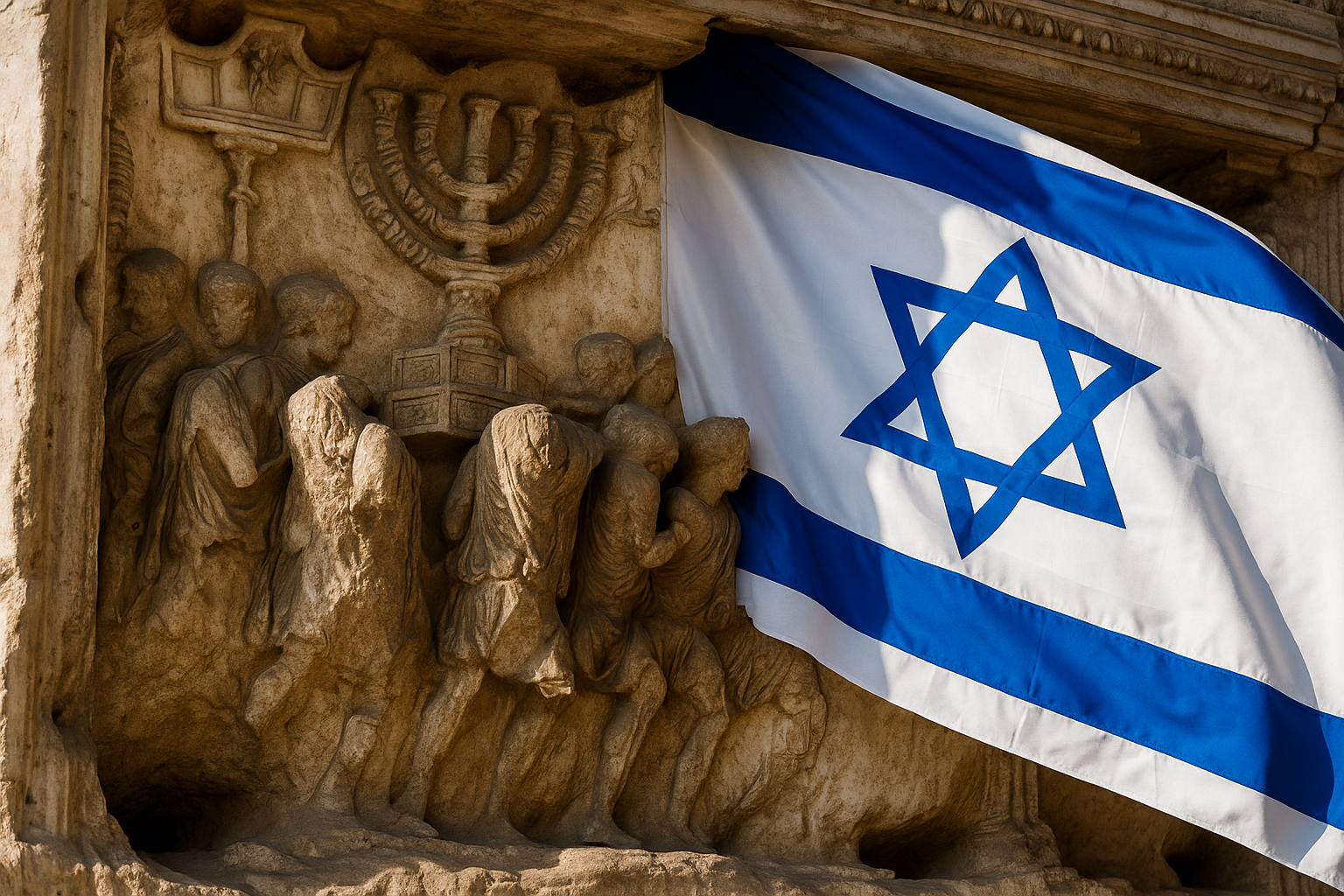
The Roman conquest in 63 BC brought the land under imperial administration, ultimately reorganized as the province of Judea.⁸ After successive Jewish revolts — first under the Maccabean descendants, then the revolt of 70 AD, and finally the Bar Kokhba revolt of 132–135 AD — the Emperor Hadrian sought to obliterate Jewish identity in the region. He expelled Jews from Jerusalem, rebuilt it as a pagan colony called Aelia Capitolina, and renamed the province Syria Palaestina.⁹ The name “Palestine” therefore originates not as a marker of native identity but as a calculated insult, designed to sever the Jewish people from their ancestral land.
Before Rome, however, there had indeed been a native sovereign people: the Jews. The Hasmonean Kingdom (140–63 BC), established after the Maccabean revolt against the Seleucids, was an independent Jewish state centered in Jerusalem.¹⁰ It minted its own coins, maintained a functioning priesthood, and governed according to Jewish law. Prior to the Hasmoneans, the land had been ruled by the Seleucid Empire, one of the Hellenistic successor states of Alexander the Great’s empire.¹¹ Alexander himself had taken the region from the Persians in the 4th century BC. Before him, the land was controlled by the Persian Achaemenid Empire (539–332 BC), which had earlier displaced the Babylonians who destroyed the First Temple in 586 BC and exiled the Jewish population.¹²
The Only Native States: Israel and Judah
Yet even before these empires, the land had been home to the Kingdoms of Israel and Judah (c. 930–586 BC). These monarchies emerged from the earlier United Kingdom of Israel, established under Saul, David, and Solomon (c. 1050–930 BC).¹³ From Jerusalem, Solomon built the First Temple and presided over a golden age of Jewish sovereignty. When the kingdom divided, Israel in the north and Judah in the south continued as independent states until their conquest by Assyria and Babylon. Even earlier, before kingship, the Israelites lived as a theocracy of the Twelve Tribes, governed under the Law of Moses.¹⁴
Before Israel’s arrival, the land was inhabited by the Canaanite city-states — small, independent polities such as Jericho and Hazor.¹⁵ These were not national states in the modern sense, and certainly not Palestinian.
The Historical Verdict
The historical verdict is unequivocal: the only indigenous sovereign polities to arise in the land were Jewish. From the conquest of Joshua, through the reigns of David and Solomon, to the Hasmonean dynasty, Jewish sovereignty was a lived reality. Every other period — Babylonian, Persian, Greek, Roman, Byzantine, Arab, Crusader, Ottoman, and British — was one of imperial occupation or foreign administration. The supposed “Palestinian state” is conspicuous only by its absence.
The very name “Palestine” entered history as a Roman political fiction, not as the title of a people’s homeland. For nearly two millennia, it denoted a geographical district, never a sovereign nation. It was only in the 20th century that the term began to be repurposed into a nationalist claim. But unlike Zionism, which revived a genuine ancient people’s aspiration for return, Palestinian nationalism lacks any precedent of statehood to restore.
Britain’s Folly: Recognizing What Never Existed
Against this backdrop, Britain’s recent decision on September 21, 2025, to formally recognize a “State of Palestine” is revealed as both historically false and politically reckless. To grant recognition to something that has never existed in history is not statesmanship but self-deception. It ignores the plain fact that the Palestinian Authority has not held presidential elections since 2005, that Hamas — a jihadist faction committed to Israel’s destruction — has ruled Gaza by force since 2007, and that no unified Palestinian polity capable of functioning as a state even exists. To dignify this fractured reality with recognition is to reward corruption, dictatorship, and terrorism, while punishing the only democracy in the Middle East.
Worse still, Britain’s recognition legitimizes a narrative built on historical falsification. It implies that there was once a Palestinian state wrongfully displaced, when in fact none ever existed. Such a gesture lends diplomatic cover to anti-Israel movements and undermines the pursuit of genuine peace by entrenching falsehoods. It is, in truth, the repetition of Hadrian’s ancient insult — a denial of Jewish history in the very land where it was written.
Conclusion: Israel’s Legitimacy, Palestine’s Invention
This reality matters because it punctures the narrative that Israel is an intruder. Israel is the latest chapter in the story of Jewish sovereignty in its ancient homeland. The “State of Palestine,” by contrast, is a recent invention of the 20th century, projected onto a past where it never existed. To recognize it as if it were the heir to an ancient polity is not an act of justice but of historical distortion.
Britain’s recognition does not advance peace; it advances illusion. The truth, borne out by centuries of history, is that Israel stands on the continuity of a real and indigenous sovereignty, while “Palestine” is a construct with no precedent in the long story of the land. Honest history should be the foundation of international policy. Anything less is not diplomacy but delusion.
Footnotes
- League of Nations, Mandate for Palestine, July 24, 1922.
- Stanford J. Shaw, History of the Ottoman Empire and Modern Turkey, Vol. 1 (Cambridge: CUP, 1976), pp. 77–81.
- Amalia Levanoni, The Mamluks in Egyptian and Syrian Politics and Society (Leiden: Brill, 2004).
- Malcolm C. Lyons & D.E.P. Jackson, Saladin: The Politics of the Holy War (Cambridge: CUP, 1982).
- Steven Runciman, A History of the Crusades, Vol. 2 (Cambridge: CUP, 1952).
- Hugh Kennedy, The Prophet and the Age of the Caliphates (London: Longman, 1986).
- James Howard-Johnston, East Rome, Sasanian Persia and the End of Antiquity (Aldershot: Ashgate, 2006).
- Josephus, Antiquities of the Jews, Book 14.
- Cassius Dio, Roman History, Book 69; Eusebius, Ecclesiastical History, 4.6.
- Victor Tcherikover, Hellenistic Civilization and the Jews (New York: Atheneum, 1975).
- Polybius, Histories, Book 31.
- 2 Kings 25:8–21; Amélie Kuhrt, The Ancient Near East c. 3000–330 BC, Vol. II (London: Routledge, 1995).
- 1 & 2 Samuel, 1 Kings; cf. K.A. Kitchen, On the Reliability of the Old Testament (Grand Rapids: Eerdmans, 2003).
- Judges 2:16–19.
- William F. Albright, The Archaeology of Palestine (Penguin, 1960), pp. 90–101.




Leave a Reply