
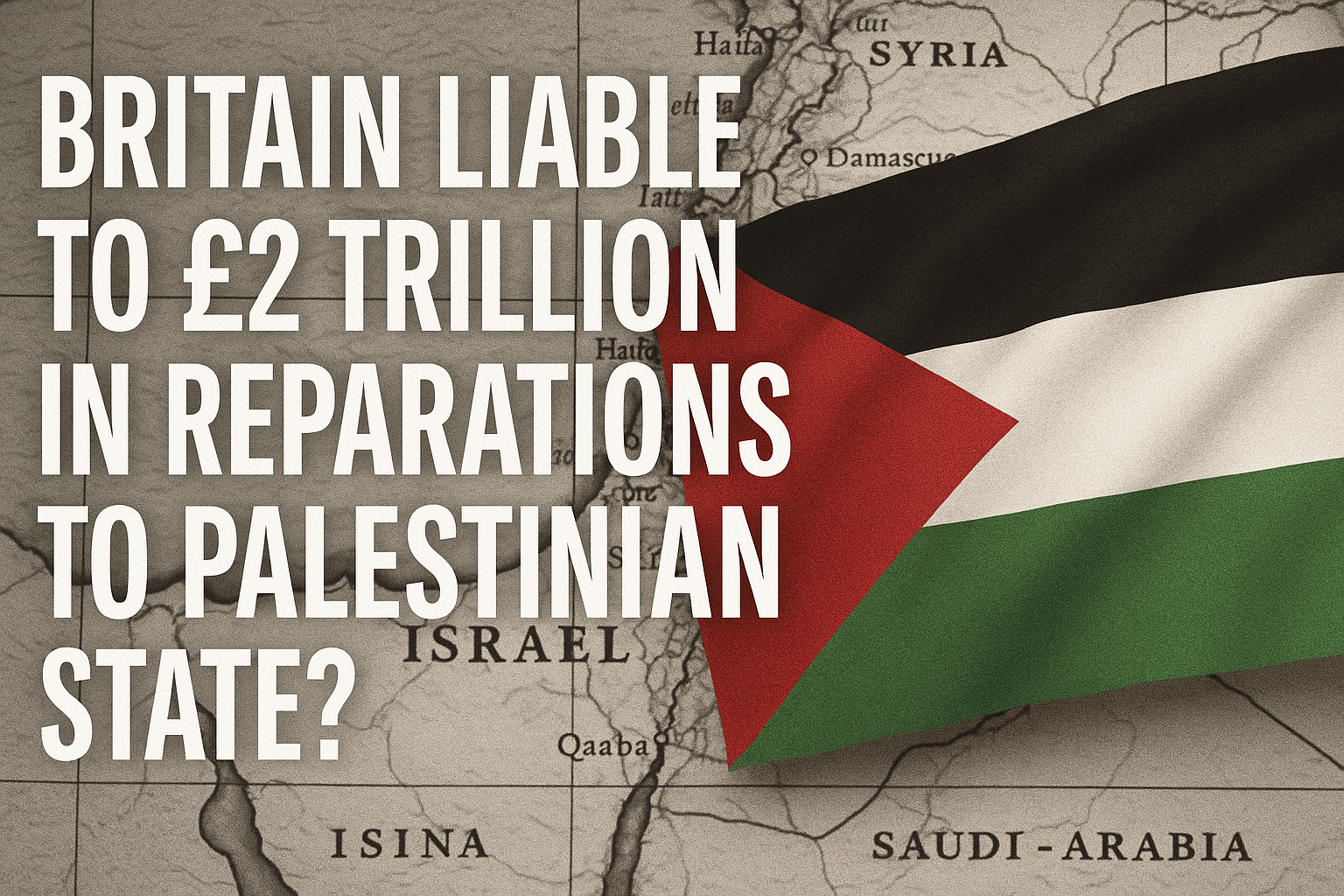
Britain and the Phantom Bill: The Illusion of Palestinian Reparations
In recent months, speculation has arisen in some quarters that Britain could face reparations claims of up to £2 trillion from a Palestinian state, on account of its role in the Mandate period of the early twentieth century. Such claims, however dramatic, are built not upon legal precedent or international obligation, but upon political imagination. To speak of liability in this context is to construct a phantom bill, unenforceable and illusory.
The Absence of a State
The most basic obstacle to such a claim is the absence of a recognised sovereign claimant. In international law, only states may bring contentious claims against other states before the International Court of Justice (ICJ).¹ While the “State of Palestine” enjoys observer status at the United Nations and has acceded to certain treaties, it is not universally recognised as sovereign. It lacks stable borders, territorial integrity, and effective government — essential criteria for statehood under the Montevideo Convention of 1933.²
Without sovereignty, there is no continuous subject of international law to inherit or quantify claims from the Mandate period. Even if the Palestinians were granted full recognition tomorrow, such status could not be retroactively applied to events a century past.
The Termination of Britain’s Mandate
Britain’s obligations in Palestine formally ended with the termination of the Mandate in May 1948, as declared by the United Nations.³ At that point, Britain ceased to exercise political or legal authority in the territory. Israel’s declaration of independence followed, and responsibility for subsequent conflicts lay with the successor states and actors, not the former Mandate power. To demand that Britain bear perpetual responsibility for later wars, displacements, and disputes is to distort the principle of legal closure in international relations.
The Question of Causation
Even if one presumes, contrary to fact, that Palestine could sue Britain, the problem of causation would prove insurmountable. Reparations require a demonstrable link between a wrongful act and specific harm. To argue that British policies in the 1920s or 1930s caused today’s geopolitical crisis would demand a chain of liability spanning generations, wars, and political upheavals. International law has consistently rejected such expansive retroactive liability.
Reparations in International Law: Genuine Precedents
Where reparations have been enforced, they have followed highly specific conditions.
- Iraq–Kuwait (1991): Following Iraq’s invasion of Kuwait, the UN Security Council created the United Nations Compensation Commission (UNCC), which ordered Iraq to pay over $50 billion to claimants worldwide.⁴ This was possible only under Chapter VII of the UN Charter, which gave the Security Council coercive authority. No such mechanism exists for Palestine.
- Kenya (Mau Mau): In 2013, the UK agreed to pay £19.9 million in compensation to survivors of abuses during the Mau Mau uprising.⁵ Crucially, the settlement was ex gratia — a political gesture, not an admission of legal liability. Britain expressly avoided setting a precedent for further colonial claims.
- Germany–Namibia: In 2021, Germany pledged €1.1 billion in development aid over 30 years, acknowledging the genocide of the Herero and Nama peoples.⁶ Yet Berlin carefully described this as a gesture of “reconciliation,” not legal reparations, to avoid exposing itself to further claims.
In each case, the settlement involved a recognised state or a defined class of victims, and the outcome was either enforced by the Security Council or reached through negotiated diplomacy. None bears resemblance to the Palestinian case.
The Politics of Reparations Campaigns
The Palestinian claim belongs less to the realm of law than to that of political advocacy. Caribbean states, through CARICOM, have long pursued a “Ten Point Plan” demanding reparations for slavery and colonialism.⁷ Yet despite eloquent appeals, they have received neither judicial rulings nor binding payments, only occasional negotiations with former colonial powers. Similarly, Palestinian activists inflate demands into the trillions to dramatise grievances and press for symbolic apologies, development funds, or concessions in diplomacy.
Such rhetoric should not be dismissed outright — it reveals the way history is weaponised for present purposes. Yet it must be recognised for what it is: political theatre, not legal liability.
Moral Versus Legal Responsibility
Here lies a crucial distinction too often blurred in public discourse: the difference between moral guilt and legal liability. A state may acknowledge that its past policies contributed to injustice without thereby admitting a binding duty to pay reparations. Britain has expressed “regret” in cases such as the Mau Mau abuses, Germany has apologised for colonial atrocities in Namibia, and France has issued statements of remorse for Vichy complicity in deportations. These are moral recognitions, aimed at reconciliation.
But moral contrition is not the same as legal obligation. Law requires defined acts, attributable responsibility, standing claimants, and enforceable mechanisms. History, by contrast, is full of ambiguities, contested narratives, and shifting sovereignties. To collapse the one into the other is to invite endless claims without closure, ensuring that every past injustice becomes a perpetual financial demand.
The danger is clear: if grievance becomes a substitute for law, history itself becomes ungovernable. Modern states would be trapped in a cycle of perpetual repayment, with no principle of limitation, no closure, and no justice — only the politicisation of memory.
Why the Claim Fails
Several principles of international law make the Palestinian claim untenable:
- Sovereign immunity: Britain cannot be compelled to submit to foreign courts without its consent.⁸
- Lack of standing: Palestine is not a universally recognised state and therefore cannot bring a claim before the ICJ.¹
- Inter-temporal law: Acts must be judged by the standards of the time, not retroactively. What is deemed unlawful today was not necessarily unlawful a century ago.⁹
- No causation: The conflicts of 1948–2025 cannot be directly attributed to British actions before 1948.
Conclusion
The suggestion that Britain faces a £2 trillion reparations bill from Palestine is a chimera. No Palestinian state exists to claim them; no tribunal has jurisdiction to impose them; no precedent supports them. The real effect of such demands is rhetorical — a bid to place a perpetual moral and financial debt upon the West.
Law distinguishes between guilt and liability, between moral acknowledgement and legal duty. Campaigners may succeed in extracting symbolic gestures or negotiated aid, but they cannot transform grievance into binding judgment. To indulge such illusions would be to confuse justice with theatre, and truth with ideology.
- Statute of the International Court of Justice, Art. 34(1).
- Montevideo Convention on the Rights and Duties of States (1933), Art. 1.
- United Nations General Assembly Resolution 181 (II), 29 Nov. 1947; British withdrawal, 14 May 1948.
- United Nations Compensation Commission (UNCC), established by Security Council Resolution 687 (1991).
- UK Foreign and Commonwealth Office, Statement on Mau Mau settlement, 6 June 2013.
- German Federal Foreign Office, “Germany and Namibia agree joint declaration,” 28 May 2021.
- CARICOM Reparations Commission, Ten Point Plan for Reparatory Justice (2014).
- UK State Immunity Act 1978; cf. International Law Commission, Articles on Jurisdictional Immunities of States and Their Property (2004).
- Island of Palmas Arbitration (1928), PCIJ Reports, principle of inter-temporal law.




Leave a Reply