
The Silent Mark: Policing by Allegation and the Rise of Shadow Criminality
A journalist’s discovery that she had been secretly recorded as a criminal suspect illustrates the dangerous evolution of British policing into ideological surveillance.
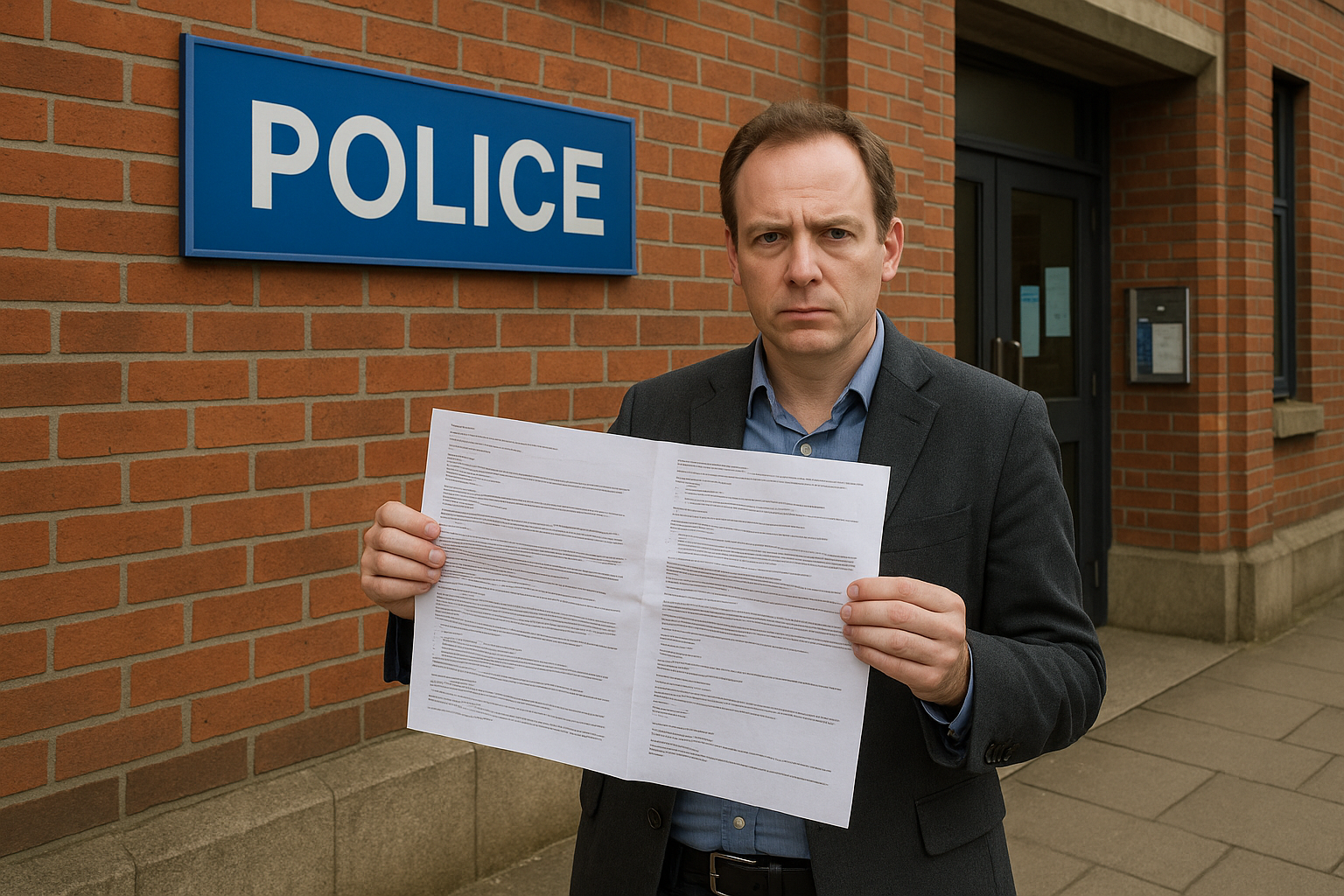
Helen Joyce recently disclosed that through a subject access request she learned the police had logged her as a perpetrator of criminal harassment aggravated by “transgender hate.” She had never been contacted, interviewed, or charged. Yet the allegation, made by a trans-identifying complainant, was officially entered into the system and closed with Outcome 15—the category meaning a suspect is identified, the complainant supports action, but evidential difficulties prevent prosecution¹. In effect, a shadow conviction was created without trial.
Initially, officers on the case had judged the remarks in question “unpleasant” but not criminal. A senior reviewing officer overturned that judgment and ordered the matter recorded as a crime. No evidence was tested, no defence heard, yet Joyce’s name was placed on record as if the complaint were established fact.
The Origins of Non-Crime Hate Incidents
This episode cannot be understood apart from the development of non-crime hate incidents (NCHIs), a concept introduced following the Macpherson Report (1999) into the Stephen Lawrence murder². Police were instructed to record incidents perceived by the “victim or any other person” as motivated by hostility, even where no offence had been committed. Over two decades, tens of thousands of such incidents were logged. In some cases, they appeared on enhanced criminal record checks, with consequences for employment and reputation³.
Critics long warned of the chilling effect on free speech. In 2021, the Court of Appeal ruled in Miller v College of Policing that the practice had disproportionately interfered with free expression, forcing the government to issue a statutory Code of Practice⁴. Since June 2023, forces may record NCHIs only when there is a “real risk of significant harm” or of escalation to crime, with trivial or malicious allegations excluded⁵. But the Joyce case suggests that in practice, subjective complaint continues to outweigh objective justice.
Growing Chorus of Criticism
Sir Andy Cooke, Chief Inspector of Constabulary, has publicly called for an end to NCHIs, arguing that they risk undermining trust and waste valuable resources⁶. A report from Policy Exchange, endorsed by former Met Commissioner Lord Hogan-Howe, warns that NCHIs were intended as intelligence tools but have mutated into a quasi-criminal recording system without democratic oversight⁷. Academics have also pointed to the perverse incentives such recording creates: police may be tempted to log dubious complaints to demonstrate “responsiveness,” diverting attention from serious crime⁸.
Parliamentarians have noted the absurd scale of the practice: over 13,000 NCHIs in a single year, including incidents involving children and petty disagreements. Lords debates have warned that the very vagueness of the category risks trivialising real hate crime⁹. Journalists, too, have documented cases where citizens were visited over controversial tweets or minor slights, raising fears of policing speech rather than crime¹⁰.
From Objective Crime to Subjective Incident
Traditional crime has an objective structure: actus reus, mens rea, and evidential burden. By contrast, NCHIs are recorded largely on the perception of a complainant. This shift from evidence to belief undermines the principle of equality before the law. As critics note, the law is being applied differentially: where identity categories are invoked, allegations are more readily transformed into official records, bypassing normal safeguards.
The result is a dual system. In one, citizens accused of burglary or assault face investigation, evidence, and trial. In the other, citizens accused of offensive words may be quietly logged as “suspects,” without knowledge, process, or recourse.
Consequences for Liberty and Democracy
Even if NCHIs are not automatically disclosed on standard background checks, they may appear on enhanced disclosures as “local police information.” The existence of such records can affect careers, reputations, and civic standing. They create a chilling effect: citizens hesitate to speak lest they acquire a permanent mark in state files. Critics argue that this is nothing less than policing by allegation.
Parliamentary oversight has been weak, since NCHI rules were rooted in guidance rather than law. The 2023 Code of Practice was meant to correct this imbalance, but Joyce’s case demonstrates how entrenched the culture has become. As long as perception is privileged over proof, injustice will remain.
What Citizens Can Do
For those who suspect or discover that they have been logged in this way, there are practical steps available under existing law:
- Submit a Subject Access Request (SAR):
Under the Data Protection Act 2018, citizens have the right to request all personal data held by the police. This includes incident logs, crime numbers, and decision notes¹¹. - Seek Rectification or Erasure:
Where allegations are inaccurate, malicious, or fail the new statutory threshold (no real risk of harm or escalation), individuals can demand correction or deletion of personal data¹². - Challenge Crime Recording:
If a matter has been wrongly recorded as a crime without sufficient evidence, citizens can ask for review against the Home Office Counting Rules. A crime can be “cancelled” if the tests for recording are not met¹³. - Escalate Complaints:
If the force refuses to act, complaints may be taken to the force Data Protection Officer, the Information Commissioner’s Office (ICO) for data accuracy, or the Independent Office for Police Conduct (IOPC) for misconduct. - Legal Action:
Where free speech or reputational harm is at stake, Miller shows that courts may intervene to strike down disproportionate practices. Citizens may pursue pre-action protocols with specialist legal advice.
These remedies do not eliminate the deeper systemic problem, but they provide ways for individuals to contest records that have been unfairly or unlawfully imposed upon them.
Speaking the Truth Without Falling into the Trap
For Christians proclaiming the truths of the faith in a culture increasingly hostile to moral absolutes, there is an added challenge: how to speak without inviting accusations that could trigger an NCHI. Some principles may help:
- Clarity without malice: Speak clearly about doctrine—on marriage, family, and the created order—but avoid personalising criticisms or targeting individuals. Proclaim truth, not insult.
- Charity in language: Even when rejecting falsehood, couch arguments in terms of reason, natural law, and human dignity. This minimises the claim that one’s words are motivated by “hatred.”
- Evidence and authority: Cite Scripture, tradition, and recognised scholarship. When statements are rooted in authoritative sources, they are less vulnerable to being misrepresented as arbitrary hostility.
- Context and prudence: Choose platforms carefully. A parish homily differs from a social media post where words can be decontextualised. Prudence is not cowardice; it is a virtue that protects both truth and messenger.
- Witness by life as well as word: Living visibly according to faith lends credibility to speech. Consistent charity in action makes it harder for detractors to paint Christian conviction as malice.
This is not a counsel of silence. It is a strategy of integrity: refusing to compromise on truth, but also refusing to hand opponents the easy weapon of alleging “hate” where only conscience and reason are at work.
The Case for Abolition
The evidence suggests that tinkering with thresholds is insufficient. The category of NCHIs itself—neither crime nor intelligence, but a hybrid with punitive effect—ought to be abolished. At minimum, it must be radically restricted, with safeguards against subjective misuse, malicious complaints, and ideological capture. Police resources should return to their proper end: the investigation of crime, not the management of opinion.
Helen Joyce’s story is thus more than a personal injustice. It is a symptom of a broader shift: from a justice system grounded in evidence and due process to one shadowed by reputation-based suspicion. A society that permits such silent marks abandons the presumption of innocence and risks replacing law with ideology.
- Home Office Counting Rules, Outcome 15 definition: “Evidential difficulties, suspect identified, victim supports action.”
- The Stephen Lawrence Inquiry (Macpherson Report), 1999, Recommendation 12.
- College of Policing, Hate Crime Operational Guidance (2014); Home Office, Filtering Rules for DBS checks (updated 2023).
- R (Miller) v College of Policing [2021] EWCA Civ 192.
- Home Office, Code of Practice on the Recording and Retention of Non-Crime Hate Incidents, in force 3 June 2023.
- Sir Andy Cooke, interview reported in The Guardian, 10 September 2025.
- Policy Exchange, Non-Crime Hate Incidents: Time for Action (2023), endorsed by Lord Hogan-Howe.
- J. Lovett et al., “The unintended consequences of improving police recording,” Policing: A Journal of Policy and Practice, 2024.
- House of Lords debate, Non-Crime Hate Incidents, Hansard, 19 November 2024.
- The Guardian, “Why everyone’s suddenly worked up about non-crime hate incidents,” 26 November 2024.
- Data Protection Act 2018, Part 3: Law Enforcement Processing, Rights of Access.
- Ibid., Rights of Rectification and Erasure.
- Home Office Counting Rules, guidance on crime cancellation.





Leave a Reply