
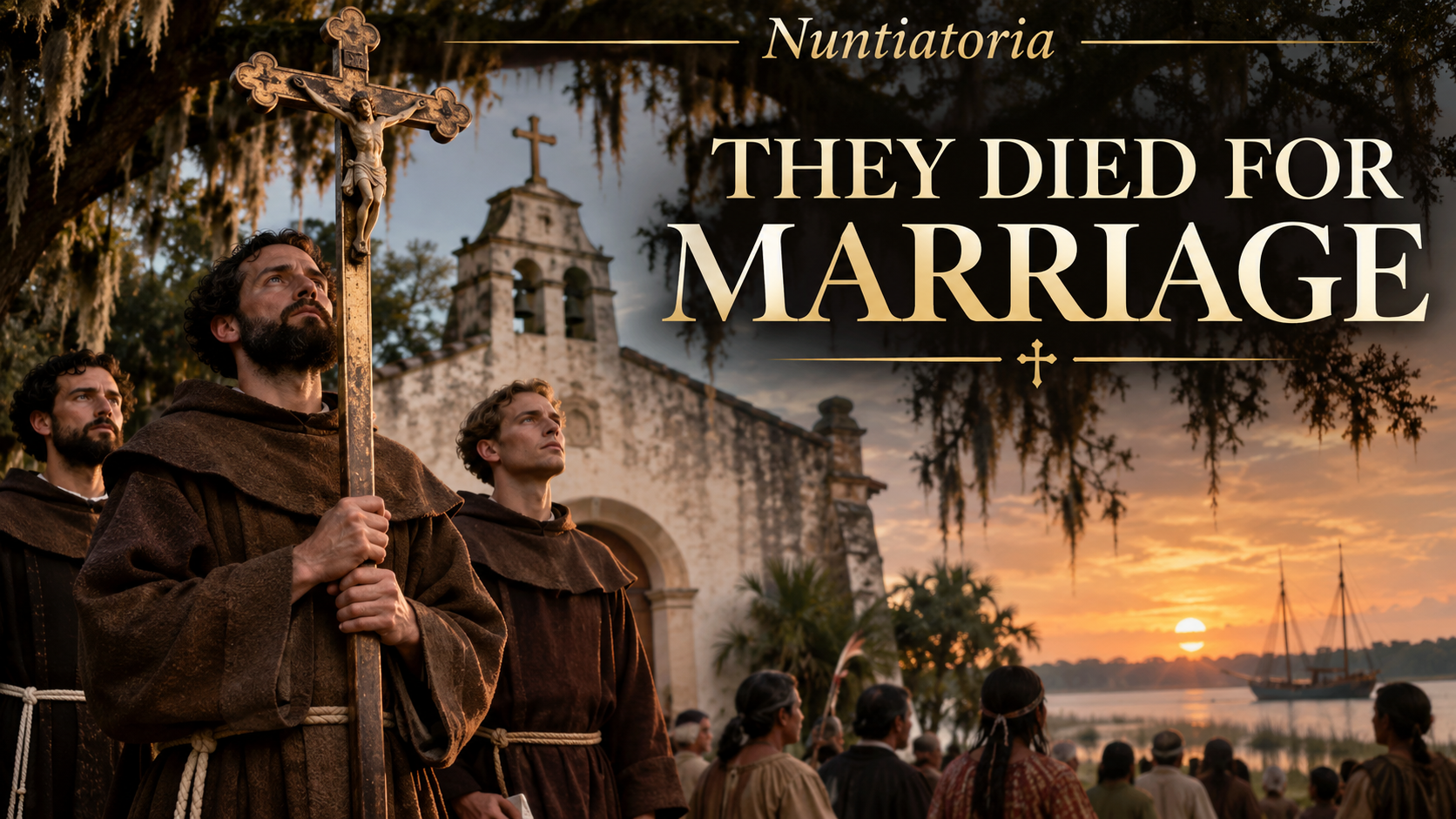
The beatification of five Franciscan missionaries in Savannah, seventeen days after the conclusion of Rome’s meeting on Amoris Laetitia, brings the unresolved question of Catholic sacramental discipline into unexpectedly sharp relief. What the Church honours in her martyrs she must also be prepared to require of her pastors.
On 16 October 1612, the Franciscan authorities of the Custody of Santa Elena wrote to Philip III of Spain explaining why five of their brethren had been killed fifteen years earlier in the province of Guale. They attributed the deaths to the missionaries’ refusal to permit Christian men to take more than one wife. According to the letter, this was the explanation still given by the indigenous people themselves.¹
Four centuries later, on 31 October 2026, Cardinal Frank Leo, Archbishop of Toronto and legate of Pope Leo XIV, beatified those five Franciscans in Savannah, Georgia: the priests Pedro de Corpa, Blas Rodríguez de Cuacos, Miguel de Añon and Francisco de Veráscola, and the lay brother Antonio de Badajoz. It was Francis who had authorised the promulgation of the decree recognising their martyrdom in odium fidei on 27 January 2025. His successor has now authorised their public veneration as Blessed.²
There was a certain providential awkwardness in the timing. Only seventeen days earlier, the meeting of the heads of the Eastern Catholic Churches and presidents of episcopal conferences convened by Leo XIV to consider the reception of Amoris Laetitia had concluded in Rome. The two events concern a question with which the Franciscans were already acquainted in 1597: what becomes of the obligations of marriage when their observance entails considerable personal or social difficulty?
What happened in Guale?
The conflict arose at Tolomato, where Pedro de Corpa ministered to the Guale people. Don Juanillo, a baptised Christian and heir to the local chiefdom, wished to take a second wife in accordance with the custom of his people. The friar opposed him. The uprising which followed cost five missionaries their lives; another Franciscan, Francisco de Ávila, survived captivity.³
There are difficulties in reconstructing the precise circumstances. The diocesan survey of the historical sources distinguishes the official inquiry of 1598, the poem of Alonso Gregorio de Escobedo and the account of Luis Jerónimo de Oré, compiled from evidence gathered during his visits to Florida in 1614 and 1616. Oré describes the dispute over marriage without naming the two protagonists. Some historians have emphasised the struggle for leadership within Guale society and the political consequences of Spanish expansion.⁴ Religious and political motives need not have been mutually exclusive. Indeed, the position of Juanillo as a prospective chief helps explain why the friar’s instruction could have had consequences extending considerably beyond his domestic affairs.
The letter of 1612 is consequently of particular interest. The attribution of the deaths to the defence of monogamy is neither a recent invention of American Catholics nor a retrospective application of the controversies of our own day. It belonged to the Franciscan understanding of the affair within living memory of the uprising. The decree of 2025, issued after a cause whose diocesan inquiry opened in 1984 and concluded in 2007, establishes the Church’s judgement upon the religious character of the deaths.¹ It does not require Catholics to endorse the entire enterprise of Spanish colonisation, or to attribute the conduct of particular men to the Guale people collectively.
Juanillo was already a Christian. Pedro was dealing, therefore, with the obligations of a member of his flock, rather than with the matrimonial customs of a people who had never received the Gospel. The Franciscans had undertaken to teach the inhabitants of Guale the same Faith which they had received in Spain. A European nobleman wishing to take a second wife would have been subject to precisely the same moral law.
The wife whom nobody consults
What is frequently missing from contemporary accounts of pastoral discernment is the perspective of the person whose marriage is already in jeopardy. The surviving records tell us little about Juanillo’s first wife. Nevertheless, the matrimonial obligation which Pedro defended concerned her as much as it concerned Juanillo. The Christian doctrine of marriage gave her a claim upon his exclusive fidelity which neither his position in society nor his wishes could override.
It is sometimes supposed that the Church’s insistence upon indissolubility favours an institution at the expense of the persons involved. But a wife deserted by her husband has a rather different interest in the matter. If her marriage is valid, the promise he made to her remains binding even after he has established another household. His preference for another woman does not extinguish her rights. Nor does a declaration of nullity dissolve an existing marriage; it establishes that the requisite bond was never validly contracted.
Our Lord’s treatment of marriage in St Matthew xix is particularly pertinent. He recalled the original constitution of marriage and explained why the Mosaic concession concerning divorce could not establish the rule for His disciples. When the disciples themselves remarked upon the difficulty of His teaching, Christ did not revise it to make marriage a more attractive proposition. The Christian doctrine of marriage makes demands which human nature, wounded by sin, does not always find congenial. Its observance is made possible by grace, not by a favourable arrangement of circumstances.
John Paul II understood the importance of the abandoned spouse. In Familiaris Consortio, no. 83, he expressly commended the fidelity of those who, despite divorce, refrain from entering another union. In no. 84 he recognised that a subsequent household might involve serious obligations towards children which prevented separation; in such cases the condition for sacramental reconciliation was the undertaking to abstain from conjugal relations. He also explained the Eucharistic reason for the discipline: the union of Christ and His Church signified by the sacrament cannot be contradicted by the conduct of those receiving it. Benedict XVI reaffirmed this teaching in 2007.⁵
What Rome has changed
As Nuntiatoria has previously documented, notably in Leo XIV Chooses the Path of Amoris Laetitia and The Sword in Cotton Wool, the controversy since 2016 has acquired a precision which makes the customary assurances that doctrine remains unchanged inadequate.⁶
On 25 September 2023, the Dicastery for the Doctrine of the Faith answered questions submitted by Cardinal Dominik Duka concerning Communion for the divorced and civilly remarried. It confirmed the status of the Buenos Aires bishops’ criteria and Francis’s approving letter as authentic magisterium. It also explained that, although continence remains proposed, sacramental Reconciliation may in certain circumstances be administered despite failure to observe it, and that mitigated responsibility can permit access to Reconciliation and the Eucharist.⁷
The difficulty is not the recognition of diminished culpability. Confessors were acquainted with ignorance, coercion, fear and habits of sin long before the publication of Amoris Laetitia. Nor is a penitent’s sincere resolution to amend his life invalidated by the possibility that he may subsequently fail. Francis himself made that point to the Apostolic Penitentiary in March 2024. Contrition requires a present purpose of amendment; it does not require a guarantee of future impeccability.⁸ A priest may help a penitent who repeatedly falls whilst persevering in the endeavour to live chastely. What remains to be explained is how far the newer practice permits sacramental reconciliation where the intention to relinquish illicit conjugal relations is itself absent.
There is a further difficulty which concerns the minister of Communion rather than the confessor. On 24 June 2000, the Pontifical Council for Legislative Texts, in agreement with the Congregations for the Doctrine of the Faith and for Divine Worship, published a declaration on canon 915. It explicitly rejected the suggestion that the minister must determine subjective culpability before applying the prohibition on admitting those obstinately persisting in manifest grave sin. It held that the prohibition derives from divine law and cannot be dispensed by ecclesiastical authority. Where serious reasons preclude separation, it provided for Communion following the undertaking of continence and with scandal removed.⁹
The distinction between canons 915 and 916 is indispensable. The latter concerns the communicant’s responsibility to examine his conscience; the former concerns the minister’s duty in the external forum. A judgement made in the confessional concerning the degree of an individual’s culpability does not, of itself, settle the external question. The 2023 response does not explain how the newer provisions are to be reconciled with the 2000 declaration in cases where its conditions continue to obtain. That question cannot be disposed of by invoking the discretion of diocesan bishops, since the declaration expressly addressed the limits of their competence.
There is no authorisation of polygamy in Amoris Laetitia. Nor are all civilly remarried Catholics in circumstances comparable to those of Juanillo. The comparison concerns the duty of a pastor towards someone whose subsisting marriage excludes conjugal relations with another person. It is quite possible to affirm indissolubility in a catechetical document whilst giving the faithful contradictory impressions of its practical meaning at the Communion rail.
The same Gospel in Rome and Savannah
In his address of 7 October, Leo XIV invited the bishops assembled in Rome to examine the experiences of their churches over the preceding decade. His message of 13 October promised subsequent reflections upon their deliberations.¹⁰ A week later, at his general audience of 21 October, he reaffirmed the teaching of the Second Vatican Council concerning the exclusive and permanent union of the spouses. Cardinal Leo expressly invoked that audience in his beatification homily in Savannah and urged Catholics to resist interpretations which undermine the received doctrine of marriage.¹¹ The Pope’s affirmation is welcome; the sacramental question remains.
John Paul II had anticipated the relevance of such a beatification in Veritatis Splendor, no. 91. In his treatment of the absolute character of negative moral precepts, he appealed to the witness of the martyrs, beginning with St John the Baptist.¹² Herod had no shortage of domestic complications. St John told him that he might not have his brother’s wife. The Church celebrates his martyrdom because fidelity to the moral law revealed by God is fidelity to Christ Himself.
The five Franciscans of Georgia have now been placed before the faithful as exemplars of that fidelity. The judgement of the Holy See concerning their deaths cannot be treated as an antiquarian interest whilst the pastoral obligations for which they died remain subject to divergent interpretations. There is a particular obligation towards those husbands and wives who, abandoned by their spouses, have lived chastely for years, believing the instruction given them by their priests. They ought to be able to receive from the bishops who met in Rome the same account of Christian marriage as the bishops gave in Savannah.
FOOTNOTES
¹ Diocese of Savannah, The Cause for Canonization, including the extract from the Franciscan letter to Philip III, 16 October 1612.
² Holy See Press Office, Promulgation of Decrees of the Dicastery for the Causes of Saints, 27 January 2025; Georgia Bulletin, Georgia Martyrs beatified in Savannah during weekend of prayer, remembrance, 8 November 2026.
³ Diocese of Savannah, The 1597 Uprising; Order of Friars Minor, Georgia Martyrs to be Beatified Oct. 31, 2026, 26 September 2026.
⁴ Diocese of Savannah, Primary Sources; Atlanta Journal-Constitution, 5 Georgia missionaries move closer to sainthood 400 years after deaths, 22 October 2026.
⁵ John Paul II, Familiaris Consortio, 22 November 1981, nn. 83–84; Benedict XVI, Sacramentum Caritatis, 22 February 2007, n. 29.
⁶ Nuntiatoria, Leo XIV Chooses the Path of Amoris Laetitia, 4 September 2026; The Sword in Cotton Wool, 28 September 2026.
⁷ Dicastery for the Doctrine of the Faith, Response to a Series of Questions Posed by His Eminence, Dominik Cardinal Duka, O.P., Regarding the Administration of the Eucharist to Divorced People Living in a New Union, 25 September 2023, nn. 2–4.
⁸ Catechism of the Catholic Church, The Acts of the Penitent, n. 1451; Francis, Address to Participants in the Course on the Internal Forum Organised by the Tribunal of the Apostolic Penitentiary, 8 March 2024.
⁹ Pontifical Council for Legislative Texts, Declaration concerning the admission to Holy Communion of faithful who are divorced and remarried, 24 June 2000, nn. 1–4.
¹⁰ Leo XIV, Address on the tenth anniversary of Amoris Laetitia, 7 October 2026; Message at the conclusion of the meeting on the occasion of the tenth anniversary of Amoris Laetitia, 13 October 2026.
¹¹ Holy See Press Office, General Audience, 21 October 2026; Cardinal Frank Leo, Full text: Cardinal Frank Leo’s homily at Georgia Martyrs’ beatification Mass, 31 October 2026.
¹² John Paul II, Veritatis Splendor, 6 August 1993, nn. 90–94.






Leave a Reply