
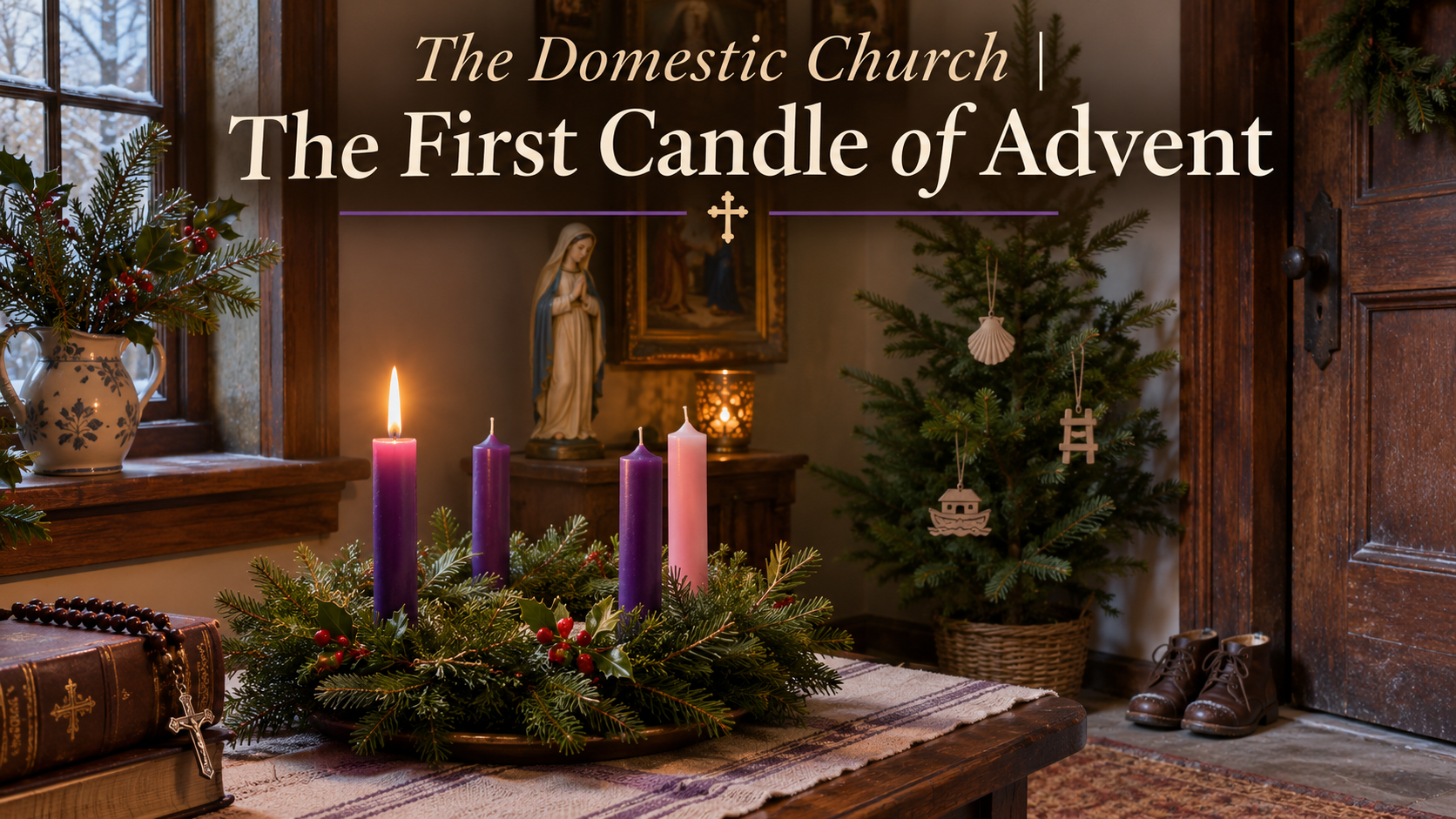
29 November–6 December 2026. This week, light the Advent wreath, begin the Jesse Tree, prepare for the Immaculate Conception and leave a pair of shoes by the door on St Nicholas’s Eve.
By Sunday evening there ought to be one small light burning in the Catholic home which will make sense of all the lights to come at Christmas. The first candle of the Advent wreath marks the beginning of the Church’s year. Those who have followed the Domestic Church over the past fortnight will already have made their Christmas pudding, prepared the family Advent calendar and given some thought to the Jesse Tree and the crib. Now the work of preparation acquires its proper spiritual purpose.1
At Mass on Sunday the children will hear Our Lord speak of the signs which shall precede His return in glory (Luke 21:25–33). It is a somewhat startling Gospel for those expecting shepherds and angels. The Child of Bethlehem is the Son of God before Whom each of us must one day appear. The Church prepares us to commemorate His birth, to receive Him now in grace and to be ready for His coming again. The opening words of the Introit, Ad te levavi animam meam (To Thee have I lifted up my soul), would make an excellent morning prayer throughout the week. The companion study, AD TE LEVAVI — The First Sunday of Advent, considers these themes in the liturgy.2
The family’s plan for 29 November–6 December
| Day and observance | Family Rosary intention | Household activity |
|---|---|---|
| Sun 29 Nov — Advent I | A holy Advent for the household | Open eye; first violet candle; Immaculate Conception novena; Advent greenery |
| Mon 30 Nov — St Andrew | Missionaries and priestly vocations | Fishing net; Christmas novena; final November suffrages |
| Tue 1 Dec — Advent feria | Expectant mothers and their unborn children | 01 Root of Jesse; first December calendar door |
| Wed 2 Dec — St Bibiana | Persecuted Christians | 02 Sun or globe; simple supper |
| Thu 3 Dec — St Francis Xavier | Conversion of souls | 03 Fruit and serpent; examination of conscience |
| Fri 4 Dec — St Peter Chrysologus; St Barbara commemorated | Sinners and those in need | 04 Ark or rainbow; first Friday; abstinence; St Barbara’s branch |
| Sat 5 Dec — Advent feria; St Sabbas remembered | Poor and neglected children | 05 Tent; bake spiced biscuits; St Nicholas’s shoes |
| Sun 6 Dec — Advent II; St Nicholas commemorated | Children and their benefactors | 06 Stars; second violet candle; St Nicholas’s gifts |
The observances are drawn from the traditional Roman calendar; consult the accompanying Ordo for the full liturgical particulars.3 Continue the Family Rosary each day. In Advent it is especially appropriate to return frequently to the Joyful Mysteries, without neglecting the customary mysteries of the other days. The family’s November suffrages conclude on Monday, but the names of the departed should remain in the prayer corner throughout the year.
Dressing the house for Advent
A house need not be bare throughout December. The holly, ivy, fir and other evergreens so happily associated with the English winter make suitable Advent decorations in their own right. A wreath upon the front door, foliage along the mantelpiece, a few pine cones and perhaps a violet ribbon will lend the house a restrained festive appearance. Leave the gold and silver, the bright baubles, tinsel, coloured lights and Christmas garlands in their boxes for a few more weeks. There is much pleasure to be had from anticipation if we allow ourselves any.
An ordinary Christmas tree may be used as the Jesse Tree. Put it up now, if that is convenient, and decorate it solely with the daily biblical symbols. Alternatively, use a branch firmly secured in a pot or vase, or a small tabletop tree, and leave the Christmas tree itself until Christmas Eve. A family using the ordinary tree should ensure that a natural tree will remain fresh until the intended end of the Christmas celebrations; an artificial tree is particularly convenient for this purpose. Keep greenery away from open flames and sources of heat. The companion guide, THE JESSE TREE: A Living Advent Calendar, gives further suggestions for making the ornaments. The published illustrated guide provides designs to copy or print.4
Reserve Christmas Eve for decorating the house and tree together. Bring out the coloured ornaments and lights, hang the Christmas cards and sing the first carols. If the Jesse Tree is also the Christmas tree, leave the biblical ornaments amongst the festive ones: the children can explain to visitors why there is an ark, a tent or a little crown upon their Christmas tree. The promises have been fulfilled. A separate Jesse Tree may instead stand beside the crib. Place the Christ Child in the manger when the family celebrates His Nativity, perhaps on returning from Midnight Mass. The decorations belong to Christmastide; keep them up at least through Epiphany, or longer according to family custom. The shops will have begun selling Easter eggs soon enough.
Set out the stable and empty manger now. A small basket of straw or paper strips beside the crib provides another occupation for the children: each time a child makes a sacrifice or does a kindness in secret, a piece of straw may be added to prepare the Child’s bed. The practice should encourage generosity, never competition or an accounting of the children’s merits.
A little rule of Advent
The household need not attempt every traditional devotion at once. Choose a regular time for the wreath and Jesse Tree, preferably when everybody is already gathered for supper or evening prayers. Light the appointed candle, make the Sign of the Cross and say the Sunday Collect. Open the day’s Advent calendar door or envelope if there is one, read the short passage of Scripture and let a child hang the corresponding ornament. Finish with the family’s prayers and an Advent hymn. The younger children can remember a sentence of the story or name the symbol; older children and adults can read the accompanying daily Nuntiatoria meditation. The two introductory ornaments for 29 and 30 November precede the numbered series which begins on 1 December. There is no need to renumber the December envelopes.
Begin the novena in preparation for the Immaculate Conception on Sunday, 29 November, and continue until Monday, 7 December.5 A simple household observance is to say the following invocation three times after the Rosary, asking Our Lady’s intercession for a particular intention: O Mary, conceived without sin, pray for us who have recourse to thee. It is worth explaining before the feast that the Immaculate Conception concerns Our Lady’s own conception, when she was preserved from original sin by a singular grace of God in view of the merits of Christ.
This is also a good week to resume the Angelus at noon or at six o’clock in the evening, and to learn the Alma Redemptoris Mater, the Marian antiphon appointed in the traditional Roman Office from the beginning of Advent.6 The little children may simply listen and learn the tune by familiarity.
As the companion article Forgotten Rubrics | St Martin’s Lent and the lost fast before Christmas explains, the Western observance of an Advent fast has a long and varied history.7 Settle on a modest family rule: simpler meals on Wednesday and Friday, a particular act of self-denial and an offering for the poor. Sunday dinner should remain a cheerful occasion. Observe the applicable Friday discipline, and leave further fasting to adults according to their health and circumstances. Children may forgo a sweet or help with an unwelcome household task. A family might keep a charitable collection box beside the crib, into which the savings from modest meals and treats can be placed. Make arrangements for Christmas Confession early, rather than leaving it until the last afternoon before the feast.
Sunday 29 November — Advent I: the open eye
Jesse Tree: an open eye. Scripture: Romans 13:11–14. St Paul tells us that the hour has come to awake from sleep. Draw an open eye on a piece of card and hang it on the tree after reading the Epistle. Ask the children to consider what might be put right at home before Christmas: an apology owed, a neglected duty or a bad habit which needs attention. If possible, make the Advent rule together over Sunday dinner.
At the first lighting of the wreath a parent may lead this suggested domestic prayer, distinct from a liturgical blessing by a priest:
V. Our help is in the name of the Lord.
R. Who hath made heaven and earth.
O Lord Jesus Christ, bless our home during this holy season of Advent. Grant that we may prepare for the celebration of Thy Nativity by repentance and charity, and be found ready when Thou shalt come again in glory. Amen.
Light one violet candle, then say the Collect of the First Sunday in an English rendering of the traditional Roman Missal:
Stir up Thy power, we beseech Thee, O Lord, and come; that by Thy protection we may escape the dangers which threaten us through our sins, and by Thy deliverance be saved. Who livest and reignest with God the Father in the unity of the Holy Ghost, God, world without end. Amen.8
Use this Collect each evening until next Sunday. Extinguish the candle when the family leaves the table. Begin the Immaculate Conception novena today.
For Sunday’s music, the companion article Advent Hymns: Wake, O Wake! — The Watchmen’s Cry introduces Philipp Nicolai’s chorale and Bach’s setting. Listen together and tell the story of the wise and foolish virgins (Matthew 25:1–13). During the week learn a verse of O come, O come, Emmanuel or the chant Rorate caeli desuper. If a traditional Rorate Mass is celebrated locally, it would make a memorable early morning outing for the family.
Monday 30 November — St Andrew: the fishing net
Jesse Tree: a fishing net. Scripture: Matthew 4:18–22; John 1:35–42. Make a little net from string or draw one on card. Read how Our Lord called the fishermen and how Andrew brought his brother Simon to Jesus. Andrew’s feast has a special place in Scotland and is an opportunity to remember the Christian origins of its national patronage. Pray for Scotland, for missionary priests and for vocations from our own families.
Begin the traditional Christmas anticipation prayer, commonly called the St Andrew Christmas Novena, recited fifteen times daily from 30 November until Christmas Eve.9
Hail and blessed be the hour and moment in which the Son of God was born of the most pure Virgin Mary, at midnight, in Bethlehem, in the piercing cold. In that hour vouchsafe, O my God, to hear my prayer and grant my desires, through the merits of Our Saviour Jesus Christ, and of His blessed Mother. Amen.
Five repetitions at morning, midday and evening prayers make the devotion easier to accommodate. Its traditional imagery expresses the humility of the Nativity; the Gospel does not record the hour or the weather. The prayer entrusts our desires to God and should never be treated as a guarantee of obtaining a particular favour. Young children may join in as they are able.
Prepare the first six numbered Jesse Tree ornaments if they are not ready. Cardboard, felt, wooden discs or salt dough will all serve. Let the children sign and date the back of their own ornaments; these are the beginnings of a family collection which can be brought out again next year. At evening prayers remember the Holy Souls by name and say the De profundis or Requiem aeternam to conclude November.
Tuesday 1 December — the Root of Jesse
Jesse Tree 01: a stump with a flowering shoot. Scripture: Isaias 11:1–3. Jesse was the father of King David. The prophet spoke of a shoot which would spring from his stock when the fortunes of David’s house seemed lost. The promised Messiah is Christ. This is the image which gives the Jesse Tree its name.10
Show the children where new shoots grow upon a pruned plant or tree, if there is one in the garden. Let the youngest child hang the ornament. Open the first door of the December Advent calendar, and remember expectant mothers in the Rosary. For a child who is too young to read, the flowering shoot and the words “God keeps His promises” are quite sufficient for tonight.
Wednesday 2 December — St Bibiana: Creation
Jesse Tree 02: a globe or sunburst. Scripture: Genesis 1:1–5, 26–31. The first words of Holy Scripture tell us that the world owes its existence to God. Read how light came into being at His command and how man was made in His image. Christ, the eternal Word through Whom all things were made, is the true Light of the world (John 1:1–9). Let the children name something in creation for which they are grateful. Remember St Bibiana, the Roman virgin and martyr, in the family prayers for persecuted Christians.
Keep the agreed Wednesday observance at supper. A plain meal of baked potatoes or vegetable soup is quite adequate. Encourage the children to help prepare it and put a little of the money saved into the charitable collection. Say the Angelus together and recall the Annunciation; the same God Who made heaven and earth took our human nature in the womb of the Blessed Virgin.
Thursday 3 December — St Francis Xavier: the Fall
Jesse Tree 03: fruit and serpent. Scripture: Genesis 3:1–15. The first parents disobeyed God and lost original holiness for themselves and their descendants. Yet even in pronouncing judgement God promised the defeat of the serpent. Explain how the promise finds its fulfilment in Christ, born of the Blessed Virgin. The novena for the Immaculate Conception affords an opportunity to explain that Our Lady was herself redeemed by Christ in a singular and pre-eminent manner.10
On St Francis Xavier’s feast, find India and Japan on a map and tell the children something of his missionary journeys. Remember that the missionaries travelled extraordinary distances to bring people the Gospel and the sacraments. Pray for those who have never heard the Faith preached. After the evening prayers, make a brief examination of conscience and say the Act of Contrition. Parents can help children prepare for their next Confession without requiring them to disclose their sins.
Friday 4 December — Noe, the Sacred Heart and St Barbara’s branch
Jesse Tree 04: an ark or rainbow. Scripture: Genesis 6:5–18; 9:8–17. God preserved Noe and his family through the Flood. St Peter himself relates the event to Baptism (1 Peter 3:20–21). Remember the children’s baptismal anniversaries and, if they are not recorded already, write them in the family Bible or calendar. Ask the children’s godparents to pray for them this Advent.10
It is the first Friday of December. If possible, assist at Mass and receive Holy Communion worthily in honour of the Sacred Heart; a visit to the Blessed Sacrament would be suitable where Mass is unavailable. The Friday supper should be meatless in accordance with the traditional discipline. Those following a voluntary Advent fast may also simplify the meal. The Advent Ember Days, on 16, 18 and 19 December, will be considered in a later instalment.
St Barbara, commemorated today, is associated with the delightful German and Central European custom of the Barbarazweig. Cut a small cherry, plum or other suitable fruit-tree branch, with permission, and put it into a vase of water in a warm, light room. Refresh the water regularly. If the branch flowers around Christmas, place it beside the crib. The children will recognise Tuesday’s image of the shoot of Jesse. The appearance of flowers depends upon the branch and growing conditions, and has no bearing on the family’s fortunes.11
For supper: vegetable and barley soup. For four people, soften a chopped onion, two carrots and two sticks of celery in a little oil. Add 100 g pearl barley, a diced potato and 1.2 litres of vegetable stock. Simmer gently for 40–50 minutes, until the barley is tender, adding water if necessary. Season to taste and serve with bread. The soup can be made in advance and reheated, which will leave more time for the family devotions.
Saturday 5 December — Abraham and St Nicholas’s Eve
Jesse Tree 05: a tent. Scripture: Genesis 12:1–7. Abraham left his homeland at God’s command, trusting the promise that in him all the families of the earth would be blessed. St Paul identifies Christ as the promised seed (Galatians 3:16). Ask the children to undertake willingly a household duty they have been postponing.10
Tonight is St Nicholas’s Eve. The fourth-century Bishop of Myra is remembered especially for his generosity to the poor. In the traditional account, he secretly provided the dowries of three impoverished young women. The three gold balls in pictures of the saint recall that gift. The practice of putting out shoes on the eve of his feast survives particularly in the Low Countries and other parts of Europe.12
Let each child polish a pair of shoes and put them by the door before bedtime. A few chocolate coins, a clementine and a holy card make appropriate gifts. If possible, the family should arrange a gift for somebody else as well, without revealing the giver. A child who has helped to prepare it will understand rather better why St Nicholas is remembered.
For Sunday: St Nicholas’s spiced biscuits. These are a simple household adaptation of the Dutch and German spiced biscuit traditions. Rub 100 g butter into 200 g plain flour with 75 g soft brown sugar, a teaspoon of cinnamon, half a teaspoon of ground ginger and a pinch each of cloves and nutmeg. Add a little milk to form a dough, chill for half an hour, roll to about 5 mm and cut into shapes. A paper template of a bishop’s mitre is easily made if there is no suitable cutter. Bake at 180°C (160°C fan) for 12–15 minutes, until lightly browned. Cool and put aside for tomorrow’s feast.
Sunday 6 December — Advent II and St Nicholas
Jesse Tree 06: stars. Scripture: Genesis 15:1–6. Abraham had no child when God promised him descendants as numerous as the stars. He believed God. If the sky is clear, take the children outside to see how many stars they can count. The promise extends beyond Abraham’s natural descendants to those who share his faith in Christ (Galatians 3:7–9).10
The Second Sunday of Advent takes precedence liturgically over the feast of St Nicholas, who is commemorated in the older Roman usage. At breakfast the children may discover what has been left in their shoes and enjoy the biscuits prepared yesterday. Pray for children who are suffering through poverty, war or neglect. Take the opportunity to show a picture of the saint in his episcopal vestments; he was a bishop of the Catholic Church before he became the inspiration for the familiar Christmas gift-bringer.
At the family prayers light two violet candles, leaving the rose and remaining violet candle unlit. Replace the previous week’s Collect with that of the Second Sunday:
Stir up, O Lord, our hearts to prepare the ways of Thine only-begotten Son, that by His coming we may be worthy to serve Thee with purified minds. Who liveth and reigneth with Thee in the unity of the Holy Ghost, God, world without end. Amen.8
There are still two days until the feast of the Immaculate Conception; continue the novena. Next week the Jesse Tree will take us through Joseph of Egypt, the giving of the Law and the story of David. There will be occasion to dress Our Lady’s shrine for her feast and prepare something special for Gaudete Sunday and St Lucy. For now, let the children see that the candle is lit every evening and that their parents are there to pray with them. They will remember that long after they have forgotten which year they made the little fishing net.
FOOTNOTES
1 Nuntiatoria, THE DOMESTIC CHURCH: 22–29 November 2026; THE DOMESTIC CHURCH: 15–22 November 2026.
2 Nuntiatoria, Ad Te Levavi: The First Sunday of Advent.
3 Dom Prosper Guéranger, The Liturgical Year — Volume I: Advent; Manualist Press, December 2026 Pre-1955 Roman Calendar.
4 Nuntiatoria, THE JESSE TREE: HISTORY, SYMBOLISM, AND THE DEVOTIONAL HEART OF ADVENT.
5 Rosary Center & Confraternity, Novena-The Immaculate Conception-2026.
6 Catholic Encyclopedia, Alma Redemptoris Mater.
7 Nuntiatoria, THE DOMESTIC CHURCH: 8–15 November 2026.
8 Lumen Viae, The Advent Wreath: the Sunday Collects; Nuntiatoria, The Advent Wreath: history and devotional purpose in traditional Catholic life.
9 Catholic Culture, The Meaning and Misconceptions of The Saint Andrew Christmas Novena.
10 Nuntiatoria, Jesse Tree.
11 Michael P. Foley, Some Customs of Advent, New Liturgical Movement.
12 St Nicholas Center, St. Nicholas Symbols; Diocese of Little Rock, Advent Traditions.




Leave a Reply