
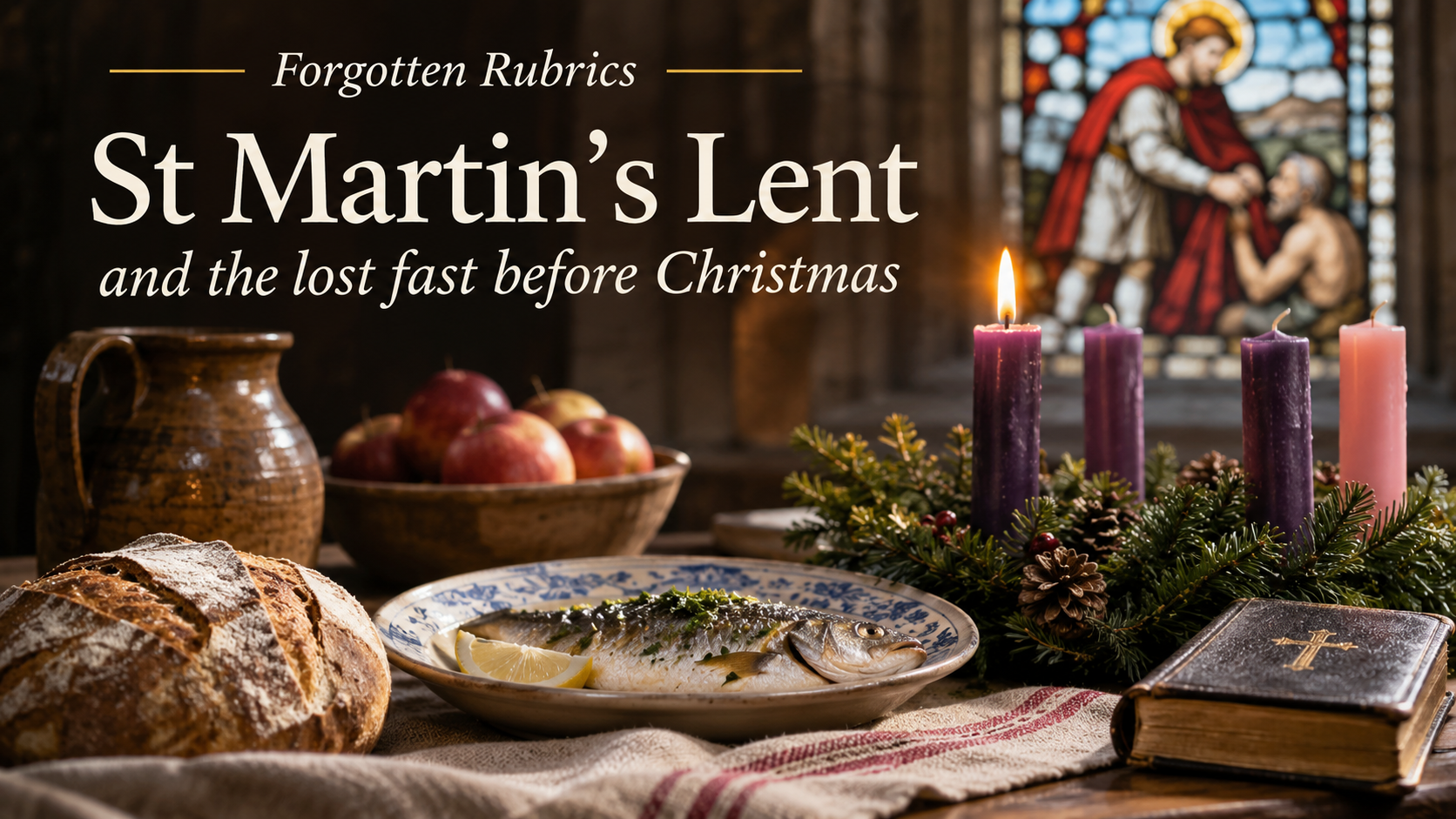
As recently as 1901, English Catholics were expected to fast on Wednesdays and Fridays in Advent. The much older discipline of St Martin’s Lent, and the Roman observance of the December Ember Days, explain why the Church once required so much more of her children in the weeks before Christmas.
In January 1901, reviewing the new edition of the Catholic Directory, The Spectator offered a small point of information to those Anglicans who had lately taken to speaking of an Advent fast. Roman Catholics, the reviewer explained, observed Wednesdays as well as Fridays in Advent as fasting days.¹ There was evidently sufficient interest among English churchmen in the recovery of the discipline to warrant the observation. A century and a quarter later, the same information may come as something of a surprise to English Catholics.
The custom had a considerable pedigree. St Gregory of Tours, writing towards the end of the sixth century, records among the arrangements of his predecessor St Perpetuus a calendar prescribing two fasts a week from the beginning of September until the feast of St Martin and three thereafter until the Nativity. Perpetuus had built the greater basilica over the tomb of St Martin in the fifth century. His provisions for the fasts and vigils of Tours survive alongside Gregory’s account of the churches which he founded.²
Martinmas, 11 November, marked the beginning of the observance subsequently known as St Martin’s Lent. As we remarked in our recent Domestic Church account of the feast, the traditional Martinmas supper and the custom of providing for the poor belonged to the same season of the year.³ There was good reason to enjoy a substantial dinner before the fast began. The saint in whose honour it was eaten had himself earned a rather particular reputation for sharing what he possessed with those who had less.
The fast and the liturgy
The ninth canon of the First Council of Mâcon, held in the early 580s, names Monday, Wednesday and Friday as the days of fasting from Martinmas to Christmas. It also directs that Mass be celebrated on those days according to the Lenten order and that the ecclesiastical canons be read for the instruction of the people.⁴ The bishops understood that a fast prescribed for the faithful ought to have its corresponding observance in church, where the reasons for the discipline could be taught. The Gallican arrangement should not be confused with the four-week Advent of the Roman Missal, nor does the name quadragesima imply that every intervening day was a fast day.
There is early evidence of a prolonged preparation for Christmas among the English, too. St Bede records that the Northumbrian St Egbert, who had gone to Ireland to study, observed a particularly severe abstinence for forty days before the Nativity, besides his customary Lenten observance.⁵ Egbert’s austerity was personal; Bede gives no warrant for imposing it on the population of seventh-century Northumbria. Nevertheless, the passage establishes how early a pre-Christmas period of penance was known to English Christians.
At Rome, meanwhile, Pope St Leo the Great had preached on the fast of the tenth month, December, in the fifth century. With the harvest gathered, Leo urged his congregation to acknowledge the bounty of Providence by exercising restraint at their own tables and making greater provision for the poor.⁶ This is evidence of the antiquity of the Roman December fast, preserved in the Ember Days, rather than of a Roman observance extending from Martinmas. The different customs were entirely compatible in purpose.
The quarterly fasts discussed in our account of September Embertide acquired a particular association with ordinations. In the Advent Ember Masses, the preparation of the Church for the Nativity is expressed in the prophecies of Isaias. On Ember Wednesday, the account of the nations ascending the mountain of the Lord to receive His teaching is followed, in the course of the Mass, by the Gospel of the Annunciation. Fr Robert Wilson drew attention to this relationship in his exposition of the liturgy last December.⁷ The days on which Catholics traditionally prayed for the ministers of the Church thus also recall the coming in the flesh of the eternal High Priest.
The Incarnation supplies the Christian with every reason to honour the body and the good things with which God sustains it. Fasting orders the appetite rather than condemning its object; the good which one freely relinquishes may also be given to another. St Leo would have had something to say to a prosperous Roman who observed abstinence by purchasing more expensive fish and found himself unable to afford alms.
How the discipline changed
By the pontificate of Innocent III (1198–1216), there was sufficient disagreement over the obligation of the Advent fast for the Archbishop of Braga to seek the Pope’s advice. His enquiry, preserved in the Decretals of Gregory IX, explained that a minority held the fast to be obligatory, whilst the greater number maintained otherwise. Innocent answered by describing the practice at Rome, where Advent fasting was observed.⁸ The exchange illustrates the difficulties of treating an ancient and widespread observance as though it had everywhere possessed the same juridical character.
Dom Prosper Guéranger, reviewing the medieval evidence, found considerable variation in its duration and in the classes of persons bound to observe it. He mentions the apparent restriction of the Salisbury provisions of 1281 to monks, and Urban V’s requirement in 1362 that the clerics of his court abstain from meat during Advent.⁹ Even where the broader fast had receded, particular obligations could remain. Conversely, the absence of a general law did not preclude the survival of a local custom or its subsequent adoption by ecclesiastical authority.
England supplies an especially interesting instance. Fr Herbert Thurston, S.J., writing on the Christian calendar for the Catholic Encyclopedia, explains from the old editions of the Laity’s Directory that in 1771 the Wednesdays and Fridays of Advent were substituted for a number of fasting vigils formerly observed by English Catholics.¹⁰ This occurred whilst Catholics still laboured under the penal laws. The discipline survived into the twentieth century, as the notice in The Spectator attests. The encyclopedia’s separate article on fasting describes a similar obligation in Ireland, Canada and Australia, and notes the more limited American practice of fasting on Advent Fridays.¹¹
The 1917 Code retained the Ember Days and the Vigil of the Nativity as days of fast and abstinence, but did not include ordinary Advent Wednesdays or Fridays among the fasting days prescribed by the general law. It made express provision for particular indults and religious rules.¹² The common Latin discipline was therefore already less extensive than the English Advent observance recorded at the beginning of the century.
A further reduction followed in 1966. Paul VI’s Paenitemini retained Ash Wednesday and Good Friday as obligatory days of both fast and abstinence. Neither the Ember Days nor the Vigil of Christmas retained their former obligation under the general law. The 1983 Code prescribes Fridays and Lent as the common penitential days and times of the Latin Church; in England and Wales the bishops restored common Friday abstinence from meat in September 2011.¹³ ¹⁴
The bishops’ own explanation of that decision deserves attention. They wished Catholics once again to share a publicly recognisable penitential observance.¹⁴ The reasons which commended that course in respect of Fridays apply with some force to Advent. A common discipline affords parents occasions to explain to their children the particular character of the season, whilst the ordinary arrangements of parish and domestic life support its observance. A family may continue to serve fish on Christmas Eve for decades after the fast itself has been forgotten. Eventually the children inherit the recipe without knowing why it was prepared.
The Byzantine Nativity Fast, generally observed from 15 November to 24 December according to the calendar in use, affords an instructive comparison. The Eastern tradition has preserved the expectation of a prolonged penitential preparation for Christmas, with its own rules and accommodations.¹⁵ Western Catholics need hardly import those rules when their own calendar and history supply ample precedent for recovering the practice.
Advent in the Catholic household
In the traditional Roman calendar, the December Ember Days in 2026 fall on Wednesday 16, Friday 18 and Saturday 19 December, followed by the Vigil of the Nativity on Thursday 24 December. Under the general discipline of the 1917 Code, all four were days of both fast and abstinence. Fasting regulated the quantity eaten, allowing one full meal and lesser refreshments according to approved custom; abstinence excluded meat and meat broth. The older law bound those who had completed their seventh year to abstinence and those who had completed their twenty-first year until the beginning of their sixtieth to fasting, subject to legitimate exemptions and dispensations.¹² Catholics following this discipline should consult the provisions applicable to them. Christmas Day itself, falling on a Friday this year, is exempt from the ordinary Friday abstinence.
Last week’s Domestic Church invited families to agree upon a sustainable household rule before Advent began.¹⁶ Those wishing to recover the English custom might make Wednesdays as well as Fridays occasions for a simpler table, undertaking any additional fast voluntarily and with due regard to health and the duties of their state of life. Children can participate through modest acts of self-denial and charity appropriate to their years. The appointed fasts require no supplementary invention; their liturgical observance gives the family its prayers and readings.
There is a practical advantage in making the arrangements before the Christmas engagements fill the diary. If a household plans a plainer supper for Ember Wednesday, it can also decide who will receive the saving. The Gospel of the Annunciation may be read at the family table and prayers offered for priests and those discerning a vocation. On Sundays the family can enjoy its dinner without embarrassment. The Church has never understood the celebration of the Lord’s Day to be an inconvenience to the exercise of penance.
One of the difficulties of keeping Advent in England today is that the festivities which formerly followed the fast have largely been brought forward to precede Christmas. By St Stephen’s Day, when the Church is still celebrating the Nativity, many people have already had quite enough of Christmas. Recovering the fast might help recover the feast as well. St Leo’s December sermon suggests a particularly Catholic way of doing both: spending a little less upon the dinners which precede the Nativity may make it possible to invite to the Christmas table somebody who would otherwise spend the day alone.
FOOTNOTES
¹ The Spectator, The Catholic Directory, 1901, 5 January 1901.
² St Gregory of Tours, Historiae, X.31.
³ Nuntiatoria, The Domestic Church: 8–15 November 2026, 6 November 2026.
⁴ First Council of Mâcon, canon 9, preserved in Canones Selecti ex Antiquissima Herovalliani Canonum Collectione, cap. XXVII.
⁵ St Bede, Ecclesiastical History of the English People, III.27.
⁶ Pope St Leo the Great, Sermon XVI: On the Fast of the Tenth Month, §§1–2.
⁷ Nuntiatoria, September Embertide, 15 September 2026; Fr Robert Wilson, Sermon for Ember Wednesday in Advent, 17 December 2025.
⁸ Innocent III, reply to the Archbishop of Braga, Decretals of Gregory IX, III.46.2.
⁹ Dom Prosper Guéranger, The Liturgical Year: Advent, chapter I.
¹⁰ Herbert Thurston, S.J., Christian Calendar, Catholic Encyclopedia, vol. III, 1908.
¹¹ Fast, Catholic Encyclopedia, vol. V, 1909.
¹² Benedict XV, Codex Iuris Canonici, 1917, canons 1250–1254.
¹³ Paul VI, Paenitemini, 17 February 1966; Code of Canon Law, 1983, canons 1249–1253.
¹⁴ Catholic Bishops’ Conference of England and Wales, Friday Penance, 2011.
¹⁵ Orthodox Church in America, Fasting & Fast-Free Seasons of the Church.
¹⁶ Nuntiatoria, The Domestic Church: 22–29 November 2026, 20 November 2026.




Leave a Reply