

Hora est iam nos de somno surgere — “It is now the hour for us to rise from sleep” (Romans 13:11). As the Church begins a new liturgical year, this edition of Nuntiatoria considers the responsibilities of those who govern, teach and profess the Christian Faith, and the opportunities Advent affords every Catholic to restore something of the life of Christ in the world.
EDITORIAL: The Hour Is Already Upon Us
The first lesson the Church has for us in Advent is that we ought to wake up. St Paul tells the Romans that their salvation is nearer than when they first believed and that they must put off the works of darkness and put on the armour of light.¹ I find it particularly salutary to read the whole of that chapter of his Epistle. The Apostle has been explaining the obligations of civil authority, the duties of subjects towards their rulers and the charity which Christians owe their neighbours. It is having reminded his readers of these very ordinary responsibilities that he tells them the night is passed and the day is at hand.
The Gospel of the First Sunday is perhaps more surprising still. Instead of taking us to Bethlehem, the Church bids us contemplate the Son of Man coming in glory, when men shall be withering away for fear of what is happening in the world. Yet Our Lord tells His disciples to lift up their heads, because their redemption is at hand.² It is worth bearing that in mind when reading some of the articles in this week’s Nuntiatoria. There is plenty to occasion despondency, particularly for those who have spent much of their lives hoping to see a recovery of Catholic life. The Christian virtue of hope, however, does not depend upon our being able to discern encouraging developments in ecclesiastical affairs.
Last week, under the title Redde rationem, we considered the account which we shall eventually have to give of our stewardship.³ We begin Advent this year a little nearer to the day upon which that account will be required of us. I wonder how many of the things which exercised us this time last year have since been forgotten, and how much of the energy we expended upon them actually contributed to the sanctification of ourselves or anybody else? There are injustices which require our attention, and a Catholic who is in a position to remedy them may well sin by his silence. But it is possible to spend a great deal of time lamenting the state of the Church whilst neglecting those aspects of her life for which we ourselves are responsible.
I have been thinking about this particularly in relation to the vocation of the priest. The publication by Cardinal Fernández of material from Pope Francis’s private writings and the public career of Alberto Ravagnani after his departure from active ministry are, of course, very different subjects. In both instances, however, we have occasion to consider what the Church ought to cultivate in the men to whom she entrusts the care of souls. The ability to attract an audience, inspire affection or exercise considerable influence may be of service to a priest. None of these abilities will necessarily help him to persevere in his vocation when the exercise of his ministry requires him to do something which he finds personally uncongenial.
There was considerable wisdom in the traditional formation of a young man for the priesthood in which he was obliged to learn the virtues in the course of his ordinary daily life. A man could acquire an admirable knowledge of theology and yet find that the most difficult part of his day was accepting a correction from his superior. The man who was particularly gifted in some respect might be required to undertake quite menial duties. Such experiences, when wisely directed, were intended to prepare him for a life in which his own inclinations would frequently have to yield to the needs of other people and to the will of God. We ought to pray for priests who have found themselves unable to persevere, and perhaps enquire rather more seriously of those responsible for priestly formation how young men are being helped to acquire the virtues upon which perseverance depends.
Our examination of the allegations concerning the oblates of the Institute of Christ the King Sovereign Priest therefore deserves careful reading. Humility and obedience are virtues; their cultivation cannot furnish a justification for the exploitation of another person. Equally, it would be unjust to impute misconduct to an entire religious community on the strength of allegations whose evidential limitations have yet to be resolved. Charity towards the person making a complaint is perfectly compatible with charity towards the person against whom it is made. We are obliged to take the trouble to ascertain the truth.
Those familiar with the difficulties of traditional Catholic apostolates will recognise something of their own experience in our investigation of the affairs of Fréjus-Toulon, the Missionaries of Divine Mercy and the Benedictines of Brignoles. There is a tendency amongst some commentators to suppose that the difficulties experienced by Catholics attached to the traditional rites could be resolved if only they were more willing to submit themselves to ordinary diocesan arrangements. The history of communities which have done precisely that, sometimes with every encouragement from their bishops, deserves to be rather better known. When people have sacrificed a great deal to establish a mission, rear their children in the Faith or provide for the formation of priests, it is hardly unreasonable that they should seek some assurance that these things will still be possible five years hence. Those of us whose apostolates subsist outside the ordinary diocesan structures understand only too well the pastoral consequences when assurances prove insufficient.
Ultimately, the difficulty is theological. The Church has received a Faith which she must transmit, and the authority of her pastors exists for that purpose. Our consideration this week of the Jubilee catecheses of Francis and Leo XIV and the present Pope’s remarks about doctrinal development concerns something of immediate practical consequence. What is a father supposed to teach his children when an apparent change in Catholic teaching is explained to him as a development? The First Vatican Council made provision for the growth of our understanding of revealed truth whilst expressly requiring the preservation of the meaning of dogma.⁴ There is ample room for intellectual endeavour within those terms. What there cannot be is an obligation upon each successive generation of Catholics to discover which of the truths taught to its predecessors it is still permitted to believe.
It is in this connection that I found Cardinal Parolin’s address to the Pontifical Lateran University particularly interesting. A Catholic university ought to be amongst the last places in the world where a man need fear the consequences of pursuing a legitimate intellectual enquiry. The Faith supplies a reason for confidence in the intelligibility of creation and in man’s capacity, however imperfect, to discover truth. Consider by contrast our reports concerning the surveillance and referral to Prevent of a pro-Israel student at Royal Holloway, the unlawful dismissal of Lorna Young from Manchester City Council and the arrest of a Christian campaigner discussing abortion on a university campus in Texas. The circumstances and legislation differ considerably; what ought to concern us in each instance is the power which officials may exercise over those whose opinions they find objectionable. Catholics who value the freedom to profess their own convictions should be prepared to defend the legitimate freedom of others to express theirs.
Which brings me to the rather unhappy controversy occasioned by Fr Calvin Robinson’s remarks about the removal of Jews from the United States. I have long maintained that Christian principles have an application to the government of nations and that the social kingship of Our Lord is a doctrine Catholics should understand and profess.⁵ It is for that very reason that I think we must be particularly careful about the political causes with which the doctrine is associated. Our examination of the theological arguments advanced in Fr Robinson’s defence, including the controversy concerning a passage in the Talmud, proceeds from the Catholic conviction that Jesus Christ is the promised Messiah and the Redeemer of mankind. We have every right to explain why we cannot accept a religious teaching which contradicts that conviction. But the Jew who lives next door is our neighbour. The doctrine of the kingship of Christ cannot relieve us of an obligation which Christ Himself has imposed upon us towards him. Indeed, I would hope that he might discover something of the character of the King we profess through his acquaintance with us.
There are other ways in which the obligations of charity are liable to be misunderstood. I was pleased to read Pope Leo XIV’s warning against reducing the Gospel to a welfare programme. Having spent a number of years working with people of various religious convictions in the service of the common good, I know from experience what can be accomplished through such co-operation. It is perfectly proper for Catholics to participate in it. But the Church has received a commission which a secular charity has not received. Consider the good that might be done by a Catholic charitable institution whose staff, besides possessing the professional competence necessary to alleviate suffering, were sufficiently instructed and encouraged to make the Faith known to those who wished to enquire about it. Our investigation of the relationship between charitable funding and evangelisation deserves the attention of anyone concerned about the future of Catholic charitable work. Last week’s examination of the scale of that provision ought to give us some idea of the opportunities it affords.
The question of who is to instruct the next generation of Christians has become rather more pressing here in Britain. The Bishop of Blackburn, the Rt Revd Philip North, has raised concerns about the proposed Conversion Practices Bill which ought to be taken seriously by those responsible for drafting the legislation. It is difficult to envisage how Christian parents could discharge their responsibilities if the ordinary conversation between a mother and her adolescent child about chastity, marriage or the nature of the human person were liable, under an inadequately defined statute, to become a matter for criminal investigation. The prevention of abuse is a legitimate object of law; the state must take care in pursuing it that it does not arrogate to itself the responsibilities which belong to the family.
We have devoted a good deal of this edition to helping families exercise those responsibilities. I am particularly pleased with the material we have assembled for Advent because it should enable even those quite unfamiliar with traditional Catholic observance to begin somewhere. A child can learn a remarkable amount about the Faith in the course of making a few ornaments for a Jesse Tree. The stories of Abraham, Moses and David gradually acquire their significance as the family follows the history of the promise of a Redeemer. One need not purchase a special tree for the purpose; the ordinary Christmas tree may serve very well, with its biblical ornaments added throughout Advent and its festive decorations reserved for Christmas Eve. Our Domestic Church feature and the weekly Ordo will help families order their observance around the Church’s calendar, beginning with the feast of St Andrew and looking towards St Nicholas.
There is also much to be gained from rediscovering the old Advent fast, the subject of this week’s Forgotten Rubrics. Those who are able to do so might voluntarily recover something of the discipline once observed by their Catholic grandparents or great-grandparents, according to their health and circumstances. And if the children are to learn that Christmas is a feast, they ought to have some experience of waiting for it. A household need not be cheerless in Advent. Evergreen decorations are quite appropriate, and there is no shortage of beautiful music for the season, as our feature on the history of Wake, O Wake! amply demonstrates. The sight of one candle burning on the wreath whilst the family sings an Advent hymn is something a child may remember with affection long after he has forgotten what he was given for Christmas. There will be ample opportunity for the carols when the feast arrives.
The same consideration informs our articles on the Latin language and Gregorian chant in the Roman Mass. I would dearly like more Catholics to have the opportunity of becoming familiar with the liturgy in which their forebears were sanctified. It is possible, with remarkably little effort over the course of a few weeks, to learn the familiar responses and to begin to recognise the prayers. There is a great pleasure in arriving in a church in another country and discovering that one can join in the worship of Almighty God with people whose conversation one cannot otherwise understand. Those who have access to the traditional Mass should consider whether there is somebody they could invite to accompany them this Advent. Those who have not might make use of a missal and our daily broadcasts to become acquainted with its prayers.
And for an evening when everybody has finished making Jesse Tree ornaments, may I commend The Bells of St Mary’s? Ingrid Bergman’s portrayal of Sister Benedict offers a rather moving lesson in the surrender of things we have come to love, even when those things are good in themselves. It is a film which gives a family something worth talking about afterwards, and which might even help some of us to understand a prayer that has apparently gone unanswered.
Advent is a comparatively short season. I hope that we shall find an opportunity during it to make a good confession, to put right some difficulty with a relative or a friend which has been allowed to persist, and to do something for a person from whom we can expect nothing in return. Those whose Christmas preparations have already occasioned anxiety about the expense of the feast might remember that the children will probably derive more lasting benefit from an evening spent with their parents learning the story of the Nativity than from another expensive present. And if there is an elderly person in the parish who might spend Christmas alone, perhaps now would be a good time to find out.
I wish you and your families a blessed Advent. Please remember in your prayers those for whom the coming feast will be particularly difficult, and those who have been deprived of the ordinary consolations of Catholic life. Pray for us, too, that in the course of the coming year we may be of some service to them.
✠ Jerome Lloyd, Titular Archbishop of Selsey
¹ Douay-Rheims Bible, The Epistle of St Paul to the Romans, 13.
² Douay-Rheims Bible, The Gospel according to St Luke, 21:25–33.
³ Nuntiatoria, 22.11.26 Nuntiatoria CXXXIII: REDDE RATIONEM, 20 November 2026.
⁴ First Vatican Council, Dei Filius, 24 April 1870, ch. IV.
⁵ Pius XI, Quas Primas, 11 December 1925.
IN THIS EDITION
- 29.11.26 Nuntiatoria CXXXIV: HORA EST IAM
 This Advent edition calls Catholics to awaken spiritually, fulfil their responsibilities and renew Christ’s presence in the world. It examines priestly formation, ecclesial accountability, doctrinal continuity, freedom of expression, charity, family education and traditional Catholic apostolates. It also offers practical guidance for Advent observance, prayer, fasting, liturgy and charitable action.
- The Domestic Church | The First Candle of Advent
 29 November–6 December 2026. This week, light the Advent wreath, begin the Jesse Tree, prepare for the Immaculate Conception and leave a pair of shoes by the door on St Nicholas’s Eve.
- AD TE LEVAVI: The First Sunday of Advent
 At St Mary Major, the Roman basilica associated with the manger of Bethlehem, the Church begins her liturgical year with the Gospel of Christ’s return in glory. The prayers and readings of the First Sunday of Advent disclose why the birth of the Redeemer is celebrated with such joy and why His return, though attended by the judgement of the world, is an object of Christian hope.
- CHRISTMAS MOVIES: The Bells of St Mary’s
 Leo McCarey’s Christmas classic offers Catholic families a perceptive study of religious vocation, education, generosity, prayer and the grace of surrendering even the good things we cherish.
- ORDO w/c 29.11.26
 29 November–6 December 2026 | Dominica I Adventus — S. Andreæ Apostoli — Dominica II Adventus The First Sunday of Advent opens the ecclesiastical year. St Andrew has First Vespers… Read more: ORDO w/c 29.11.26
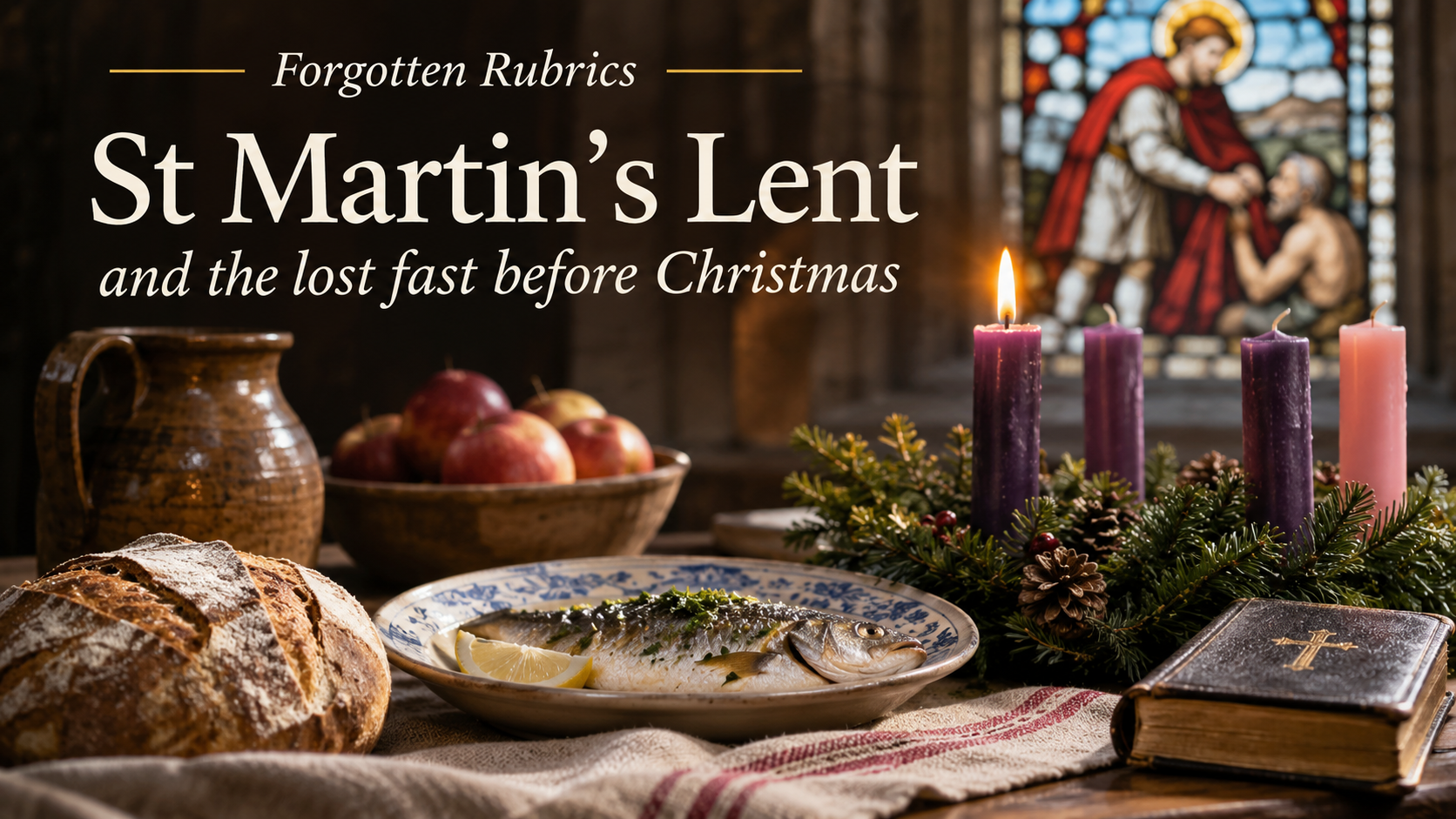
- Forgotten Rubrics | St Martin’s Lent and the lost fast before Christmas
 As recently as 1901, English Catholics were expected to fast on Wednesdays and Fridays in Advent. The much older discipline of St Martin’s Lent, and the Roman observance of the December Ember Days, explain why the Church once required so much more of her children in the weeks before Christmas.
- ADVENT HYMNS: WAKE, O WAKE! — THE WATCHMEN’S CRY
 From the plague-stricken streets of sixteenth-century Unna to the Advent services of English cathedrals, Philipp Nicolai’s chorale and Bach’s celebrated setting bear witness to a Catholic liturgical inheritance which survived the Reformation: the annual summons of St Paul to rise from sleep and prepare for the coming of Christ.
- THE JESSE TREE: A Living Advent Calendar
 Turn the ordinary Christmas tree into a living Advent calendar with homemade biblical ornaments, daily Scripture readings, a household blessing and prayers for every day of Advent.
- Leo XIV’s Test of Tradition: When Does Development Become Contradiction?
 Pope Leo XIV has rejected rupture with the Church’s authoritative teaching and cited war, slavery and capital punishment as examples of doctrinal development. The International Theological Commission must now explain how those examples accord with the principles established by its own predecessors.
- Christian Arrested on Texas Campus as New Laws Restrict Free Speech
 A Christian campaigner spent twenty-four hours in custody after discussing abortion with students at the University of Texas at Dallas. Behind his arrest lies a remarkable reversal of Texas legislation protecting freedom of speech, an administrative culture increasingly intolerant of independent expression, and an uncomfortable lesson for conservatives who entrust the regulation of dissent to public authorities.
- Equality on Condition of Agreement: The Dismissal of Lorna Young
 Manchester City Council unlawfully dismissed its own equality manager after colleagues objected to her gender-critical beliefs. The judgment raises a question of particular consequence for Catholics in public employment: how far may an authority require its employees to subscribe personally to its corporate philosophy?
- Driving Out the Jews — Calvin Robinson and the Limits of Christian Nationalism
 Asked how Catholics should counter dual-covenant theology in American government, Fr Calvin Robinson proposed the removal of Jews from the United States. His defenders have invoked Scripture, the social kingship of Christ and the Talmud. Their case warrants examination by those who take seriously both the restoration of Christendom and the Catholic Faith upon which it must depend.
- THE CHRIST OF THE CREED: Two Popes and the Substance of Catholic Catechesis
 The Vatican’s publication of the Jubilee catecheses of Francis and Leo XIV invites examination of the theological substance of contemporary papal instruction. As Rome considers anew the transmission of Apostolic Tradition, the traditional exposition of the Creed supplies an established measure of what such instruction ought to accomplish.
- Who Has the Right to Raise Your Child? Bishop of Blackburn Challenges Conversion Practices Bill
 Bishop Philip North and other witnesses have warned that the draft Conversion Practices Bill may intrude into family conversations, clinical judgement and religious ministry. Although Anglican bishops support protection from abuse, they seek clearer definitions and safeguards. Evidence from Baroness Cass and family lawyers highlights risks to parental authority, preventive orders and legitimate care.
- A Welfare Programme or a Mission of Salvation?
 Leo XIV has warned against reducing the Gospel to a welfare programme. Yet the Vatican’s own studies of Catholic charitable work tell us considerably more about the people assisted than about the people evangelised. The difficulty may owe as much to the financing of the Church’s institutions as to their conception of mission.
- Why the Roman Mass Should Always Be in Latin
 The Latin language belongs to the theological, musical and spiritual inheritance of the Roman Rite. Its preservation concerns the integrity of Catholic worship, the transmission of doctrine and the unity of the Church across nations and generations.
- The University and the Unfashionable Pursuit of Truth
 Cardinal Pietro Parolin’s address to the Pontifical Lateran University raises a question extending well beyond Rome: whether universities can recover their intellectual purpose, and whether Catholic universities possess sufficient confidence in their own intellectual inheritance to lead that recovery.
- When the Priest Becomes the Product: Alberto Ravagnani and the Perils of Influencer Catholicism
 Alberto Ravagnani’s departure from active ministry raises questions about the formation of priests in virtue, the purpose of evangelisation and the dangers of clerical celebrity.
- Fréjus-Toulon: A Bishop Removed, a Monastery Suppressed and Four Priests Ordained by Exception
 The resignation of Bishop ✠Dominique Rey, the disputed ordinations at Brignoles and the prolonged difficulties of the Missionaries of Divine Mercy raise questions about Roman government of traditional Catholic communities. The surviving records, including the monastery’s contemporary statements and the diocese’s response to Nuntiatoria, also help explain why apostolates outside regular diocesan structures remain wary of the assurances offered by Rome.
- Royal Holloway’s Secret Surveillance of a Pro-Israel Student
 Royal Holloway kept extensive records of a pro-Israel student’s movements and political activity before referring him to Prevent. Counter-terrorism police declined to pursue the case.
- Francis’s Private Diary: The Temptations of Power and the Defence of a Pontificate
 Cardinal Fernández intended the publication of Francis’s private writings to vindicate his pontificate. The late Pope’s own account of his spiritual crisis, and the cardinal’s subsequent admissions, invite closer examination of the manner in which papal authority was exercised.
- Butlers in Cassocks? The Claims Against the Institute of Christ the King
 An ex-oblate’s testimony raises questions about life inside the Institute—and about the evidence used to condemn it.
- When Music Becomes the Measure of Worship: Why Gregorian Chant Meets Resistance
 The article argues that Gregorian chant’s marginalisation resulted not from Vatican II alone, but from changing pastoral priorities, musical education, publishing and cultural preferences for personal expression and emotional engagement. Despite repeated papal and conciliar support, local practice often substituted contemporary repertoire. The author calls for renewed formation, faithful liturgical music and recovery of the Church’s musical inheritance.






Leave a Reply