
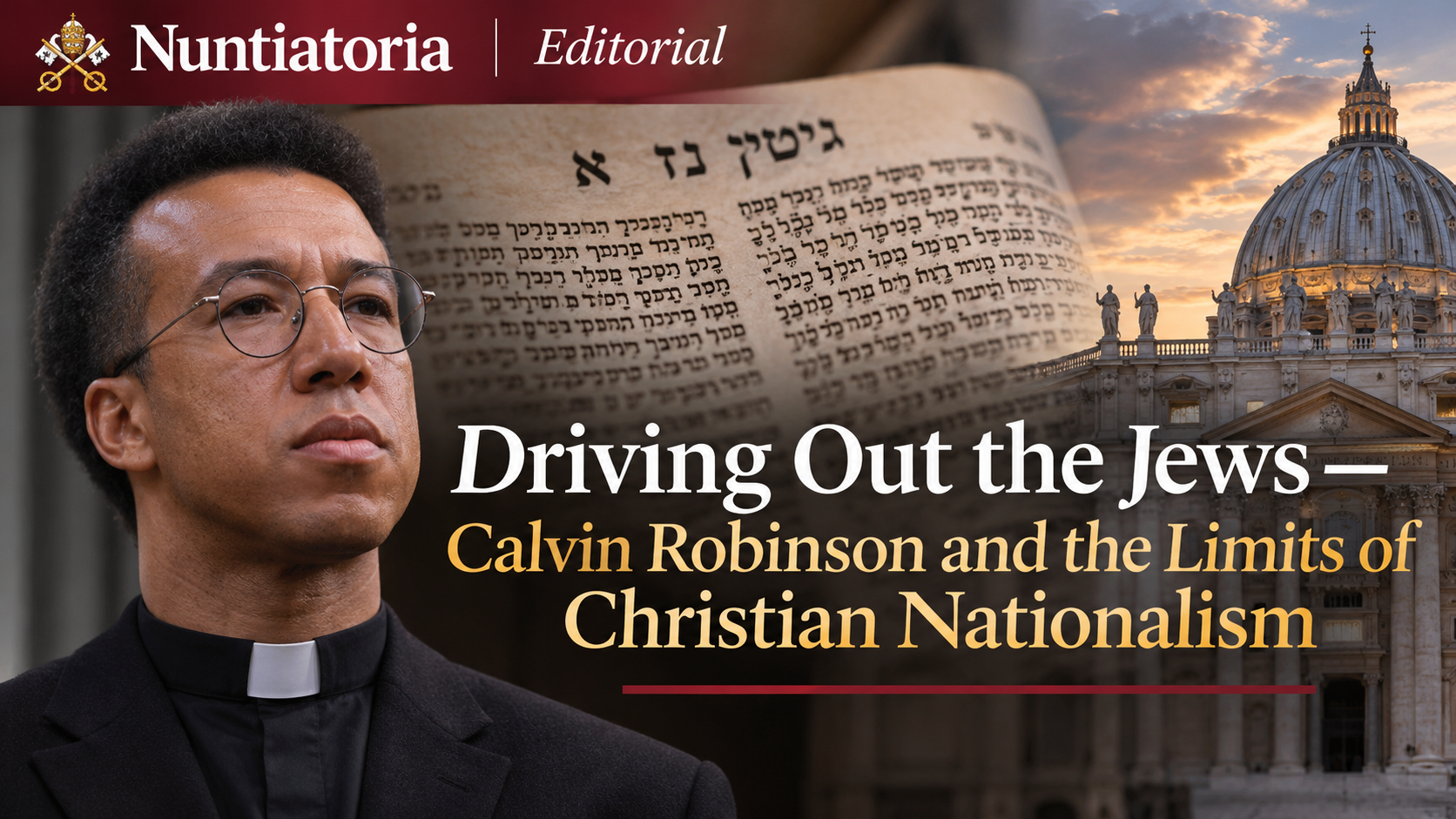
Asked how Catholics should counter dual-covenant theology in American government, Fr Calvin Robinson proposed the removal of Jews from the United States. His defenders have invoked Scripture, the social kingship of Christ and the Talmud. Their case warrants examination by those who take seriously both the restoration of Christendom and the Catholic Faith upon which it must depend.
EDITORIAL
The subject under discussion was Zionism; the proposed remedy was the removal of Jews from America. There is a considerable distance between the two, which Fr Calvin Robinson traversed in less than two minutes during the 13 November edition of The Command Show. The transcript of the full recording, available in video and podcast form, is considerably more instructive than the extract which subsequently occasioned the controversy. Joe Enders, Timothy Gordon and the commentator known as Pinesap joined Fr Robinson in discussing the compatibility of Zionism with Christianity.¹
At 33:39 Enders introduced the question of American politics, advancing the allegation that the United States was effectively governed by a Jewish oligarchy. He attributed this in part to the influence of evangelical Christians who believed that the Jews retained a covenant with God alongside the Christian covenant. Having described this as heretical, he asked (35:04–35:12): “How do we as Catholics prevent that heresy from permeating the highest levels of our government and maybe even pushing back against it?” The ensuing discussion concerned the meaning of a second covenant which, its proponents sometimes insist, is without independent significance for salvation.
Fr Robinson then returned to the question (36:30–36:53): “I think driving out the Jews is the answer.” He expressly compared the proposal with the mass deportation of Muslims, alleged that Jewish representation in the entertainment industries and other influential institutions was responsible for cultural subversion, and suggested that Jews should go to Israel. America, he maintained, was “an explicitly Christian land for an explicitly Christian people” (37:07–37:24). When Enders suggested that Zionists could exercise the same influence from abroad, Fr Robinson advocated the registration of foreign interests and, at 37:57, added: “And that means white Christians usually have English heritage. Yeah, it’s true.”¹
The broadcast contains no evidence establishing Enders’s allegation of collective Jewish control. More particularly, his question concerned the influence of a theological proposition on government. It was Fr Robinson who introduced expulsion as the remedy. The significance of the exchange lies precisely in that transition, for which subsequent appeals to the context of his remarks offer remarkably little assistance.
On 18 September Fr Robinson had already published a statement attributing a catalogue of political and intellectual movements, from Marxism to neoconservatism, to Jewish agency. He qualified the accusation by excluding some Jews, whilst insisting that Jews were invariably responsible.² It would be difficult to reconcile even the history of Marxism with such a proposition, let alone the histories of the other movements enumerated. The existence of Jewish adherents to a political philosophy is an inadequate account of its origin, appeal or influence.
Fr Robinson has since insisted that he wishes Jews no harm. In remarks reported by LBC on 25 November he denied having advocated their expulsion from America, explaining that he intended the deportation of people from abroad whose religion and conduct he regarded as subversive of Christian values. That explanation is narrower than his recorded remarks. The distinction between a foreign national and an American citizen was absent from his proposed solution, and his contemporaneous reference to deportation on 20 November scarcely supports the suggestion that he had envisaged only voluntary emigration. Meanwhile, Robert Garson, president of the American Association of Jewish Lawyers and Jurists, has sought a review of his immigration status. The State Department has acknowledged awareness of the remarks; no decision to revoke his visa has been established.³
The defence of Fr Robinson
On 19 November Archbishop Jayden A. M. Hagood, ordinary of the English Catholic Church to which Fr Robinson belongs, published a statement occasioned by the remarks of an unnamed priest of his jurisdiction. He affirmed the universal call to conversion, denied that ancestry conferred any privilege in the order of salvation, and expressly rejected collective punishment, ethnic discrimination and deprivation of rights.⁴ There was much in the statement which might have constituted the basis of an appropriate ecclesiastical response to the broadcast.
On 20 November the board of Command Media, of which Fr Robinson is managing director, published A Formal Apology for Fr. Calvin Robinson’s Comments. Its opening was hardly penitential: “There is none. Christ is King, you idiots.” The board denied that its host had referred indiscriminately to persons of Jewish ancestry, invoked the terminology of St John’s Gospel, reiterated the charge of Jewish oligarchy and defended the removal of those it considered responsible for the imposition of religious pluralism and other alleged evils.⁵
The joint statement of 23 November, signed by Archbishop Hagood, NXR Studios and Command Media, and published the following day by Anglican Ink, was rather more decorous. Its signatories denied that Fr Robinson intended harm, violence, coercion or forced conversion. They maintained that the nations belong to Christ, that governments have duties towards true worship, and that communities should be constituted around a common faith. They appealed to Fr Robinson’s advocacy of the removal of Muslims from Britain and America as evidence of the consistency of his position, and promised to defend him by legal means if his immigration status were jeopardised.⁶
The last undertaking is entirely intelligible. The theological defence, however, leaves Archbishop Hagood with a difficulty arising from his own statement four days earlier. What becomes of the rights of Jewish Americans who decline the invitation to leave? An invitation they may refuse without penalty would scarcely effect the political change Fr Robinson advocated. A policy which obliged them to depart would involve coercion. Nor does the fact that the same policy has been advocated in respect of Muslims establish its conformity with Christian teaching.
It is necessary to consider the substance of the argument rather than speculate about Fr Robinson’s personal sentiments towards individual Jews. Much of the controversy has been conducted as though a man’s protestation of affection for a particular people sufficed to establish the justice of whatever he proposed should be done with them.
The covenant and the kingdom
Catholics have perfectly sound theological reasons for objecting to a doctrine of two independent ways of salvation. Our Lord’s declaration in St John xiv. 6 admits no such qualification; St Peter affirmed the same truth before the Sanhedrin (Acts iv. 12). The promises made to Abraham were promises of God, and the Christian confession of their fulfilment in Jesus Christ neither impugns their original validity nor requires the denial of St Paul’s teaching concerning Israel in Romans ix–xi.
The Congregation for the Doctrine of the Faith reiterated the uniqueness and universality of Christ’s saving mediation in Dominus Iesus (2000). Even the 2015 theological reflection of the Commission for Religious Relations with the Jews, The Gifts and the Calling of God are Irrevocable, about which traditional Catholics have raised other legitimate questions, expressly repudiates the theory of independent Jewish and Christian paths to salvation (§35). That document does not claim magisterial status; its significance here is that it is hardly an exponent of the soteriological proposition Enders was denouncing. The dispute concerning the continuing significance of Israel’s election, and the controversy over the manner in which the Church should evangelise Jews, require a more exact theological vocabulary than the indiscriminate application of the expression dual covenant.⁷
As Nuntiatoria argued on 3 March, the Christian understanding of the promises made to Israel cannot be made to furnish a divine mandate for the policies of the modern Israeli government.⁷ Neither the rejection of dispensationalism nor the confession of Christ as the promised Messiah entails a judgement against the existence of the State of Israel as such. Whether a particular territorial claim, military action or arrangement of international relations is just must be determined according to the appropriate moral and political principles. A secular or religious Jew may support the existence of Israel without subscribing to the eschatology of American evangelicals; indeed, the dispute between those evangelicals and Catholics is about rival Christian interpretations of Scripture.
The removal of American Jews would scarcely resolve that disagreement. It is a peculiar remedy for the theological errors of one’s fellow Christians.
The controversy over the Talmud
On 23 November Archbishop Hagood published an observation about the Babylonian Talmud, alleging that minority Jewish sects continued to teach a passage concerning the punishment of Jesus of Nazareth after death. Dr Gavin Ashenden reproduced the statement in his essay When Christians Weaponise the Talmud, published on 24 November. He argued that the passage had been divorced from its literary and historical circumstances and employed to attribute contempt for Christ to Jews generally. He is entitled to insist upon those circumstances; a further investigation is necessary, however, if the substance of the Christian objection is to be properly understood.⁸
The passage is found in Gittin 56b–57a, among narratives concerning the destruction of Jerusalem. Onkelos, contemplating conversion to Judaism, summons the spirits of Titus, Balaam and a third figure to enquire about the standing of Israel in the next world and their respective punishments. In uncensored manuscripts the third figure bears the name Yeshu, in some witnesses with the designation ha-Notzri. The Koren-Steinsaltz translation available on Jewish religious websites identifies him as Jesus the Nazarene and renders his punishment as boiling excrement. The accompanying maxim ascribes this fate to those who mock the teaching of the sages.⁹
Archbishop Hagood is therefore correct about the existence of the passage and the familiar meaning of its words. He is less satisfactory in describing the absence of Jesus’s name in certain editions simply in terms of censorship by Jewish sects. The replacement of the name by a designation for sinners of Israel belongs to the history of Christian censorship of the Talmud, including anticipatory self-censorship by Jewish publishers. The name’s appearance in restored editions need not indicate the adoption of a new doctrine or the existence of a particularly hostile sect.
There is also something in the narrative which Archbishop Hagood’s citation omitted. When asked how Onkelos ought to treat Israel, the figure of Jesus counsels its welfare, appealing to the image in Zacharias ii. 8 of the apple of God’s eye. The concluding observation contrasts his benevolence with the malevolence of Balaam. The rabbis were quite capable of preserving a favourable recollection of Jesus alongside an offensive judgement upon Him. Ashenden is right to draw attention to the former; it would be an odd exercise in textual criticism to permit it to cancel the latter.
Ashenden also raises the possibility that Yeshu was a disciple of Rabbi Joshua ben Peraḥiah who lived approximately a century before Christ. The chronological objection derives from other rabbinic narratives and deserves rather less weight than it is sometimes accorded. In Jesus in the Talmud (2007), Peter Schäfer examines the Babylonian traditions as literary responses to the Christian Gospel. On his reading, the stories belong to a polemic between religious communities and their authors were sufficiently acquainted with Christianity to parody its distinctive claims. It is consequently unnecessary to suppose that the chronological displacement of a character named Jesus necessarily makes him a different person. An author writing a polemical counter-narrative is under no obligation to observe the chronology of the narrative he disputes.
Schäfer’s interpretation of Gittin goes further than Ashenden’s summary suggests. He proposes a deliberately degrading reversal of the Eucharistic discourse in St John vi, in which Christ promises eternal life to those who eat His flesh and drink His blood. The French historian Thierry Murcia, writing in the Revue des études juives in 2014, disputes that particular explanation and instead identifies echoes of rabbinic traditions associating idolatry with excrement. His conclusion is hardly more acceptable to Christian theology: the narrative would then be treating Christianity as a recrudescence of pagan idolatry. Neither hypothesis should be mistaken for a demonstrated intention of every contributor to the text; both scholars recognise its polemical character.¹⁰
The investigation of Bernard Dupuy
Twenty years before Schäfer’s book appeared, the French Dominican Bernard Dupuy devoted a study to the passage in the Revue des études juives. His interest was in the history of the saying ascribed to Jesus and the maxim of Rav Aḥa ben Ulla which the redactor employed to qualify it. Dupuy proposed that the consonantal expression subsequently understood in a scatological sense might originally have signified a testament or teaching characterised by irascibility. He traced the maxim to the rabbinic discussion of Ecclesiastes xii. 12 in Eruvin 21b, where the words of Rav Aḥa are themselves disputed by Raba.¹¹
Dupuy did not contend that the received translation was a malicious Christian invention. He acknowledged that the sequence of corporeal images in the Onkelos narrative favoured it. His reconstruction posited an earlier tradition remembering Jesus’s love of Israel, subsequently qualified by a judgement on His disputes with the religious teachers, and finally given its offensive form when incorporated into the story alongside the punishments of Titus and Balaam. The philological possibility and the proposed sequence of composition remain hypotheses; the latter does not depend upon finding a modern edition in which the offending words have disappeared.
Dupuy’s particular contribution to this controversy is to explain how the same narrative could retain a remembrance of Jesus’s attachment to Israel whilst expressing hostility towards His teaching. Ashenden’s observation about the favourable saying is thus rather more substantial than an exercise in apologetics. Dupuy nevertheless regarded the final form of the story as offensive, and there is no basis in his study for denying that Jesus is its subject.
The Christian objection would survive even the acceptance of Dupuy’s earlier, less coarse interpretation. It is precisely Christ’s authority over the religious teachers which the Gospel asserts. The Scribes and Pharisees were obliged to recognise Him; He was under no obligation to submit His divine teaching to their approval. To represent Him as culpable for His disagreement with them, and to place Him amongst the dead undergoing judgement, contradicts the Christian confession of His sinlessness, Resurrection and sovereignty. A Catholic who finds the insult to the person of Our Lord intolerable has quite sufficient theological reason for doing so, without invoking theories about the intentions of Jews living fifteen centuries later.
What must a Jew believe about the passage?
The Babylonian Talmud is a foundational work of rabbinic Judaism. Comprising the Mishnah and the discussion known as the Gemara, it contains legal determinations, conflicting opinions, scriptural exposition and narratives. Its reception throughout subsequent Jewish history renders somewhat inadequate Ashenden’s description of this particular story as the literary production of a geographically and chronologically confined minority. Its authors inhabited such a setting; the book in which their words were preserved acquired an authority extending very considerably beyond it.
But what sort of authority? Rabbinic tradition itself has long distinguished halakhah, governing religious law and observance, from aggadah, encompassing non-legal interpretations and narratives. In a 1993 study in the Orthodox Jewish journal Tradition, Simha Friedman reproduces several particularly relevant medieval authorities. The Mavo ha-Talmud, traditionally ascribed to Samuel ha-Nagid, though also attributed to Samuel ben Hofni Gaon, allows the reader of aggadah to accept what commends itself to his understanding, distinguishing this liberty from the obligation to observe commandments received from Moses.
Hai Gaon (939–1038), an authority of the Babylonian rabbinic academies, similarly regards such interpretations as differing in character from received tradition. His position is more discriminating than a simple dismissal of aggadah. He accords narratives within the Talmud greater weight than those outside it, requiring an effort to ascertain their meaning where it is obscure; nevertheless an interpretation which cannot be satisfactorily resolved need not be relied upon as though it were a binding legal determination. Friedman acknowledges that other Jewish authorities have understood the obligation to assent to the sages more extensively.¹²
The qualifications are worth observing. It is not sufficient to say that Gittin 57a is aggadah and therefore nobody believes it, any more than its inclusion in the Talmud establishes that everyone must believe it.
The question had already arisen in Christian controversy with Judaism at Barcelona in July 1263. In the presence of James I of Aragon, the Dominican convert Pablo Christiani sought to demonstrate the Messiahship of Jesus by appeal to rabbinic tradition. Rabbi Moses ben Naḥman, better known as Naḥmanides, refused to be bound by a tradition according to which the Messiah was born on the day of the Temple’s destruction. Christiani’s argument depended upon the obligation of his interlocutor to accept an interpretation which Naḥmanides denied.¹³
In 2020 Yaakov Taubes reconsidered the dispute in the Jewish Quarterly Review. He distinguishes the freedom claimed by medieval Jewish commentators in the interpretation of biblical passages from the greater authority they might concede to rabbinic teaching on theological questions. Naḥmanides’s refusals at Barcelona concerned instances of exegesis; they cannot be treated as a general repudiation of rabbinic authority in matters of belief.¹⁴
These authorities give us firmer grounds for accepting Ashenden’s objection to the indiscriminate use of the Talmud than the mere assertion that the passage belongs to a vanished community. They also oblige us to qualify that objection. The story expresses a theological judgement and deserves to be considered as such, although it is conveyed in a non-legal narrative. Some Jews may accept it literally, others allegorically or critically, and others have no acquaintance with it. To establish Archbishop Hagood’s claim about particular contemporary sects would require evidence of their actual teaching and reception of this passage. The existence of an uncensored edition supplies evidence of the text’s transmission, not of the convictions of its readers.
The Catholic reading of Jewish tradition
The Pontifical Biblical Commission’s The Jewish People and their Sacred Scriptures in the Christian Bible (2001) is sometimes cited as though it conceded the theological equivalence of Jewish and Christian interpretations of Scripture. In fact §22 expressly denies that Christians should adopt the religious presuppositions of rabbinic Judaism, because this would entail the exclusion of faith in Jesus as Messiah and Son of God. It recognises the historical continuity of Jewish biblical exegesis and the benefit Christians may derive from its study. That is an exegetical judgement, in a study by a commission of scholars; it does not invest the Talmud with the authority of inspired Scripture for Christians.¹⁵
The Commission also examines the polemical language of the New Testament in the light of the prophetic reproofs found in the Old. Such an examination is particularly pertinent to Command Media’s invocation of St John’s Gospel. Where the Evangelist refers to opponents of Christ, the identity of those opponents must be determined from the passage concerned. St John himself was a Jew. So were Our Lady and the other Apostles. The most elementary acquaintance with the Gospel ought to prevent its employment as a designation for an enduring conspiracy of people of Jewish descent. Nostra aetate §4 explicitly rejects the indiscriminate attribution of responsibility for the Passion to Jews then living or to subsequent generations.¹⁶
The Christian evaluation of Gittin must be conducted in the same spirit of intellectual probity which we expect of others when they read our Scriptures. Its judgement upon Jesus is irreconcilable with the Catholic Faith; we are entitled to say so. What we are not entitled to do is impute that judgement to a person without ascertaining whether he holds it. Even if he does, it remains necessary to establish what civil wrong, if any, he has committed before proposing a civil penalty.
The example of St Pius V
The historical precedent invoked by Enders at 38:07 is especially unfortunate. He asserted that St Pius V had given all the Jews of Rome a period in which to leave under threat of execution. The decree to which he evidently referred, Hebraeorum gens, of 26 February 1569, expressly excepted Rome and Ancona from the expulsion it prescribed. The specified punishment for disobedience after three months was perpetual servitude, with the threat of still graver penalties. The existing Roman and Anconitan Jewish communities were permitted to remain subject to restrictions, partly for reasons of commerce and partly in the hope of conversion.¹⁷
The correction does not turn a harsh decree into an enlightened one. Pius V made sweeping allegations concerning Jewish conduct and authorised a coercive measure against communities within his temporal dominions. As a sovereign prince he was exercising a jurisdiction which he possessed as ruler of the Papal States. His judgement about the expediency of expulsion was not a dogmatic definition of the obligations of Christian sovereigns. Sixtus V subsequently relaxed the restrictions in 1586. The canonisation of Pius V does not oblige Catholics to regard his successor’s different policy as a departure from the Faith.
The papal record extends back rather further than the sixteenth century. The protections customarily known as Sicut Judaeis were repeatedly promulgated to restrain Christians from injuring Jews, compelling their baptism or unlawfully interfering with their property and observances. In 1272 Gregory X expressly repudiated the accusation that Jews habitually murdered Christian children for religious purposes and intervened against the abuses to which that accusation gave rise.¹⁸ No modern theory of religious indifferentism was required to persuade a medieval pontiff that the testimony of an accuser should be examined and that an innocent Jew should be protected.
In March 1928 the Holy Office, under Pius XI, suppressed the association Amici Israel, whose proposals it considered incompatible with the mind and traditions of the Church. In the same decree the congregation recalled the Holy See’s protection of Jews against unjust persecution and condemned the hatred known as antisemitism.¹⁹ It did not consider the conversion of Jews to Christ an objectionable aspiration. Here is evidence, from well before the Second Vatican Council, of the simultaneous affirmation of Catholic missionary doctrine and rejection of hostility towards Jews on account of their identity.
The duties of a Christian government
The joint statement’s appeal to the kingship of Christ invokes a Catholic doctrine which Nuntiatoria has consistently defended. In Quas Primas Pius XI taught that Christ’s dominion encompasses civil societies and that those who govern owe Him public acknowledgement.²⁰ Leo XIII, in Immortale Dei, explained the duties of the state towards the true religion, whilst expressly allowing the toleration of other religions where required for the common good or the prevention of greater evils.²¹
Indeed, the question of Jewish worship in a Christian polity had been considered quite specifically by St Thomas Aquinas. In the Summa Theologiae (II–II, q. 10, a. 11) he argues that the rites of the Jews should be tolerated on account of the witness they bear to the origins of the Christian religion. In a. 8 he explains why those who have never received the Faith cannot be compelled to embrace it. Faith requires the assent of the will.²² Aquinas does not thereby concede that post-biblical Judaism is a sufficient religion of salvation; he is considering what a Christian government ought to do about people who profess a religion it considers erroneous.
There is thus a rather considerable omission in the assertion that the historic Christian view requires people to live exclusively amongst co-religionists. The Catholic doctrine of the obligations of civil society towards Christ is entirely compatible with the presence of persons who do not acknowledge those obligations. The declaration Dignitatis humanae subsequently affirmed immunity from religious coercion within due limits, whilst expressly retaining the traditional teaching concerning the duties of men and societies towards the true religion.²³ Whatever objections a traditional Catholic may raise concerning the declaration’s interpretation and application, he need not appeal to it to establish the legitimacy of tolerating Jewish residents in a Christian country. St Thomas and Leo XIII have already done so.
The restoration of Christian government would not dispense civil authorities from the requirements of justice towards their subjects. A restriction justified by the protection of the common good must have a proportionate relation to the evil it seeks to prevent. Mere religious affiliation is not evidence of criminal conduct, nor does the exercise of political influence by an individual establish culpability on the part of his co-religionists. The same standard ought to govern the scrutiny of lobbying organisations, foreign interference and the conduct of those responsible for the dissemination of morally objectionable material. Otherwise a Christian could engage with impunity in the very activities for which a Jew would be banished.
Christian patriotism
In the editorial published here on 13 November, the Archbishop of Selsey proposed Christian patriotism as a more satisfactory description of the enterprise of restoring Britain’s Christian inheritance.²⁴ He recalled the experience of English Catholics whose allegiance to the Apostolic See was adduced as evidence of their political disloyalty. The penal legislation which ensued ought to make Catholics particularly wary of the assumption that a man’s religious allegiance renders him incapable of genuine loyalty to his country. That history has some bearing upon the present controversy, as does Nuntiatoria’s August examination of the distinction between the Christian identity of Britain and hostility towards Muslims.²⁵
There is considerable irony in a British immigrant explaining to American Jews that the country in which they and often their forebears were born belongs to people of English descent. In 1790 George Washington wrote to the Hebrew congregation at Newport, Rhode Island, assuring its members of the liberty of conscience enjoyed by their fellow citizens.²⁶ The letter antedates the ratification of the First Amendment. Whatever a Catholic may think of the religious principles underlying the American constitutional settlement, the suggestion that Jewish Americans are necessarily foreigners is irreconcilable with its history.
Fr Robinson’s defenders invoke American religious liberty in arguing that he ought not to lose his visa for expressing his convictions. They are entitled to test the legality of any immigration action, and objections to his opinions do not in themselves establish grounds for his removal. Visa holders and citizens do not, of course, have identical rights of residence. Nevertheless, one may reasonably wonder whether the liberty to which the signatories appeal would extend to a Jewish minister in their proposed Christian nation. Their own defence of Fr Robinson proceeds from the principle that the expression of religious convictions ought not, of itself, to occasion expulsion.
The signatories might usefully have devoted rather more attention to the moral obligations of the Christian sovereign whose authority they invoke. In the exchange which gave rise to this controversy Fr Robinson offered to introduce the inhabitants of America to Jesus Christ. The Jewish inhabitant who declines that invitation is entitled to the justice which Christ requires of those who govern. What purpose, either evangelical or civil, would be served by depriving him of his country? Neither Fr Robinson nor his defenders have yet supplied an adequate answer.
FOOTNOTES
¹ Command Media, On Zionism — The Command Show, episode 3, 13 November 2026, 33:39–38:18; Calvin Robinson, Can we Restore Britain?, 13 November 2026, containing the video; time-stamped transcript supplied to Nuntiatoria.
² Searchlight, Calvin Robinson: ‘It is the Jews. It has always been the Jews’, 19 September 2026.
³ Alex Carson, US urged to review Calvin Robinson visa over call to ‘drive out the Jews’, The Jerusalem Post, 24 November 2026; Georgia Bell, Preacher Calvin Robinson’s US visa to be reviewed after “Jews out” comments, LBC, 25 November 2026.
⁴ Jayden A. M. Hagood, Statement on the Universal Call of the Gospel, 19 November 2026.
⁵ Command Media Board, A Formal Apology for Fr. Calvin Robinson’s Comments, 20 November 2026; George Conger, Calvin Robinson faces visa challenge after calling for Jews to be driven out of America, Anglican Ink, 21 November 2026.
⁶ Command Media, NXR Studios and Jayden A. M. Hagood, Statement in support of Fr Calvin Robinson, 23 November 2026, published 24 November.
⁷ Nuntiatoria, Christian Zionism and the Jewish Question: Fulfilment, Providence, and the Temptation of Geopolitical Theology, 3 March 2026; Congregation for the Doctrine of the Faith, Dominus Iesus, 6 August 2000, §§13–15; Commission for Religious Relations with the Jews, The Gifts and the Calling of God are Irrevocable, 10 December 2015, §§35–37.
⁸ Gavin Ashenden, When Christians Weaponise the Talmud, 24 November 2026.
⁹ Babylonian Talmud, Gittin 57a, Koren-Steinsaltz edition.
¹⁰ Peter Schäfer, Jesus in the Talmud, Princeton University Press, 2007, ch. 8; Thierry Murcia, B. Giṭṭin 56b–57a: L’épisode talmudique de Titus, Balaam et Yeshu en enfer — Jésus et l’insolite châtiment de l’excrément bouillant, Revue des études juives 173, nos. 1–2 (2014), pp. 129–157.
¹¹ Bernard Dupuy, Le logion de Jésus rapporté dans le Talmud (Giṭṭin 57a). Sens et portée d’une sentence de Rav Aḥa ben ‘Ulla, Revue des études juives 146, nos. 3–4 (1987), pp. 255–264.
¹² Simha Friedman, Emunat Hakhamim: Faith in the Sages, Tradition 27, no. 4 (1993), section on the Mavo ha-Talmud and the Geonim.
¹³ Naḥmanides, The Barcelona Synagogue, 1263 — Rabbi Moses ben Nahman, Center for Online Judaic Studies; Robert Chazan, The Barcelona “Disputation” of 1263: Christian Missionizing and Jewish Response, Speculum 52, no. 4 (1977), pp. 824–842.
¹⁴ Yaakov Taubes, In Denial: A Fresh Approach to Naḥmanides and Aggadah at Barcelona, Jewish Quarterly Review 110, no. 4 (2020), pp. 679–701.
¹⁵ Pontifical Biblical Commission, The Jewish People and their Sacred Scriptures in the Christian Bible, 24 May 2001.
¹⁶ Second Vatican Council, Nostra aetate, 28 October 1965, §4.
¹⁷ St Pius V, Hebraeorum gens, 26 February 1569, Bullarium Romanum, Turin ed., VII, pp. 740–742; Praeceptum de Iudaeorum exterminatione, Digital Inquisition catalogue; Rome, Jewish Encyclopedia.
¹⁸ Gregory X, Papal Protection of the Jews, 7 October 1272.
¹⁹ Sacred Congregation of the Holy Office, Decretum de consociatione vulgo “Amici Israel” abolenda, Acta Apostolicae Sedis 20 (1928), pp. 103–104.
²⁰ Pius XI, Quas Primas, 11 December 1925.
²¹ Leo XIII, Immortale Dei, 1 November 1885.
²² St Thomas Aquinas, Summa Theologiae, II–II, q. 10, aa. 8, 11.
²³ Second Vatican Council, Dignitatis humanae, 7 December 1965, §§1–2.
²⁴ Nuntiatoria, Christian Patriotism: A Proposal to Those Who Would Restore Christian Britain, 13 November 2026.
²⁵ Nuntiatoria, Christian Britain Is Not Anti-Muslim: Rowan Williams, Nigel Farage and the increasingly dangerous confusion between Christian identity and hostility to Islam, 21 August 2026.
²⁶ George Washington, From George Washington to the Hebrew Congregation in Newport, Rhode Island, 18 August 1790, Founders Online, National Archives.





Leave a Reply