
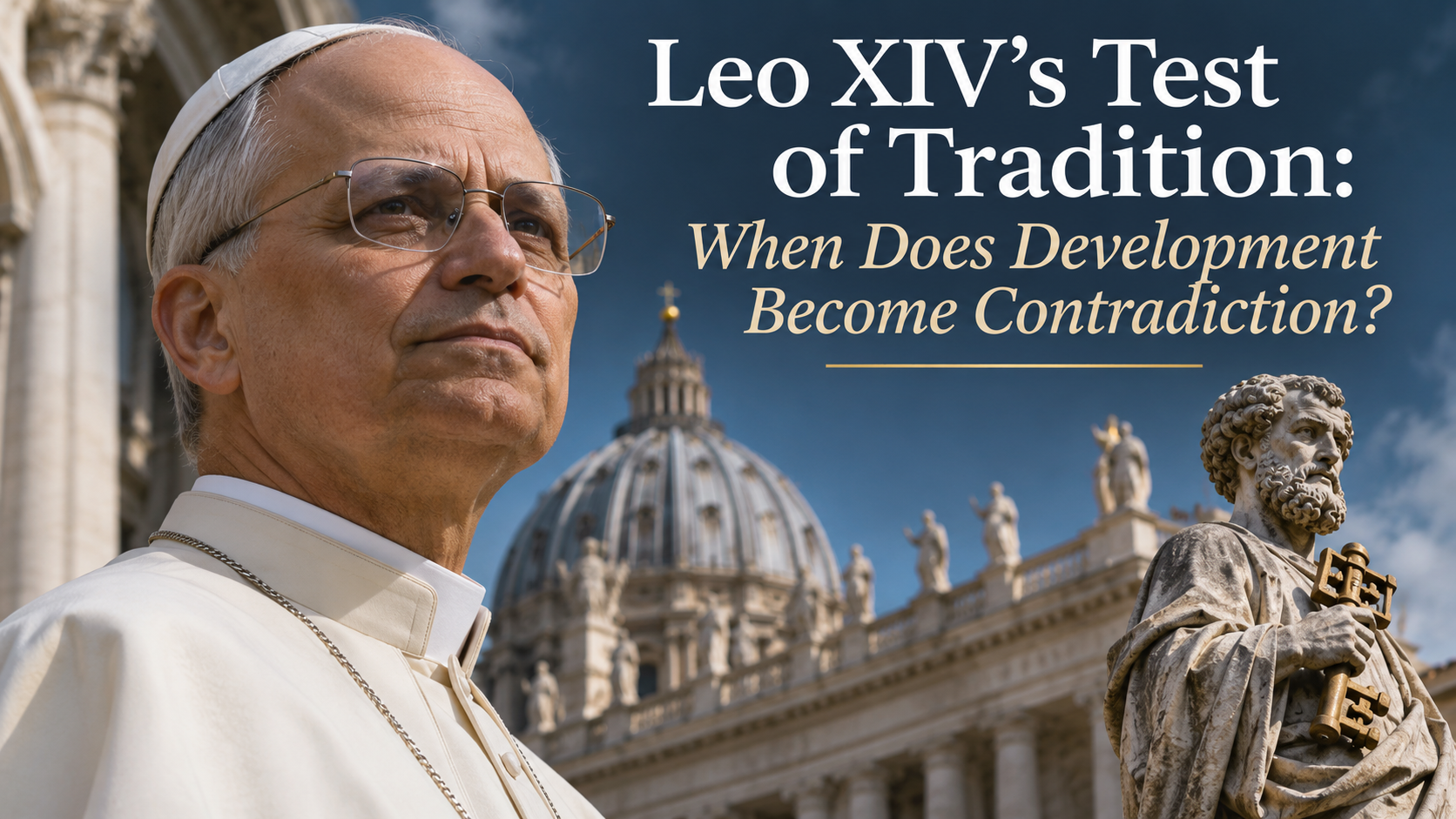
Pope Leo XIV has rejected rupture with the Church’s authoritative teaching and cited war, slavery and capital punishment as examples of doctrinal development. The International Theological Commission must now explain how those examples accord with the principles established by its own predecessors.
On 25 November, receiving the International Theological Commission in the Consistory Hall at the beginning of its eleventh quinquennium, Pope Leo XIV invoked a warning delivered by Paul VI on the first anniversary of the conclusion of the Second Vatican Council. Theological enquiry, Paul had insisted, could not justify emancipation from what the Church had authoritatively taught. Leo repeated that warning and affirmed the growth in understanding of Sacred Tradition described in Dei Verbum. He then explained that such growth entailed no rupture in magisterial teaching, referring instead to the development of its animating principles: uno sviluppo dei principi che lo animano. His examples were war, slavery and capital punishment.¹
In October, Nuntiatoria examined the proposed work of the renewed Commission and recalled that under Cardinal Joseph Ratzinger its predecessors had already investigated substantially the same subjects. Their studies, Faith and Inculturation (1988) and The Interpretation of Dogma (1989), remain available on the Vatican website. The latter supplied criteria for distinguishing authentic doctrinal development from corruption. What was reported in October about the Commission’s prospective work has now received papal confirmation; the examples Leo has chosen furnish a particularly revealing opportunity to apply those criteria.²
There is a considerable difference between a development in our understanding of a principle and a change in the principle itself. The distinction is already implicit in the passage of Dei Verbum to which Leo refers: it is the Church’s understanding of what has been handed down which grows. Two paragraphs later, the Council expressly subordinates the Magisterium to the Word of God. It cannot confer revealed status upon a proposition simply by teaching it. The First Vatican Council, adopting the formulation of St Vincent of Lérins, had prescribed that growth in doctrinal understanding should proceed in eodem scilicet dogmate, eodem sensu eademque sententia: in the same doctrine, the same sense and the same judgement.³
Read in the context of Leo’s rejection of rupture, his reference to the development of principles admits of an orthodox interpretation. It would be premature to accuse him of asserting their mutability. His examples, however, require the Commission to distinguish a deeper apprehension of an enduring truth from a correction of an earlier judgement or a change in the circumstances governing its application. The consequences of confusing those operations extend well beyond Catholic social teaching.
The supposedly obsolete just war
In Magnifica Humanitas, dated 15 May, Leo XIV pronounced just-war theory outdated, whilst expressly reserving the right of self-defence in its strictest sense. His objection concerned both the abuse of the theory to justify wars and the availability of alternatives to armed conflict.⁴ On the very day of his address to the theologians, however, he reaffirmed at his general audience the right of governments to legitimate defence, citing Gaudium et spes §79. He also envisaged international bodies capable of intervening effectively to restore justice and protect the oppressed.⁵
These qualifications are important because they preserve the very moral problem which just-war doctrine was devised to resolve. St Thomas treated war under the virtue of charity. Drawing upon St Augustine, he required legitimate authority, just cause and right intention. A ruler could possess a just cause and nevertheless prosecute a war unjustly. The tradition was intended to restrain rulers, whose ingenuity in discovering justifications for military adventures has scarcely diminished since the thirteenth century.⁶
The Catechism still enumerates in §2309 the conditions under which military defence may be legitimate, including the gravity of the threatened harm, the exhaustion or impracticability of alternatives, reasonable prospects of success and proportionality. It expressly identifies these as the traditional elements of just-war doctrine.⁷ Modern armaments may alter the assessment of proportionality, just as effective international institutions might diminish the necessity of military action. Neither development dispenses with the obligation to make those assessments.
If the Pope intends to reject the presumption that war is an acceptable instrument of national policy, the received tradition provides ample grounds for doing so. If he proposes that the criteria themselves are obsolete, it remains to be explained how governments are to distinguish their legitimate defence of the innocent from aggression. The Commission might usefully begin by clarifying the relationship between the encyclical and the Catechism rather than by devising an entirely new theology of peace.
Slavery and the correction of ecclesiastical judgements
In §176 of Magnifica Humanitas, Leo acknowledges the involvement of the Apostolic See in authorising enslavement and asks pardon for the Church’s historical failures. The encyclical maintains that the Christian affirmation of man’s dignity endured despite the tardiness with which its implications for slavery were recognised. Its footnote 175 acknowledges that as late as 1866 the Holy Office had not condemned slavery in its entirety.⁸
Nicholas V’s Romanus Pontifex (1455) confirmed privileges granted to Afonso V of Portugal which included the perpetual enslavement of conquered peoples. Paul III, in Sublimis Deus (1537), affirmed the liberty and property rights of indigenous peoples irrespective of their reception of the Christian religion. Gregory XVI condemned the slave trade and unjust enslavement in In supremo apostolatus (1839); Leo XIII urged the eradication of slavery in In plurimis (1888).⁹ The intervening instruction of the Holy Office in response to questions from Mgr Guglielmo Massaia, Apostolic Vicar among the Galla, went beyond tolerating an existing institution: it expressly maintained the possible existence of just titles to servitude and permitted transactions in slaves under specified conditions.¹⁰
It would be misleading to account for this history merely by distinguishing chattel slavery from penal servitude or other restrictions upon liberty, although those distinctions are necessary. Some ecclesiastical authorities really did sanction the possession of human beings. Their decisions must be judged according to what they authorised, the grounds upon which they authorised it and the doctrinal authority those judgements possessed.
Nor were the moral resources for a more satisfactory judgement unavailable to earlier generations. In his fourth homily on Ecclesiastes, St Gregory of Nyssa challenged the presumption that a man might claim ownership of another creature made in the image of God.¹¹ His argument belongs to the fourth century, not the nineteenth. The Christian doctrine of creation afforded grounds for condemning the practice long before abolition became a political cause.
The indefectibility of the Church has never guaranteed the justice of every papal concession to a temporal ruler or the irreformability of every decision of a Roman congregation. In Donum veritatis (1990), the Congregation for the Doctrine of the Faith itself acknowledged that magisterial interventions of a prudential character could contain deficiencies. It recognised a legitimate role for theological enquiry in discerning the permanent principles involved.¹² The Commission ought to establish which historical propositions concerning slavery were mistaken, rather than allow the imprecise language of development to obscure the possibility that some of them required correction.
Capital punishment: from necessity to intrinsic dignity
The capital punishment example presents a difficulty of a different order. The Roman Catechism, promulgated by St Pius V in 1566, explained the just exercise of the civil magistrate’s penal authority to impose death as consistent with obedience to the Fifth Commandment. It was a proposition taught to parish priests for the instruction of the faithful, rather than a concession made to a particular sovereign in particular historical circumstances.¹³
John Paul II’s Evangelium vitae (1995) restricted the permissible use of capital punishment to cases of absolute necessity, judging such cases exceptionally rare in view of modern penal arrangements. The 2018 revision of the Catechism under Francis went further, declaring the punishment inadmissible on grounds of human dignity. Cardinal Luis Ladaria’s accompanying letter affirmed continuity with previous teaching, appealing in part to the changed circumstances of contemporary penal systems.¹⁴
Were the question confined to the necessity or expediency of capital punishment under modern conditions, the theological problem would be comparatively straightforward. But the Dicastery for the Doctrine of the Faith subsequently stated in §34 of Dignitas infinita (2024) that capital punishment violates human dignity “regardless of the circumstances”.¹⁵ This is considerably more difficult to reconcile with the Roman Catechism. The difficulty no longer concerns the adequacy of prisons or the frequency of judicial error; it concerns whether the act which earlier Catholic teaching held could be just is necessarily an offence against the dignity of the person.
It is sometimes suggested that the traditional doctrine arose from an insufficient appreciation of the dignity of criminals. Yet the Christian concern for the condemned man’s soul, the ministry of priests attending him before execution and the traditional understanding of punishment as capable of expiatory value all presupposed that his humanity remained intact. Indeed, §2266 of the present Catechism retains the expiatory character of punishment voluntarily accepted by the offender.¹⁶
Catholics need not favour the restoration of capital punishment to recognise the theological difficulty. The Commission should ascertain whether the contemporary teaching concerns an obligation to abolish a particular penalty under present conditions or whether it excludes the moral competence of public authority to impose that penalty in principle. If the latter is intended, what precisely was erroneous in the earlier doctrine and on what grounds can it be corrected? The word inadmissible cannot indefinitely substitute for an answer.
The Commission’s own criteria
In its consideration of Newman’s seven notes of authentic development, the 1989 Commission formulated the sixth with admirable economy: “development becomes corruption when it contradicts the original doctrine or earlier development.” It also required continuity of principles and logical coherence between the original teaching and the conclusions subsequently derived from it.¹⁷
Those criteria have particular relevance to Leo’s examples. The right of legitimate defence, expressly retained by the Pope, can survive a considerable alteration in the circumstances of warfare. The historical correction of ecclesiastical judgements concerning slavery does not entail the alteration of revealed truth. The teaching on capital punishment, however, requires a more precise account of the relationship between the moral character of an act and the authority of the propositions previously taught concerning it.
It would be hazardous to employ these quite different cases collectively as precedents for a theory of doctrinal development applicable indiscriminately to sacramental theology or ecclesiology. The revision of an assessment of political circumstances furnishes no precedent for reversing a proposition definitively taught by the Church. Nor does the recognition that non-definitive teaching can require correction imply that such teaching may ordinarily be disregarded.
The cultures Rome has already evangelised
Leo’s second subject, the cultural transmission of the Faith, follows the publication of Venite ad me on 22 October. Our earlier investigation examined the Dicastery’s acknowledgement of the crisis of transmission, including the loss of collective ritual memory and the need to recover the religious education once afforded by Catholic family and community life.¹⁸ The Pope’s particular emphasis upon popular piety in his latest address ought to occasion some consideration of the cultures in which Christianity had already become thoroughly established.
A child who heard the Angelus bell, knew why the family abstained from meat on Fridays and accompanied his parents to pray for the dead in November had received something of a Catholic education before opening a catechism. The traditional Roman liturgy itself was successfully received among peoples of extraordinarily different languages and cultures, without the abandonment of its common sacred language. It accommodated local musical traditions, devotions and customs without requiring that the rites themselves be reconstructed for every generation.
The Commission’s Faith and Inculturation was quite explicit in 1988 about the obligation to evangelise modern cultures and the transcendence of revelation over any particular cultural expression.¹⁹ Its successors might therefore enquire whether some of the cultural assumptions which informed ecclesiastical reform in the twentieth century ought themselves to have been subjected to more rigorous evangelisation. They might also investigate the consequences of curtailing older forms of Catholic life for the families now expected to transmit the Faith without them.
Secularisation cannot be attributed exclusively to decisions made by ecclesiastical authorities; nor does its existence exempt those authorities from examining the consequences of their decisions. The experience of communities retaining the traditional Roman Rite ought to form part of any serious comparative enquiry into Catholic religious formation and perseverance. Their exclusion would deprive the Commission of evidence directly pertinent to its subject.
The International Theological Commission has no independent power to define doctrine. Its responsibility is to assist the Holy See through theological scholarship. Leo XIV has expressly rejected rupture with authoritative Catholic teaching; his theologians should take him at his word. They have in the studies of their predecessors the means of examining the claims made for more recent developments, and in the history of the Church the evidence necessary to test them. It would be unfortunate if the principal function of the new investigation were to supply a justification for conclusions which its members had been required to accept before they began.
FOOTNOTES
¹ Leo XIV, Address to the Members of the International Theological Commission, 25 November 2026; Discorso ai membri della Commissione Teologica Internazionale.
² Nuntiatoria, Leo XIV Asks What Counts as Tradition. Rome Answered in 1989, 23 October 2026.
³ First Vatican Council, Dei Filius, 24 April 1870, Chapter IV; Second Vatican Council, Dei Verbum, 18 November 1965, §§8–10.
⁴ Leo XIV, Magnifica Humanitas, 15 May 2026, §192.
⁵ Leo XIV, General Audience: The Documents of the Second Vatican Council. IV. Constitution Gaudium et Spes. 9, 25 November 2026.
⁶ St Thomas Aquinas, Summa Theologiae, II–II, q. 40, a. 1.
⁷ Catechism of the Catholic Church, §§2308–2309.
⁸ Leo XIV, Magnifica Humanitas, §§174–177, especially §176 and note 175.
⁹ Nicholas V, Romanus Pontifex, 8 January 1455; Paul III, Sublimis Deus, 1537; Gregory XVI, In supremo apostolatus, 3 December 1839; Leo XIII, In plurimis, 5 May 1888.
¹⁰ Holy Office, Instruction concerning the questions of Mgr Massaia, 1866, response 15, Latin text and English translation.
¹¹ St Gregory of Nyssa, Homilies on Ecclesiastes, Homily IV, on Ecclesiastes 2:7.
¹² Congregation for the Doctrine of the Faith, Donum veritatis, 24 May 1990, §§23–24.
¹³ Roman Catechism, Part III, Chapter VI, Fifth Commandment.
¹⁴ John Paul II, Evangelium vitae, 25 March 1995, §56; Congregation for the Doctrine of the Faith, Letter to the Bishops Regarding the New Revision of Number 2267 of the Catechism of the Catholic Church on the Death Penalty, 1 August 2018, §§7–8.
¹⁵ Dicastery for the Doctrine of the Faith, Dignitas infinita, 2 April 2024, §34.
¹⁶ Catechism of the Catholic Church, §§2266–2267.
¹⁷ International Theological Commission, The Interpretation of Dogma, 1989, Part C, criteria for contemporary interpretation.
¹⁸ Dicastery for the Doctrine of the Faith, Venite ad me: Considerations on the Transmission of the Faith in an Epochal Change, 22 October 2026, §§94, 104; Nuntiatoria, Venite ad me: Leo XIV, Cardinal Fernández and the Tradition Rome Has Failed to Transmit, 23 October 2026.
¹⁹ International Theological Commission, Faith and Inculturation, 1988, Introduction, §§5–8.






Leave a Reply