
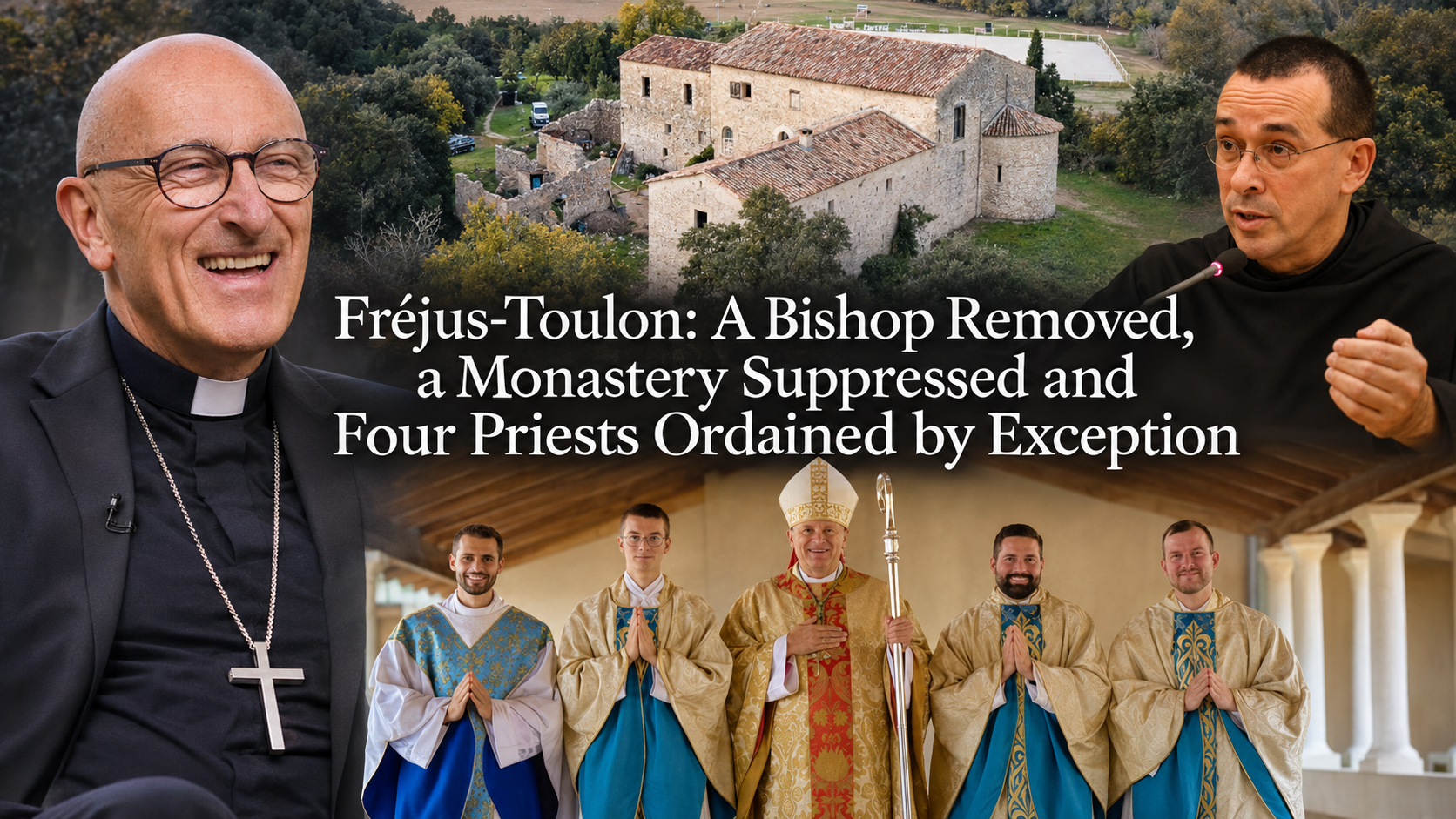
The resignation of Bishop ✠Dominique Rey, the disputed ordinations at Brignoles and the prolonged difficulties of the Missionaries of Divine Mercy raise questions about Roman government of traditional Catholic communities. The surviving records, including the monastery’s contemporary statements and the diocese’s response to Nuntiatoria, also help explain why apostolates outside regular diocesan structures remain wary of the assurances offered by Rome.
Four members of the Society of the Missionaries of Divine Mercy received the Catholic priesthood at the Benedictine Abbey of Notre-Dame de Triors on 31 October 2026. Clément Anouil, Henri Gilliot, Guillaume Le Gall and Thibaud Perruchot were ordained by Bishop ✠François Touvet of Fréjus-Toulon, bringing to an end five years in which the Society had celebrated no priestly ordinations. The four new priests would serve the Society’s missions in Draguignan, Marseille, Strasbourg and Lyon, where their arrival had been awaited with understandable impatience. Bishop ✠Touvet had secured a Roman indult permitting them to celebrate Mass according to the 1962 Missal, without which he had considered it imprudent to commit them irrevocably to the priesthood. Their ordination, however, was celebrated according to the postconciliar Pontifical, in Latin and with Gregorian chant. The arrangement, as the bishop subsequently explained, had been agreed with Rome.1
The ceremony was certainly a cause for rejoicing, although it presented an incongruity which deserves closer examination. The Missionaries undertake their priestly formation within the traditional Roman liturgical inheritance, including the progression through tonsure, minor orders, subdiaconate and diaconate. The older rites accompany successive stages of a vocation directed towards the sacred priesthood, shaping the candidates’ understanding of their duties and the sacramental ministry they will eventually exercise. Yet the ceremony conferring that priesthood was taken from different liturgical books. Meanwhile, the Priestly Fraternity of Saint Peter continued to enjoy the express permission of Pope Francis to use the traditional Pontificale Romanum, and the Institute of Christ the King Sovereign Priest continued conferring orders according to the older Roman rites. Both institutes possess particular faculties which differ from those governing the Missionaries, a diocesan society whose clergy are incardinated in Fréjus-Toulon. The law explains the different permissions. The pastoral reason for the disparity is less apparent, especially when the Society’s cooperation with diocesan authority has never been seriously in doubt.2
The history of these four ordinations is inseparable from the wider troubles of Fréjus-Toulon. In April 2022, another traditional community within the diocese, the Benedictine Monastère Saint-Benoît at Brignoles, arranged ordinations from a bishop whose identity remains publicly undisclosed. Dom Alcuin Reid, its prior, received the priesthood, whilst Brother Ildephonse Swithinbank received the subdiaconate and diaconate. The ceremonies took place outside France without the requisite dimissorial letters. The community invoked necessity; Bishop ✠Dominique Rey, who had previously welcomed its foundation, imposed canonical sanctions and subsequently suppressed the public association of the faithful under which it had received ecclesiastical recognition. Less than three years later Bishop ✠Rey himself relinquished Fréjus-Toulon at the express request of Pope Francis. He was seventy-two, three years short of the customary retirement age. The Holy See had already subjected his administration to an apostolic visitation and appointed Bishop ✠Touvet as coadjutor with special governing faculties, but the eventual request for his resignation was not accompanied by a detailed public explanation.3
Bishop ✠Rey’s approach to the government of Fréjus-Toulon had made the diocese something of an exception within French Catholicism. Appointed in 2000 by Pope John Paul II, he welcomed new religious and missionary communities, encouraged priestly vocations and allowed a variety of spiritual traditions to develop within the diocese. France’s ecclesiastical circumstances made such an approach understandable. In many dioceses declining religious practice, ageing congregations and the diminishing number of priests had produced a succession of parish reorganisations without any corresponding revival of Catholic life. Bishop ✠Rey looked for communities willing to evangelise and capable of attracting men to the priesthood. Some employed contemporary missionary methods; others preserved traditional liturgical and devotional observances. He did not regard the latter as disqualified from participation in the Church’s mission merely because their spirituality belonged to an older pattern of Catholic life.
The Society of the Missionaries of Divine Mercy was founded in 2005 by Fr Fabrice Loiseau, formerly of the Priestly Fraternity of Saint Peter. Its particular apostolate combined devotion to Divine Mercy, the traditional Roman liturgy and evangelisation, especially amongst Muslims. The Society undertook parish ministry, catechesis, the administration of the sacraments, visits to homes, prison and hospital chaplaincy, and missionary activity in public places. Its work amongst Muslims was explicitly concerned with proposing the Catholic faith and inviting conversion to Jesus Christ. The older Roman Mass belonged to the spiritual life from which this apostolate proceeded. The Society did not, however, insist upon exclusive celebration of the traditional liturgy. Its priests also celebrated according to the postconciliar books where required and participated in diocesan liturgical occasions. When Bishop ✠Touvet subsequently defended their position, he drew attention to their missionary commitment, fidelity to the Pope and willingness to cooperate with the ordinary structures of the diocese.4
The monastery at Brignoles reflected another aspect of Bishop ✠Rey’s willingness to receive traditional foundations. Under Dom Alcuin Reid, the Australian liturgical scholar associated with the international Sacra Liturgia conferences, the community pursued traditional Benedictine observance centred upon the Divine Office and conventual Mass. According to the monastery’s account, Dom Alcuin had been incardinated in Fréjus-Toulon in June 2009. The foundation received recognition as a public association of the faithful in 2019, and the monks maintained that Bishop ✠Rey approved revised statutes in January 2022. Such recognition did not amount to the erection of an autonomous Benedictine abbey enjoying all the rights of an established religious institute. It nevertheless placed the community within an acknowledged canonical relationship with its bishop. Its traditional liturgical life was known, its statutes had received approval, and the monastery was pursuing a vocation which diocesan authority had previously accepted.
The troubles which subsequently overtook Fréjus-Toulon must be considered against the substantial administrative concerns which brought the diocese under Roman scrutiny. Following an earlier fraternal visitation by Cardinal ✠Jean-Marc Aveline, an apostolic visitation was conducted by Archbishop ✠Antoine Hérouard and Bishop ✠Joël Mercier. The matters examined extended to the reception and formation of clergy, the canonical supervision of communities, financial management and the general conduct of diocesan affairs. After succeeding Bishop ✠Rey, Bishop ✠Touvet described fifty-two priests, amongst approximately 250 diocesan clergy, whose situations required attention. Those circumstances varied considerably, including moral, canonical, judicial and personal difficulties. They cannot be treated collectively as fifty-two cases of established misconduct. The bishop also described problems involving communities whose development had not always been accompanied by adequate oversight, together with a financial shortfall estimated at €1.5–2 million. The figure concerned diocesan resources and expenditure; it was not a finding of personal financial misappropriation by Bishop ✠Rey.5
There were evidently matters requiring investigation. A bishop who receives candidates rejected or questioned elsewhere must examine their previous formation and suitability. Communities seeking recognition require careful supervision, and enthusiasm for missionary expansion cannot replace the obligations of diocesan government. Bishop ✠Rey’s willingness to encourage vocations may have produced genuine apostolic fruits whilst also exposing weaknesses in the administration responsible for those foundations. The question is how the Roman authorities assessed those weaknesses and why the measures initially adopted were eventually judged insufficient. The complete findings of the apostolic visitation have not been published. Consequently, the available record permits examination of the concerns identified by Bishop ✠Touvet, but does not establish the particular responsibility attributed to Bishop ✠Rey for every failure, the remedial measures already undertaken or the considerations which finally persuaded Rome to request his departure.
On 21 November 2023 Pope Francis appointed Bishop ✠François Touvet coadjutor of Fréjus-Toulon, granting him special faculties over economic administration, the clergy, seminarian formation and the supervision of communities. He took canonical possession on 10 December. The arrangement placed those areas under new direction whilst allowing Bishop ✠Rey to remain in office, and a coadjutor’s right of succession provided continuity should the see subsequently become vacant. According to Bishop ✠Rey’s official resignation statement, Pope Francis encouraged him during a private audience on 23 December 2023 to collaborate fraternally with Bishop ✠Touvet and specifically not to resign. This is the bishop’s own testimony concerning a private conversation, for which no independently published transcript is available. Approximately a year later, the Apostolic Nuncio informed him that the Pope now wished him to relinquish office. Bishop ✠Rey stated that he had not been made aware of new circumstances beyond those already considered when the coadjutor was appointed. His resignation was accepted on 7 January 2025.3
The sequence leaves an obvious gap in the public account. The arrangement may have proved unworkable, further administrative difficulties may have emerged, or Rome may have concluded that the previously identified problems could not be satisfactorily remedied whilst Bishop ✠Rey remained diocesan bishop. None of these possibilities can be established as the decisive explanation from the documents released. Bishop ✠Rey was not publicly deprived of office by a penal decree following conviction for an ecclesiastical offence. He was requested to resign and complied. Canon 401 §2 provides for such a request where ill health or another grave cause renders a diocesan bishop less able to discharge his office, but the Holy See did not publish a detailed determination identifying the particular cause relied upon. His favourable treatment of traditional communities had undoubtedly formed part of the controversy surrounding his government. Bishop ✠Touvet nevertheless maintained that this consideration did not explain the principal problems confronting him. There is sufficient evidence to reject the suggestion that Roman scrutiny arose solely from hostility to Tradition. There is insufficient evidence to establish precisely why Pope Francis changed his position between December 2023 and the following year.
The monastery’s own statements cast further light upon the circumstances preceding its disputed ordinations. On 13 May 2022, before the decree of suppression, the monks published a detailed account of their predicament. They maintained that three monastic visitations had recommended the necessary ordinations, the latest in December 2021, and that Bishop ✠Rey had acknowledged both the candidates’ suitability and the monastery’s need for priests. According to their account, he became increasingly reluctant to proceed because further Roman intervention might follow. The monks expressly recognised his earlier support and suggested that pressures beyond his immediate control had affected his decision. These assertions remain the testimony of the community; the visitors’ complete reports and the bishop’s private deliberations have not been published. Their date is nevertheless significant. The monks explained their apprehensions before the suppression, and their account acknowledged the bishop’s goodwill even whilst questioning his refusal to provide the priestly ministry which they believed their vocation required.6
In January 2022 Bishop ✠Rey had informed the monastery that he could not proceed with the proposed ordinations. The monks subsequently consulted ecclesiastics concerning their position. They maintained that a senior prelate, not approached by them for that purpose, offered to confer the necessary orders. They feared that the restrictions affecting traditional communities might eventually deprive them of regular conventual Mass and the sacramental ministry necessary to sustain their common life. The concern was grave in their own estimation, although the canonical consequences of such apprehensions require examination independently of their sincerity. After prayer, fasting and consultation, they accepted the prelate’s offer. In April 2022, at an undisclosed location outside France, Dom Alcuin received priestly ordination and Brother Ildephonse the subdiaconate and diaconate according to the older Roman rites. The monastery stated that the bishop was in communion with the Holy See, that the ceremonies were properly witnessed and documented, and that no payment had been offered or requested. It acknowledged the absence of dimissorial letters, but deliberately withheld the bishop’s identity.
The identity of an ordaining bishop is a matter of ecclesiastical record, not a detail which may be left to rumour. Canon 1015 ordinarily requires candidates to receive Holy Orders from their proper bishop or another bishop possessing lawful dimissorial letters, whilst canon 1053 regulates registration of the ordinations. The provisions protect sacramental certainty and the orderly exercise of priestly ministry. A validly consecrated bishop may confer orders validly whilst acting unlawfully because the necessary authorisation has not been obtained. The monastery asserted that the ceremonies were documented and could be verified, but the publicly accessible record does not contain authenticated evidence identifying the prelate. The monks subsequently indicated that disclosure might expose him to canonical penalties. That concern may explain their reluctance, but the competent Ordinary had a legitimate interest in determining who had ordained members of a community under his jurisdiction. Protecting the bishop’s identity from public speculation is one matter; withholding information necessary for ecclesiastical verification is another. No particular cardinal or bishop should be named upon the strength of conjecture.
Bishop ✠Rey responded by declaring suspensions and, on 10 June 2022, suppressing the public association of the faithful known as the Monastère Saint-Benoît. The authorisation for its oratory was also withdrawn. The diocesan chancery cited the unauthorised ordinations, their canonical consequences and what it described as persistent disobedience. It alleged that the monks had refused requests to meet Bishop ✠Rey and had declined to identify the ordaining bishop despite repeated demands. The chancery also maintained that suspensions affected the entirety of the association’s definitively incorporated membership, a circumstance relevant to its ability to function under its approved arrangements. Its published statement expressly identified itself as an explanation drawn from the suppression decree rather than the decree itself. The complete juridical reasoning and operative provisions have therefore not been made available through that notice.7
The monastery’s response of 21 June 2022 disputed the charge of obstinate disobedience in considerable detail. It maintained that Dom Alcuin had repeatedly sought meetings with Bishop ✠Rey, that one summons arrived after the proposed appointment date, and that another meeting could not be attended because he was outside France. According to the monks, apologies and renewed requests for discussion had been made. They also contested the suggestion that they had refused to assist in verifying the ordinations. Their account described an offer to provide satisfactory verification through a private meeting, whilst avoiding public identification of the prelate. Whether such an arrangement would have met the bishop’s legitimate requirements cannot be established without the correspondence. The diocesan allegation of persistent refusal to meet him is nevertheless directly contested by a specific contemporary account. The published statements disclose a serious breakdown in communication; they do not permit every disputed exchange to be resolved conclusively.8
The canonical questions must be examined according to their proper distinctions. Canon 1388 §1, as revised in 2021, prescribes consequences for a bishop who ordains another’s subject without lawful dimissorial letters and for the recipient of such orders, subject to the general provisions governing penal imputability. Canons 1323 and 1324 recognise circumstances, including certain cases of grave fear or necessity, in which culpability may be excluded or mitigated. The monks invoked these provisions, maintaining that the threatened interruption of the priestly ministry essential to their observance created an exceptional situation. Their apprehensions were expressed contemporaneously, but neither the gravity of their fears nor their conviction that they had acted rightly establishes by itself the necessity contemplated by penal law. The monastery also asserted that any penalties incurred had been remitted. No authenticated act has been publicly established specifying the competent authority, terms or juridical effect of that remission. There is also a distinction between remission of a penalty and reversal of the separate administrative decree suppressing an association. Even if the claimed remission were proved, it would not automatically restore the monastery’s former canonical status.
The community nevertheless continued its common life at Brignoles. Its members remained on the property, supported through their civil association, and continued publishing accounts of their observance, liturgical celebrations and monastic activities. Such continuity does not establish restoration of canonical recognition, but neither should it be ignored when considering what followed the suppression. In an interview published by AdVaticanum in August 2026, Dom Alcuin described the monastery’s continued adherence to traditional Benedictine liturgical life, including the Divine Office and the pre-1955 Holy Week ceremonies. He stated that permission had previously been obtained from the Holy See for the latter observance and indicated that the community was pursuing canonical regularisation with the competent ecclesiastical authorities. The underlying permission and any eventual settlement have not been independently authenticated from the published material. The interview does, however, establish that the monastery’s prior publicly described continuing efforts to resolve its ecclesiastical position rather than an abandonment of that possibility.9
The Diocese of Fréjus-Toulon has since had an opportunity to supplement its published account. Nuntiatoria sought documentation concerning the apostolic visitation, Bishop ✠Rey’s departure, the monastery’s suppression and the Missionaries’ liturgical permissions. On 24 November 2026, Clémence Ribette, the diocese’s Head of Media and Public Relations, replied: « Le diocèse n’a pas d’information complémentaire à communiquer à ce sujet. » The diocese had no additional information to communicate on the matter. The response did not address the individual questions separately, and it would be inaccurate to present it as a refusal to answer each allegation. It supplied no further documents, leaving the chancery’s published explanation as the official diocesan account presently available. The monastery’s contemporary statements provide its detailed contrary account, particularly concerning the alleged refusal to meet Bishop ✠Rey. The resulting evidential limitations can be stated without assuming that the absence of additional records establishes either party’s account in its entirety.
The relationship between the Brignoles affair and the wider Roman intervention also requires chronological care. The monastery’s ordinations took place in April 2022. A Roman decree postponing ordinations throughout Fréjus-Toulon was dated 28 April, although the suspension became publicly known in June. The monastery was suppressed on 10 June. Its earlier apprehensions about further Roman intervention thus preceded the public announcement of the general restriction. Yet the examination of Bishop ✠Rey’s administration had begun before the clandestine ceremonies, and the concerns raised by Rome extended well beyond Brignoles. There is no sufficient public evidence that the monastery’s actions caused the general suspension or contributed decisively to Bishop ✠Rey’s eventual resignation. It is worth observing that the bishop whose reception of traditional communities attracted criticism was also the bishop who suppressed one of those communities when its members acted without his authorisation. Whatever judgement is ultimately reached concerning the proportionality of that decision, the episode hardly supports the suggestion that his sympathy for traditional worship rendered him incapable of asserting episcopal jurisdiction.
The Missionaries of Divine Mercy encountered a different difficulty and chose a different course. Once the general suspension of diocesan ordinations had been lifted, their candidates remained uncertain whether they would be permitted to celebrate the traditional Mass after receiving the priesthood. Under Traditionis Custodes and its subsequent interpretation, the relevant authorisation could not simply be supplied by the diocesan bishop acting independently. The Society lacked the particular faculties enjoyed by certain institutes of pontifical right. Bishop ✠Touvet considered it imprudent to ordain men without assurance that they could exercise the ministry for which they had entered the Society. In a joint interview with Fr Jean-Raphaël Dubrule, published by La Nef in September 2026, he explained the seriousness of making candidates irrevocably priests when an essential feature of their future apostolate remained uncertain. His position deserves recognition. Having been appointed to correct the diocesan difficulties identified by Rome, he defended the legitimate expectations of a traditional community whose fidelity and missionary work he expressly acknowledged.1
Christophe Geffroy reported in La Nef in November 2024 that the Roman authorities had initially required ordinations according to the newer books and sought written acknowledgement from candidates that permission for their subsequent celebration of the traditional Mass could not be guaranteed. Geffroy also reported that Cardinal ✠Arthur Roche later allowed Bishop ✠Touvet greater discretion concerning the ordination ceremonies, whilst the question of the newly ordained priests’ use of the older Missal remained unsettled. That qualification prevents an assertion that Rome maintained an absolute prohibition of the traditional ordination rite throughout every stage of negotiations. Six members of the Society received the diaconate on 1 December 2024. In autumn 2025, Bishop ✠Touvet obtained the indult necessary for their eventual priestly ministry, and four proceeded to ordination in October 2026. The two other deacons were not included. Bishop ✠Touvet and Fr Dubrule explained that each candidate’s suitability required individual discernment; there is no adequate evidence for attributing their exclusion to the liturgical dispute.10
The Society had endured several years of uncertainty and eventually secured the permission necessary for its continuation. The final arrangement nevertheless provided for ordination according to the postconciliar Pontifical. Its own account of formation describes approximately eight years of preparation, including the traditional progression through tonsure, the minor orders, subdiaconate and diaconate, culminating in priesthood. The Society associates the subdiaconate with preparation for celibacy and recitation of the Breviary. Under present Latin discipline, tonsure no longer confers the clerical state, whilst the older minor orders and subdiaconate do not possess the juridical status assigned to them by earlier law. Their continued ceremonial use remains significant because they express an inherited pattern of preparation for sacred ministry. The traditional Pontifical belongs to the same liturgical inheritance. Its prayers, admonitions and ceremonies articulate Catholic teaching concerning priesthood, sacrifice and the sanctification of the faithful.11
The validity of the postconciliar rite of priestly ordination is not in question, nor does every element of the older ceremony constitute the matter or form strictly required for sacramental validity. What requires explanation is why candidates formed within the older Roman liturgical sequence should conclude that formation according to different books when other recognised communities retain the traditional Pontifical. The December 2021 Responsa ad dubia restricted use of the older Rituale Romanum and Pontificale Romanum, permitting narrowly defined concessions concerning the former whilst excluding comparable ordinary diocesan discretion over the latter. The stated objective was to establish a unified liturgical expression of the Roman Rite according to the postconciliar books. Yet in February 2022 Pope Francis expressly confirmed the Priestly Fraternity of Saint Peter’s use of the Missal, Ritual, Pontifical and Breviary in force in 1962. The Institute of Christ the King likewise continues its traditional programme of formation and ordinations. The juridical distinction between these institutes and the Missionaries explains the different permissions; it does not itself demonstrate the pastoral advantage of excluding the traditional Pontifical from the Missionaries’ final arrangements.2
The complete correspondence between Rome and Bishop ✠Touvet has not been published. It would therefore be wrong to assert that a particular final request for the older Pontifical was definitively refused. The reported discretion allowed by Cardinal ✠Roche suggests that the negotiations were more complicated than such an assertion would imply. What is known is that the agreed ceremony used the postconciliar books, although Rome continued to authorise the traditional rite for other institutes. The Holy See plainly does not regard that rite as intrinsically incompatible with valid priestly formation, Catholic doctrine or ecclesiastical communion. Nor had the Missionaries demonstrated hostility towards the postconciliar liturgy. Their willingness to participate in diocesan worship and cooperate with their bishop had been repeatedly acknowledged. That such a community should obtain an indult preserving its traditional Mass whilst concluding its priestly formation through another rite is an arrangement whose pastoral rationale deserves a more particular explanation than the general provisions of Traditionis Custodes supply.
Pope Benedict XVI addressed the relationship between the Church’s inherited worship and contemporary liturgical discipline when promulgating Summorum Pontificum in 2007. His accompanying letter explained that the older Roman liturgy remained part of the Church’s sacred inheritance and could continue to nourish Catholic spiritual life. The promulgation of revised rites did not retrospectively render the former ceremonies defective. The traditional Roman Pontifical had been used to confer Holy Orders upon generations of Catholic priests, and its theological content did not cease to be Catholic because other ceremonies were subsequently authorised. Equally, recognition of its value requires no denial of the validity or legitimacy of the postconciliar rites. The Church possesses authority to regulate public worship, but questions concerning the prudence of particular regulations remain distinct from the doctrine expressed in the rites themselves. The Second Vatican Council’s Sacrosanctum Concilium recognised the dignity of legitimately acknowledged liturgical rites and the importance of the Church’s inheritance. Its fourth paragraph cannot reasonably be made to guarantee perpetual authorisation of every historical edition of the Roman books, but the Council’s treatment of liturgical tradition remains relevant when considering the restriction of ceremonies used in the Latin Church over centuries.12
The purpose of Traditionis Custodes was explained by Pope Francis in July 2021. He expressed concern that celebration according to the older Roman liturgy had sometimes become associated with rejection of the Second Vatican Council, the postconciliar liturgical reform and the authority of the Roman Pontiff. Such difficulties undoubtedly require attention where they arise. Some traditional Catholics have adopted positions concerning doctrine, ecclesiastical government or the legitimacy of contemporary rites which raise questions extending beyond liturgical preference. Bishops are obliged to examine those matters according to the actual circumstances of the communities concerned. The Missionaries, however, were publicly acknowledged by Bishop ✠Touvet as faithful to the Pope, willing to celebrate the postconciliar liturgy and actively engaged in diocesan life. Their predicament arose from the application of general restrictions to a community which had not been shown to possess the particular attitudes those restrictions were intended to remedy. Brignoles involved actual canonical irregularity and must be assessed accordingly. The comparison illustrates why the effects of Roman liturgical policy cannot be evaluated solely by examining communities which have acted without authorisation.
Nuntiatoria has previously examined this wider difficulty. In Écône Remembers: Why the SSPX Answered Leo XIV as It Did, published on 30 June 2026, we considered the history underlying the Society of Saint Pius X’s mistrust of Roman assurances, including the vulnerability of traditional communities whose established liturgical life depends upon discretionary permissions.13 The events at Fréjus-Toulon supply a concrete illustration. The Missionaries accepted the ordinary canonical process and secured their future only after prolonged negotiations. The monastery at Brignoles invoked necessity, obtained orders without authorisation and lost its recognised canonical association. Bishop ✠Rey, who had encouraged both foundations, was himself required to resign, although the full reasons for the final decision remain undisclosed. These are different histories involving different responsibilities. They nevertheless arose within the same ecclesiastical circumstances, under legislation whose effects continued after Rome had intervened to change the diocese’s government.
One consequence deserves particular attention. Bishop ✠Touvet was appointed precisely because the Holy See considered the administration of Fréjus-Toulon to require correction. He subsequently supported the Missionaries and worked to protect their established apostolate. Yet he could not independently resolve their difficulty concerning celebration of the traditional Mass by newly ordained priests. The matter depended upon Roman permission. Changing the diocesan government did not remove that obstacle because the restriction arose from legislation applying beyond the diocese. The eventual accommodation was welcomed by the Society and its supporters, but its successful conclusion should not obscure the years during which otherwise suitable candidates remained uncertain about the ministry for which they had been formed.
There are consequences here for the credibility of Rome’s assurances towards traditional Catholics. A recognised community may establish missions, form clergy and assume responsibilities towards the faithful under arrangements approved by ecclesiastical authority, only to discover that essential features of its spiritual life remain dependent upon permissions whose continuation cannot be taken for granted. The question is not whether ecclesiastical authority may regulate such arrangements. It concerns the degree of security communities can reasonably derive from recognition when later decisions substantially affect the terms upon which their members entered religious or priestly life. Is it any wonder, then, that traditional Catholic apostolates operating outside regular diocesan structures, such as the Society of Saint Pius X and the Old Roman Apostolate, remain cautious, even suspicious, of Rome’s intentions?
Their respective histories and ecclesiological positions cannot be treated as identical. The Society of Saint Pius X arose from the disputes surrounding Archbishop ✠Marcel Lefebvre, the postconciliar reforms and the episcopal consecrations of 1988. Its relationship with the Holy See has involved disciplinary measures, negotiations and particular faculties granted for certain sacramental ministries. The Old Roman Apostolate proceeds from a different historical inheritance associated with the Ultrajectine succession and maintains a profession of Catholic faith, Roman primacy and the doctrinal obligations arising from that profession. Its understanding of episcopal responsibility, apostolic mission and liturgical continuity is not reducible to the history of the SSPX. Neither body can claim that events in Fréjus-Toulon settle the canonical questions surrounding its own position, or that distrust of particular disciplinary decisions dispenses Catholics from the obligations of ecclesiastical communion and legitimate authority.
Those obligations do not require indifference to the treatment of communities which have already accepted the institutional dependence irregular apostolates are frequently encouraged to seek. The Missionaries obeyed, cooperated with their bishop and eventually obtained an indult. Brignoles acted without the necessary authorisation and suffered the consequences, although the monastery has since publicly described efforts to regularise its position. Bishop ✠Rey, whose administration had attracted serious criticism, departed office following a papal request whose final grounds have not been comprehensively explained. For apostolates whose continued existence has been shaped by concern for the preservation of Catholic worship, such cases will inevitably influence their assessment of Roman assurances. Their apprehensions cannot be adequately answered by repeated demands for trust whilst the treatment of already recognised communities continues to generate uncertainty.
The Holy See possesses the authority to regulate liturgical discipline and ecclesiastical government. Those responsibilities entail obligations towards clergy and faithful who have organised their spiritual lives around recognised arrangements. Where restrictions are imposed, their reasons should be capable of explanation. Where permissions have been granted, their purpose should be respected. Where communities have demonstrated fidelity and an effective apostolate, the preservation of their established liturgical life deserves serious consideration. The four ordinations at Triors were a welcome achievement, and Bishop ✠Touvet deserves recognition for pursuing the agreement which made them possible. The outcome does not explain why the preceding uncertainty continued for so long, nor why an approved community formed according to the older Roman liturgical progression ultimately received priests ordained according to different books when the traditional Pontifical remained authorised elsewhere.
The diocese has now informed Nuntiatoria that it has no further information to communicate concerning the documentary questions raised. The monastery has published its account, the chancery has supplied the grounds advanced for suppression, and the public record permits serious examination of their differences. The complete suppression decree, authenticated identification of the ordaining bishop, any act remitting canonical penalties, the findings of the apostolic visitation and the full terms of the Missionaries’ indult remain unavailable for independent assessment. Their absence cannot establish improper motives, but neither does it remove the questions raised by decisions whose consequences are already documented.
If Rome wishes traditional apostolates to place greater confidence in its assurances, it must reckon with the treatment of communities which have already accepted its ordinary structures. Fréjus-Toulon demonstrates how even recognised traditional foundations may encounter prolonged difficulties despite the support of their bishop and an acknowledged commitment to Catholic mission. The lawfulness of ecclesiastical authority and the prudence with which it is exercised are distinct considerations. The first cannot be invoked to silence examination of the second. The unresolved question is whether Rome’s recent government of such communities has given them reasonable grounds to trust that their liturgical inheritance, priestly formation and apostolic life will be respected.
EDITORIAL NOTE — 25 NOVEMBER 2026
This investigation draws upon published records of the Diocese of Fréjus-Toulon, the Monastère Saint-Benoît’s statements of May and June 2022, subsequent testimony by Dom Alcuin Reid, contemporary reporting concerning the Missionaries of Divine Mercy and earlier Nuntiatoria coverage. On 24 November 2026, Clémence Ribette, Head of Media and Public Relations for the Diocese of Fréjus-Toulon, replied to a documentary enquiry from Nuntiatoria, stating that the diocese had no additional information to communicate on the matters raised. The chancery’s published explanation of the monastery’s suppression is a summary of the decree, rather than the decree itself. The monastery disputes material elements of that explanation, particularly the allegation of persistent refusal to meet Bishop ✠Rey. Matters which cannot be conclusively resolved from the available documents have been identified accordingly.
FOOTNOTES
¹ Diocese of Fréjus-Toulon, ‘Retour sur les ordinations sacerdotales des Missionnaires de la Miséricorde Divine’; Missionaries of Divine Mercy, ‘Photos des ordinations sacerdotales du 31 octobre 2026’; La Nef, ‘Ordinations sacerdotales des Missionnaires de la Miséricorde divine’, 9 September 2026
² Pope Francis, ‘Decree Confirming the FSSP’s Use of the 1962 Liturgical Books’, 11 February 2022; Institute of Christ the King Sovereign Priest, ‘2026 Ordinations Pilgrimage’; Congregation for Divine Worship, ‘Responsa ad dubia’, 4 December 2021
³ Monastère Saint-Benoît, ‘Statement – Communiqué’, 13 May 2022; Bishop Dominique Rey, ‘Official Resignation Statement’, 7 January 2025
⁴ Missionaries of Divine Mercy, ‘Vocation’; Diocese of Fréjus-Toulon, ‘Missionnaires de la Miséricorde Divine’
⁵ Le Monde, ‘Les chantiers de l’évêque François Touvet’, 14 January 2025
⁶ Monastère Saint-Benoît, ‘Statement – Communiqué’, 13 May 2022
⁸ Monastère Saint-Benoît, ‘Statement – Communiqué’, 21 June 2022; Code of Canon Law, canons 1323–1324 and 1355; Code of Canon Law, canon 1388 §1
⁹ Dom Alcuin Reid, ‘Quantum potes, tantum aude’, AdVaticanum, August 2026; InfoVaticana, ‘Dom Alcuin Reid: The Liturgical Reform Went Beyond What Was Established by Vatican II’, 17 August 2026
10 Christophe Geffroy, ‘Ordinations des Missionnaires de la Miséricorde divine: une étrange logique’, La Nef, 28 November 2024; Diocese of Fréjus-Toulon, ‘Ordinations dans le diocèse de Fréjus-Toulon’, December 2023
11 Missionaries of Divine Mercy, ‘Étapes vers le sacerdoce’
12 Benedict XVI, ‘Letter Accompanying Summorum Pontificum’, 7 July 2007; Second Vatican Council, ‘Sacrosanctum Concilium’, 4 December 1963; Pope Francis, ‘Traditionis Custodes’, 16 July 2021
13 Nuntiatoria, ‘Écône Remembers: Why the SSPX Answered Leo XIV as It Did’, 30 June 2026





Leave a Reply